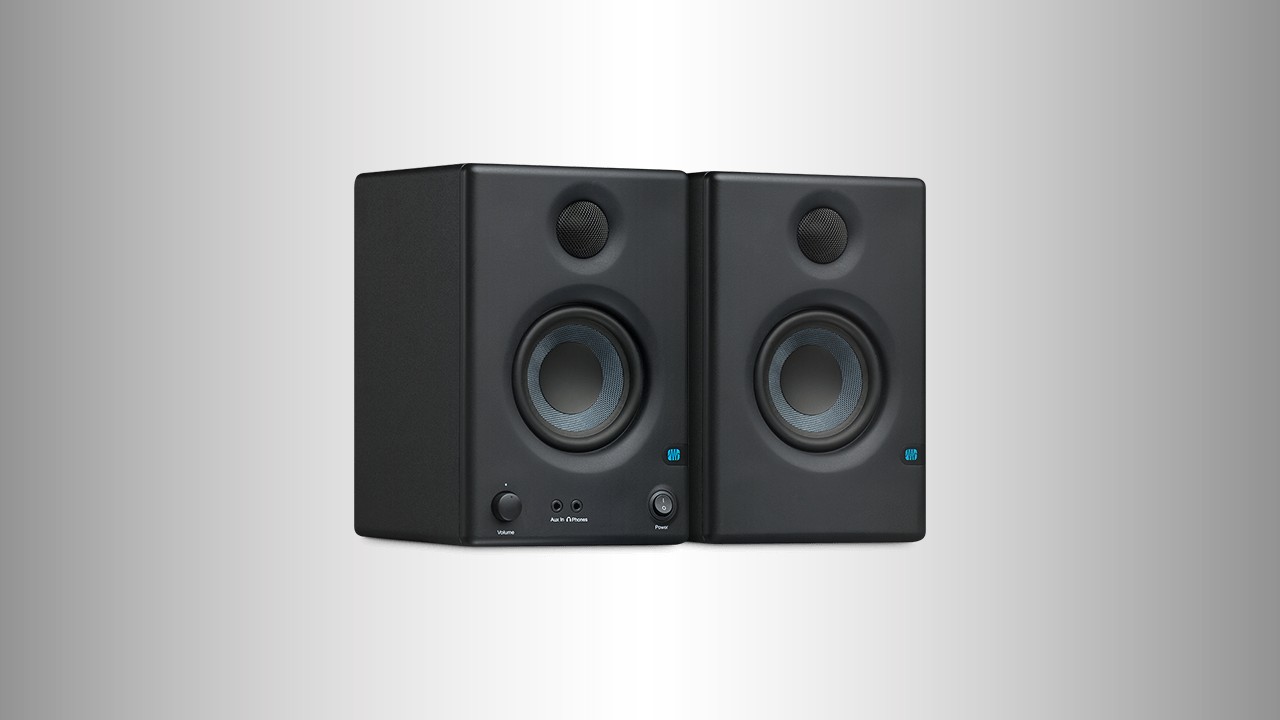
The PreSonus Eris E3.5 is the entry point to the company’s Eris studio-monitor range: a compact, active pair designed for desktop production, media playback and other close-range applications where space is limited. Their small footprint, low weight and modest ambitions make them an obvious fit beside a laptop, on an office desk or in a compact home-studio setup.
There are two versions. The standard Eris E3.5 reviewed here is wired only, while the PreSonus Eris E3.5 BT adds Bluetooth. The two models otherwise share the same core specification. That distinction matters for buyers who want straightforward wired monitoring from a computer, DAC or console, rather than wireless playback convenience.
What comes in the box

PreSonus supplies the Eris E3.5 in a conventionally printed retail carton, complete with product imagery, claims and specifications. Inside are an RCA-to-3.5mm cable, a 3.5mm-to-3.5mm cable and a 1.5m speaker cable to link the active speaker to its passive partner. These are basic supplied cables, but they are sufficient to get a desktop system running without an immediate extra purchase.
The printed manual is brief. The included material also states that PreSonus products, including the Eris E3.5, can be registered through my.presonus.com for access to software within the Studio Magic package; prospective owners should check the current terms of that offer before buying.
Understated cabinets and genuinely useful controls

These are compact active monitors built from vinyl-laminated MDF, finished in matte black. PreSonus has avoided brightly coloured trim and conspicuous driver treatments, giving the E3.5 a more restrained appearance than many budget desktop monitors. The matte surface is also less prone to showing fingerprints and smudges.
Each cabinet uses a 2.6cm silk-dome tweeter behind a fixed grille, partnered with a 9cm dark grey-blue Kevlar composite mid/bass driver. The crossover point is 2.8kHz. Given the small driver, this is not a speaker intended to deliver deep bass; its purpose is controlled, close-range monitoring rather than room-filling low-frequency output.
The active speaker places several everyday controls where they are easy to reach. A front-panel volume knob sits alongside a 3.5mm auxiliary input and 3.5mm headphone output, with the power switch below. A small blue indicator above the level control is the only notable illumination. Around the back are the bass-reflex port, high- and low-frequency trim controls, primary input connections and the output for the second speaker.
That layout is especially sensible for a desk system. Connecting a phone or laptop temporarily does not require reaching behind the cabinet, and the headphone socket makes it easy to move from speakers to headphones without reorganising the system. The tone controls also affect the headphone output, so their adjustment is not limited to the speakers themselves.
Placement is central to getting the best from the Eris E3.5

The Eris E3.5 is a rear-ported design, so its relationship with the wall behind it will affect bass weight. PreSonus provides a placement guide on its website, and it is well worth consulting: monitor positioning has a major effect on tonal balance and stereo imaging at this scale.
In the setup described for this review, the monitors worked best in a vertical orientation, with the tweeters at ear height, aimed directly at the listener and placed roughly 20–30cm from the rear wall. A listening distance of around 40–70cm suited their nearfield role. Nearby corners, particularly asymmetrical side-wall boundaries, can upset the balance and should be avoided where possible.
At a desk-distance listening position, the speakers delivered ample level with the volume control around the 10–11 o’clock position when fed from an SMSL Sanskrit 10th MK II DAC via RCA. Their strongest use case is clearly close listening rather than high-volume playback across a larger room. As level rises, the review found that resolution and depth began to diminish.
Sound: lively, direct and best judged at close range
The central appeal of the Eris E3.5 is the amount of energy and clarity it can produce from such a small enclosure. The assessment found them fast, dynamic and relatively even in balance without demanding extensive equalisation or calibration from the outset. The silk-dome tweeter was described as clean, smooth and detailed, while the Kevlar-composite mid/bass driver kept transients tidy and lively at sensible volumes.
Imaging is another strength when the monitors are carefully positioned. Their soundstage is not presented as exceptional for the category, but a convincing sense of space was achievable with the speakers correctly toed in. In this setup, aiming the tweeters so their axes met just behind the listener’s head helped bring the stereo image into focus.
The trade-off is low-frequency extension. The review characterises output as rolling away below roughly 120Hz, with useful extension around 80Hz before a steeper decline. Software EQ can compensate to a degree—potentially bringing the response closer to 70Hz—but it cannot change the physical limits of a 9cm driver in a very small cabinet. Listeners who need greater low-end reach should consider adding a subwoofer such as the Eris Sub8, or moving to a larger model such as the Eris E7 XT.
The rear-panel high- and low-frequency controls offer a practical way to accommodate a desk, wall proximity or personal preference. The review found the neutral 0dB/0dB setting the most useful starting point, with software equalisation available for finer correction if required.
Inputs, headphone use and minor caveats
The front 3.5mm auxiliary input and the rear inputs were found to sound broadly similar in this setup. RCA connection worked well with the unbalanced DAC used here. The review also noted a faint background hiss with and without programme material, plus a small click or impulse when switching the speakers on and off. These were not described as severe, but they are worth noting for buyers who sit very close to their monitors. A balanced connection was not tried, so no conclusion can be drawn here about whether it would reduce the noise.
The front headphone output is a convenience feature rather than a substitute for a dedicated stationary headphone amplifier. Even so, it was found perfectly usable for temporary listening, and its placement makes it particularly helpful in a work or study environment. Readers looking for dedicated headphones listening may still prefer a separate amplifier, but the inclusion is more useful than a rear-panel-only socket would have been.
PreSonus Eris E3.5 versus Mackie CR3

The most direct comparison in the original evaluation was with the similarly priced Mackie CR3. Both are compact active monitors aimed at the same broad desktop market, but the PreSonus offers a useful advantage in its bass and treble trim controls. The Mackie lacks this adjustment, which limits flexibility when placement is less than ideal.
In that comparison, the Eris E3.5 came across as cleaner, airier and more open at the top end, with a small advantage in perceived detail and microdynamics. The CR3 was heard as more weighty through the midrange and bass. Either balance may suit a particular desk or preference, but the PreSonus’ tonal controls make it the more adaptable option.
Verdict

The PreSonus Eris E3.5 makes the most sense when treated as what it is: a very compact nearfield monitor, not a replacement for larger, full-range home hi-fi speakers. Place it correctly, listen from close range and keep expectations realistic below 80Hz, and it offers an engaging, tidy and flexible desktop presentation.
The small cabinets, front-panel auxiliary and headphone connections, rear tonal adjustment and restrained styling add up to a thoughtful package for a home office, bedroom studio or compact production desk. Those requiring substantial bass should budget for a subwoofer or larger monitors; for space-conscious nearfield use, however, the Eris E3.5 remains a well-focused option.