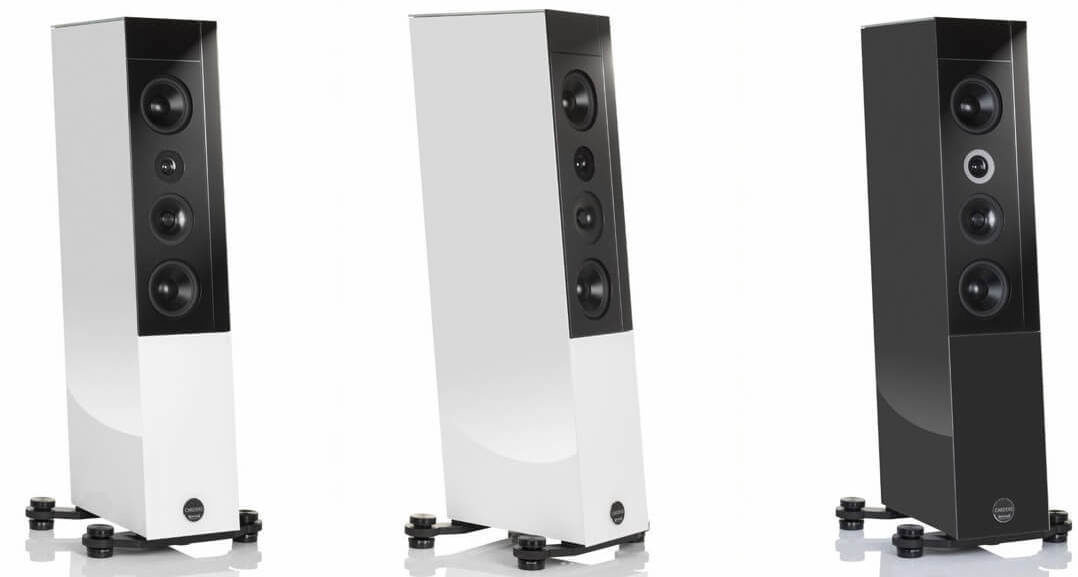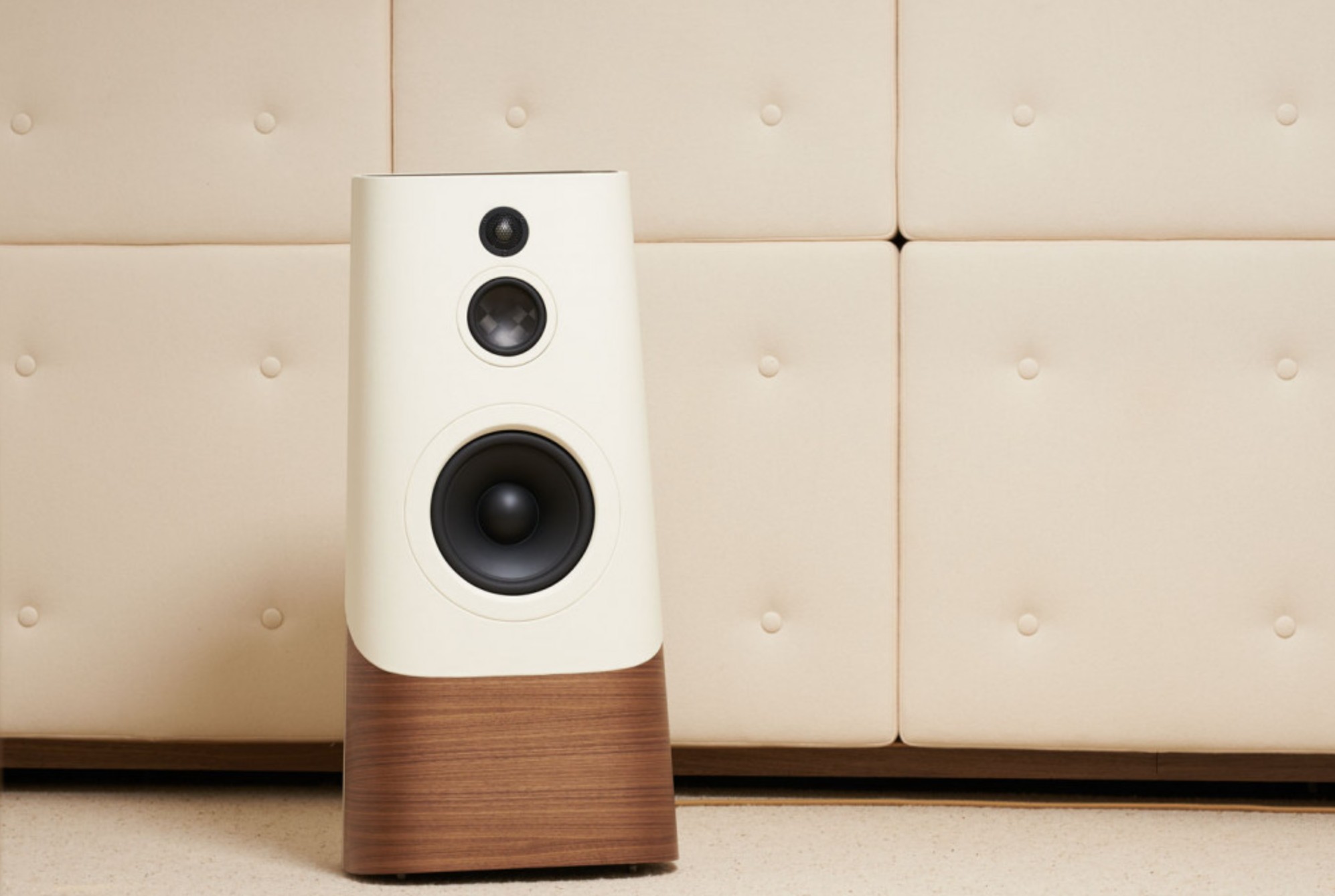
Danish loudspeaker maker Davone has introduced the Reference 1, a flagship-scale three-way floorstanding speaker that takes an explicitly engineering-led route to driver selection and cabinet construction. Its headline ingredients are a pure-beryllium tweeter, a 4.5-inch Textreme carbon-fibre midrange driver, and a 10-inch long-throw bass unit with a treated-cellulose cone.
That is a notably different proposition from a compact two-way floorstander. By assigning treble, midrange and bass to dedicated transducers, the Reference 1 is intended to let each driver work over a more focused part of the audible range. The potential benefit is lower mechanical compromise: the tweeter need not handle midrange energy, the midrange unit can be optimised for the critical vocal and instrumental band, and the larger woofer can concentrate on moving the volume of air required at low frequencies. As ever, the eventual result depends heavily on crossover implementation, driver integration and room setup; Davone has not published crossover details in the supplied information.

A beryllium tweeter with a high-strength motor
The Reference 1’s high-frequency driver uses a diaphragm made from pure beryllium. Beryllium is valued in tweeter diaphragms because it is extremely light and stiff, two characteristics that can help push unwanted diaphragm break-up behaviour beyond the driver’s intended working band. In practical terms, a rigid dome is designed to behave more like a single piston over its useful range rather than flexing in complex modes as frequency rises.
Davone specifies a moving mass of just 0.1g for this diaphragm. Low moving mass matters because the voice coil and magnetic motor have less inertia to start and stop, which is fundamental to a tweeter’s ability to trace rapid waveform changes. It should not be confused with a guaranteed statement about the speaker’s sound, but it is a meaningful part of the engineering rationale for using beryllium at high frequencies.
The tweeter is also said to use a powerful magnetic system capable of generating magnetic induction of 2 Tesla in the gap. The magnetic field in this gap is where the current-carrying voice coil produces force. A strong, well-controlled motor can provide the driver designer with useful control over the diaphragm, though the final behaviour also depends on the coil, suspension, damping and crossover network. No frequency-response, distortion or dispersion measurements have been supplied, so those aspects cannot be assessed from the specification alone.
Textreme midrange and a dedicated 10-inch bass driver
For the midrange, Davone has chosen a 4.5-inch continuous-profile cone made from Textreme carbon fibre by Swedish specialist Oxeon. Textreme is a spread-tow carbon-fibre material: compared with a conventional woven carbon-fibre cloth, its fibres are spread into flatter, wider tapes. This construction can reduce the pronounced crimp pattern associated with traditional woven fabrics and is used where high stiffness and controlled material behaviour are priorities.
Davone says the cone is intended to provide controlled behaviour near resonant frequencies. This is important in a midrange driver because every cone has modes at which it ceases to move as one coherent surface. Those resonances must be managed through the cone material, driver geometry, damping and crossover design. The supplied information does not identify the crossover frequencies or network topology, but the use of a separate, relatively compact 4.5-inch midrange suggests an approach aimed at keeping the crucial midband away from the larger woofer’s excursion demands.

Bass is handled by a 10-inch driver with a double-magnet assembly, long voice-coil travel and a processed-cellulose cone. A 10-inch cone has considerably more radiating area than the midrange driver, which is useful at low frequencies where substantial air displacement is needed. Long travel, or excursion capability, is particularly relevant to bass output: as notes descend, a driver needs either more cone area, more movement or a combination of both to maintain output.
The double-magnet arrangement and long voice-coil travel are therefore relevant details, although they do not by themselves reveal the speaker’s maximum output, low-frequency extension or distortion performance. Treated paper or cellulose remains a highly credible cone material in loudspeaker design. It can offer useful internal damping, and its final properties can be tailored through the treatment process. The important point is not that one cone material is inherently superior to another, but that Davone has specified different materials where their respective mechanical strengths are most relevant: very low-mass beryllium for treble, stiff carbon fibre for the midrange and treated cellulose for the bass unit.
Non-parallel cabinet geometry and a top-mounted reflex port
The Reference 1 cabinet is shaped without parallel surfaces and incorporates internal bracing and baffles intended to optimise airflow. Cabinet design is not merely an aesthetic exercise. Parallel internal walls can support standing waves, where certain frequencies reflect back and forth and build up inside the enclosure. These internal resonances can potentially pass back through the cone or cabinet panels and colour the speaker’s output. Avoiding parallel surfaces is one established method of making those standing-wave paths less straightforward.
Internal bracing has an equally practical role. A loudspeaker cabinet must resist the reaction forces generated when its drivers move. If the enclosure panels flex or vibrate significantly, they become unwanted radiating surfaces. Bracing divides larger panels into smaller, more rigid sections and can move panel resonances to less troublesome regions. The internal baffles and airflow management cited by Davone also matter because the air volume inside a reflex enclosure forms part of the bass system’s acoustic behaviour.
Davone uses a bass-reflex, or ported, alignment, with the port exiting on the top panel. In a reflex speaker, the port and enclosure volume are tuned to support the woofer over a selected low-frequency region. Around the tuning frequency, the port contributes useful output while woofer cone excursion can be reduced. This can be an efficient way to obtain deeper bass from a cabinet of a given size, although it also makes room placement and port interaction considerations worth taking seriously.
A top-mounted port differs from the more familiar rear- or front-firing arrangement. It may make the speaker less directly dependent on the immediate boundary behind it than a rear-ported design, but that should not be read as a guarantee that placement is uncritical. The speaker’s bass balance will still be affected by its distance from walls and corners, the listening room’s modes, and the chosen listening position. Davone has not stated recommended wall clearances, so owners should begin with sensible space around each cabinet and adjust by ear or, ideally, with in-room measurement.

Amplifier matching: 87dB sensitivity and a 4-ohm load
The Reference 1 is specified at 87dB sensitivity and 4 ohms nominal impedance, with a stated minimum of 3.6 ohms at 26Hz. These are among the most useful figures for prospective amplifier matching, even though they are not a complete picture of how demanding a speaker will be. An 87dB sensitivity figure is moderate rather than exceptionally high, so the speaker is unlikely to be a natural fit for very low-powered amplifiers if substantial listening levels are required.
The nominal 4-ohm rating and 3.6-ohm minimum indicate that an amplifier should be comfortable driving lower-impedance loudspeakers. Impedance describes the electrical load presented to the amplifier, and lower impedance can require greater current delivery for a given voltage. The 3.6-ohm minimum occurs at 26Hz, a low-bass frequency where music can demand meaningful energy, especially in recordings with sustained electronic bass, organ or large-scale orchestral material.
This does not mean an amplifier must be selected by wattage alone. Its stability into lower impedances, current capability, power-supply design and protection behaviour are at least as relevant as the headline power figure. A well-engineered integrated amplifier or separate power amplifier specified for 4-ohm operation is the logical starting point. Conversely, buyers using a small amplifier whose manufacturer gives no guidance on 4-ohm loads should establish compatibility before committing.
There is no information here on the Reference 1’s bi-wire terminals, input connector type, recommended amplifier power, frequency response or maximum sound-pressure capability. Those are worthwhile details to confirm with Davone or a dealer when planning a system. They would help determine whether the speaker suits a particular amplifier, room size and desired listening level.
Size, installation and who the Reference 1 suits
Each Reference 1 measures 970 x 470 x 370mm and weighs 42kg. Regardless of the stated dimension order, this is a large, physically substantial loudspeaker rather than a slim lifestyle floorstander. The 42kg mass, together with the described bracing, points to a cabinet built with mechanical stability as a priority. It also makes delivery, unpacking and positioning a two-person task in most homes.
Given the 10-inch bass driver and reflex loading, careful setup should form part of the buying decision rather than an afterthought. Start with symmetrical placement where possible, ensure both speakers see broadly similar side-wall and rear-wall conditions, and avoid placing either cabinet in a corner unless the resulting bass balance has been checked. Small position changes can have a larger effect on low-frequency response than changing many upstream components. Toe-in should likewise be treated as an adjustment, not a fixed rule: it affects the balance of direct and reflected high-frequency energy at the listening seat.
Davone will offer the Reference 1 in two finishes, although the finishes have not been identified in the available details. The speaker is likely to appeal most to listeners building a serious two-channel system around an amplifier with credible 4-ohm drive capability, and who have enough room to accommodate a large three-way floorstander with some freedom of placement. Its specification suggests a design that prioritises dedicated driver roles, rigid enclosure engineering and substantial bass-driver capability rather than pursuing the smallest possible cabinet.
What remains to be established are the final practical details that matter in a purchase decision: price, finish names, availability, crossover implementation, measured response and dealer setup guidance. But the core architecture is clear. The Davone Reference 1 combines technically ambitious diaphragm materials with a conventional but purposeful three-way, bass-reflex format, and its electrical specifications make amplifier matching a key consideration for any prospective owner.