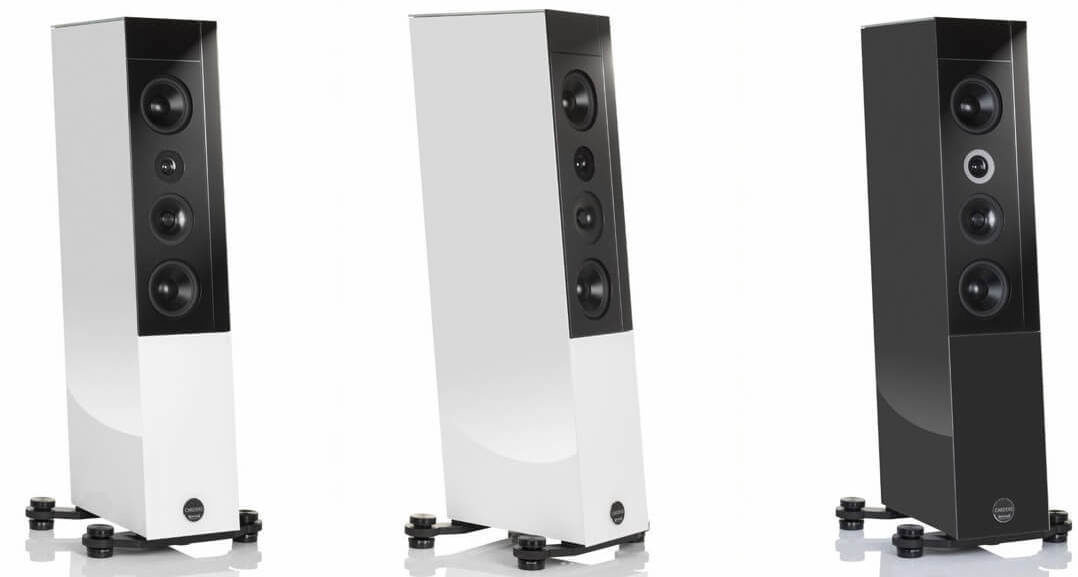
Audio Physic has announced a new generation of its Cardeas flagship loudspeaker, a ground-up four-way design that brings together a new cabinet structure, proprietary driver engineering and an unusual approach to bass and mid-bass driver suspension. The German manufacturer groups these elements under the name PowerTrain, presenting the new Cardeas as a platform intended to reduce mechanical interference and preserve low-level musical information.
At €36,550 per pair in Europe, Cardeas occupies the uncompromising end of the passive loudspeaker market. This is not simply a large, cosmetic update to an established floorstander: Audio Physic says the model has been developed entirely from scratch. The headline specifications are a claimed 25Hz–40kHz frequency range, 89dB sensitivity and 4-ohm nominal impedance, but the more interesting story lies in how the speaker attempts to manage cabinet vibration, driver alignment and the unwanted resonant behaviour that can obscure a transducer’s output.
The company’s stated objective is expansive, large-scale sound while retaining access to fine detail. That is an ambitious target for any full-range loudspeaker. It requires a cabinet that does not add too much of its own voice, drivers that remain controlled across their intended bandwidths, and a crossover that integrates those drivers without compromising timing or dispersion. Cardeas’s architecture suggests that controlling those interactions is central to the design.
A four-way flagship built around structural control
Cardeas is a four-way loudspeaker housed in a multi-layer, asymmetric honeycomb cabinet. In broad terms, a four-way layout divides the audio band among more specialised drive units than a conventional two- or three-way design. That can allow each driver to work over a narrower, more manageable frequency range, potentially improving power handling and reducing excursion demands on the midrange and treble units. The trade-off is crossover complexity: each handover between drivers must be carefully engineered to maintain an even tonal balance and coherent radiation into the room.
Audio Physic has not specified the crossover frequencies, driver diameters, enclosure loading or the number of individual drive units in the supplied announcement. Those details will matter when assessing how Cardeas achieves its stated bandwidth and how it behaves in a real room. What is clear is that the loudspeaker separates the tweeter and crossover from the main internal volume, rather than treating the enclosure as one shared space.

The cabinet uses a layered honeycomb construction, with honeycomb internal bracing or spacers. This is significant because a loudspeaker enclosure is never a passive box in the simple sense. The drivers push air forward, but their motor systems also react in the opposite direction; meanwhile, internal air pressure and panel vibration can store and release energy. If cabinet panels or braces flex at audible frequencies, that delayed energy may colour bass, blur transients or make the presentation less clean at higher playback levels.
A honeycomb structure is a well-established way of combining stiffness with controlled mass. Its cellular geometry can resist bending while using material efficiently, and the internal spacers are intended to tie sections of the cabinet together. Audio Physic says the finished loudspeaker weighs 68kg, an indication that structural mass is also part of the strategy. Weight alone does not guarantee low resonance—the geometry, material damping and bracing arrangement are equally important—but a substantial enclosure is generally easier to keep mechanically stable than a lightly built one.
The Cardeas cabinet is also asymmetric and slopes backwards. Non-parallel surfaces can help prevent simple, repetitive internal standing-wave patterns that may arise between parallel walls. In an enclosure, such modes can feed back through the cone and emerge as unwanted response irregularities. A sloped front baffle can additionally alter the relative acoustic arrival times of drivers mounted at different heights. Audio Physic has not published its exact time-alignment targets, so it would be wrong to claim a particular acoustic result, but the physical layout is consistent with a design that pays attention to driver integration.
Offset drivers and a separate tweeter/crossover chamber
The drive units are offset from the centre line of the front baffle. This is more than a visual flourish. A centrally mounted driver on a symmetrical baffle can encounter diffraction from the cabinet edges in a symmetrical way; those edge reflections can cause small response effects at the listening position. Moving a driver off-centre changes the path lengths to the edges and spreads those effects across frequencies rather than concentrating them so neatly. It is a common acoustic technique, although its success ultimately depends on the baffle dimensions, crossover voicing and the speaker’s off-axis response.
Audio Physic’s HHCT III+ tweeter is mounted in its own chamber, which also contains the crossover. The company has not described the HHCT III+ mechanism or its material in this announcement, so its exact operating principle should not be assumed. However, isolating a high-frequency driver from the main enclosure volume has clear engineering logic. A tweeter is especially sensitive to mechanical vibration, and physical separation can help reduce the transfer of energy from bass drivers and cabinet panels to its mounting structure.
Housing the crossover in that same dedicated chamber can have benefits too. Crossover components, particularly inductors, can be sensitive to vibration, while the network itself needs to work predictably despite the high sound pressures and mechanical activity generated inside a full-range speaker. Separation is therefore a sensible means of reducing one potential path for interference. It also indicates that Cardeas’s PowerTrain concept is concerned with the behaviour of the entire electro-mechanical system, not merely the visible drivers.

The outer sides of the sloping cabinet are finished with glass panels, continuing an established Audio Physic visual motif. Glass is a hard, rigid material, but the announcement does not state whether these panels are structural, damped, decorative, or perform several functions at once. The important practical point is that the Cardeas is a substantial, design-led loudspeaker: prospective owners will need to consider not only its acoustic location but also safe handling, floor protection and visual integration within a room.
Cardeas’s unusual driver-suspension approach
Perhaps the most distinctive technical claim concerns the Cardeas bass and mid-bass drivers, which were developed specifically for this model. Audio Physic says these drivers dispense with a centring washer—the component more commonly called a spider in loudspeaker engineering.
In a conventional cone driver, the surround at the outer edge of the cone and the spider closer to the voice coil both help keep the moving assembly centred in the magnetic gap. The spider also contributes to the driver’s restoring force and influences its compliance, linearity and resonance characteristics. It is indeed a necessary and useful component in the vast majority of conventional moving-coil drivers, which makes its omission noteworthy.
Audio Physic’s position is that the centring washer can suppress dynamics. The company says it has compensated for removing it by reinforcing the connection between the cone and the suspension. In principle, reducing or changing the mechanical restraints on a cone can alter how freely the moving system responds to small signals and large excursions. But it also creates demanding engineering problems: voice-coil alignment must remain stable, the cone must not rock, and the driver’s mechanical behaviour must remain controlled over time and at output.
It is therefore best understood as a design choice with potential benefits and substantial implementation demands, rather than a blanket claim that every conventional spider-equipped driver is dynamically inferior. The value of the approach will depend on execution—motor geometry, surround behaviour, cone stiffness and the way each driver is used in the Cardeas crossover system. Audio Physic’s purpose-developed units are intended to address those demands, but the manufacturer has not supplied distortion, excursion or impedance measurements in this announcement.
Amplifier matching: 89dB sensitivity and a 4-ohm load
Audio Physic rates Cardeas at 89dB sensitivity and 4 ohms impedance. An 89dB figure is moderate rather than exceptionally high sensitivity, so Cardeas should not automatically be treated as an easy loudspeaker for low-powered amplification. In broad terms, sensitivity describes the sound-pressure level a speaker produces for a given input under a specified measurement convention; it offers a useful starting point for estimating amplifier needs, although it does not tell the whole story.
The 4-ohm impedance rating is equally important. Compared with an 8-ohm nominal speaker, a 4-ohm design can ask an amplifier to deliver more current for a given voltage. A robust amplifier with a well-designed power supply and output stage is therefore likely to be a more natural partner than one selected purely for a headline watts-per-channel figure. Buyers should verify an amplifier’s stated suitability for 4-ohm loudspeakers and consult Audio Physic’s eventual full technical documentation for minimum impedance and recommended amplification guidance.
The claimed 25Hz low-frequency extension indicates that Cardeas is designed to reach well into the bass region without relying on a subwoofer. Yet room placement remains crucial. Deep bass is strongly shaped by the listening room, particularly by boundary reinforcement from nearby walls and room modes. A speaker of this scale should be positioned with care, beginning with adequate space from rear and side walls where the room allows, then refined by listening and measurement. The final position will depend on the room, furnishings and bass behaviour rather than a universal distance.
At the opposite extreme, the specified 40kHz upper limit extends beyond the conventional audible band. Such figures should not be interpreted as a guarantee of audible ultrasonic content; rather, they describe the manufacturer’s claimed response range. More practically, controlled response and dispersion through the audible treble region will be more relevant to tonal balance, image stability and how the speaker interacts with a typical listening room.
What Cardeas asks of an owner
Cardeas is clearly intended as the foundation of a serious two-channel system rather than a flexible, compact all-rounder. Its 68kg mass means installation should be planned in advance, ideally with more than one person available to position each cabinet safely. It will also reward a stable floor and a careful approach to any supplied feet or interface system, although Audio Physic has not detailed the speaker’s support arrangement in the information released so far.
Its £36,550-per-pair European pricing—quoted by Audio Physic as €36,550 per pair—also puts the spotlight on the electronics and room around it. A capable source and amplifier are necessary, but the room is not an afterthought. The speaker’s four-way configuration, claimed bass extension and offset-driver baffle make thoughtful placement, toe-in experimentation and listening-seat positioning central parts of achieving its potential.
The new Cardeas appears compelling because Audio Physic is not relying on a single fashionable material or an extravagant specification. Instead, the PowerTrain proposition joins cabinet construction, internal bracing, driver placement, tweeter isolation and an unconventional bass-driver suspension scheme into one system-level approach. The unanswered questions are the equally important ones for a flagship launch: full driver complement, crossover architecture, enclosure loading, connection provision, dimensions and amplifier recommendations. Those will need confirmation before a complete technical judgement can be made.
For now, the Cardeas stands as a deliberately engineered flagship for listeners prepared to accommodate a large, heavy 4-ohm floorstander and partner it with suitably capable electronics. Its most distinctive promise is not simply bigger bass or wider bandwidth, but an attempt to reduce the mechanical constraints and resonances that can stand between the electrical signal and the music emerging into the room.