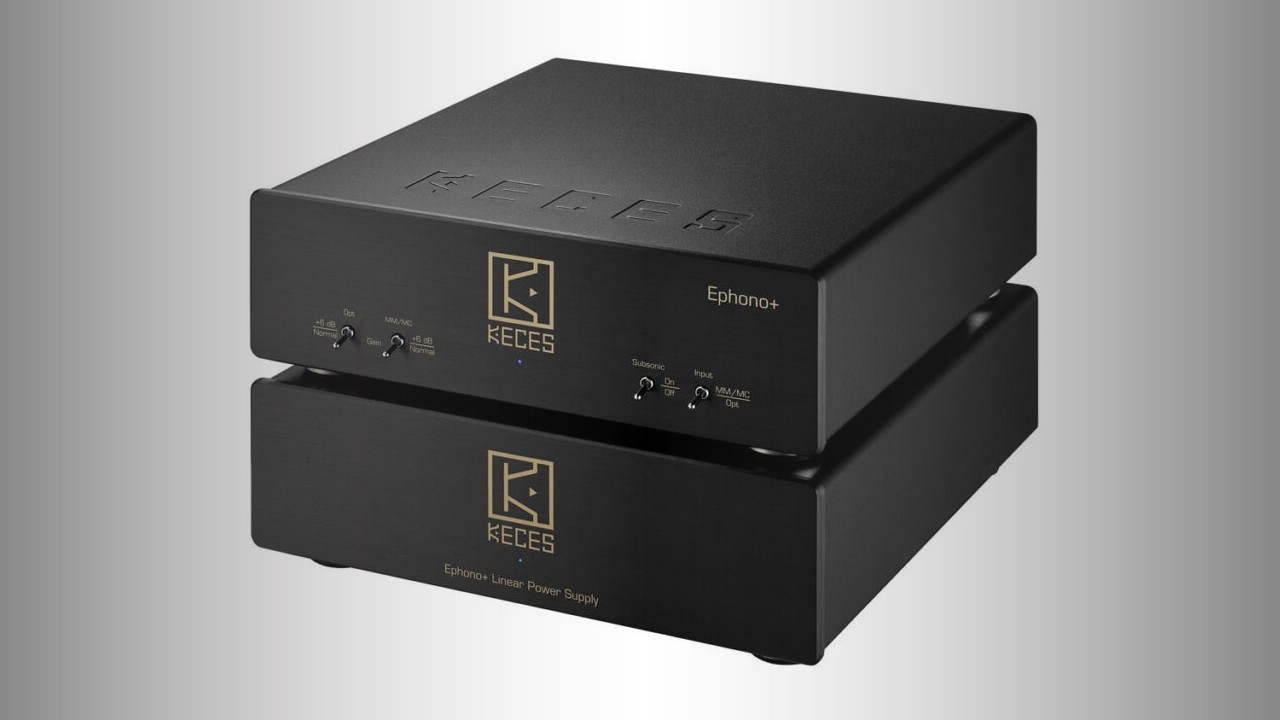
Keces Audio has announced the Ephono+, a versatile external phono preamplifier intended to accommodate far more than a single conventional turntable and cartridge combination. First shown at the 2025 Munich High End Audio Show, the Taiwanese company’s new unit supports moving-magnet (MM) and moving-coil (MC) cartridges, offers adjustable gain and impedance settings, includes a subsonic filter, and adds an equaliser section for DS Audio’s optical cartridges.
Perhaps most notably, the Ephono+ uses a separate linear power supply rather than keeping the transformer and supply circuitry in the same enclosure as the extremely low-level phono amplification stages. It is an approach with practical appeal in vinyl replay, where the phono stage is required to amplify a cartridge’s tiny output while applying precise equalisation without adding hum, noise or unwanted low-frequency artefacts.
Keces has not yet detailed all adjustment values, input arrangements or full technical specifications in the supplied announcement. Even so, the confirmed feature set positions the Ephono+ as a potentially useful hub for listeners who change cartridges, operate more than one turntable, or want to explore DS Audio’s distinctive optical pickup system without adding a dedicated equaliser component.
A phono stage where flexibility matters
A phono preamplifier has two fundamental jobs. First, it raises the exceptionally small signal produced by a turntable cartridge to a level that a line-level preamplifier or integrated amplifier can accept. Second, it applies the required playback equalisation. Records are cut with bass reduced and treble boosted; the inverse equalisation in the phono stage restores an appropriate tonal balance during replay. Both operations need to be performed accurately, but the gain requirement in particular makes a phono stage vulnerable to noise and interference.
The required gain differs substantially between cartridge types. MM cartridges generally produce a comparatively higher output, whereas many MC designs produce considerably less voltage and consequently need more gain from the phono stage. Applying too little gain can leave the system sounding quiet and may force excessive volume-control settings; too much can overload a following stage or make background noise more apparent. The Ephono+ provides defined gain stages for matching the phono preamp to MM and MC cartridges.
Loading is the other important variable. A cartridge is an electromechanical generator, rather than a universally interchangeable line-level source. Its interaction with the phono stage’s input impedance can affect electrical behaviour and, in turn, the final balance and presentation. MC cartridges in particular are commonly partnered with a chosen resistive load, while MM cartridges also require appropriate capacitance consideration across the tonearm wiring and interconnect. Keces says the Ephono+ provides adjustable impedance values, allowing users to optimise the match rather than relying on one fixed setting.
That adjustability is most valuable when it is approached methodically. A sensible starting point is the cartridge manufacturer’s recommended gain and loading range. From there, one change at a time makes it easier to identify whether a setting improves the match in a particular system. The exact adjustment options and whether they are operated from the front panel, rear panel or internally will need to be confirmed by Keces, but the presence of selectable parameters is a meaningful advantage over a fixed MM-only stage or a basic MM/MC design with minimal setup scope.

Why the Ephono+ puts its linear power supply in a separate enclosure
The external linear power supply is central to the Ephono+ concept. Keces says the circuit design isolates signal processing from potential interference sources, and the separate supply is intended to reduce both electrical noise and mechanical influence from the transformer and power circuitry.
This is a logical engineering priority for a phono stage. The voltage arriving from a cartridge is minute compared with a typical CD player, streamer or DAC output. As a result, any mains-related hum, transformer magnetic field or noise coupled into the sensitive gain circuitry can be magnified along with the wanted musical signal. Moving the transformer and much of the power supply outside the phono-stage chassis creates physical distance between those possible sources and the low-level audio circuits.
A linear supply conventionally uses a mains transformer followed by rectification, smoothing and regulation. It is distinct from the compact switched-mode supplies found in many modern electronics. Neither format automatically determines sound quality: implementation, grounding, regulation and noise control matter more than a broad label. However, a generously engineered linear supply in a separate enclosure can be attractive in a phono design because it addresses transformer placement directly and allows the audio chassis to be dedicated to the amplification and equalisation circuitry.
There is also a mechanical argument. Transformers can vibrate slightly in use, and a separate enclosure keeps that potential vibration away from the phono electronics. Keces describes the arrangement as providing mechanical decoupling as well as helping to minimise noise. The supplied information further states that the power supply includes overheating and overload protection.
In installation terms, an external supply does mean finding space for two boxes and routing an additional cable. It should be placed sensibly rather than bundled tightly with the turntable’s signal leads, mains leads or other components. Good cable dressing will not replace sound circuit design, but keeping low-level phono cables away from mains transformers and power cables remains sound practice in any analogue system.

DS Audio equalisation makes this more than a conventional MM/MC stage
The most unusual part of the Ephono+ specification is its complete equaliser section for DS Audio optical cartridges. This is not simply another MC loading option. DS Audio cartridges use an optical system: changes in stylus position modulate light, which is detected by photosensors. The resulting signal and equalisation requirements differ from those of conventional moving-magnet and moving-coil generators.
For that reason, a DS Audio cartridge needs compatible dedicated equalisation rather than an ordinary RIAA phono input alone. By including a DS Audio equaliser section, Keces intends the Ephono+ to cover three distinctly different analogue front-end formats in one component: standard MM, standard MC and DS Audio optical playback.
This could be significant for an enthusiast building a system around cartridge experimentation. Usually, adding an optical cartridge entails accommodating a dedicated energiser/equaliser as part of the signal chain. The Ephono+ suggests a route towards integrating that functionality with a conventional adjustable phono stage. Exactly which DS Audio models are supported and how the relevant connection and operating modes are implemented are details prospective buyers should verify before purchase.
For conventional cartridges, the broader benefit is not that DS Audio functionality improves MM or MC playback by itself, but that the product is designed as a flexible analogue control point. A listener can retain a familiar moving-magnet or moving-coil cartridge today while preserving the option to investigate optical playback later, subject to final compatibility confirmation.

Subsonic filtering and balanced connection options
Keces has also fitted a subsonic filter. This feature deals with very low-frequency energy that is below, or close to the lower edge of, the audible band. Such energy can arise from a warped record, an imperfectly flat pressing, footfall, record eccentricity, a turntable/tonearm resonance or interactions between the turntable and its support.
These signals may not present themselves as audible bass, yet they can make woofer cones move excessively, consume amplifier headroom and potentially affect the performance of a loudspeaker system. This is especially relevant with ported speakers, high-output systems, and setups where the turntable is exposed to vibration. A well-considered subsonic filter can reduce that unwanted energy while leaving the musical bass region intact. The trade-off with any such filter is that its turnover frequency and slope matter; those specifications have not been provided, so it is not possible to judge the precise implementation from the announcement alone.
The Ephono+ offers a choice of RCA and XLR connections. RCA remains the normal connection standard in many turntable and integrated-amplifier systems. XLR is useful where the following preamplifier, integrated amplifier or active loudspeaker system has balanced line inputs. In a properly balanced system, a balanced connection can improve rejection of noise picked up along the interconnect, particularly over longer cable runs or in electrically busy installations.
It is important not to assume that an XLR socket alone reveals the entire internal circuit topology. The announcement confirms connection options but does not state whether every stage is fully differential, nor does it specify whether the cartridge input itself is balanced. Owners should therefore view XLR primarily as a potentially convenient and noise-resistant line-level output option until Keces publishes fuller circuit information.

System context and what to confirm before buying
The Ephono+ appears best suited to vinyl listeners whose systems demand more adaptability than a basic, fixed-setting phono input can provide. That includes owners of low-output MC cartridges, those moving between cartridges with different loading recommendations, and listeners using an amplifier without a suitable onboard phono stage. Its DS Audio compatibility also makes it relevant to a more specialised audience considering optical cartridge replay.
As with any separate phono preamplifier, placement and gain structure will be important. The turntable should connect to the appropriate Ephono+ input using short, well-screened leads, with correct grounding where required by the turntable and phono stage. The Ephono+ then feeds a line-level input on an amplifier or preamplifier; it should not be connected to another phono input, which would apply gain and equalisation a second time.
Before making a purchase decision, the essential unanswered questions are the exact gain options, load values, capacitance settings for MM use, input count, output configuration, dimensions, price and availability. MC cartridge owners should also check that the available gain and impedance ranges encompass the recommendation for their specific cartridge. These details shape usability as much as the headline MM/MC compatibility does.
Still, the principle behind Keces Audio’s new design is clear: the Ephono+ combines adjustable conventional phono playback with DS Audio equalisation, a subsonic filter and both RCA and XLR connectivity, while separating the linear power supply from the sensitive audio chassis. For analogue systems where cartridge matching and noise management are genuine priorities, that is a more ambitious proposition than an entry-level phono stage with a single fixed operating mode.