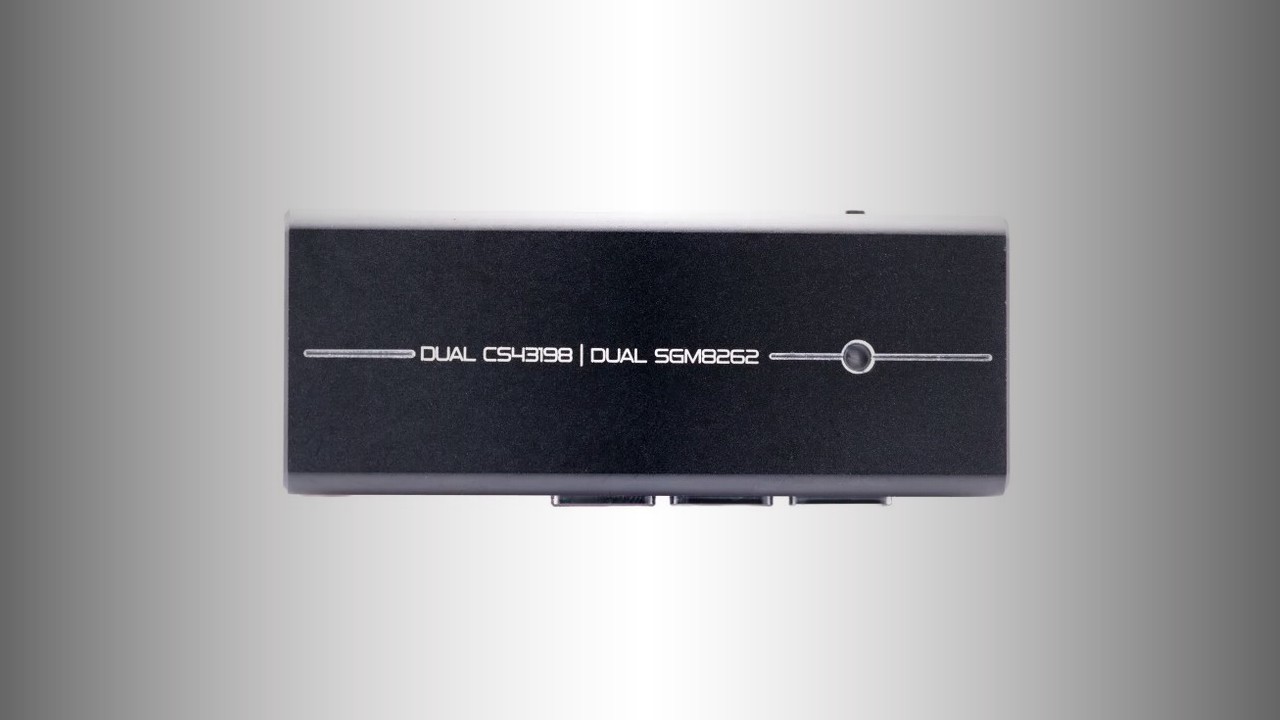
CrinEar is bringing its headphone-tuning background to hardware with the Protocol Max, a compact USB DAC and headphone amplifier built around two Cirrus Logic CS43198 DAC chips. The headline specification is up to 600mW into 32 ohms from its 4.4mm balanced output, but the more distinctive idea is its onboard, browser-configured parametric EQ: create a correction or preference curve in Hangout.Audio’s Graph Tool, save it to the device, and the profile remains available when the DAC is subsequently used with another compatible source.
That makes the Protocol Max more than a conventional USB dongle. Most small DAC/amps leave EQ to the phone, computer or player app feeding them. CrinEar’s approach is intended to move that adjustment into the playback hardware itself, which could be useful for listeners moving the same IEMs or headphones between a Windows laptop, Mac and Android device. The company specifies Windows, macOS and Android via OTG compatibility; iOS support is not listed in the supplied specification.

A dual-DAC portable design, with balanced and single-ended outputs
The Protocol Max uses a pair of CS43198 DACs, accompanied by two SG Micro SGM8262-2 operational amplifiers. A DAC’s job is to reconstruct an analogue audio waveform from the digital data supplied over USB, while the analogue amplification stage then provides the voltage and current needed by connected headphones. Using two DACs can allow a designer to assign conversion resources separately to the two stereo channels or to implement a balanced signal path, although the precise channel allocation and circuit topology have not been detailed here.
Cirrus Logic’s CS43198 is a widely used DAC family member in portable audio, and CrinEar positions the pair in the Protocol Max as the basis of a clean, neutral conversion stage. That component choice alone does not determine a product’s sound or measured performance: power-supply design, clocking, analogue layout, output-stage implementation and firmware all matter. Still, the use of two converter chips indicates that this is not intended as the most minimal type of phone dongle.
For listening, there are two physical headphone connections:
- 4.4mm balanced output, rated at up to 600mW into 32 ohms.
- 3.5mm standard (single-ended) output.
The 4.4mm Pentaconn-style connector is now common on portable balanced headphone cables. In a balanced headphone output, each channel is driven with separate positive and negative signal connections rather than sharing a common return as a conventional 3.5mm connection does. One practical benefit is that the amplifier can be designed to deliver greater voltage swing, and therefore potentially more power, from a USB-powered device. It is important, however, to use a properly terminated balanced cable; a standard 3.5mm plug is not interchangeable with a 4.4mm balanced connection.
CrinEar’s 600mW figure applies specifically to 32-ohm headphones through the balanced socket. This is a meaningful amount of power for a compact USB-powered device, and it should give the Protocol Max useful headroom with many full-size headphones that are reasonably efficient. But power is only one part of headphone matching. Higher-impedance designs may demand more voltage rather than simply more current, while low-sensitivity planar magnetic headphones can be particularly demanding. Since CrinEar has not supplied output-power figures at other impedances, nor voltage or current limits, prospective owners should not extrapolate the 32-ohm number to every headphone load.

Why the sub-1-ohm output impedance matters for IEM users
The Protocol Max is specified with an output impedance of less than 1 ohm. This is especially relevant to the IEM audience that CrinEar is likely to attract. Many multi-driver in-ear monitors use crossover networks whose electrical impedance changes substantially across the audible frequency range. If the source has relatively high output impedance, it can interact with those impedance changes and alter the earphone’s frequency response—sometimes audibly shifting bass, midrange or treble balance.
A low output impedance reduces that potential interaction and gives the amplifier better electrical control over the connected load. It does not guarantee that every IEM will be free of hiss or that every headphone will sound identical from every source, but it is the appropriate starting point for a DAC/amp expected to work with sensitive, multi-driver earphones.
CrinEar also says that noise and distortion remain minimal, including at higher volume levels. Exact noise, distortion and channel-separation measurements have not been provided, so this should be treated as a manufacturer claim rather than an independently verified performance result. In practical terms, the key ownership question for very sensitive IEMs will be whether the gain structure remains quiet at normal listening levels and permits fine volume adjustment. Those are details that need proper testing rather than can be confirmed from the published feature list.
Onboard parametric EQ is the Protocol Max’s differentiator
Rather than offering a few fixed tone presets, the Protocol Max supports parametric equalisation through the browser-based Hangout.Audio Graph Tool. Parametric EQ is more flexible than broad bass and treble controls because it allows the user to define a filter’s centre frequency, the amount of boost or cut, and—depending on the tool’s available controls—how broadly or narrowly that adjustment is applied.
That makes it suitable for several different jobs. An IEM owner could modestly reduce an excessive upper-midrange peak, add a carefully controlled low-bass shelf, or apply a personal target curve. A headphone listener may use it to compensate for a known tonal preference without relying on a particular desktop player or Android EQ app. The quality of the result depends on both the chosen filters and the listener’s judgement: aggressive boosts can reduce available headroom and may make distortion or clipping more likely in any digital EQ system. Sensible cuts and modest, considered boosts are generally the more conservative approach.
The important feature here is persistence. Once a curve has been created in the Graph Tool and saved to the DAC’s internal memory, CrinEar says it remains active without requiring a nearby computer or companion app. This could make the Protocol Max particularly convenient for users who regularly switch sources. It also avoids the familiar frustration of carefully creating an EQ profile on one device, then losing it when connecting the same headphones to a work laptop or another Android handset.
The supplied information does not state how many EQ profiles can be stored, how profiles are selected on the hardware, the number and type of filters available, or whether EQ can be bypassed without returning to the browser tool. Those workflow details will matter as much as the headline feature for listeners who maintain different profiles for several headphones.

Eco and Boost modes: choosing power according to the load
CrinEar provides two operating modes. Eco mode is intended to reduce power consumption when the Protocol Max is connected to a smartphone or laptop, and makes sense for sensitive IEMs and easy-to-drive portable headphones. Boost mode unlocks the amplifier’s maximum output for more demanding headphones. The company says switching is quick and does not require a restart.
This is a more useful distinction than simply treating maximum output as the best setting for every situation. Sensitive IEMs rarely require large amounts of power, and using a lower-power mode may improve practical battery life when the DAC is host-powered. For a harder-to-drive headphone, Boost mode offers the best chance of retaining level headroom on dynamic recordings. Users should nevertheless begin with volume low after changing modes or swapping headphones, particularly when moving from a full-size model to a highly sensitive IEM.
The Protocol Max is powered over USB and does not require an external power supply. This suits its role as a desktop-and-mobile component, although USB power necessarily comes from the host device. Phone users should therefore expect some battery draw, while laptop users will want to consider cable routing and the physical strain that a heavier headphone cable can place on a small USB-connected unit.
Milled aluminium body and practical system fit
The enclosure is machined from a single piece of aluminium. In a portable DAC/amp, a rigid metal chassis can provide better day-to-day durability than a lightweight plastic shell, while also protecting the compact circuit board and offering a degree of shielding from external electrical interference. It is not, by itself, proof of superior audio performance, but it is an appropriate construction method for a device likely to live in a pocket, bag or desktop travel kit.
With both 3.5mm and 4.4mm outputs, the Protocol Max can accommodate existing conventional headphone cables while offering a balanced route for headphones or IEMs fitted with one. It is not a wireless receiver, streamer, phono stage or standalone music player; it needs a compatible USB host to supply music data and power. No digital-input alternatives, line outputs, microphone support, Bluetooth functions, supported PCM/DSD limits or MQA capability are stated in the available details, so buyers needing any of those functions should confirm them before purchase.
Who is the CrinEar Protocol Max for?
The Protocol Max looks most compelling for a wired-headphone listener who wants a single, portable USB front end that can cover two very different use cases: low-impedance, sensitive IEMs on the move and moderately demanding full-size headphones at a laptop or compact desktop setup. Its sub-1-ohm output impedance is well aligned with complex IEM loads, while the 600mW-at-32-ohms balanced rating gives the device more scope than basic dongles when a larger headphone is connected.
Its standout feature is not simply dual DAC chips or a balanced socket—both are increasingly familiar in this category—but the promise of device-resident parametric EQ. For enthusiasts who already use measured headphone corrections or personal EQ curves, being able to carry that profile between compatible sources could be genuinely useful. Conversely, listeners who prefer an entirely app-free, no-adjustment experience may gain less from the Protocol Max’s central advantage.
Final buying decisions will depend on information not yet included in the specification, including price, physical dimensions, supported digital formats, volume-control behaviour and independently verified noise and power performance. On the facts available, though, CrinEar has specified a compact DAC/amp with credible connectivity, a high-output balanced mode and an unusually practical route to portable, persistent headphone EQ.
CrinEar Protocol Max specifications
- DACs: 2 × Cirrus Logic CS43198
- Operational amplifiers: 2 × SG Micro SGM8262-2
- Output power: up to 600mW at 32 ohms, balanced output
- Headphone outputs: 4.4mm balanced and 3.5mm standard
- Output impedance: less than 1 ohm
- EQ: parametric EQ via the browser-based Hangout.Audio Graph Tool
- Power modes: Eco and Boost
- Power: USB
- Compatibility: Windows, macOS and Android (OTG)
- Chassis: milled aluminium