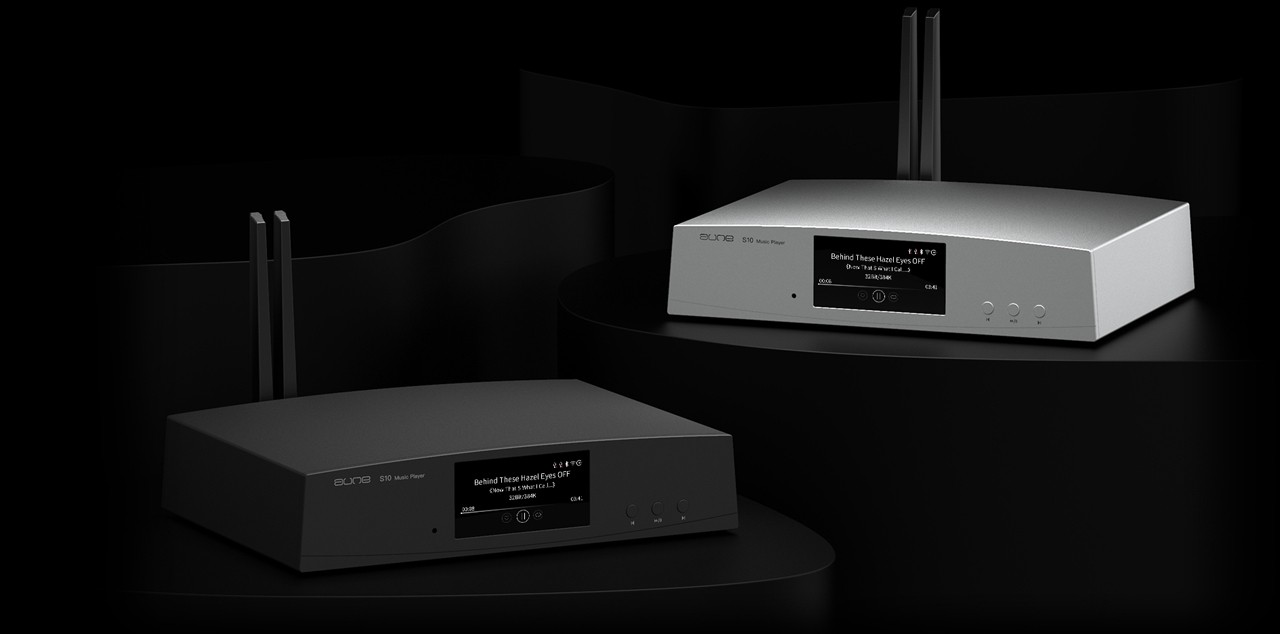
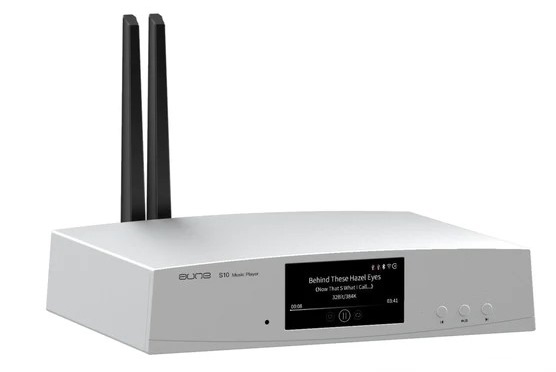
Aune’s S10N is a compact network music player aimed at listeners who want to bring local files, network libraries and mainstream streaming services into a desktop or small-system hi-fi setup. Rather than presenting itself simply as a streamer, the S10N combines network playback, Bluetooth reception, high-resolution file decoding, digital outputs and variable-level RCA and XLR analogue outputs in one component.
The central technical claim is a multi-core architecture: Aune assigns streaming, Bluetooth, clocking and FPGA signal-generation functions to separate processing sections. In principle, this is a sensible approach for a digital audio product. Network activity, wireless radio operation and display or control tasks can create electrical noise and impose changing processing demands; separating those duties from time-sensitive audio handling is intended to make the digital signal path more predictable. That alone does not establish audible performance, of course, but it is a more considered design direction than treating a network player as a single all-purpose computing board.
The S10N is particularly relevant to users who need flexibility at the source. It can feed an existing DAC or integrated amplifier digitally, or connect directly to an amplifier, active loudspeakers or a pre/power system through its analogue outputs. Its stated support for PCM up to 32-bit/768kHz and native DSD512 also makes it a potentially capable local-file player on paper, provided the rest of the system and the chosen playback route support those formats.
A network player designed for more than one playback route
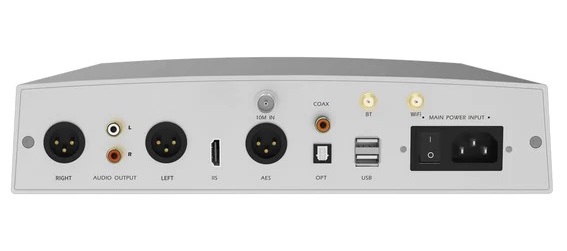
At its most straightforward, the S10N can act as the front end of a desktop system: connect its analogue output to powered speakers or an amplifier, join it to the home network and use the supplied S10N setup app to access music. The product is also configured for a more modular hi-fi system. Coaxial, optical and IIS digital outputs allow it to serve as a transport for an external DAC, while the analogue RCA and XLR connections provide an alternative all-in-one route.
That distinction matters. A network streamer with digital outputs lets an owner retain a preferred DAC, including a DAC built into an amplifier, and concentrate the S10N’s role on obtaining, organising and transmitting the music stream. Conversely, analogue outputs mean the player can take on the digital-to-analogue conversion stage itself and reduce box count. Aune says those RCA and XLR outputs have variable preamp functionality, so the unit may be able to control volume before a power amplifier or a pair of active speakers.
Variable output is useful, but it should be approached thoughtfully in a conventional system. If the S10N is connected to an integrated amplifier or a preamplifier with its own volume control, a fixed-level source setting is normally the tidier gain-structure choice, where available. A variable output is most useful when the S10N is the sole volume-control component ahead of a power amp or active speakers. The supplied information does not specify output voltage, volume-control implementation or whether fixed and variable modes are selectable independently for every output, so prospective buyers should confirm those details if direct connection is their intended use.
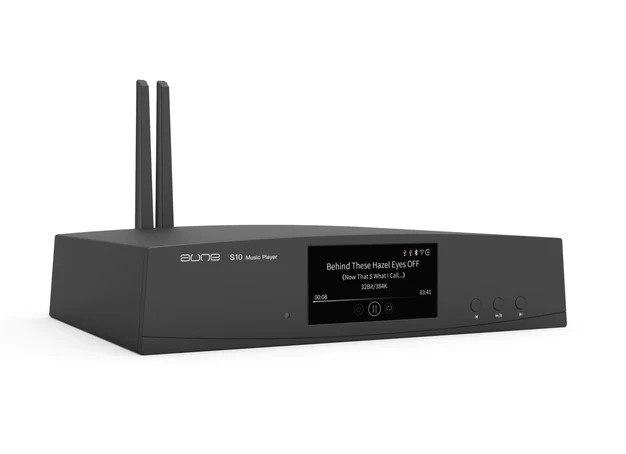
What Aune means by its multi-core architecture
Aune describes the S10N as using separate streaming, FPGA signal-generation, Bluetooth, PLL clock and NXP processing cores. The broad aim is clear: avoid asking one processor and one clock domain to manage every task simultaneously.
Streaming and control
The network section is based around a MediaTek streaming engine, with the S10N app handling setup and control. Aune lists Tidal, Qobuz and QQ Music among the services available, alongside NAS and DLNA playback and AirPlay. This gives the player several ways to reach music, but those methods are not interchangeable.
NAS playback means the S10N can access a music library stored on a network-attached storage device or another compatible shared location on the home network. For collectors with downloaded FLAC, WAV or DSD files, this can be preferable to relying entirely on a cloud catalogue. DLNA is the established home-network protocol family commonly used to browse and play those libraries from a server or control app. AirPlay, meanwhile, is useful for sending audio from an Apple device or compatible software, although the draft does not identify which AirPlay generation is supported or the maximum format available through it.
It is also important not to assume capabilities that have not been stated. The supplied information names Tidal, Qobuz and QQ Music, but does not specify whether each service is integrated directly into the S10N app, available via a casting or connect protocol, or subject to particular subscription tiers or regional availability. Likewise, it does not mention Roon, Spotify Connect, Chromecast, Ethernet or Wi-Fi specifications. These are practical questions worth checking before purchase, especially for anyone building a system around a particular control ecosystem.
FPGA processing and clock management
An FPGA—field-programmable gate array—is a programmable logic device that can be configured for tightly defined digital tasks. In audio products it is often used for signal routing, data formatting, filtering, oversampling or clock-related processing rather than relying entirely on general-purpose software running on a standard processor. Aune says the S10N’s FPGA regenerates the digital signal and works with two independent ultra-low-jitter oscillators.
The company also identifies an asynchronous FPGA core and a dedicated PLL clock-processing core. PLL, short for phase-locked loop, is a clock-recovery and control technique used to keep digital timing stable. Digital audio does not merely require that data arrive intact; it also requires that samples are presented at regular intervals. Timing uncertainty is commonly described as jitter. Aune’s separate clock section and twin oscillators are therefore intended to maintain cleaner timing across the supported sample rates.
There is a useful caveat here. “Low jitter” is not a complete performance specification in isolation, and Aune has not provided jitter measurements, oscillator frequencies or details of the relationship between its internal and external clock modes. The company does state that both internal and external clock systems are supported. External clock compatibility could interest owners of a dedicated master clock, but the source material does not identify the clock connector, accepted frequencies or operating modes. It should not be treated as a guaranteed upgrade path without confirmation.
Local-file capability: PCM to 768kHz and native DSD512
Aune calls the S10N’s third-generation decoding arrangement a “basic hardware decoding core”, comparing the framework with that of a classic CD player and claiming fast start-up. Whatever terminology is used, the key practical point is that the player is designed to decode files locally rather than function only as a network bridge.
Its quoted format support includes WAV, FLAC, DFF, DSF and ISO files, with PCM support up to 32-bit/768kHz and native DSD512. WAV and FLAC are familiar PCM containers: WAV is generally uncompressed, while FLAC reduces file size without discarding PCM audio data. DSF and DFF are common file containers for DSD material. ISO playback is relevant to users who have made disc-image archives, though compatibility can depend on the particular image and metadata structure.
“Native DSD512” is a meaningful claim in that it indicates the player is specified to handle DSD data at up to 512 times the 44.1kHz base rate without first converting it to PCM in the stated playback path. It does not, however, tell us which DAC architecture the S10N uses, how DSD is treated at its analogue outputs, or whether all inputs and network services can deliver every stated maximum. Those details can vary significantly by input and app. The DAC chip or converter topology is not disclosed in the supplied information, so it would be premature to draw conclusions about the character or ultimate quality of the analogue stage.
For most music libraries, the headline 768kHz and DSD512 limits are less important than dependable library navigation, metadata handling and stable network performance. But high format ceilings can be valuable to enthusiasts with a mixed collection who want to avoid maintaining separate playback chains for conventional CD-resolution files, high-resolution PCM downloads and DSD albums.
Bluetooth is a convenience input, not just an afterthought
The S10N uses Qualcomm’s QCC5125 Bluetooth chipset as a receiving input. That means a phone, tablet or computer can send audio wirelessly to the Aune, which then supplies the decoding and output stages. Aune lists LDAC and aptX HD among the supported transmission protocols.
For everyday use, this is valuable because Bluetooth makes it quick to play audio from apps that may not be available in the streamer’s own software, or to share music without altering network settings. LDAC and aptX HD are higher-bandwidth Bluetooth codecs than basic SBC, but the actual codec used depends on the transmitting device as well as the receiver. An iPhone, for example, will not transmit LDAC or aptX HD. Bluetooth also remains a lossy wireless transmission method, so listeners seeking the most direct path from a lossless streaming service or NAS will generally use the network playback facilities instead.
The separate Bluetooth core is part of Aune’s wider partitioned design. The intention is that radio handling does not have to share the same processing resources as streaming and FPGA audio work. The draft does not specify Bluetooth version, whether AAC is supported, or the full codec list, so those details remain unconfirmed.
Digital and analogue connections: choosing the right path
The connection provision makes the S10N more adaptable than a streamer restricted to one output type. Its coaxial and optical digital outputs should suit many external DACs and integrated amplifiers. Coaxial S/PDIF uses an electrical connection, while optical uses a light-based link that can be useful where electrical isolation between components is desirable. Their maximum supported sample rates are not stated, and these interfaces do not necessarily carry every format the S10N can decode internally.
The IIS output is likely to appeal to owners of DACs with a compatible IIS input. IIS, often written I²S, is a digital audio bus format that separates audio data and clock signals rather than combining them as S/PDIF does. It can be an effective internal or short-distance connection, but external IIS pin assignments are not universal. Compatibility between the S10N and a specific DAC must therefore be verified; a connector that looks physically similar is not by itself a guarantee that the devices will communicate correctly.
RCA and XLR analogue outputs cover unbalanced and balanced system connections. In a suitable system, balanced XLR can offer better rejection of externally induced noise over long cable runs, while RCA remains the standard connection on a huge number of integrated amplifiers and active speakers. Balanced connection does not automatically mean superior sound in every setup; it is primarily a system-interface decision, and the internal analogue circuit topology has not been detailed.
Who should consider the Aune S10N?
On the information available, the S10N makes most sense for a listener who wants one desktop-sized source to cover network libraries, selected streaming services, Bluetooth and both analogue and digital system integration. The variable RCA and XLR outputs make it potentially attractive for active loudspeakers or a minimalist power-amplifier system, while coaxial, optical and IIS outputs leave room to use an established external DAC.
Its strongest stated technical points are the deliberately divided processing architecture, FPGA and PLL clocking provision, broad local-format support and unusually broad output selection. The trade-off is that several ownership-critical details have not yet been supplied: network hardware, full streaming-service implementation, DAC design, output levels, digital-output limits and the precise external-clock and IIS specifications. None invalidates the product’s proposition, but each could influence whether it is the right match for a particular system.
For prospective buyers, the sensible next step is to establish the intended playback route first. Those using an external DAC should confirm digital-output compatibility and format limits. Those planning to run directly into active speakers or a power amp should ask how the variable analogue output is implemented and whether its range suits their downstream amplification. And anyone invested in a specific streaming platform should verify native service support rather than assuming that a named service can be controlled in their preferred way.
That practical flexibility is the S10N’s appeal. It is not positioned merely as a way of getting a streaming app into a hi-fi rack, but as a digital hub designed to accommodate both a compact desktop system and a more ambitious, separable source chain.