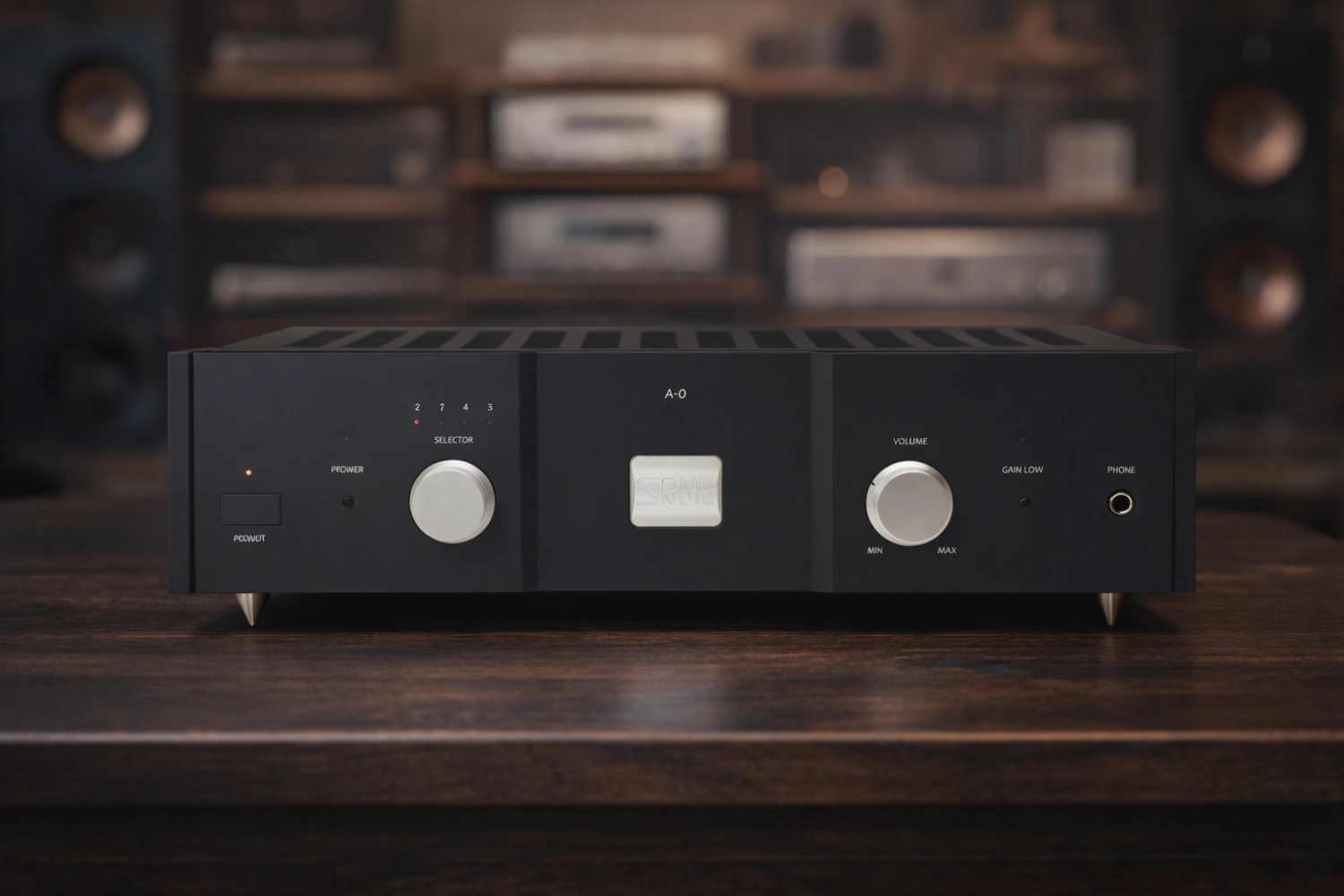
Soulnote’s A-0 ver.2 is not an integrated amplifier built around the familiar race for ever-higher wattage. Rated at 10W per channel into 8 Ohms, it is instead a compactly specified purist design aimed at listeners prepared to match it carefully with suitably efficient loudspeakers. Its priorities are a fully discrete circuit, an intentionally short signal path and operation without negative feedback (NFB), while version 2 introduces a revised bias circuit and retains the ability to work as a preamplifier.
At €2,700, the A-0 ver.2 is therefore a specialised proposition rather than an all-purpose integrated amplifier. It will not be the natural choice for difficult, low-sensitivity loudspeakers in a large room, or for anyone who expects substantial reserves for very high playback levels. But for a system based around compatible loudspeakers—potentially including sensitive horn designs—the modest power rating is part of a clearly defined engineering approach, not simply a limitation on a spec sheet.
A deliberately low-power integrated amplifier

The headline specification is 10W per channel into 8 Ohms. That figure needs to be read in the context of the loudspeaker, listening distance and room rather than in isolation. Loudspeaker sensitivity determines how much acoustic output a speaker produces from a given electrical input, while its impedance curve influences how demanding it is for the amplifier to drive. A sensitive loudspeaker can produce satisfying, realistic levels from relatively little power; an insensitive model, or one that presents a difficult impedance load, will demand far more voltage and current as levels rise.
For that reason, the A-0 ver.2 makes most sense as the hub of a system chosen around its capabilities. The draft specifically identifies sensitive horn loudspeakers as one possible pairing. Such speakers can make 10W go a long way in a typical living room, while also exposing low-level information and amplifier noise that may be less apparent with less sensitive designs. That makes the amplifier’s claimed 115dB IHF A-weighted signal-to-noise ratio relevant: a high signal-to-noise figure is intended to help keep the electronic background quiet when no music is playing and during very soft passages.
There is no published sensitivity or minimum-impedance recommendation in the supplied information, so prospective owners should not assume that every nominally 8 Ohm loudspeaker will be equally suitable. In practice, the sensible route is to start with an efficient, benign load and to assess required volume in the intended room. Low-power amplifiers can sound highly composed within their operating envelope, but the available headroom ultimately remains finite.
What a no-feedback, discrete design means

Soulnote uses a fully discrete circuit and dispenses with negative feedback. “Discrete” means the circuit is constructed from individual active components rather than relying on integrated circuit packages for the gain stages. It is an approach that gives an amplifier designer control over the circuit implementation and component operating conditions, although discrete construction in itself is not a guarantee of performance; execution is what matters.
The more distinctive choice is the absence of NFB. In a conventional feedback amplifier, a portion of the output is returned to an earlier part of the circuit and compared with the input signal. The amplifier can then correct for deviations. Properly applied negative feedback is a well-established engineering tool that can reduce measured distortion, lower output impedance and improve consistency. It is not inherently at odds with musical results.
Soulnote takes the alternative route, seeking direct signal transmission through a circuit designed to work without that correction loop. The manufacturer says this supports open transients, micro-detail and a natural musical flow. Those are manufacturer claims rather than independent listening or measurement findings, but the underlying design intent is clear: minimise the complexity between input and output and avoid using a global feedback loop as the principal means of error correction.
That same reductionist thinking extends to the A-0 ver.2’s architecture. Input selection and volume control feed directly into the power amplifier, with as few components as possible in the signal path. A short signal route can be attractive because every switch, buffer stage and coupling component has to be selected and implemented carefully. The trade-off is that a minimalist integrated amplifier may not offer the broad feature set, extensive input count or digital facilities found in more conventional all-in-one products. Soulnote has not specified the A-0 ver.2’s input complement in the supplied details, so buyers who need onboard DAC, streaming, phono or home-cinema integration should confirm connectivity before treating it as the centre of a system.
Fast output devices and a single push-pull stage
The output stage is described as a single push-pull circuit using TO-220 transistors with low collector-base capacitance, or COB. Push-pull operation uses complementary devices to handle the positive and negative halves of the waveform. It is a common output-stage arrangement, but the specific implementation—one output stage rather than a more heavily parallelled arrangement—aligns with Soulnote’s preference for reducing circuit complexity.
Transistor capacitances matter because they affect how a device behaves as signals change. Lower collector-base capacitance can reduce unwanted capacitive loading and can be advantageous in a high-speed amplifier circuit. Soulnote’s stated goal is stable impulse handling and faithful retrieval of subtle dynamic changes. It would be inappropriate to turn that design description into a promised sonic result without an independent audition, but it does explain why the company highlights these particular TO-220 devices.
Version 2 revises the bias circuit

A key change in the A-0 ver.2 is its revised bias circuit. Bias is the quiescent operating condition of an output stage: the current set through its devices when no music signal is present. In many amplifier designs, careful bias management is important to linearity, crossover behaviour, heat and long-term operating stability. The optimum setting depends on the topology and the devices used, so there is no universally “best” bias value.
Soulnote says the revised circuit provides a stable bias setting and reduces background noise, with the intention of making small musical nuances easier to discern. This is particularly relevant to an amplifier whose whole concept centres on low-level resolution and timing rather than outright scale. A quiet electronic background can help preserve the contrast between silence and the softest recorded information, whether that is a decay, ambience or a small shift in level.
The supplied specifications list a speaker-output frequency response of 5Hz–350kHz, measured at 8 Ohms and 1W, within +0/–1dB. The headphone figure is 5Hz–400kHz at 32 Ohms and 200mW, again within +0/–1dB. These bandwidths extend well beyond the conventional audible range. That should not be interpreted as proof of audible ultrasonic content; rather, it describes the amplifier’s stated small-signal bandwidth under the specified conditions. Wide bandwidth also places demands on circuit stability and system layout, which makes implementation especially important in a feedback-free design.
Headphones and preamp duties broaden the A-0 ver.2’s role

Although primarily a loudspeaker integrated amplifier, the A-0 ver.2 includes a headphone output rated at 3W per channel into 32 Ohms. That is a substantial published power figure for a headphone stage, and indicates that Soulnote has not treated headphones merely as a convenience feature. The amplifier’s stated headphone gain is 8dB, lower than its 22dB speaker gain, which is a practical choice: headphones often require less voltage gain than passive loudspeakers and can reveal noise more readily.
Power alone does not establish compatibility with every headphone. Sensitivity and impedance vary greatly between models, and the source does not provide output-impedance information or a list of recommended headphone loads. As always, extremely sensitive in-ear monitors may need particularly careful volume adjustment, while the suitability of very high-impedance or unusually demanding headphones should be confirmed rather than assumed. Still, the 3W-into-32-Ohm rating makes the A-0 ver.2 potentially interesting for owners who want a single analogue control centre for speakers and conventional wired headphones.
The A-0 ver.2 can also be used as a preamplifier. Its pre-outs are available on both RCA and XLR connectors, and two level modes are provided. This broadens the ways it can be integrated into a system: it can feed an external power amplifier, active loudspeakers or a subwoofer that accepts line-level input. RCA is the usual unbalanced connection, while XLR provides a balanced interface where the partnering equipment supports it. Balanced connection can be useful in installations involving longer cable runs or where noise rejection is desirable, though the benefit depends on the implementation of the whole system.
The two selectable pre-out levels should be useful when accommodating components with different input sensitivities. Correct gain matching matters: too much gain can make the volume control unnecessarily abrupt, while too little may prevent the system reaching the desired level. The available information does not state the voltage for either mode, so it is worth checking the manual or dealer guidance when pairing the Soulnote with a specific active speaker, subwoofer or power amplifier.
Size, system context and the important compromises

Measuring 430 x 109 x 418mm (W x H x D) and weighing 8kg, the A-0 ver.2 has conventional full-width hi-fi proportions, with a notably deep 418mm chassis. Buyers should allow extra clearance at the rear for cables and sensible ventilation around the amplifier. The supplied material does not state its heat output, cooling arrangement or exact input layout, so those are details to confirm during installation planning.
The A-0 ver.2’s appeal lies in the coherence of its brief. It combines 10W-per-channel output, a direct volume-to-power-amp route, discrete circuitry, no negative feedback, a revised bias arrangement, a capable-looking headphone specification and genuinely useful RCA/XLR pre-outs. It is not trying to be a high-power universal integrated, a network streamer or a feature-heavy digital hub.
That clarity also defines the trade-offs. Its low output means loudspeaker choice is not optional system fine-tuning but a foundational decision. Its purist analogue approach means source requirements need consideration: owners will need appropriate external components if they require digital conversion, streaming or a phono stage. Conversely, listeners already building around an established source and efficient speakers may value the A-0 ver.2 precisely because it avoids adding functions and stages that they do not need.
Soulnote A-0 ver.2 specifications
- Fully discrete circuit with no negative feedback
- Output power: 10W per channel into 8 Ohms
- Headphone power: 3W per channel into 32 Ohms
- Speaker output frequency response: 5Hz–350kHz (8 Ohms / 1W, +0/–1dB)
- Headphone output frequency response: 5Hz–400kHz (32 Ohms / 200mW, +0/–1dB)
- Signal-to-noise ratio: 115dB (IHF A-weighted)
- Total gain: 22dB (speakers), 8dB (headphones)
- Pre-outs: RCA and XLR, with two level modes
- Dimensions (W x H x D): 430 x 109 x 418mm
- Weight: 8kg
- Price: €2,700