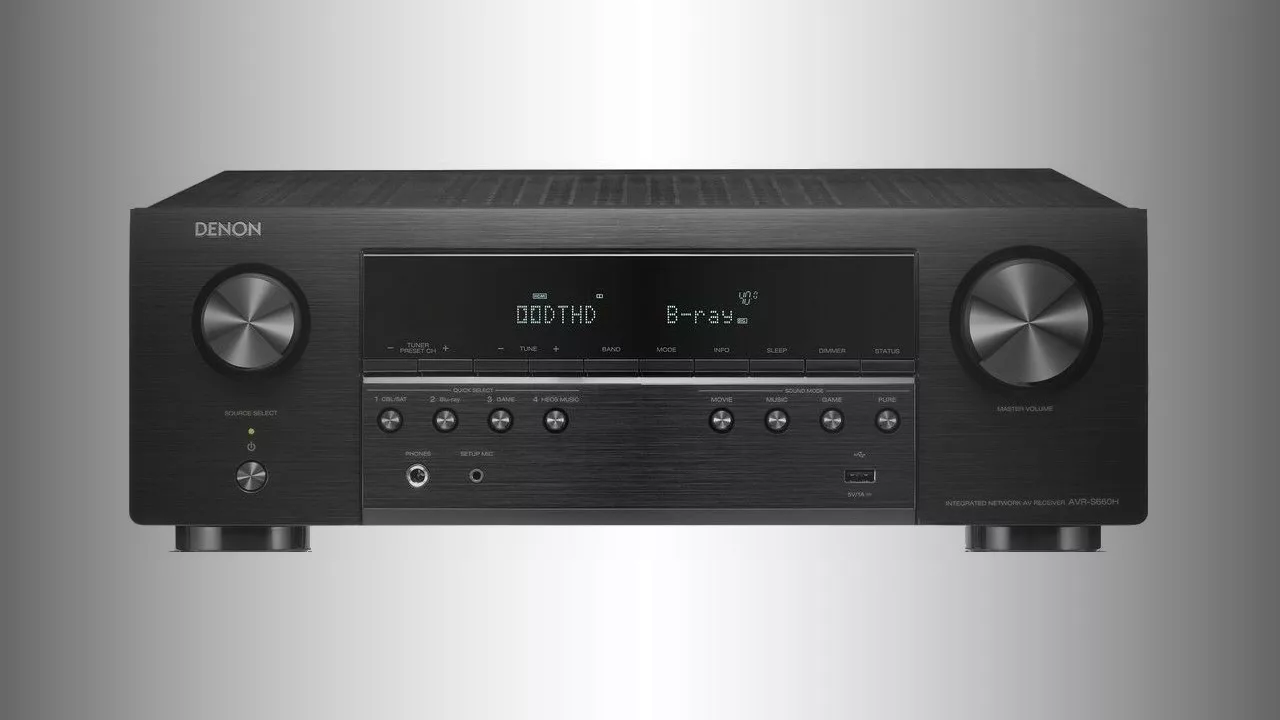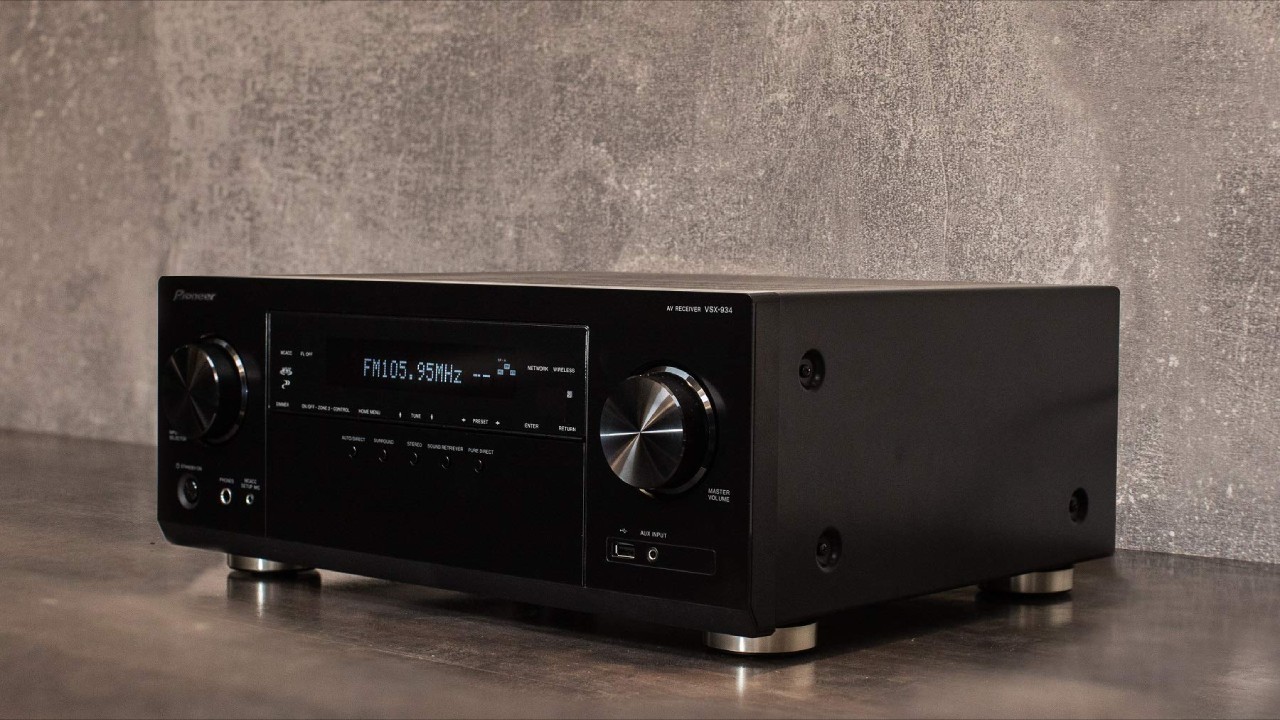
The Pioneer VSX-934 is a seven-channel AV receiver intended to cover two increasingly important jobs in one chassis: act as the switching and decoding centre of a Dolby Atmos or DTS:X cinema system, while also serving as a network music player for a household using several streaming and multiroom ecosystems.
It succeeds the VSX-933, a model recognised by EISA in 2018–19 for its price-to-performance proposition. The VSX-934 retains the basic seven-channel architecture but adds meaningful flexibility, most notably a second HDMI output, post-DAC Zone 2 capability and virtual-height processing through Dolby Atmos Height Virtualization and DTS Virtual:X. Those additions matter because they broaden what the receiver can do in rooms where extra speakers—or, particularly, ceiling speakers—are impractical.
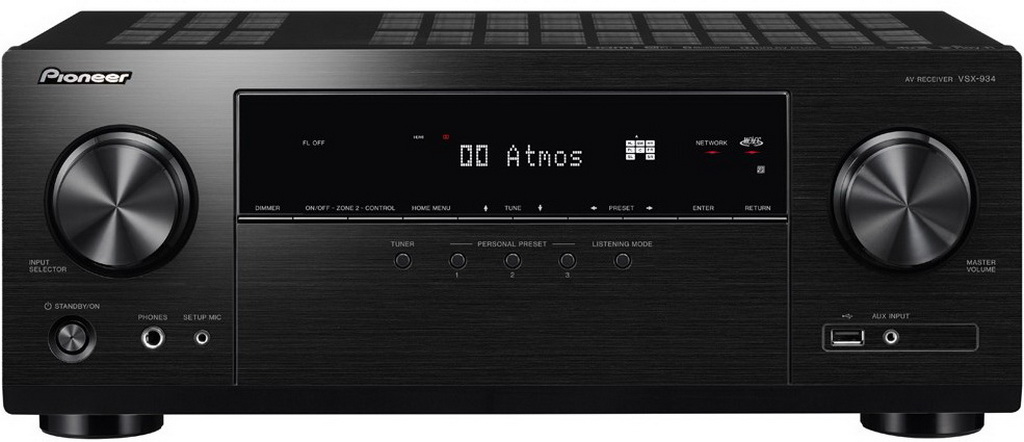
A 7.2-channel receiver with choices to make
The VSX-934 has seven amplified channels and two subwoofer outputs. In a conventional surround installation, that allows a 7.2 layout with front left/right, centre, surround left/right and rear surround left/right speakers, plus up to two subwoofers. It can alternatively be configured as a 5.2.2 Dolby Atmos or DTS:X system, reallocating the final two amplifier channels to a pair of height or ceiling speakers.
As with most seven-channel receivers, those channels cannot do every job simultaneously. The unit has seven pairs of screw speaker terminals, so owners must decide how to allocate the built-in amplification: a full seven-speaker main-zone layout, height channels, a powered second zone, or bi-amping compatible front loudspeakers. Bi-amping uses separate amplifier channels for a speaker’s high- and low-frequency terminal sections, but it requires loudspeakers with separate terminals and does not add amplifier channels to the system. Equally, assigning channels to Zone 2 means sacrificing channels in the main room when that zone is active.
This is an important buying distinction. The VSX-934 is well suited to a single-room 5.2.2 installation or a conventional 7.2 system, with occasional secondary-room use. A user who needs a full 5.2.4 speaker layout, or wants more simultaneous flexibility between a surround system and powered Zone 2, will need a nine-channel design. Pioneer’s VSX-LX304 is identified as the step-up model based on the same platform and exterior design, adding nine-channel capability as well as hardware support for Roon and IMAX.
Atmos and DTS:X without ceiling speakers
The receiver decodes Dolby Atmos and DTS:X, alongside Dolby TrueHD, Dolby Digital Plus, DTS-HD Master Audio, DTS-HD High Resolution Audio and DTS-HD Express. It also provides Dolby Surround and DTS Neural:X upmixing. These processors can derive activity for the available surround or height channels from soundtracks that were not originally encoded with an object-based soundtrack, which is useful when a system has height speakers but the source material is conventional stereo or 5.1.
The headline addition is Dolby Atmos Height Virtualization and DTS Virtual:X. Rather than sending discrete effects to physical height speakers, these modes use DSP to alter the relationship between sounds delivered by the existing speakers, aiming to suggest a higher soundstage and overhead activity. They are a practical option for rooms where installing ceiling loudspeakers, on-wall heights or Atmos-enabled upfiring modules is not possible.
Virtualisation should not be confused with adding real channels: the receiver remains a seven-channel amplifier, and virtual height cannot reproduce the discrete spatial information or placement precision of a properly installed 5.2.2 system. Results also depend heavily on speaker position, listener location and room acoustics. Nevertheless, for a 5.1 system in a living room, it offers an accessible way to explore the presentation that object-based formats are intended to create without running new cable.
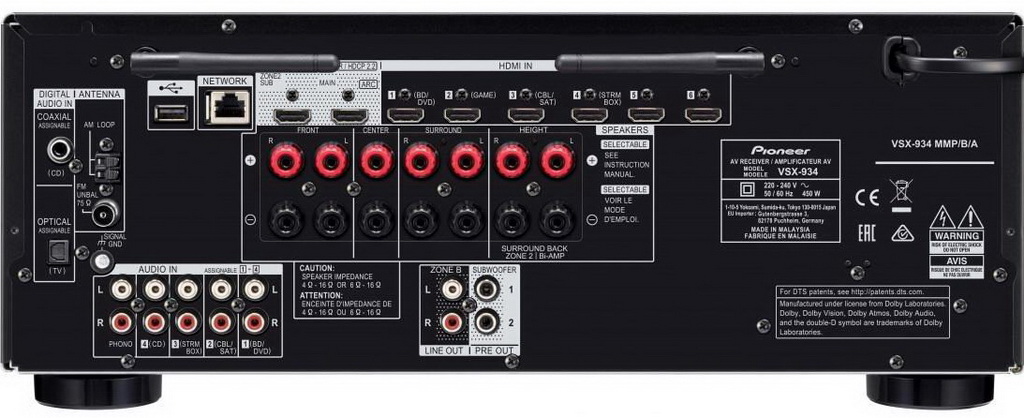
HDMI switching and a more useful second zone
Six HDMI 2.0 inputs support 4K/60Hz video, HDCP 2.2, HDR10 and Dolby Vision. This is enough connectivity for a typical collection of source components—such as a games console, disc player, media streamer and set-top box—without relying on an external HDMI switch. The receiver has two HDMI outputs, also specified for 4K/60Hz, HDCP 2.2 and HDR10. A second output can be valuable for an installation with both a television and a projector, although users should check the capabilities of every component in the signal chain when planning HDR playback.
The VSX-934’s Zone 2 provision is more substantial than simply mirroring an analogue source. It offers both a Zone 2 line output and a powered acoustic output, and its dedicated DAC in the second-zone signal path means digital sources selected in Zone 2 can be converted independently of the source playing in the main zone. The line output is useful if the second room already has an integrated amplifier or active speakers; the powered option can drive passive speakers, subject to the channel-allocation compromise described above.
For source connectivity beyond HDMI, Pioneer provides a phono input, four stereo RCA line inputs, one coaxial digital input, one optical input, USB and Ethernet. The phono input is specified at 3.5mV and 47kOhms, the conventional loading arrangement for a moving-magnet cartridge. A turntable using a moving-coil cartridge would normally require an external phono stage with suitable gain and loading before being connected to one of the line-level inputs.
There are also two subwoofer outputs. The supplied specification does not establish whether these are independently processed, so they should not automatically be assumed to offer separate equalisation or delay for two differently placed subwoofers. Their presence nevertheless makes a two-subwoofer installation physically straightforward, a potentially useful route to smoother bass coverage across more than one seat when the room and setup permit it.
MCACC setup and crossover control
Pioneer’s MCACC auto-calibration system uses the supplied external microphone to measure the loudspeaker system at the listening position. According to the supplied technical information, it adjusts frequency response and phase, includes subwoofer-channel linearity correction, and measures distance with millimetre-level resolution using cyclic high-level noise fragments.
In practical terms, distance measurement is important because it sets the time alignment between speakers. If the centre channel is physically closer than the front pair, for example, its output must be delayed so dialogue reaches the seat in step with the rest of the front soundstage. Level setting establishes a common reference at the listening position, while room correction attempts to address some of the response irregularities introduced by speaker placement and room boundaries.
Automatic calibration is a strong starting point, not a substitute for sensible installation. Place the microphone at ear height at the principal seat, keep the room quiet during measurement and avoid positioning speakers inside furniture or directly against walls where possible. The VSX-934 also supplies independent crossover-frequency adjustment per channel, with settings from 40Hz to 200Hz: 40, 50, 60, 70, 80, 90, 100, 120, 150 and 200Hz. That is useful where the front, centre and surround speakers have different low-frequency limits. Smaller surrounds may need a higher crossover than floorstanding front speakers, allowing the subwoofer to take over before the smaller driver is stressed.
The receiver includes a Direct mode as well. Generally, such modes are useful when an owner wishes to minimise signal processing for two-channel listening, but the exact processing bypassed in each input and playback configuration should be confirmed in the product manual before assuming that all room correction or bass management is defeated.
Network playback: broad ecosystem support, with limits
Network versatility is a major part of the VSX-934 proposition. It supports dual-band 2.4GHz and 5GHz Wi-Fi as well as wired Ethernet, DLNA v1.5, Bluetooth 4.1 and AirPlay 2. The Pioneer control app is available for iPhone and Android, while built-in streaming services include TuneIn Radio, Tidal, Spotify, AUPEO! and Deezer.
AirPlay 2 is significant for Apple households because it permits straightforward playback from compatible Apple devices and participation in an AirPlay 2 multiroom group. Sonos compatibility adds another route for homes already invested in that ecosystem. DTS Play-Fi and Pioneer’s FlareConnect provide further wireless multiroom possibilities; these systems matter less as abstract “protocols” than as decisions about how music is selected, grouped and controlled around a home. Before buying additional wireless speakers, it is prudent to confirm compatibility with the exact platform one intends to use.
For files held on a local server or computer, the stated support includes MP3, WMA and WMA Lossless, FLAC, Ogg Vorbis, AAC, Apple Lossless, LPCM, WAV up to 24-bit/192kHz and DSD up to 5.6MHz. These formats cover the most common CD-quality and high-resolution library types. File support is not identical to a guarantee of seamless browsing or gapless playback in every server/app combination; the user experience will still be shaped by the chosen DLNA server and control method.
Chromecast does not appear in the supplied VSX-934 feature list, unlike the earlier model’s stated provision. That need not be decisive for every installation: a separate compatible streaming device can be connected to one of the HDMI inputs. The receiver is also not specified as Roon Ready. For listeners whose library management and discovery workflow is centred on Roon, that absence is a meaningful limitation rather than a minor checklist omission.
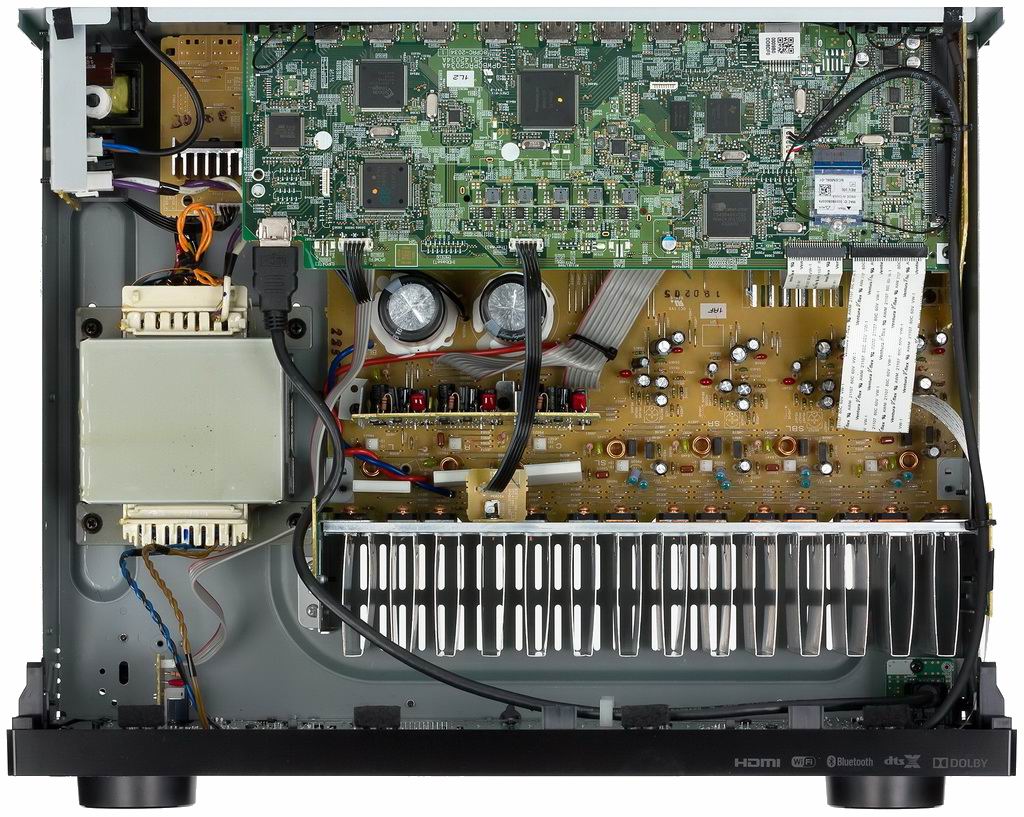
Inside the VSX-934: processing, conversion and amplification
The audio section uses a quad-core 32-bit CS49844A DSP for processing. Digital-to-analogue conversion is assigned to an eight-channel AK4458VN 32-bit DAC and a two-channel Burr-Brown PCM5101A, while a pair of Burr-Brown PCM9211 devices handles input processing and incorporates 24-bit/96kHz analogue-to-digital converters. This division of roles reflects the demands placed on an AV receiver: it must accept and route many kinds of analogue and digital signals, decode multichannel formats, apply bass management and room correction, and feed several output channels simultaneously.
Amplification is conventional, using complementary Toshiba 2SA1941/2SC5198 output-transistor pairs. The detailed technical description states 80W per channel into 8 Ohms with distortion no greater than 0.08%, while the headline specification quotes 135W per channel into 6 Ohms at 1kHz with one channel driven under IEC conditions. These figures are not directly interchangeable. AV receiver power ratings depend on load impedance, test frequency, permitted distortion and, crucially, the number of channels driven. The 6-ohm, one-channel figure indicates available output under that particular test condition; it should not be read as seven channels each continuously delivering 135W in a demanding soundtrack.
The power supply uses a high-current transformer, with two Nichicon 6,800µF, 63V reservoir capacitors stated in the capacitive buffer. The receiver’s total power consumption is specified as 460W. In use, speaker sensitivity, impedance behaviour, room size and listening distance are at least as important as the headline wattage. It should be a sensible match for a reasonably efficient, amplifier-friendly surround speaker package in a small to medium room. Owners of very low-sensitivity loudspeakers, speakers with difficult impedance dips, or large rooms played at high reference-like levels should be cautious and consider the demands of all active channels, especially during action-film peaks.
Daily-use details and system-planning advice
Three system presets are available. Holding a dedicated front-panel button saves a chosen combination of source, mode and other settings, which can subsequently be recalled from the remote control or Pioneer Remote App. This is a genuinely useful convenience feature: one preset could be tailored to film viewing with surround processing and a chosen HDMI input, another to a music source, and a third to a late-night setup with revised levels or processing.
The VSX-934 measures 435 x 173 x 370mm (W x H x D) and weighs 9.6kg. Allow additional depth for HDMI plugs, speaker cable and bend radius, and leave ventilation space around the chassis. Like any multi-channel receiver using a traditional amplifier stage and internal power supply, it should be installed on a stable, open shelf rather than in a tightly enclosed cabinet. The quoted standby consumption is 0.15W.
At its core, this Pioneer is a flexible 7.2-channel receiver rather than a route to unlimited expansion. Its strongest appeal is to the owner who wants proper Atmos/DTS:X decoding, numerous HDMI connections, music playback from both local files and mainstream services, and several options for multiroom integration—all without moving to a larger nine-channel class. The trade-offs are clear: seven amplified channels impose allocation choices, Roon is not specified, and virtual height is an alternative to rather than a replacement for physical height speakers. Within those boundaries, the VSX-934’s combination of second-zone functionality, two HDMI outputs, MCACC calibration and broad network support gives it a notably wide remit.
Pioneer VSX-934 key specifications
- Channels: 7.2
- Output power: 135W per channel, 6 Ohms, 1kHz, one channel driven, IEC
- Line input sensitivity/impedance: 200mV / 47kOhms
- Phono input sensitivity/impedance: 3.5mV / 47kOhms
- HDMI inputs: 6 x HDMI 2.0; 4K/60Hz, HDCP 2.2, HDR10 and Dolby Vision
- HDMI outputs: 2 x HDMI 2.0; 4K/60Hz, HDCP 2.2 and HDR10
- Audio formats: Dolby Atmos, DTS:X, Dolby TrueHD, Dolby Digital Plus, DTS-HD Master Audio, DTS-HD High Resolution Audio and more
- Virtual processing: Dolby Atmos Height Virtualization and DTS Virtual:X
- Room calibration: MCACC auto-calibration
- Network: Ethernet, dual-band Wi-Fi, DLNA v1.5, AirPlay 2 and Bluetooth 4.1
- Local file support: WAV up to 24-bit/192kHz and DSD up to 5.6MHz, plus FLAC, Apple Lossless and other formats
- Additional connections: phono, 4 x RCA line input, coaxial, optical, USB, Zone 2 line output, 2 x subwoofer output and 6.3mm headphone output
- Power consumption: 460W; standby 0.15W
- Dimensions (W x H x D): 435 x 173 x 370mm
- Weight: 9.6kg