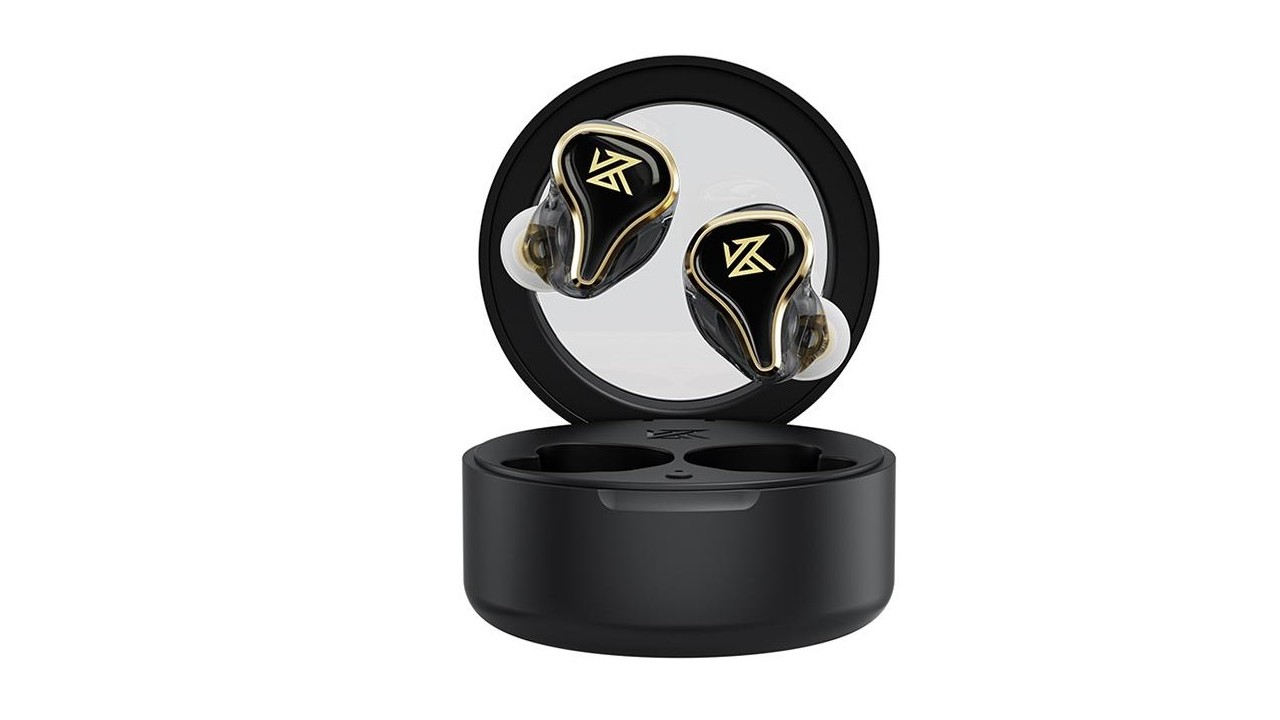
KZ has introduced the KZ SK10, a pair of true-wireless earbuds that brings the company’s familiar hybrid-driver approach to an unusually affordable $43 price point. Rather than relying on a single full-range driver in each earpiece, the SK10 combines a 10mm dynamic driver with a 30019 balanced armature, while Bluetooth 5.2, touch operation and a charging case make it a conventional cable-free proposition for everyday listening.
On paper, it is the driver arrangement that separates the SK10 from many entry-level TWS designs. Hybrid earphones have long been a KZ speciality in wired in-ear monitors, but putting a dynamic driver and balanced armature together in a small, battery-powered wireless earpiece creates a more ambitious engineering brief than the price alone might suggest. The published information does not specify the crossover arrangement, Bluetooth codecs, water resistance or the charging connection, so those are important details to establish before treating the SK10 as a direct alternative to a more fully specified sports or travel-focused TWS model.
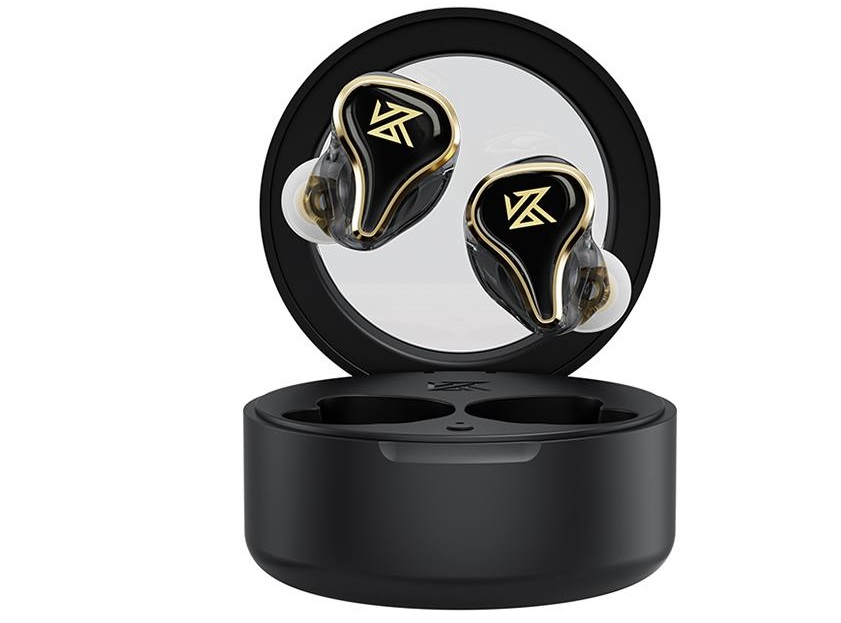
A hybrid driver layout, explained
The SK10 uses a 10mm dynamic driver alongside one 30019 balanced armature driver per earbud. These two driver types work in very different ways and, when sensibly integrated, can allow an earphone designer to divide the frequency range according to each unit’s strengths.
A dynamic driver operates rather like a miniature loudspeaker: a voice coil moves a diaphragm to create sound. In compact in-ear products, a relatively large 10mm diaphragm can potentially move more air than the smaller dynamic drivers often used in TWS earbuds. In general terms, that gives a designer useful scope in the bass and lower-midrange regions, where air displacement matters. It is not, however, a guarantee of a particular bass quantity, extension or sound signature; enclosure volume, tuning, seal in the ear and DSP all have substantial influence, and KZ has not supplied frequency-response data for the SK10.
The 30019 balanced armature is a different kind of transducer, designed around a tiny armature moving within a magnetic field. Balanced armatures are valued in in-ear monitors because they are extremely compact and can be tuned to handle a selected part of the spectrum. In a hybrid arrangement, such a driver is commonly used to supplement the dynamic driver through the midrange and treble, where speed and fine control are particularly useful design goals.
The crucial issue with any hybrid earphone is integration. Two drivers do not automatically make a better earphone than one: their acoustic outputs must meet smoothly at the crossover region, and their relative levels, phase behaviour and acoustic paths need to be managed carefully. KZ has confirmed the driver complement but has not detailed its crossover design or tuning targets. As such, the specification signals a potentially more sophisticated approach than a basic single-driver TWS earbud, rather than providing enough information to predict the SK10’s tonal balance.
Bluetooth 5.2 and touch control
Wireless connection is handled by Bluetooth 5.2. Bluetooth version numbers alone should be treated cautiously: they describe the generation of the underlying wireless standard, but do not reveal which audio codecs are available, the maximum audio quality, actual latency in video use, or connection stability in a busy radio-frequency environment. Those practical factors depend on the implementation and on the source device as well as the earbuds themselves.
KZ quotes a signal range of up to 15 metres. That figure is useful as an indication of the intended wireless freedom, but as with all Bluetooth-range claims it should be regarded as a best-case figure. Walls, the human body, Wi-Fi traffic and other wireless devices can all reduce the usable distance. For normal use around a room or office, a stable connection matters more than a maximum line-of-sight number; no specific information has been provided about multipoint pairing, companion-app features or low-latency modes.
Touch controls are fitted to the earpieces. This avoids protruding physical buttons and means an earbud can be operated without pressing it more deeply into the ear canal. The trade-off is familiar to anyone who has used touch-controlled TWS designs: gesture sensitivity and the range of commands available make a significant difference to everyday usability. KZ has not listed the specific gestures or stated whether volume can be adjusted directly from the earbuds.
Passive isolation rather than confirmed active noise cancelling
KZ says the SK10 provides good passive noise reduction through its new ear tips. This wording matters. Passive isolation is created mechanically by the ear tip sealing the ear canal, reducing the level of outside sound that reaches the ear. It is fundamentally different from active noise cancellation (ANC), which uses microphones and electronic processing to counter external noise.
No ANC system is specified for the SK10, so prospective buyers should not assume that it offers the low-frequency suppression associated with active noise-cancelling travel earbuds. A good in-ear seal can nevertheless be valuable: it can reduce ambient distraction, improve perceived bass by preventing low-frequency leakage, and allow lower listening levels in moderately noisy surroundings.
Fit is consequently central to the SK10 experience. Even an excellent driver configuration will not deliver its intended balance if an ear tip does not seal consistently. Users should try the supplied tip sizes, if included, and choose the size that remains secure without discomfort. The draft refers to “ear pads”, but in this type of in-ear design the relevant contact point is normally the ear tip. KZ has not specified the tip material or the number of sizes supplied.
Battery life, weight and portable use
KZ rates the SK10 for approximately 6.5 hours of operation from the earbuds themselves, rising to up to 26 hours when the charging case is included. The latter is a total system figure rather than a single uninterrupted listening session: once the earbuds are depleted, they return to the case for additional charging.
Battery-life figures are always conditional. Playback volume, the music being played, codec choice and wireless conditions can affect real-world endurance, so KZ’s numbers are best viewed as quoted maximums or approximate targets. Still, 6.5 hours per charge is long enough to cover many commutes, working sessions and listening periods without requiring an immediate return to the case. The published material does not state charging time, fast-charging capability or wireless charging support.
One earbud weighs 6g, while the earbuds and case together weigh 57g. A 6g earpiece is light in absolute terms, although comfort depends at least as much on the shell shape, nozzle angle and ear-tip selection as it does on the number on a scale. The 57g combined figure suggests a case that should remain easy to carry in a pocket or bag, but KZ has not supplied its dimensions.
What the KZ SK10 is—and is not—positioned to offer
At $43, the KZ SK10 is aimed at listeners who want the convenience of a true-wireless earphone but are interested in a more involved acoustic architecture than the category’s usual single-driver starting point. The hybrid configuration is its defining feature, supported by Bluetooth 5.2, touch controls and a claimed 15-metre wireless range.
The available specification also makes its boundaries clear. There is no confirmed active noise cancellation, no stated codec list, no quoted water- or dust-resistance rating, and no details on calls, microphones, app control or equalisation. Those omissions do not prove that any particular feature is absent, but they mean buyers for whom gaming latency, frequent voice calls, gym durability or advanced ecosystem integration are priorities should verify the final retail specification before buying.
For a listener principally interested in music, the SK10’s hybrid driver arrangement and in-ear passive isolation are the meaningful points to investigate. It is available in black, white and pink, with a stated price of $43. Its appeal will ultimately rest on the quality of KZ’s acoustic tuning and the consistency of its wireless implementation—areas that cannot be determined from the announced specifications alone.