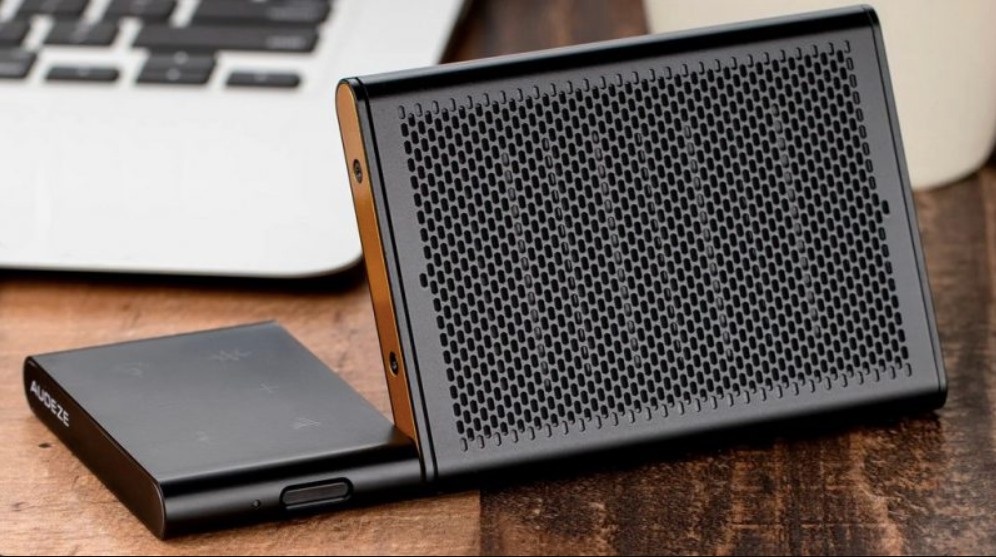
Audeze is taking its planar magnetic expertise beyond headphones with the Filter, a portable conference speakerphone intended for hybrid working, small meetings and calls made away from a fixed desk. It is an unusual move for a company best known in hi-fi for large-area planar diaphragms: rather than applying that technology to a conventional portable music speaker, the Filter combines a planar magnetic loudspeaker with voice-capture processing, noise reduction and steerable microphone coverage.
The central proposition is not simply louder calls. Audeze says the Filter is designed to make speech intelligible at both ends of a conversation: its speaker is intended to reproduce voices clearly, while an intelligent processing system aims to reduce the unwanted sounds captured by its microphones. The compact, foldable unit connects over USB or Bluetooth 5.0 and has an internal battery rated for up to 15 hours of normal listening.
A planar magnetic driver in a speakerphone
The Filter uses a 70mm by 105mm planar magnetic driver with a stated frequency response of 300Hz to 20kHz. That range says much about its intended role. A lower limit of 300Hz does not suggest a device built to reproduce deep bass in music, but it comfortably covers the core vocal region that determines whether a colleague, client or conference participant sounds natural and understandable. The 20kHz upper figure extends beyond the frequencies most important to speech, although it should not be treated on its own as a complete indication of sound quality.
In a planar magnetic design, a thin, lightweight diaphragm carries conductive traces and is driven across a broad surface by a magnetic field. This differs from the more familiar dynamic loudspeaker arrangement, where a voice coil drives a cone or dome from a relatively small area. In principle, distributing the driving force over a diaphragm can help reduce uneven motion and associated distortion. For a speakerphone, those potential benefits are especially relevant to the articulation of consonants and the avoidance of harshness at elevated voice levels.
Audeze says the Filter’s driver incorporates its patented Fluxor magnet arrangement for improved efficiency and a Uniforce diaphragm. Fluxor is Audeze’s term for a magnet configuration intended to concentrate magnetic flux where the diaphragm needs it, while Uniforce refers to the company’s approach to maintaining a more even driving force across the diaphragm. The company claims high sound-pressure capability and low distortion, but has not supplied sensitivity, maximum SPL or distortion measurements in the information provided. Those figures would be needed to make direct comparisons with other speakerphones.
The company’s use of planar magnetic technology here has a longer history than its headphone range. Audeze notes that its first product was a large planar magnetic speaker array developed for military use, and cites a speech-intelligibility test at Edwards Air Force Base in which listeners reportedly understood all words at distances of up to one mile. That is a very different application from a desktop speakerphone, but it explains why the company frames the Filter principally around vocal intelligibility rather than broad-band music playback.
Noise suppression and beamforming for real rooms
On the capture side, the Filter employs what Audeze calls an Intelligent Zero-Noise processing algorithm. Its deep neural network (DNN) noise-suppression system has been trained on more than 500,000 noise samples, according to the company, and is intended to identify and reduce common office and home distractions so that the outgoing signal prioritises speech.
This is important because a good speaker alone cannot rescue a poor conference call. Keyboard noise, HVAC systems, traffic through an open window, fans and nearby conversation can all make a voice difficult to follow. Noise suppression attempts to distinguish the characteristics of speech from more constant or incidental sounds, then attenuate the latter. As with all such systems, its usefulness will depend on how effectively it separates speech from complicated, changing background noise; Audeze has not provided independent performance data or recordings from the Filter, so the real-world effectiveness of its processing remains to be assessed.
The Filter also offers variable microphone beamforming coverage from 70 to 360 degrees, with Audeze claiming voice pickup within a three-metre radius. Beamforming uses multiple microphones and timing differences between them to place greater emphasis on sound arriving from a chosen direction or area. A narrower 70-degree pattern should be useful when one person is seated directly in front of the device, as it can favour that speaker over sound arriving from the sides. A wider setting makes more sense for huddle-room use, where several participants are distributed around a table. The option to extend coverage to 360 degrees is therefore a practical distinction from a fixed-pattern desktop microphone.
Placement will still matter. For the most consistent speech level, a speakerphone should sit on a stable surface with a reasonably direct path to the person speaking, rather than being hidden behind a laptop screen or placed at the far end of a large table. A three-metre pickup claim describes the stated coverage area, not a guarantee that a distant voice will have the same presence and signal-to-noise ratio as one closer to the unit. In larger or more reverberant rooms, reducing the microphone coverage angle and bringing the Filter closer to the main talker should generally make the voice-processing system’s task easier.
Compact foldable format and connection options
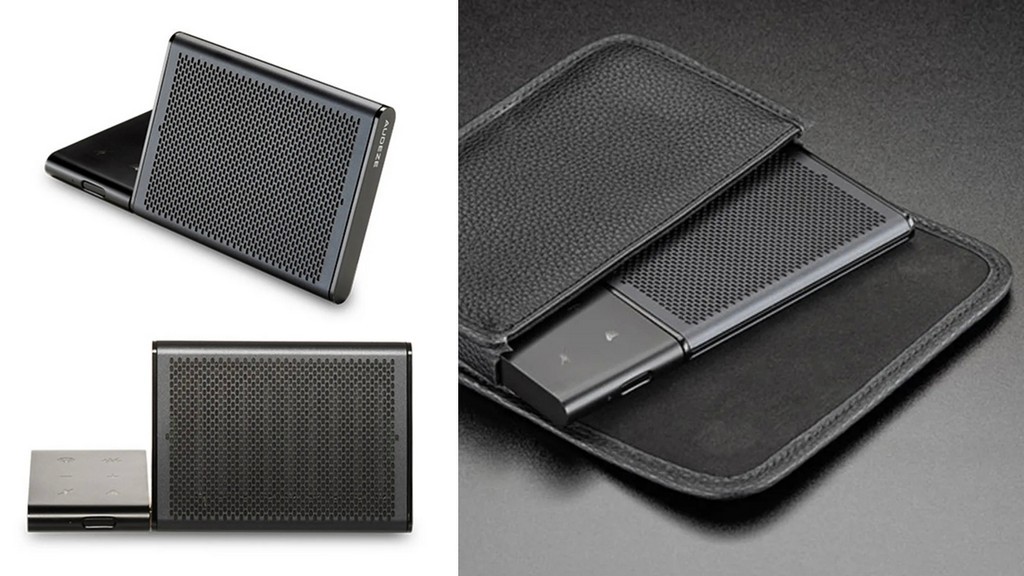
Audeze describes the Filter as roughly smartphone-sized and gives it a foldable design that allows the speaker to stand vertically. The vertical position is a sensible arrangement for a single-driver product used on a desk: it can direct sound more clearly towards seated listeners while occupying little work surface. Audeze also specifies an adjustable touch-control panel, although the supplied details do not list its individual controls or confirm whether call functions, volume and microphone modes are all accessible directly from the device.
The built-in 1,100mAh lithium-polymer battery is rated for up to 15 hours of normal listening. Battery-life figures vary significantly with output volume, connection type and how much processing is active, so this should be read as the manufacturer’s normal-use estimate rather than a fixed result. Nonetheless, the stated endurance is clearly aimed at a working day of occasional calls rather than brief, emergency use between charges.
For source connection, the Filter supports USB and Bluetooth 5.0, allowing it to work with a computer, phone or tablet. USB is likely to be the straightforward choice for a desk-based computer setup, avoiding wireless pairing and potentially preserving a more predictable connection during long meetings. Bluetooth is the more convenient route for a phone, tablet or a temporary meeting space. Audeze has not specified supported Bluetooth codecs, USB audio formats, operating-system compatibility or whether the Filter can be used while charging, so buyers with a particular software or workplace deployment requirement should verify those details before purchase.
What the Filter is—and is not—trying to be
The Filter should be understood as a specialised communications product rather than a compact alternative to a conventional Bluetooth music speaker. Its specified 300Hz lower frequency limit, beamforming system and neural-network noise processing all point towards voice communication as the priority. That focus could appeal to users who find that many portable speakerphones are adequate for casual calls but struggle to provide clear pickup in a busy home office or shared meeting area.
For hi-fi enthusiasts, the more interesting aspect is Audeze’s decision to apply established planar magnetic principles to a very different category. A large diaphragm, controlled magnetic drive and a stated emphasis on low distortion are credible engineering choices for vocal reproduction. But the supplied information does not include response curves, output measurements, microphone specifications, latency figures, codec support, price or availability. Those omissions mean the Filter’s final value and performance relative to dedicated conferencing hardware cannot yet be judged from specifications alone.
What is clear is the intended user: someone moving between a home desk, a backpack and a small huddle room, who wants one compact device for USB and Bluetooth calls. The foldable form, 15-hour quoted battery life, adjustable beamforming and broad claimed three-metre pickup make that use case more specific than a generic portable speaker. If Audeze’s noise suppression and planar driver perform as intended, the Filter could bring a distinctly audio-led approach to the everyday problem of being heard—and hearing others—more clearly.
“The Filter has been designed to be portable and has a foldable design that allows the speaker to be placed vertically. The compact form factor is roughly the size of a smartphone and comes with an adjustable touch control panel, but the Filter has more power than many speakerphones three times its size. With USB and Bluetooth 5.0, the Filter can connect to your computer, mobile phone or tablet,” said Sankar Thiagasamudram, CEO of Audeze. “This is a product designed for the hybrid workforce. You can use it at home for online meetings, but it's small enough to fit in your backpack for conference calls or huddle rooms at work.”