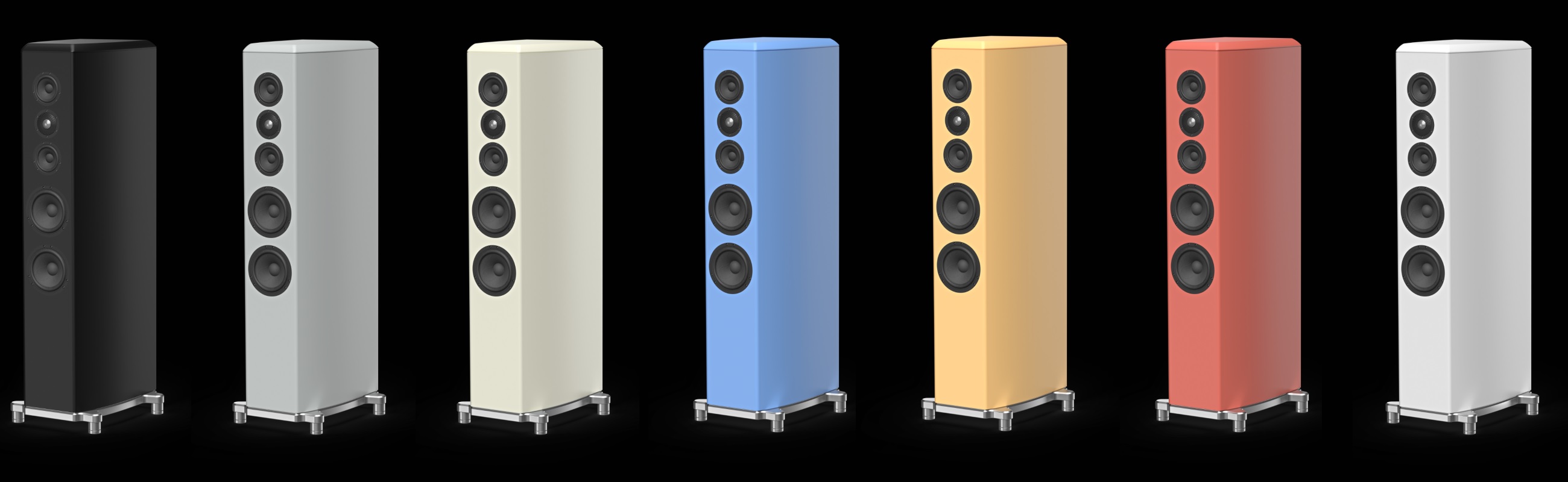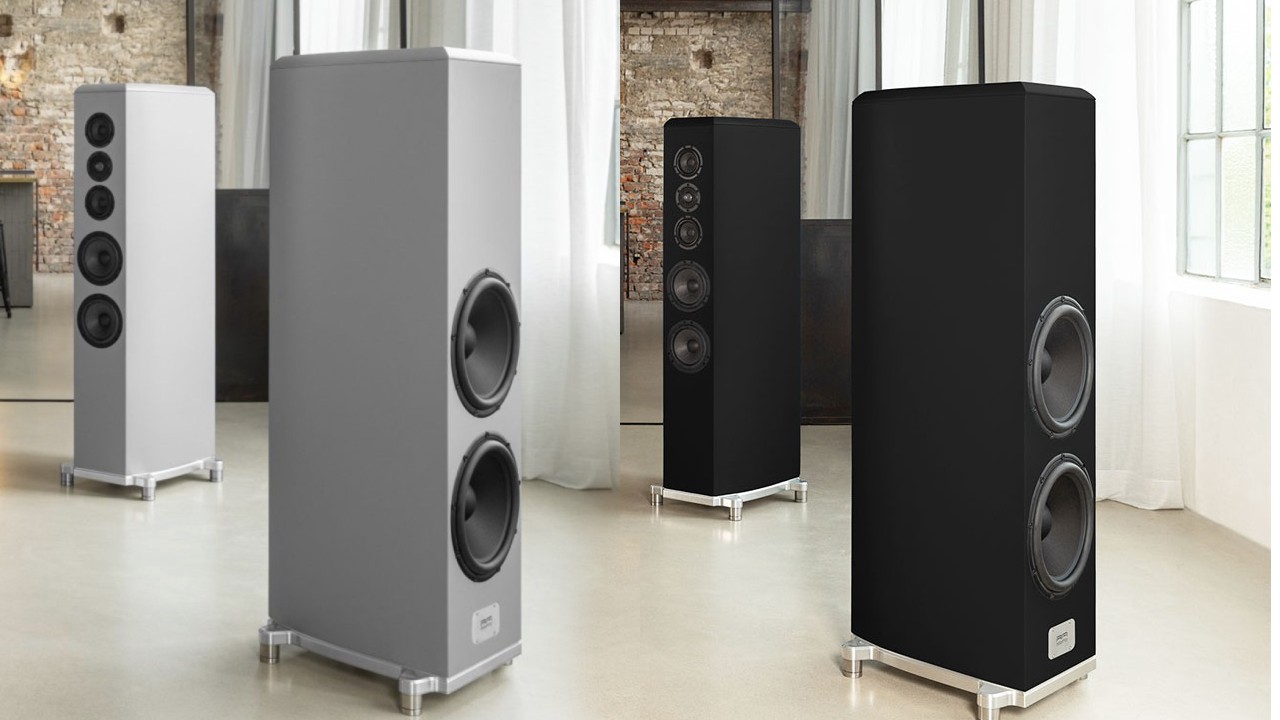
RA Acoustics has introduced the Magna R3, its new flagship loudspeaker and the largest statement of the young German manufacturer’s approach to cabinet construction and bass integration. It is a substantial floorstander in every sense: each speaker measures 1,389 x 340 x 480mm including its feet, weighs 120kg and combines a 4.5-way front-facing driver system with two 32cm woofers at the rear.
The key distinction is that those large rear woofers are DSP-controlled, giving the Magna R3 an active bass section while the main loudspeaker remains specified as a high-sensitivity design. RA Acoustics quotes 92dB sensitivity at 2.83V/1m and a frequency response of 20Hz to 40kHz within ±3dB. At approximately $70,000 per pair, it is positioned as an uncompromising, large-scale loudspeaker for systems and rooms able to accommodate its physical and financial scale.
A flagship from RA Acoustics
RA Acoustics was founded in 2021 by Robert Auer, who says he began designing and building loudspeakers at the age of 15 and later sold more than 100 units. The company now offers seven models across three ranges. Magna contains two floorstanding speakers with integrated active subwoofers; Parabola comprises three passive floorstanders; and Gravis consists of two active subwoofers.
That range structure is useful context for the Magna R3. Rather than treating bass as an afterthought or requiring a separate subwoofer from the outset, the Magna concept incorporates dedicated low-frequency drivers into the floorstanding enclosure. The R3 sits at the top of that family and applies the idea on a considerably more ambitious physical scale.
Hybrid active/passive loudspeakers can offer a practical division of labour. Deep bass requires the greatest cone excursion and, often, the greatest demand on an amplifier. A separately controlled bass system can be engineered around the woofers’ particular needs, while the owner’s main amplifier is principally responsible for the upper bass, midrange and treble section. Precisely how RA Acoustics divides those duties, and the power rating or connection arrangements of the active section, have not been specified in the launch information. Those are important details prospective owners should confirm with a dealer, particularly when planning source and amplifier connections.
Sealed cabinet, DSP-controlled rear woofers
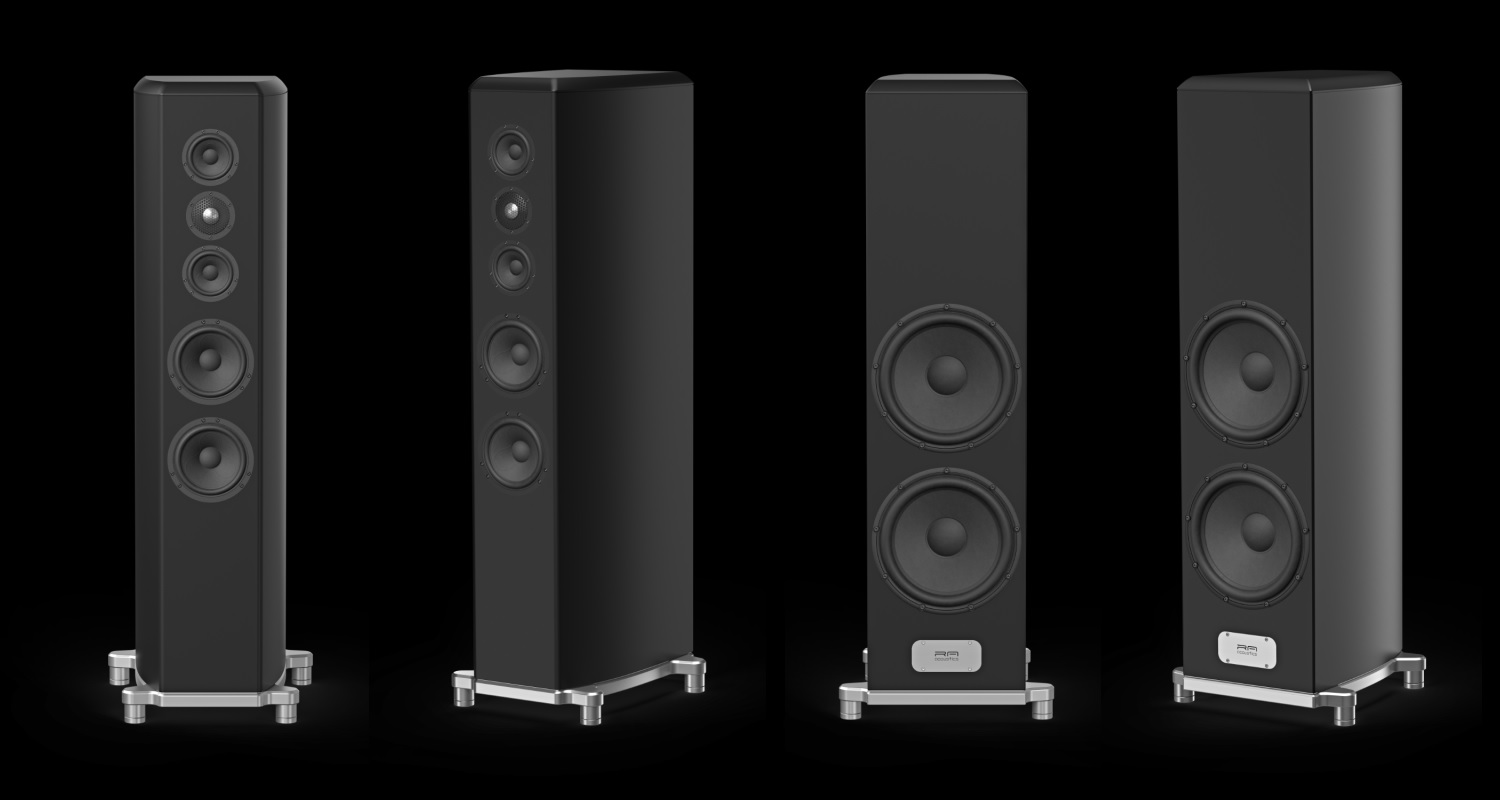
The Magna R3 uses a closed enclosure; there is no bass-reflex port. This is a meaningful design choice in a loudspeaker intended to reach as low as 20Hz. In conventional passive speakers, a port can increase output around its tuning frequency, but it also introduces the behaviour of the port and its internal air resonance into the system. A sealed cabinet instead uses the air trapped inside as a pneumatic spring acting on the bass driver.
Neither approach is automatically superior, but a sealed system is often valued for its more gradual low-frequency roll-off and for the control it can offer over woofer movement. In this case, the sealed alignment is partnered with DSP control of the two 32cm rear woofers. Digital signal processing can be used to shape the bass system’s response and protect the drivers within their intended operating range. It also gives the designer a means of pursuing deep extension from a closed cabinet without relying on a port. The published 20Hz lower limit is stated at ±3dB, which is a more useful tolerance than an unqualified headline frequency figure, although RA Acoustics has not supplied measurement conditions or in-room response data.
Two 32cm woofers provide a large total radiating area. That matters because moving more air at low frequencies can be achieved with less excursion than a smaller driver would require at the same output. Bass output, distortion and dynamic headroom are all influenced by the complete implementation—driver design, enclosure volume, amplification, DSP and limits built into the system—so the diameter alone does not reveal how loudly the Magna R3 will play. Nevertheless, the hardware indicates that low-frequency reproduction is central to this loudspeaker’s design rather than a supplementary feature.
The placement of the woofers at the rear also makes installation especially significant. Bass wavelengths are long, and room boundaries strongly affect what reaches the listening position. Positioning a large rear-radiating bass system close to the wall behind it will generally alter the bass balance compared with bringing it further into the room. A sealed, DSP-controlled solution may give the designer useful control over the speaker’s native response, but it cannot remove the acoustic effect of the room. Owners should therefore expect careful experimentation with distance from the front wall, spacing between speakers and listening position.
A 4.5-way front array with beryllium treble
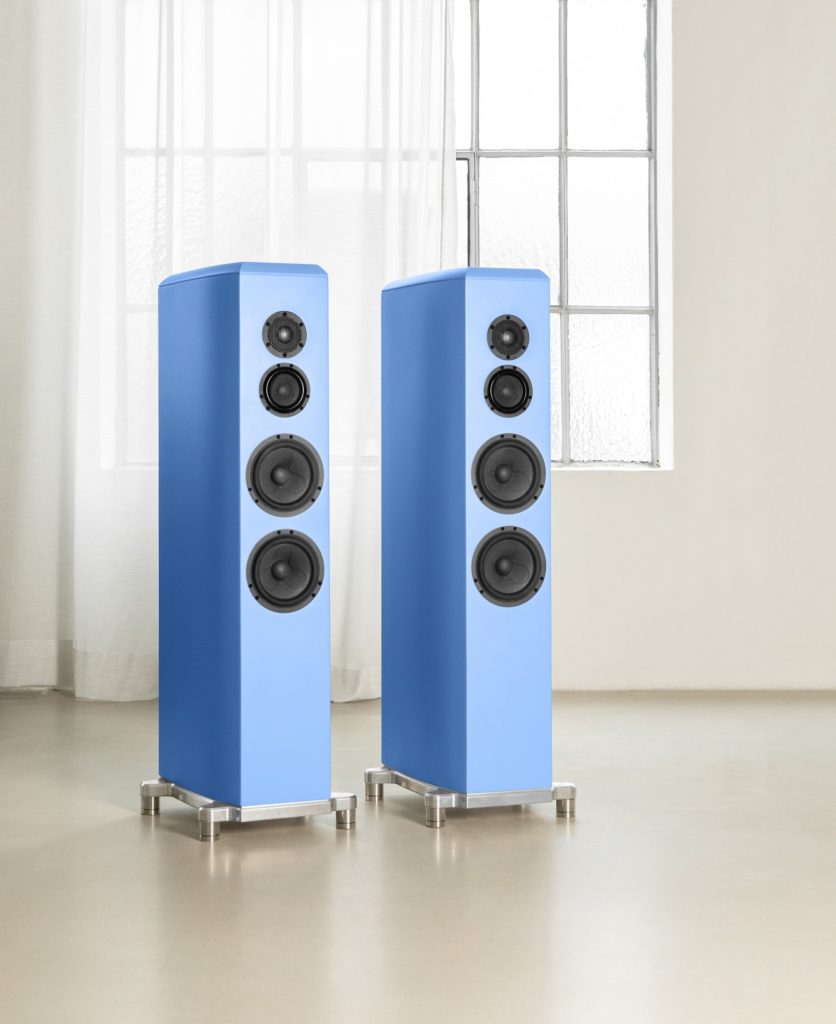
Five drivers are mounted on the Magna R3’s front baffle, including a beryllium tweeter. RA Acoustics describes the front system as a 4.5-way arrangement. In broad terms, multi-way loudspeakers allocate different frequency bands to dedicated drivers so that no individual unit is asked to cover an unnecessarily wide range. The “.5” designation generally indicates that one bass or lower-midrange driver operates over a narrower portion of the spectrum than the main multi-way system, reinforcing a particular region rather than acting as a completely separate full band. RA Acoustics has not published the driver complement beyond the tweeter, nor the crossover frequencies, so the exact implementation should not be assumed.
Beryllium is a material often selected for tweeter diaphragms because it combines low mass with high stiffness. In engineering terms, a stiff and light dome can push breakup behaviour beyond the intended audible operating band, allowing the crossover designer to pursue controlled high-frequency operation. The presence of a beryllium tweeter does not by itself establish the final sound of a loudspeaker: the motor system, waveguide or baffle environment, crossover and off-axis response are at least as consequential. But it is consistent with the R3’s stated 40kHz upper frequency limit and with its flagship positioning.
RA Acoustics specifies sensitivity at 92dB for 2.83V at one metre. This is relatively high by contemporary floorstander standards and suggests that the speaker’s main amplifier may not need extreme voltage swing to achieve realistic levels. Sensitivity is only one part of amplifier matching, however. The impedance curve, electrical phase angle and crossover design determine the current load an amplifier sees, and none of those figures has been provided. It would be premature to describe the Magna R3 as easy or difficult to drive without them. A prospective buyer should seek the manufacturer’s recommended amplification range and minimum impedance before choosing an amplifier.
Cabinet engineering: RA Acoustics’ “armoured wood”
RA Acoustics makes its cabinets in-house from what it calls “armoured wood”, a material produced under high pressure from natural wood and synthetic components. The company says this process creates panels and parts for very low-resonance enclosures.
Cabinet resonance is a fundamental issue in loudspeaker design. When a driver moves, its reaction force attempts to excite the enclosure as well as the air in front of it. If cabinet panels flex or store energy strongly at particular frequencies, they can add delayed vibration to the output. Designers address this through a combination of material choice, panel thickness, bracing, geometry, damping and mass. A dense, stiff composite-type panel can be one route to shifting or reducing problematic resonances, although material alone is not the whole story: how the cabinet is braced and damped internally remains crucial.
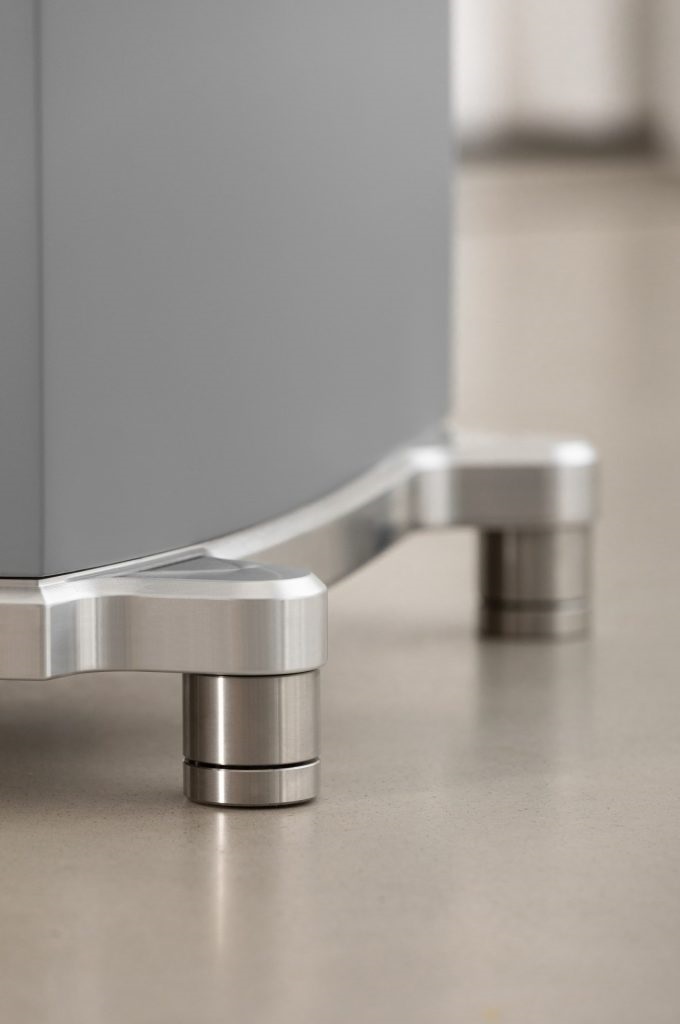
The Magna R3’s 120kg weight is therefore more than an attention-grabbing number. A massive enclosure can contribute to mechanical stability and reduce the degree to which the cabinet itself reacts to the driver’s motion. It also brings real ownership considerations. These are not speakers to move casually during a listening session, and installation should be planned before delivery. The stated dimensions include the feet, but RA Acoustics has not detailed the foot design, adjustment method or floor-protection options. Given the mass involved, owners with suspended timber floors or delicate surfaces should establish those practicalities in advance.
There is a second setup implication. A stable, carefully levelled speaker is valuable not only for preventing accidental movement; it gives the crossover, driver alignment and bass tuning the best chance of behaving as intended. The final position should be established methodically, in small increments, rather than by assuming that a large flagship will work optimally when pushed tightly into a room’s corners.
What the Magna R3 needs from a system
The Magna R3 is aimed at the kind of system where speaker placement, amplification and room acoustics are considered together. Its quoted 20Hz extension means it has the potential to energise room modes that smaller loudspeakers may not excite as strongly. That can be rewarding when the room and positioning are well sorted, delivering the scale and foundation that full-range music demands. It can also make untreated or problematic rooms more obvious.
The active bass architecture may reduce the burden on the external amplifier at the lowest frequencies, but it does not make matching irrelevant. The amplifier still needs to work convincingly with the front 4.5-way system, and the absence of published impedance data means buyers should avoid making assumptions based on the 92dB sensitivity figure alone. Auditioning with a suitably capable amplifier, preferably in a room of comparable size to the intended installation, remains the sensible route.
Connection flexibility is another point to clarify. The supplied information does not identify analogue or digital inputs, whether the DSP is user-adjustable, or whether any room-correction facilities are provided. These features vary widely among active-bass loudspeakers. Some designs are largely self-contained and accept a conventional speaker-level signal for the passive section, while others offer line-level bass inputs or configuration controls. The appropriate cabling and system layout will depend on RA Acoustics’ specific implementation.
Price and perspective
The RA Acoustics Magna R3 costs approximately $70,000 per pair. At that level, its appeal rests on a distinctive combination of elements: a very heavy sealed cabinet made from the company’s proprietary “armoured wood” material, a complex front-mounted 4.5-way array, a beryllium tweeter and dual DSP-controlled 32cm rear woofers.
On paper, the R3 is not attempting to be a compact, easily accommodated high-end floorstander. Its scale, mass and rear bass-driver arrangement demand a committed installation, while its hybrid architecture raises sensible questions about setup and connectivity that should be answered before purchase. For listeners seeking a genuinely full-range loudspeaker with integrated active bass rather than a conventional passive tower plus separate subwoofers, however, the Magna R3 presents a technically interesting alternative. The next questions are the ones not answered by the initial announcement: the precise crossover and active-bass implementation, amplifier compatibility, available adjustment and how the speaker behaves in real rooms.