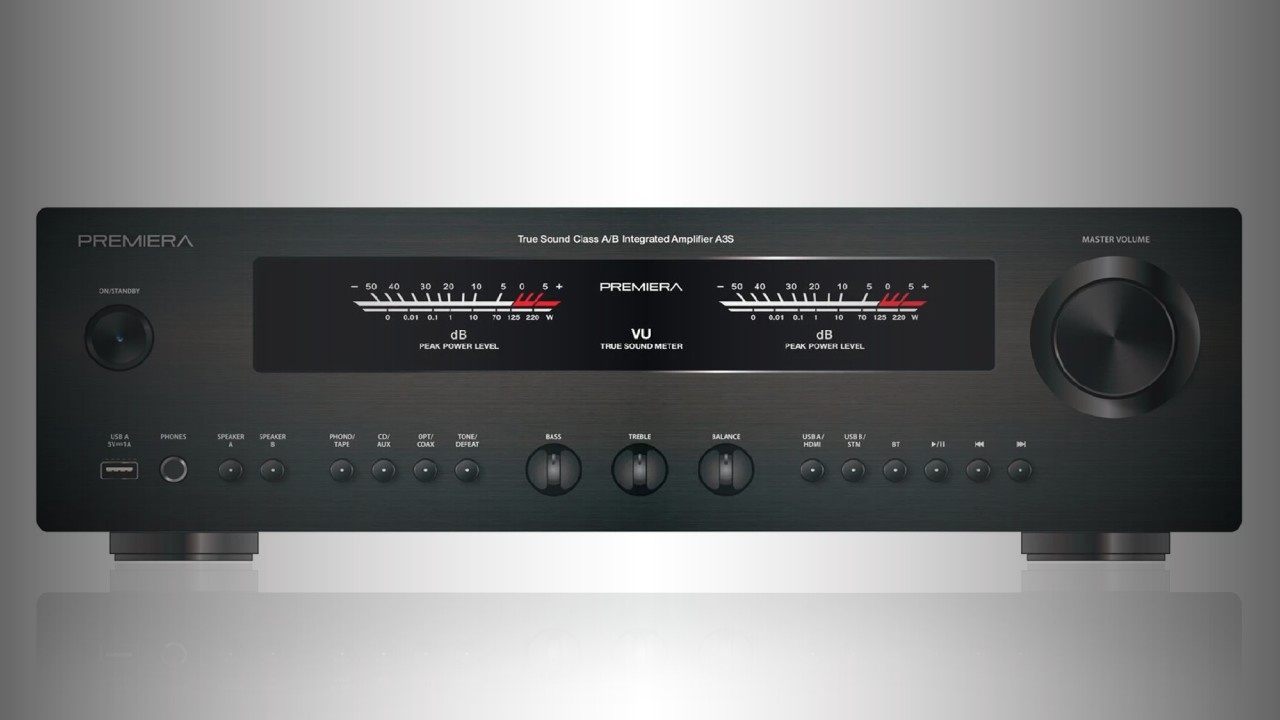
The Premiera A2 is an integrated amplifier that deliberately gives classic hi-fi facilities equal billing with a few thoroughly modern conveniences. Its large illuminated power meters, physical tone controls and switchable MM/MC phono stage place it firmly in the tradition of the all-purpose stereo amplifier, while HDMI ARC, Bluetooth 5.0 and USB playback acknowledge the way many systems now handle television and file-based music alongside conventional sources.
Rated at 2 x 55W into 8 Ohms and built around a Class AB power amplifier, the A2 sits in the accessible integrated-amplifier category rather than attempting to be an all-in-one streaming platform. That distinction matters: its digital provision is functional, but the connection count and phono flexibility show that analogue sources and system expansion are central to the proposition. Premiera is owned by Russian company JSC MMS; the products are designed in Moscow, with final manufacture undertaken by electronics producers in Korea, China and Taiwan.
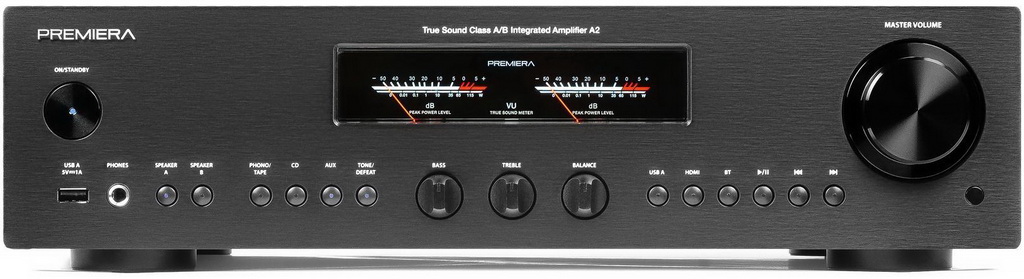
A classic integrated amplifier approach, updated for mixed-use systems
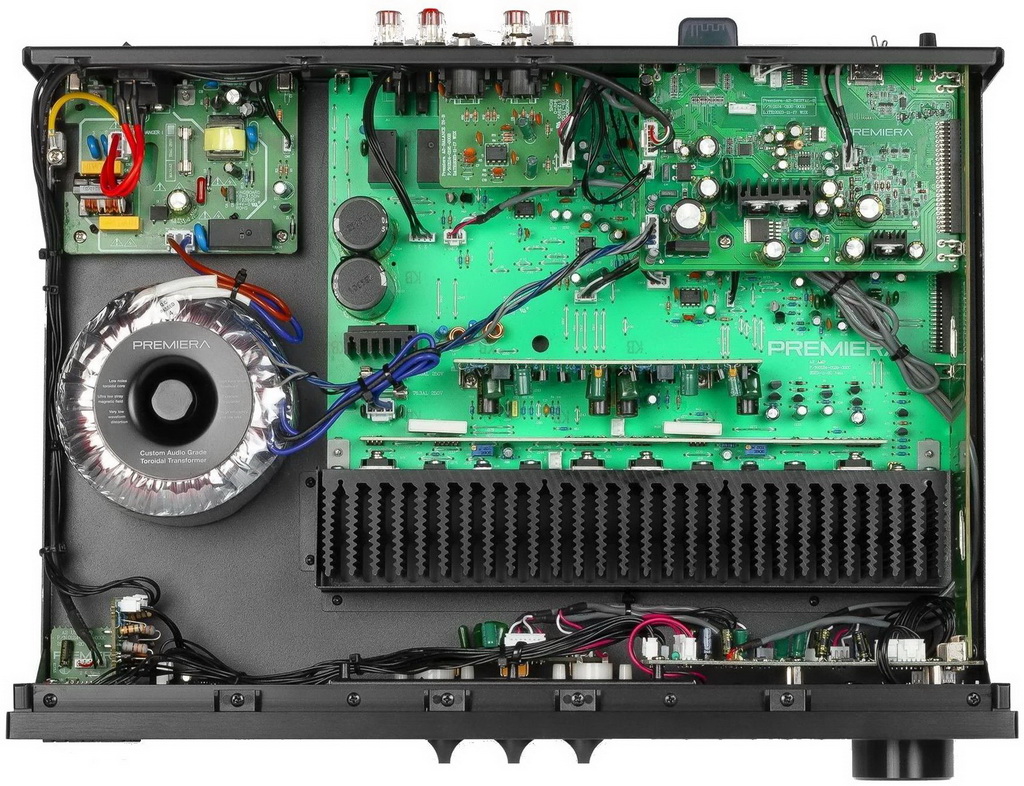
An integrated amplifier combines a preamplifier — which selects sources and controls volume — with the power amplifier that drives passive loudspeakers. The Premiera A2 follows this familiar architecture in Class AB. In broad terms, Class AB output stages are a long-established solution because they can offer low distortion and useful output current without the constant high power consumption associated with traditional pure Class A designs. The A2’s stated maximum consumption is 350VA, a figure that provides some context for the power supply and output-stage demands when the amplifier is working hard.
Its nominal output is 55W per channel into 8 Ohms. That is a meaningful, rather than extravagant, rating, and should be considered alongside the loudspeaker rather than in isolation. With sensibly sensitive speakers of a benign impedance, 55W can provide substantial volume in a typical room. Speakers with a particularly low sensitivity, difficult impedance curve or a very large listening room may call for more power and current reserve; Premiera does not state a 4 Ohm output figure in the supplied specifications, so that is an important detail for prospective owners to confirm where demanding loudspeakers are involved.
The quoted damping factor is greater than 200 at 8 Ohms. Damping factor describes the relationship between a loudspeaker’s nominal impedance and the amplifier’s output impedance. A higher figure can indicate tighter electrical control of driver motion, especially around bass resonances, although it is only one part of the amplifier/speaker relationship and should not be used as a standalone predictor of sound quality.
Premiera specifies a 20Hz–50kHz amplified frequency range within ±0.5dB, channel separation of 80dB and a signal-to-noise ratio of more than 100dB. The extended bandwidth is not a promise that one will hear to 50kHz, but it indicates that the amplifier is specified to remain closely level through and well beyond the conventional audible band. Channel separation refers to the degree to which left- and right-channel signals are kept apart; this supports stable stereo imaging when the rest of the system and recording permit it. Total harmonic distortion is quoted at below 0.07% at 2 x 45W into 8 Ohms across the amplified frequency band.
Illuminated meters and useful tone shaping
The A2’s most conspicuous feature is its pair of backlit pointer indicators. These display the maximum power being delivered to the load, according to Premiera. Their logarithmic scale is significant: it makes small signals easier to see, so the needles remain visually active at ordinary listening levels rather than moving only when the amplifier approaches high output. Meter illumination brightness can be changed from the remote control, a welcome practical provision for listeners who use the amplifier in a darkened room or want a less visually assertive front panel.
More consequential to day-to-day use are the bass and treble controls, facilities that have become less common on minimalist integrated amplifiers but remain useful in real rooms. The A2 offers ±10dB adjustment at 100Hz and 10kHz. A bass control centred at 100Hz affects the upper-bass and lower-midbass region: it can compensate modestly for a lean recording, speaker placement away from boundaries, or the subjective balance at low listening levels. The 10kHz treble control operates much higher up, principally influencing perceived sparkle, air and the energy of cymbals or sibilants rather than the core presence range.
These controls are deliberately broad tools, not substitutes for treating a major room-acoustics problem or correcting a poorly matched loudspeaker. A 10dB range is nevertheless substantial, so small adjustments are likely to be more appropriate than extreme settings. Crucially, the front-panel TONE DEFEAT button bypasses the tone-control circuit. That lets an owner compare the equalised and flat paths immediately, or retain the simplest signal route when tonal adjustment is unnecessary.
MM and MC phono support makes vinyl a serious use case
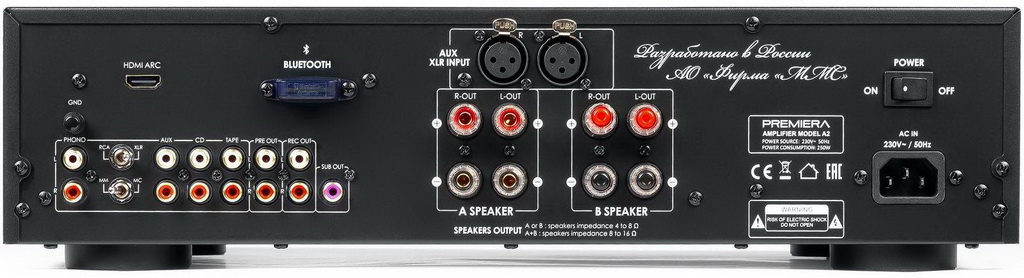
Vinyl replay is more than a token addition here. The built-in phono preamplifier can be switched between moving-magnet (MM) and moving-coil (MC) cartridge modes using a rear-panel toggle. A turntable cartridge generates a far smaller signal than a line-level source and also requires RIAA equalisation, so it cannot simply be connected to one of the ordinary RCA inputs. Including both modes makes the A2 compatible with the two principal cartridge families without automatically requiring an external phono stage.
Premiera quotes phono sensitivities of 5mV for MM and 0.5mV for MC. This tenfold difference reflects the lower output typically produced by moving-coil cartridges. The published numbers are helpful confirmation that the two modes have appropriately different gain requirements, though they do not specify cartridge loading, overload margin or gain in decibels. Those considering a very low-output MC cartridge should therefore check compatibility before purchase; 0.5mV is the stated nominal sensitivity, not a universal guarantee for every MC design.
The practical benefit is straightforward. An owner can begin with a conventional moving-magnet turntable setup, then potentially move to a moving-coil cartridge without first having to add a separate phono preamp. Conversely, enthusiasts who already own a specialist phono stage can feed it into one of the A2’s line inputs and use the amplifier purely for line-level control and power amplification.
Analogue connections, outputs and system expansion
The A2 has three RCA inputs, an XLR input and dedicated MM/MC phono input. One of its two line inputs can be switched between RCA and XLR connection, identified as AUX. Balanced XLR interconnection is principally valuable when both source and amplifier provide a genuinely balanced interface, and can be especially helpful in installations where long cable runs risk picking up electrical noise. It should not be assumed that an XLR connector alone guarantees a particular internal circuit topology, but the option gives owners of balanced DACs, CD players or preamplifier-equipped sources an additional connection route.
The stated nominal input sensitivities are 630mV for RCA and 1.23V for XLR, while maximum permissible input levels are 3.17V and 6.18V respectively. In practical terms, sensitivity describes how much source voltage is needed to reach the amplifier’s nominal operating level, while maximum permissible level indicates the voltage the input can accept before overload becomes a concern. The higher XLR figures are consistent with the higher signal voltages often used by balanced source equipment.
For recording or analogue archiving, the rear panel includes Tape In and Rec Out. A record output is useful because it provides a fixed-level feed to a recorder or another downstream device rather than following the volume control. The A2 also has a line-level preamplifier output. This can be used to feed an external power amplifier, offering a potential route to a more powerful amplifier stage later, though the exact operational relationship between the internal power amp and pre-out should be checked in the manual.
There is also a dedicated mono output for an active subwoofer. This is a worthwhile inclusion for systems where compact standmounts or slim floorstanders need assistance in the lowest octave, or where the room allows smoother low-frequency performance with carefully positioned bass reinforcement. The supplied details do not state whether a high-pass filter is applied to the main speaker outputs, so buyers should assume the main speakers may continue to receive a full-range signal unless Premiera confirms otherwise. As with most stereo-plus-sub systems, careful subwoofer crossover, level and placement adjustment will matter far more than simply adding more bass.
Digital inputs serve convenience rather than a complete streaming ecosystem
Where the Premiera A1 is presented as having a broader digital input provision, the A2 is more explicitly analogue-led. It does not list Ethernet, Wi-Fi or a network-streaming platform, so listeners wanting native access to services such as Qobuz, Tidal or internet radio will need to add a separate network streamer to an analogue or digital input elsewhere in their system. That is not necessarily a disadvantage: separating streamer and amplifier can make software upgrades or a future source change less disruptive.
The front USB Type-A port accepts music from a flash drive in MP3, MP4, WAV, AIFF and FLAC formats, at resolutions up to 24-bit/48kHz. This is a convenient local playback feature, but it should not be confused with a computer USB DAC input. Nor does the stated maximum support extend to higher-resolution PCM rates or DSD. File compatibility can also depend on the USB drive’s formatting and the files’ encoding, so a prospective owner should consult the manual for the supported file-system details.
HDMI ARC is arguably the A2’s most useful modern connection. ARC, or Audio Return Channel, allows a compatible television to send its audio back down an HDMI cable to the amplifier. This can simplify a two-channel TV-and-music installation: the television becomes a source selected at the amplifier, with sound reproduced by the main stereo speakers rather than the set’s small built-in drivers. Exact compatibility with a particular television’s HDMI settings and audio formats should be confirmed, but the presence of ARC makes the A2 a more natural centrepiece for a living-room system.
Bluetooth 5.0 adds quick wireless playback from a phone, tablet or computer. The supplied information does not identify supported Bluetooth codecs, so it would be unwise to assume aptX, LDAC or any other specific codec. Bluetooth remains useful for convenience and discovery, while a wired source or dedicated streamer is the more predictable choice for listeners building a system around critical playback.
Who the Premiera A2 is for
At 434 x 115 x 340mm and 7.2kg, the A2 is a conventional full-width component that should sit on a rigid, ventilated shelf rather than being enclosed tightly in furniture. Although the supplied specification does not detail heat output or ventilation requirements, any Class AB amplifier needs reasonable airflow around its chassis. Its full-size front panel, touch input buttons with LED indicators and supplied remote suggest a system intended to be operated directly as well as from the listening position.
The strongest case for the Premiera A2 is a listener who values a straightforward, speaker-based stereo system with vinyl at its centre, but also wants TV sound, Bluetooth and USB playback without populating the rack with numerous small boxes. The MM/MC phono stage, defeat-able tone controls, tape loop, pre-out and subwoofer output are particularly more flexible than the stripped-back input arrangements often found on contemporary minimalist amplifiers.
Its trade-off is equally clear. The available information points to a capable digital convenience section rather than comprehensive high-resolution DAC and network functionality, and there is no supplied price, 4 Ohm power rating, headphone specification, Bluetooth codec list or streaming support to assess. The A2 should therefore be judged as an analogue-first integrated amplifier with carefully chosen modern connections — not as a direct replacement for a network amplifier. For the right mixed vinyl, television and passive-speaker system, however, that balance may be precisely its appeal.
Premiera A2 specifications
- Power amplifier class: AB
- Inputs: 3 x RCA, XLR, Phono MM/MC, HDMI ARC, USB-A
- Outputs: Pre Out and Rec Out on RCA, Sub, Phones
- Wireless connection: Bluetooth 5.0
- Nominal sensitivity of RCA/XLR inputs: 630mV/1.23V
- Maximum permissible level at RCA/XLR inputs: 3.17/6.18V
- Sensitivity of the MM/MC phono preamplifier input: 5/0.5mV
- Tone control depth at 100Hz and 10kHz: ±10dB
- Nominal output power: 2 x 55W (at 8 Ohm)
- Damping factor: >200 (8 Ohm)
- Signal-to-noise ratio: more than 100dB
- Channel separation: 80dB
- Amplified frequency range: 20–50,000Hz (±0.5dB)
- THD in the amplified frequency band: <0.07% (2 x 45W, 8 Ohm)
- Power consumption: up to 350VA
- Dimensions: 434 x 115 x 340mm
- Weight: 7.2kg