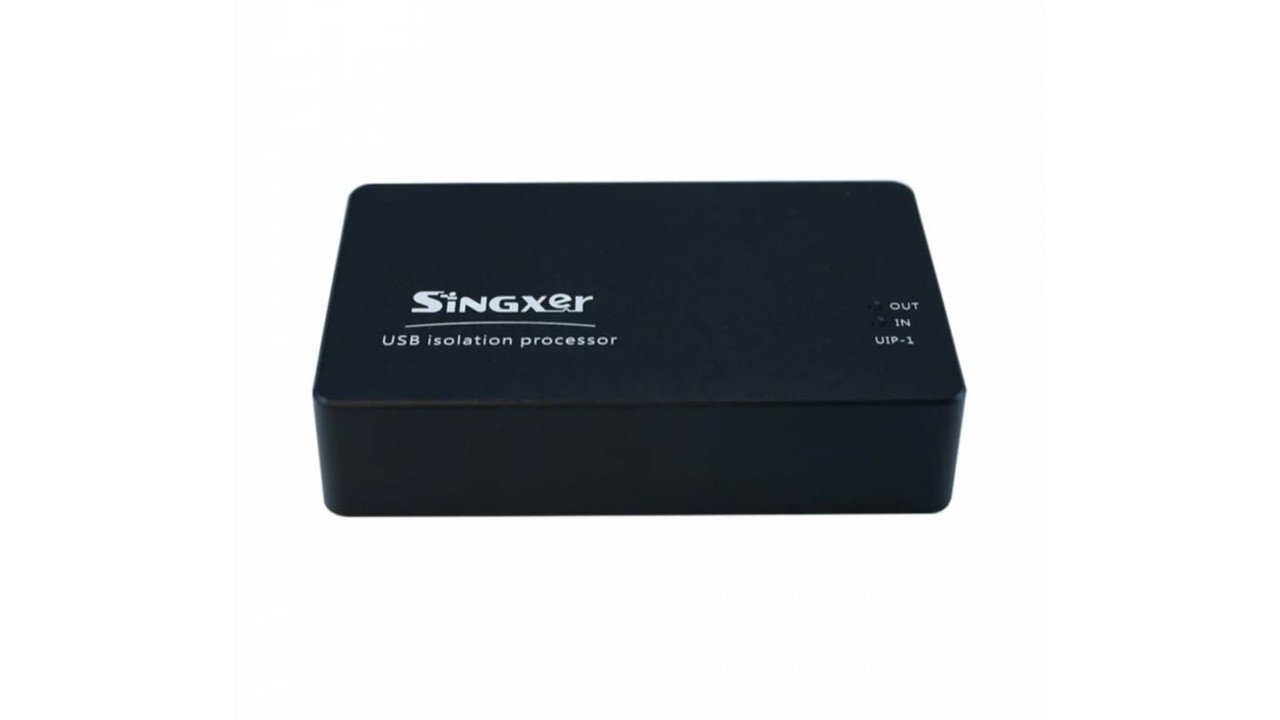
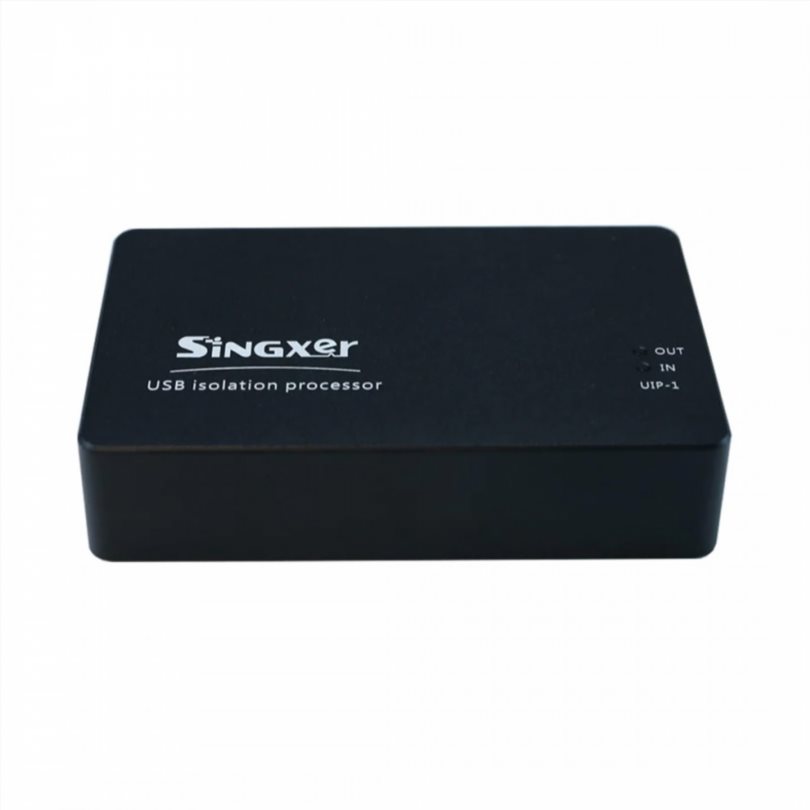
The Singxer UIP-1 Pro is a compact USB isolator intended for a familiar computer-audio problem: the electrical connection between a noisy digital host—such as a PC, music server or streamer—and a USB DAC. Rather than simply regenerating a USB connection, the UIP-1 Pro is specified to galvanically isolate the USB signal, power and ground circuits, creating a barrier between the two sides of the link.
That distinction matters in a hi-fi system. USB carries data, but its cable also normally connects the ground reference of a computer and DAC. Switching noise from processors, storage devices and their power supplies can therefore find a path towards the audio system. In some installations, ground potential differences can also contribute to audible hum or noise. An isolator is designed to break that direct electrical path while retaining USB communication.
The UIP-1 Pro supports USB 1.0, 1.1 and USB 2.0, with a stated maximum throughput of 480Mbps—the full high-speed USB 2.0 data rate. It uses a USB-B input and USB-A output, is described as plug-and-play without drivers, and measures 112 x 72 x 26mm.
What USB isolation does—and does not—address
Galvanic isolation uses an isolation barrier to transfer information without a direct conductive connection between input and output. The UIP-1 Pro’s quoted 2kVRMS isolation voltage indicates the electrical robustness of that barrier; it is not an audio-performance measurement, but a safety and engineering specification describing the level of voltage isolation it is designed to withstand.
In practical USB-audio terms, the aim is to reduce the transfer of common-mode electrical noise and to sever a possible ground-loop path. This can be especially relevant where a DAC is connected to a desktop computer, a network switch or another source with multiple mains-powered components. Whether an isolator produces an audible change depends heavily on the particular source, DAC, cables, grounding arrangement and the existing noise rejection of the DAC itself. It is best regarded as a system-integration tool, not an automatic upgrade for every USB connection.
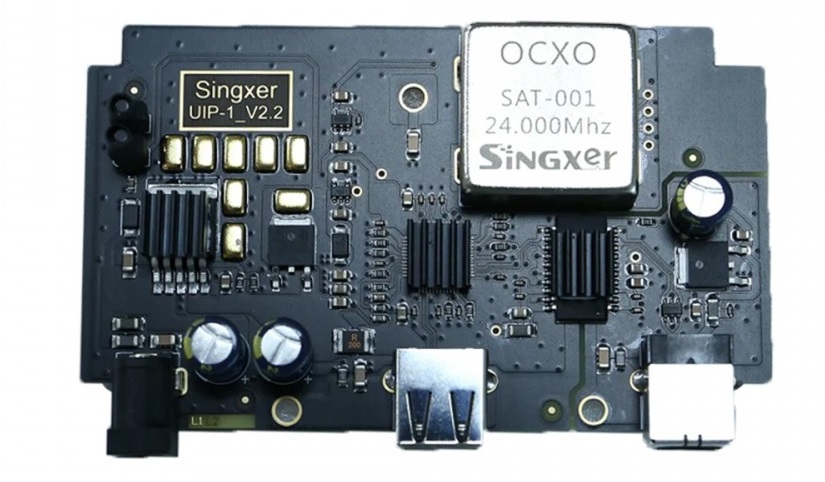
Singxer says the UIP-1 Pro isolates the USB signal as well as USB power and ground, then converts the isolated signal in its USB controller. The company also associates this process with reduced jitter. That needs careful interpretation: modern asynchronous USB DACs ordinarily use their own local clocking to set conversion timing, so a USB isolator should not be assumed to improve every DAC’s timing performance. Its more direct purpose is electrical separation and cleaner power/ground conditions at the downstream USB device.
Importantly, isolation is not the same thing as filtering every form of interference. Noise can still enter an audio system by other routes, including analogue interconnects, mains supplies, Ethernet connections and radiated electromagnetic interference. Diagnosis remains useful: if a system has no ground noise, no dropouts and a well-engineered DAC, an isolator may be unnecessary. Conversely, it can be a sensible targeted solution when a USB-connected computer is suspected of introducing noise.
USB 2.0 high-speed support and external power
A key point in the UIP-1 Pro specification is its 480Mbps maximum throughput. Many earlier USB isolators were limited to USB full-speed operation, which can restrict compatibility with some high-resolution USB audio implementations. High-speed USB 2.0 capability gives this model a broader potential role between a host and a contemporary DAC, although users should still check their DAC’s USB implementation and required audio modes before buying. The published specification confirms USB standards and transfer rate, but does not list supported PCM or DSD sample rates, so those should not be assumed from the isolator’s bandwidth figure alone.
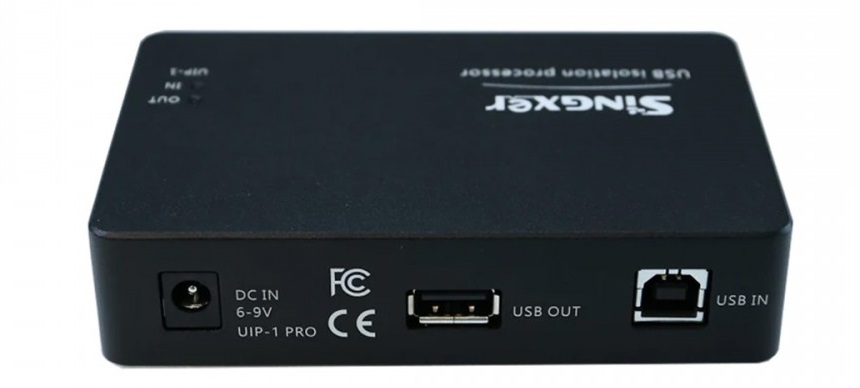
The input is a USB-B 2.0 port operating at 5V, while the isolated output is a USB-A 2.0 connection with a maximum output current of 1A. This means the unit is physically arranged to sit in the USB path between source and downstream device; the DAC-side cable must be appropriate for the USB-A output and the input on the DAC. For many DACs that means a USB-A-to-USB-B cable, though the correct cable ultimately depends on the DAC’s socket.
The output’s stated 1A current capability is significant because USB-powered peripherals draw power from the same interface that carries data. Singxer specifies output noise of 20µV, a low figure for the isolated USB supply. In principle, a quieter downstream 5V rail may be useful where a connected device relies on USB bus power. However, owners should not treat 1A as a guarantee of compatibility with every USB-powered product: start-up current, cable losses and a device’s own power requirements can all matter. A self-powered DAC may use the USB connection principally for data, while a bus-powered DAC or USB interface has a more direct dependence on the output supply.
The UIP-1 Pro itself requires external DC power through a 5.5/2.1mm barrel connector. It accepts 6V to 9V DC, with 7.5V recommended by Singxer. The draft specification does not state whether a power supply is included, nor does it specify polarity, connector depth or the required current rating. Those are details to verify with the retailer or manufacturer before installation. As with any externally powered digital accessory, use a suitable regulated supply meeting the manufacturer’s requirements rather than substituting an unspecified adaptor.
Installation, compatibility and protection
Physically, installation should be straightforward: connect the source to the UIP-1 Pro’s USB-B input, power the isolator from the specified DC supply, then connect its USB-A output to the DAC or other USB device. The plug-and-play claim means no separate drivers are required for the isolator itself. The host computer may still require the normal driver for the connected DAC, particularly where that DAC uses a manufacturer-specific USB audio driver.
Careful placement is worthwhile. At 112 x 72 x 26mm and 0.2kg net weight, the unit is small enough for a desktop or equipment rack, but should not be left hanging from USB sockets under cable tension. Keep the DC lead and USB cables tidy, avoid placing the unit immediately beside large mains transformers or switching power bricks, and use sound, correctly terminated USB cables. These are basic measures, yet they help minimise mechanical stress and avoid introducing other sources of interference around a digital front end.
The UIP-1 Pro is also specified with ESD protection up to 15,000V IEC for air discharge. Electrostatic discharge protection is valuable on a USB accessory that may be handled frequently, particularly in dry environments, because a static discharge can otherwise damage interface circuitry. It should not be confused with a guarantee against every electrical fault or an invitation to hot-plug equipment carelessly, but it is a sensible protective feature in a device positioned between expensive source and DAC hardware.
There are a few practical limitations inherent to the format. The unit provides one USB input and one USB output, so it is not a USB hub and cannot add extra ports. Its USB-A output is also oriented towards a conventional DAC connection rather than providing the increasingly common USB-C output. And while 480Mbps is USB 2.0 high speed, it is not USB 3.x; that is not normally a concern for USB audio, but it defines the product’s intended purpose.
Who the Singxer UIP-1 Pro is for
The Singxer UIP-1 Pro makes most sense for enthusiasts using a computer, server or streamer into a USB DAC and wanting to investigate a suspected ground or electrical-noise issue without changing the core components. Its combination of high-speed USB 2.0 support, separate DC power input, 1A isolated output and 2kVRMS isolation makes it more than a simple USB adaptor: it is intended to establish a properly separated USB link while maintaining the bandwidth expected by many current DACs.
It is not, however, a substitute for good system fundamentals. A DAC with robust USB input design, sensible cable routing, properly grounded equipment and a clean source remains the foundation. Nor do the published specifications alone establish a particular sonic outcome. The most persuasive reason to add an isolator is a specific system need—noise, hum, instability or a desire to isolate a bus-powered USB device—followed by a compatibility check covering the DAC, cable arrangement and external power supply.
For systems where USB is the main digital connection and electrical separation is desirable, the UIP-1 Pro’s specification is well focused: USB 1.0/1.1/2.0 support, 480Mbps maximum throughput, an isolated 1A output and a compact enclosure. Buyers should confirm the supplied accessories, DC-power details and compatibility with their intended DAC before committing.
Singxer UIP-1 Pro specifications
- Product type: USB isolator
- Input: 1 x USB-B 2.0
- Output: 1 x USB-A 2.0
- Supported USB standards: USB 1.0 / 1.1 / 2.0
- Maximum throughput: 480Mbps
- Maximum output current: 1A
- Isolation voltage: 2kVRMS
- Output noise: 20µV
- Operation: Plug and play
- External power input: 5.5/2.1mm DC jack; 6V to 9V DC accepted, 7.5V recommended
- Dimensions: 112 x 72 x 26mm
- Finish: Black
- Net weight: 0.2kg
- Gross weight: 0.45kg