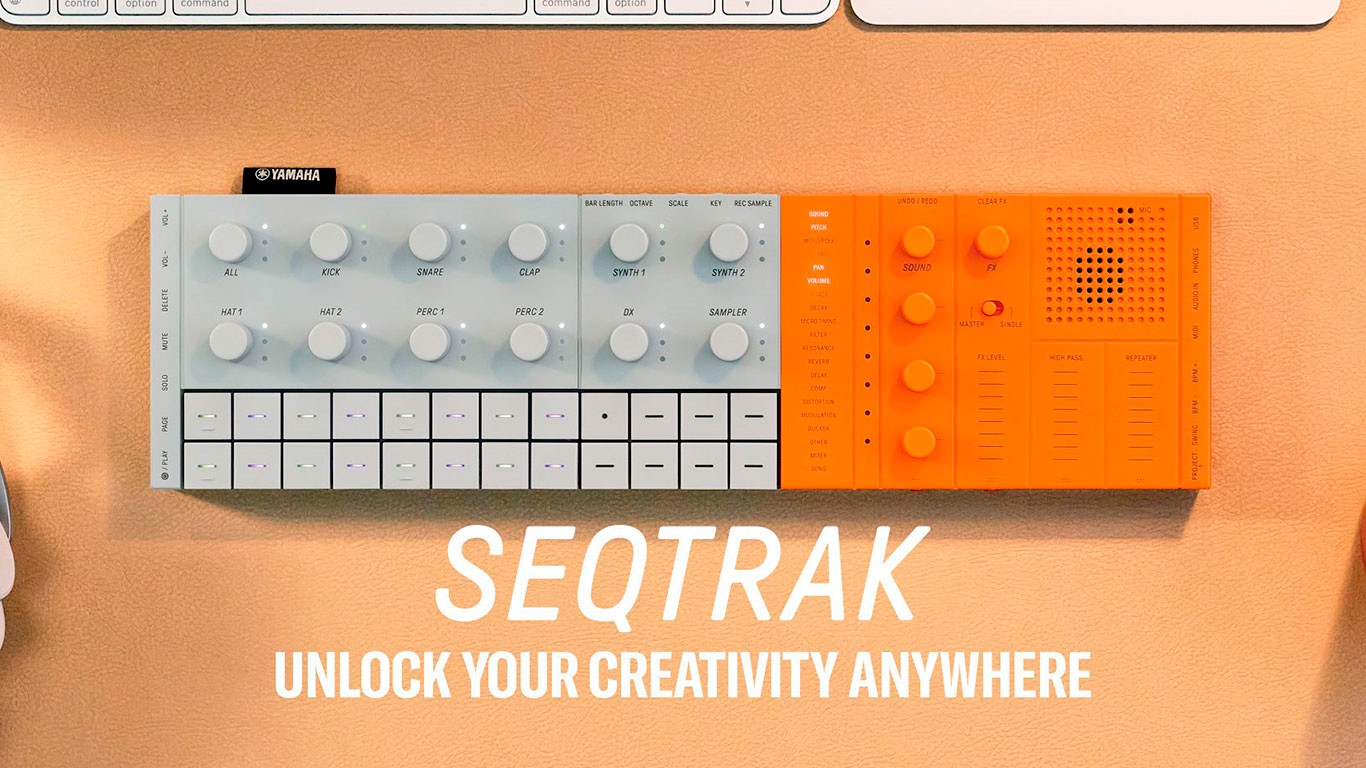
Yamaha’s SEQTRAK is a compact, battery-powered groovebox intended to cover the core stages of electronic music creation without requiring a computer: beat building, synthesis, sampling, sequencing and basic mix processing. Announced around the January 2024 NAMM Show in Anaheim, California, the $599 instrument represents an unusually broad attempt to combine Yamaha’s established FM heritage with sample-based production and modern wireless control in a small, self-contained unit.
Its most important distinction is that it is not simply a miniature synthesizer or a pad-based drum machine. SEQTRAK is conceived as a dawless workstation: a device on which patterns and complete ideas can be constructed, arranged and performed independently of a desktop DAW. That does not mean it excludes a computer or phone. Yamaha has made its companion app a central part of the proposition, particularly for detailed editing, while USB, MIDI and wireless connectivity allow the groovebox to sit within a larger production setup.
The resulting approach will appeal most to producers who want a portable sketchpad with more sound-generation variety than a conventional sample-only groovebox. It also makes some clear ergonomic compromises. SEQTRAK’s compact control surface and lack of a dedicated monitoring output mean users should understand how they intend to listen, edit and connect it before treating it as the hub of a studio.
A compact workstation, rather than a single-purpose instrument
Yamaha positions SEQTRAK as drawing on the “DNA” of its DX and AWM2 instruments. In practical terms, this refers to two very different but complementary methods of producing sound. DX is Yamaha shorthand for frequency-modulation synthesis, the family of instruments that made the original DX series famous. AWM2, meanwhile, is Yamaha’s sample-based synthesis platform, widely used across its keyboards. Bringing both into one portable device gives SEQTRAK a potentially wider palette than a groovebox based solely around virtual analogue synthesis or playback samples.
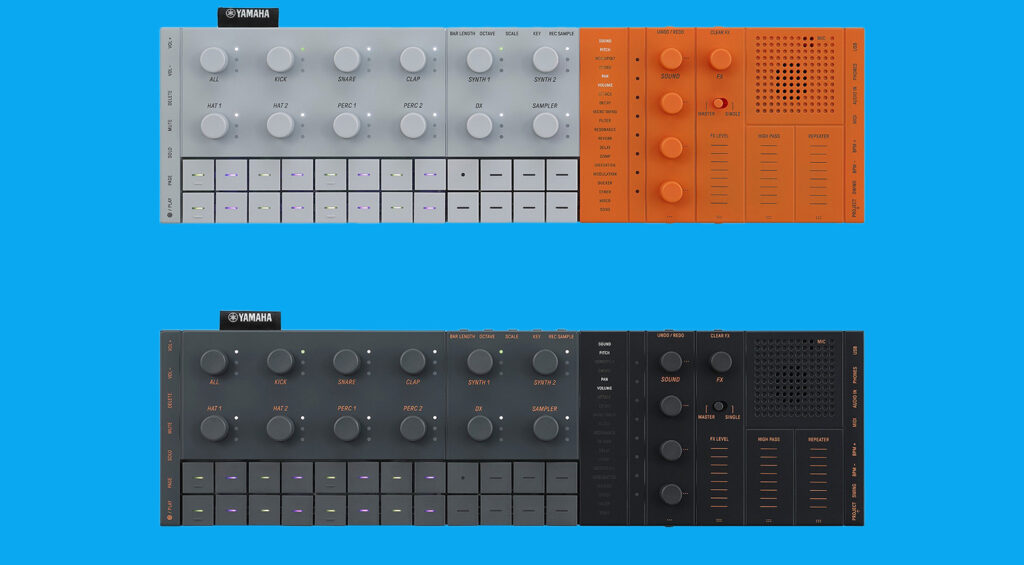
The unit is available in all-black and grey-orange finishes. Its horizontal form factor, compact keys and dense array of controls place it in the contemporary portable-instrument category, visually recalling products such as Korg’s SQ-64 and Teenage Engineering’s OP-1. However, its feature set is its own: drum voices, multiple synth engines, a sampler, effects and a step sequencer are all integrated.
Battery operation matters here. A portable groovebox is most useful when it can be picked up away from a desk—on a journey, in a rehearsal room or on a sofa—without needing to assemble a laptop, audio interface and MIDI controller. The trade-off is that a small device necessarily offers less immediate space for dedicated controls than a larger production workstation. Yamaha’s answer is a split workflow: the physical panel handles performance-oriented adjustments, while the SEQTRAK app exposes deeper parameters and visual feedback.
Seven drum parts and a library of more than 2,000 sounds
The rhythm section is sample-based and provides seven dedicated sound slots: kick, snare, claps, open hi-hat, closed hi-hat and two percussion parts. This is a purposeful allocation for electronic production. It reserves the most frequently programmed drum functions while retaining two flexible lanes for toms, shakers, rimshots, found sounds or more unusual percussive elements.
A fixed set of drum lanes can be more productive than an entirely open-ended arrangement when building patterns quickly. It establishes a familiar drum-machine logic: the kick and snare define the pulse, hats establish subdivision and movement, while claps and percussion provide accents and character. The limitation, relative to a multitrack DAW, is that the part allocation is not described as infinitely expandable. Producers working with densely layered kits will therefore want to plan how sounds are grouped, resample combinations where appropriate, or complete additional layering elsewhere.
Yamaha says the onboard library contains more than 2,000 sounds, and users can upload their own material to make custom kits. That capability is fundamental to keeping a sample-based drum engine useful over time. Factory sounds offer immediate access to programmed rhythms, but imported samples let a user build a personal library of one-shots, field recordings and processed percussion. The value is not just novelty: using a consistent set of personally selected samples can make patterns feel more coherent across a project.
Four synthesis engines: FM, AWM2 and DX-derived sound design
SEQTRAK’s synthesis section is one of its more ambitious aspects. Yamaha specifies four engines: a four-operator FM engine, two AWM2 engines with 128-note polyphony, and a DX engine. It is worth separating the terminology, because FM and DX are related but not interchangeable descriptions.
Frequency modulation generates complex spectra by using one oscillator to modulate another. In a four-operator architecture, four sound-generating blocks can be configured in different relationships, generally allowing sounds that range from glassy electric-piano tones and metallic percussion to sharp basses, bells and evolving digital textures. FM’s appeal lies in its harmonic complexity and its responsiveness to programming changes; a relatively small adjustment to modulation depth or envelope behaviour can substantially alter the tone.
Yamaha says the dedicated DX engine sounds identical to its full-size DX-series synthesizers, while the separate FM engine is inspired by other Yamaha FM instruments. That is a significant manufacturer claim, but the supplied information does not specify the exact DX implementation, patch compatibility or parameter set. Prospective owners interested specifically in recreating existing DX programming should therefore confirm those details rather than assuming that every historical DX workflow is duplicated.
The two AWM2 engines bring sample-based synthesis into the melodic side of the instrument. Yamaha quotes 128-voice polyphony for these engines. Polyphony describes how many notes can sound simultaneously before the instrument must prioritise or “steal” an existing voice. A high figure is useful for sustained chords, layered arrangements and long release tails, though real-world voice use can depend on the exact patch structure and effects. The important point is that AWM2 offers a different kind of sound source from FM: rather than deriving timbre through modulation, it starts with recorded waveform material and shapes it through synthesis controls.
Across the instrument, the physical control section provides access to pitch, level, stereo position, amplitude-envelope behaviour and filters. Pitch and level are self-explanatory but essential for making parts coexist; pan places an element within the stereo field, while filter and envelope adjustment determine much of a sound’s perceived attack, brightness and decay. The AD envelope—attack and decay—offers a concise way to control whether an event hits immediately or fades in, and whether it cuts off sharply or rings out.
For deeper patch creation, Yamaha directs users to the SEQTRAK app. This is potentially a sensible compromise in a compact machine. Fine editing of synthesis parameters benefits from a display and a more complete visual representation of values, whereas hands-on controls are more useful for gestures made while composing or performing.
Sampling, resampling and computer integration
SEQTRAK’s sampler records at 44.1kHz and 16-bit resolution. Those figures match CD-quality digital audio: 44.1kHz is the sampling frequency, while 16-bit defines the available amplitude resolution. In use, that format is sufficient for drum hits, vocal fragments, found sound and musical phrases, and it provides a straightforward, widely compatible basis for sample exchange.
Recording can be made with SEQTRAK’s built-in microphone or from connected sound sources. The built-in mic supports spontaneous capture—claps, environmental textures or quick spoken ideas—without external hardware. A connected source is likely to be the better route where cleaner, more controlled recordings are required, since microphone placement, room noise and source level have a large influence on the result.
The instrument can also receive audio over USB. When attached to a computer, Yamaha says SEQTRAK is recognised as an audio interface, which should make it easier to move material from computer-based work into the device without relying solely on analogue recording. It can additionally resample files already stored in its memory. Resampling is a particularly useful groovebox technique: a producer can turn a processed sound, layered part or effect-heavy phrase into a new sample, then manipulate that new audio as a single object. It is both a practical way to conserve arrangement resources and a creative route to more distinctive textures.
Effects and a 128-step sequencer
The included effects comprise delay, reverb, distortion, compression and a set of modulators. Yamaha says processing may be applied either to individual sounds or to the master channel. This distinction has direct consequences for a mix. Per-part processing is useful when, for example, a snare needs a short reverb but the kick should remain dry and direct. Master processing affects the complete output, making it more appropriate for gently binding a pattern together, adding overall ambience or applying final tonal character.
Delay creates repeats; reverb simulates a sense of acoustic space; distortion adds harmonic density; and compression controls dynamic range. Used carefully, these are foundational production tools rather than decorative extras. Modulation effects can introduce movement through changes in pitch, time or spectral character. Their effectiveness depends heavily on parameter control and gain staging, so the availability of more detailed editing in the app is relevant rather than incidental.
The 128-step sequencer records both sound events and note data, with monophonic, polyphonic and chord modes. A 128-step capacity gives enough room for patterns beyond the most basic one- or two-bar loops, depending on the selected resolution and tempo. Monophonic sequencing is appropriate for basslines and lead lines in which one note sounds at a time. Polyphonic operation permits overlapping notes, while chord mode makes it easier to enter harmonic material from the compact key layout.
Some of SEQTRAK’s body controls act as a chromatic keyboard while sequencing. The instrument also supports scales and modes, and includes an arpeggiator with its own settings. Scale assistance can be especially useful on a small interface: it reduces the chance of accidental out-of-key notes and lets a producer concentrate on rhythm, voicing and pattern variation. It should be seen as a compositional aid rather than a replacement for harmonic choice; the musical result still depends on the notes, timing and sound selection supplied by the user.
Connectivity, monitoring and app-led editing
SEQTRAK provides Bluetooth MIDI for communication with its companion app, plus Wi-Fi, MIDI In/Out, USB-C, an AUX connection and a headphone output. Yamaha lists Windows, macOS, iOS and Android support for the SEQTRAK app. Besides providing deeper effect and synthesis control, the app visualises the signal and displays edits more clearly than the compact hardware panel can.
MIDI In/Out is important for users who want SEQTRAK to be part of a hardware system. MIDI is control data rather than audio: it can carry note, timing and parameter messages between sequencers, keyboards, drum machines and other compatible equipment. That makes it possible to synchronise SEQTRAK with external devices or use it to control them, subject to the specific implementation and configuration.
There is no separate dedicated output for monitor speakers. Yamaha’s stated expectation is that users will work through headphones or the built-in speaker. For private composing and travel, that is entirely logical. For studio integration, however, it is an important consideration: owners planning to connect the groovebox permanently to active monitors, a mixer or an audio interface should check the intended routing and connector requirements. The supplied details identify an AUX connection and headphone output but do not set out a dedicated balanced monitor-output specification.
Who SEQTRAK makes sense for
SEQTRAK is best understood as a portable composition and performance instrument with unusually varied sound sources. The combination of a seven-part sample-based drum machine, user sample import, sampling, resampling, FM, DX-derived synthesis and AWM2 engines gives it more breadth than a device built around one synthesis method. Its battery power and integrated speaker reinforce the idea of making music wherever an idea occurs, rather than only in a fixed studio.
Its trade-offs are equally clear from the design. The compact panel will not offer the one-control-per-function immediacy of larger hardware, and the companion app is likely to be the more practical place for detailed sound design. Likewise, the absence of a separate monitor output means it is not presented as a conventional studio desktop centrepiece. But for producers looking for a self-contained, laptop-optional way to build patterns, capture samples and explore Yamaha-style digital synthesis, the $599 SEQTRAK has a focused and compelling feature set.
Yamaha scheduled SEQTRAK sales to begin in February 2024, following its NAMM 2024 presentation. Further product information is available on Yamaha’s official SEQTRAK page.
Watch Yamaha’s SEQTRAK video · See a further SEQTRAK demonstration · Watch another Yamaha SEQTRAK video