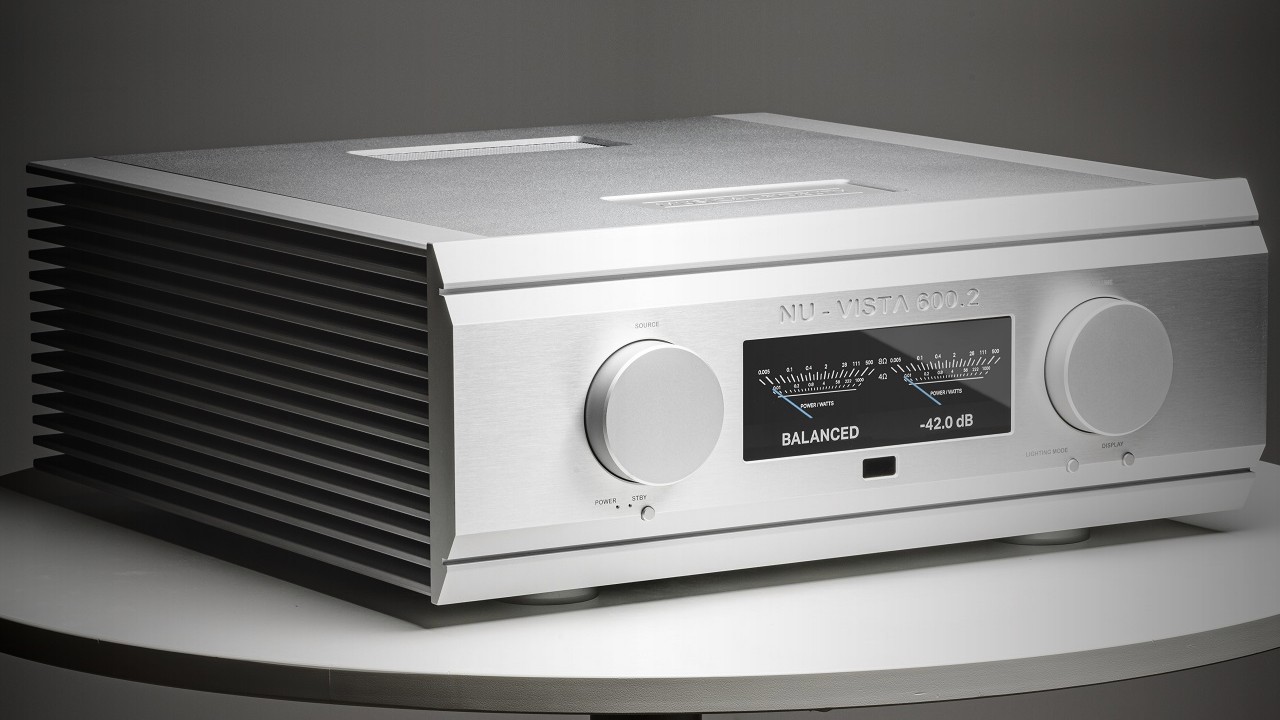
Musical Fidelity describes the Nu-Vista 600.2 as the successor to its Nu-Vista 600, but the company is positioning this as a substantially deeper revision than the move from the Nu-Vista 800 to the 800.2 reissue. On the evidence of the published design changes, that distinction matters: the new integrated amplifier receives a revised internal layout, relay input switching, a fully dual-mono preamp/input/NuVistor arrangement, redesigned amplifier stages and a version of the firm’s Titan power-supply concept.
It remains an uncompromisingly analogue integrated amplifier. There is no onboard DAC, network streamer, Bluetooth receiver or phono stage listed in the supplied specification. Instead, the Nu-Vista 600.2 is intended as the central analogue amplification component in a high-end separates system, with conventional line inputs and balanced connectivity for sources such as Musical Fidelity’s Nu-Vista Vinyl phono stage and Nu-Vista DAC.
Its quoted output is 160 watts per channel into 8 ohms, rising to 300W into 4 ohms, with peaks of 500W into 2 ohms. Those figures alone do not tell us how an amplifier will sound, but they do indicate a design intended to remain capable when a loudspeaker’s impedance falls well below its nominal rating. The accompanying power-supply work is therefore at least as important as the headline wattage.
A genuinely revised Nu-Vista platform
The defining element of the Nu-Vista range is its use of NuVistor valves. These are very small, metal-and-ceramic thermionic valves originally developed for applications where conventional glass valves were impractical. Musical Fidelity has long used them in hybrid designs, pairing the valve gain or buffer stage with solid-state circuitry that can deliver the substantial current required by loudspeakers.
In the Nu-Vista 600.2, the 6S51N NuVistors are used in a discrete Class A amplifier buffer on a newly designed top PCB layer. A buffer stage is not simply an ornamental addition to a circuit: in broad terms, it is used to isolate one part of the amplifier from the next, allowing the preceding gain circuit to work into a more favourable load while providing a low-impedance drive to what follows. Operating such a stage in Class A means its active devices remain conducting throughout the audio waveform, avoiding the switching point associated with Class B and many Class AB stages. The trade-off is greater heat and inefficiency in that section, so this is an approach usually reserved for designs where linear operation is prioritised.
Musical Fidelity says that the output-stage, preamplifier and NuVistor-stage topologies have all been significantly revised. It has not supplied a circuit diagram, transistor count or detailed distortion measurements, so it would be inappropriate to draw conclusions about the precise implementation. What can be said is that the changes affect the signal path and power-delivery architecture rather than merely adding a suffix to the fascia.
Dual-mono separation begins before the power amplifier
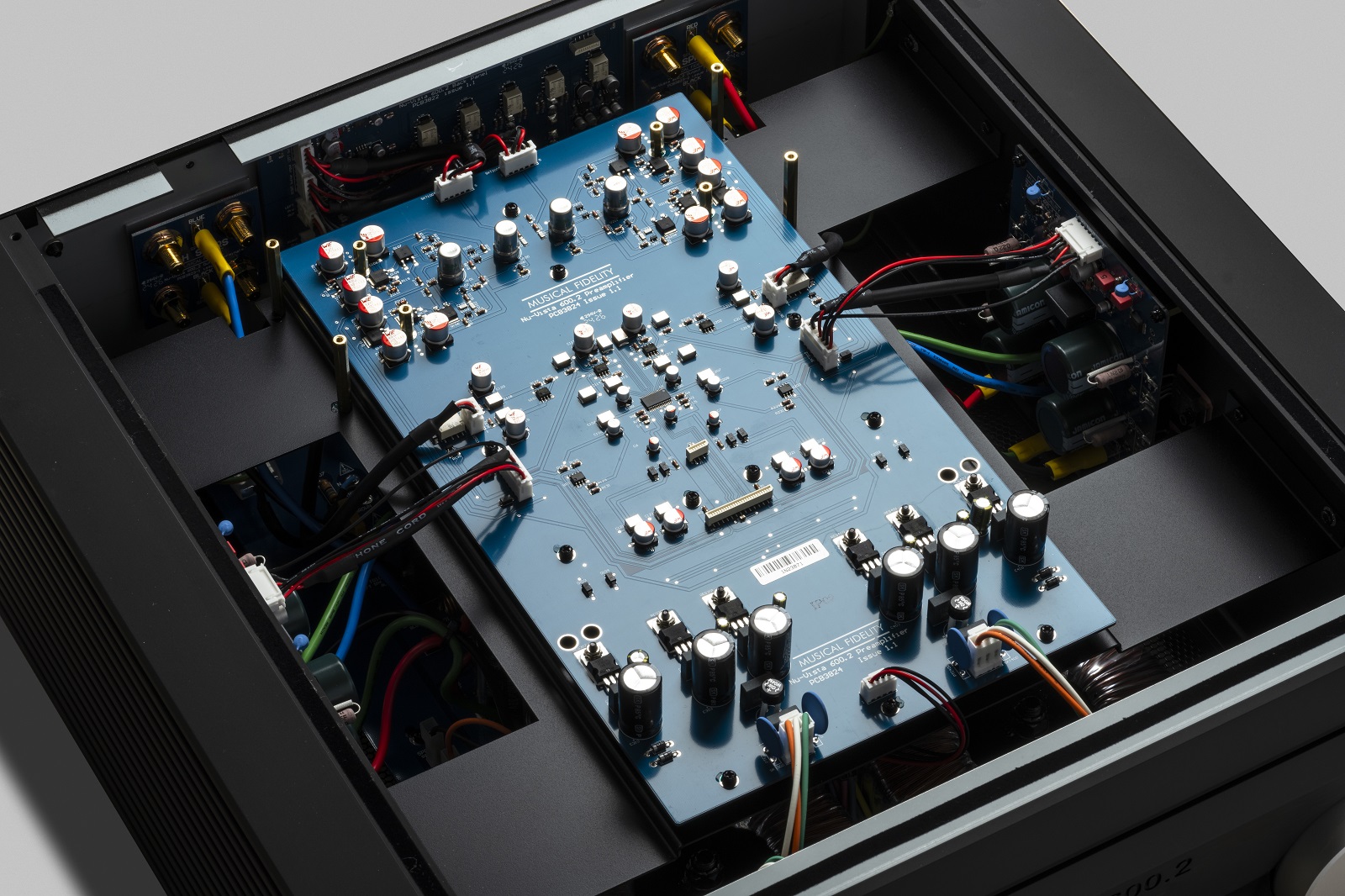
One of the more consequential changes is the move to a fully dual-mono configuration for the preamplifier, NuVistor and input circuits, with separate left- and right-channel power supplies. “Dual mono” is sometimes used loosely, but its practical purpose is clear: reducing the extent to which current demands or noise in one channel can modulate the supply feeding the other. Better channel independence can be especially valuable in the low-level preamplifier stages, where unwanted supply contamination is more likely to intrude on small music signals.
The preamplifier circuitry has also moved from a PCB at the rear of the amplifier to a shielded tray at the top of the chassis. The rationale is sensible in a high-power integrated design. The rear of an amplifier is inevitably a busy location, with mains entry, loudspeaker terminals, input wiring and potentially high-current paths in close proximity. Relocating sensitive low-level circuitry and enclosing it in a shielded structure is intended to reduce the risk of electromagnetic interference and noise coupling.
That physical separation complements the electrical separation. An integrated amplifier must accommodate both tiny line-level signals and substantial loudspeaker currents in one enclosure; careful routing, shielding, grounding and supply partitioning are fundamental to keeping the former clear of the latter. The Nu-Vista 600.2’s revised layout appears to address that engineering challenge directly.
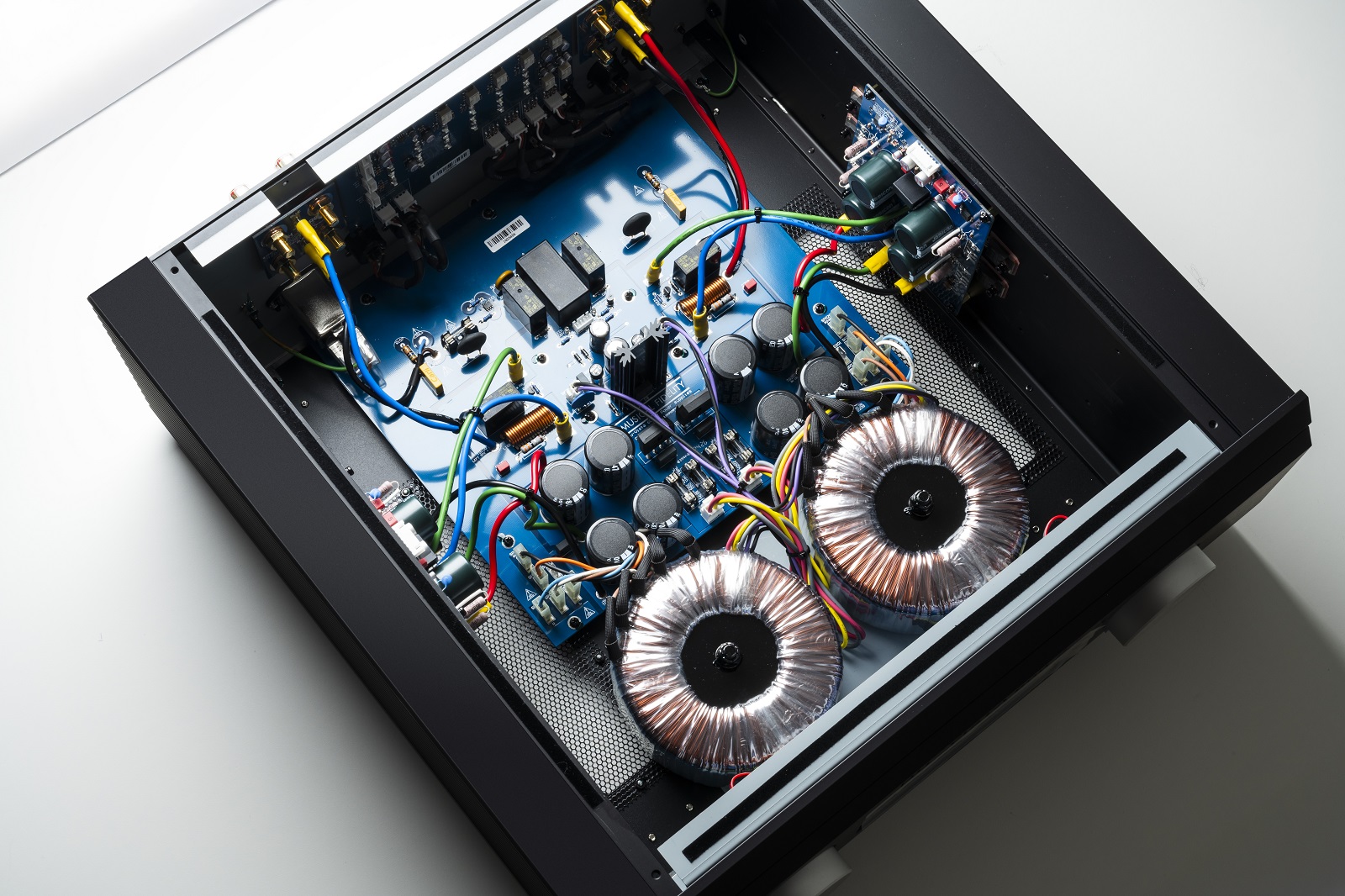
Musical Fidelity also says the amplifier uses a multi-array power supply, with filtering for both pre- and power-amplifier sections. Separate filtering and local energy storage are not a guarantee of a particular sonic result, but they are relevant to how an amplifier deals with rapidly changing current demands and prevents noise generated by one circuit block from reaching another.
Titan power supply: why local capacitance matters
The Nu-Vista 600.2 adopts Musical Fidelity’s Titan design, bringing it into line with the larger Nu-Vista 800.2 and the company’s PRE/PAS/PAM range. The stated implementation places a high-current bulk power-supply capacitor alongside each output transistor. In principle, putting stored energy close to the output devices reduces the length and impedance of the path between the capacitor and the transistor.
That is particularly relevant during musical transients. A bass drum strike, orchestral crescendo or abrupt electronic bass note can demand a short-lived but considerable increase in current from the output stage. Local reservoir capacitance can help supply that current without relying solely on a more distant central bank of capacitors. Musical Fidelity says this arrangement reduces impedance in the energy-flow path, improves transient response and enhances ripple filtering at high currents, with further capacitors distributed around the amplifier.
It is worth separating the manufacturer’s engineering intent from a listening verdict. The published information supports the conclusion that power-supply impedance and current access were priorities in the redesign; it does not, by itself, establish how the amplifier performs with every loudspeaker or in every room. Nonetheless, this is exactly the sort of design attention that matters for an amplifier specified to drive 4- and 2-ohm loads at high output.
Relay switching and a more precise volume control
The original Nu-Vista 600 used an input-switching integrated circuit. In the 600.2, Musical Fidelity replaces that arrangement with relays. A relay is an electromechanical switch: when properly specified and implemented, it can provide a short, direct signal path and strong isolation between unselected inputs. The company says the change improves separation and dynamic performance. While those performance claims cannot be independently verified from the supplied details, relay switching is a credible choice in a premium analogue preamplifier where minimising interaction between source inputs is a priority.
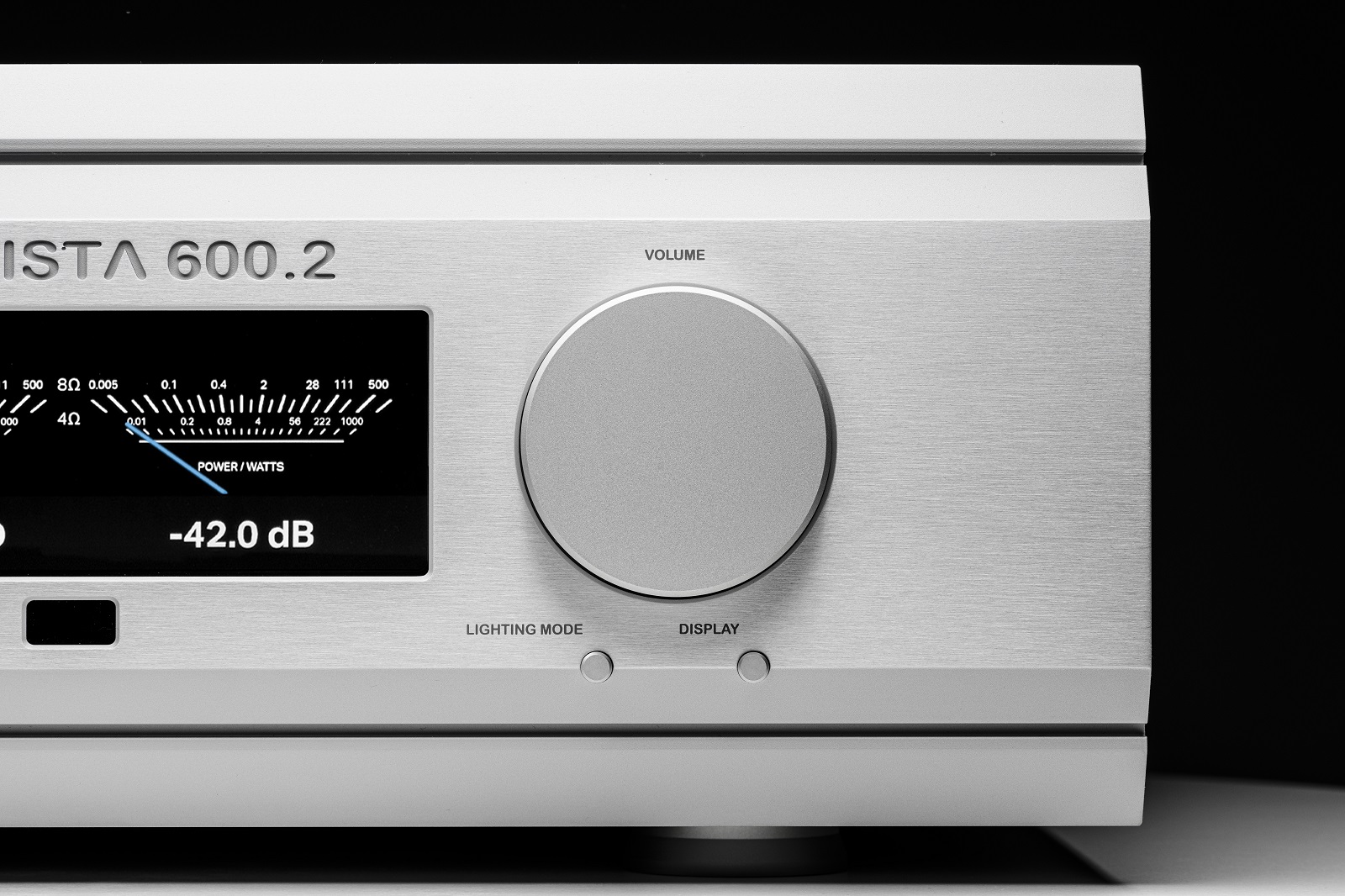
The volume control is another area of revision. Musical Fidelity’s laser-trimmed control is specified with a gain error of +/- 0.5dB, including at lower volume settings. This is a practically useful specification. Conventional analogue volume controls can exhibit channel imbalance near the bottom of their range, making a stereo image drift slightly to one side when listening quietly. Tighter gain matching should improve left/right level consistency, particularly for late-night listening or efficient loudspeakers that require only a small volume setting.
The claim is about gain accuracy rather than absolute volume calibration, and it does not tell us the control’s number of steps, taper or remote-control implementation. Still, it addresses an everyday usability issue that can be overlooked in otherwise ambitious integrated amplifiers.
Connections: built for analogue separates systems
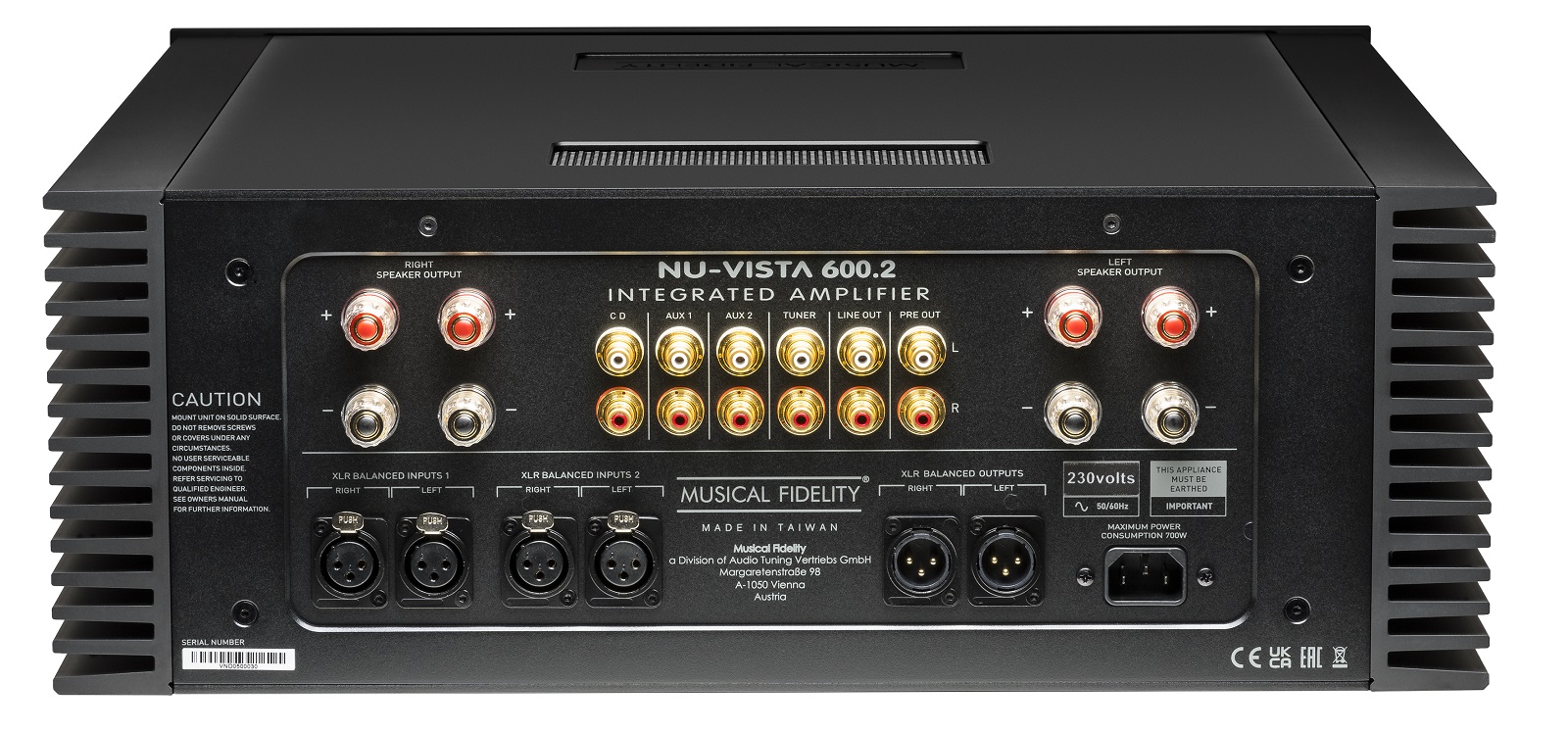
The rear panel is geared towards source flexibility and future system expansion. There are two balanced XLR inputs, four pairs of RCA line-level inputs, a balanced XLR preamplifier output and a pair of RCA line-level outputs. Musical Fidelity states that every line output is separately buffered, an important detail where more than one downstream component may be connected.
Buffering outputs individually is intended to prevent one connected component from imposing its electrical load on another. In practical terms, it makes the pre-outs more suitable for systems that might feed a recording device, an external power amplifier, a subwoofer solution with line-level inputs, or another line-level destination—provided the connected equipment itself is compatible and its gain is set appropriately.
The two balanced inputs will be especially relevant to owners of suitably equipped high-end source components. Balanced XLR connection can offer improved rejection of externally induced noise when the source and amplifier use a genuinely balanced circuit and the cable run is long or electrically challenging. It is not automatically superior to RCA in every domestic installation, but it is a valuable option, and a natural match for the company’s Nu-Vista DAC and Nu-Vista Vinyl components.
For loudspeakers, the 600.2 provides two pairs of 4mm banana plug/binding posts. This gives owners the option of connecting two speaker pairs, subject to the manufacturer’s operating guidance, or of using separate cable runs to compatible loudspeakers. It should not be assumed that two pairs of terminals denote two independently amplified zones; the supplied information identifies the terminals but does not specify a multi-room function.
- 2 x balanced XLR line inputs
- 4 x RCA line inputs
- 1 x balanced XLR preamplifier output
- 1 x pair of RCA line outputs
- 2 x pairs of 4mm banana plug/binding posts
Power, speaker matching and installation considerations
The Nu-Vista 600.2’s 160W-per-channel rating into 8 ohms suggests ample headroom for a wide range of floorstanding and standmount loudspeakers in sensibly sized rooms. More telling is the increase to 300W into 4 ohms and the stated 500W peak capability into 2 ohms. Speakers rarely present a perfectly steady impedance, and many nominally 4- or 8-ohm designs dip lower at certain frequencies. An amplifier with a robust supply and output stage is better placed to maintain control through those more demanding portions of the load.
That does not mean that every 2-ohm loudspeaker load is automatically suitable, nor does it remove the need to observe a speaker manufacturer’s recommendations. Cable terminations must be secure, positive and negative terminals must never touch, and users should avoid connecting or disconnecting loudspeakers with the amplifier powered. For difficult speakers, the useful question is not only the nominal impedance but also its minimum value, phase angle and sensitivity—information that should be considered alongside room size and desired listening level.
At 36kg and measuring 187 x 483 x 510mm (H x W x D), the Nu-Vista 600.2 is a physically substantial integrated amplifier. The 510mm depth is particularly important when planning a rack: allow additional room behind the unit for XLR plugs, RCA cables, loudspeaker leads and mains routing. Its 187mm height also means it should not be treated as a component for a tight, enclosed shelf. Any powerful amplifier requires sensible ventilation, and the Class A NuVistor buffer stage reinforces the case for free air above and around the chassis.
The chassis uses extruded aluminium profiles for its front and side panels, following the robust construction approach of the Nu-Vista 800.2. Beyond the visual impression of a premium component, a rigid metal enclosure can contribute to mechanical solidity and provide a useful shield around sensitive circuitry. The supplied information does not specify feet, internal bracing or vibration-control measures, so those aspects remain to be confirmed.
Musical Fidelity notes that the amplifier uses an SMPSU only while in standby. This wording should not be read as confirmation that the main amplification supply is switch-mode during normal playback. Rather, it indicates a standby-power arrangement; prospective buyers seeking a full account of operational power consumption or the main supply topology should consult the final manual or manufacturer documentation.
What the Nu-Vista 600.2 is—and is not
The Nu-Vista 600.2 is for listeners who want a high-power, all-analogue integrated amplifier rather than a compact all-in-one hub. Its appeal lies in bringing a carefully partitioned preamplifier, a Class A NuVistor buffer, relay-selected inputs and serious power-supply architecture into one substantial chassis. Owners can build around it with a separate DAC, streamer, phono stage or analogue source, choosing the digital and vinyl front end that best suits their system.
The corresponding trade-off is clear. Anyone needing HDMI eARC, streaming services, USB audio, a headphone output, room correction or a built-in phono input will need additional components or should consider a different kind of integrated amplifier. This is a deliberately focused proposition, and its connection set confirms that Musical Fidelity expects it to sit at the heart of a conventional high-end separates system.
Most importantly, the move from Nu-Vista 600 to 600.2 appears to be more than a reissue. The revised low-level circuit placement, fully dual-mono architecture, localised Titan capacitance, relay input selection and laser-trimmed level control all address fundamental aspects of amplifier design: noise management, channel separation, current delivery and day-to-day level accuracy. Final judgement will depend on a full review and system matching, but the technical brief makes the Nu-Vista 600.2 one of Musical Fidelity’s more consequential integrated-amplifier updates.