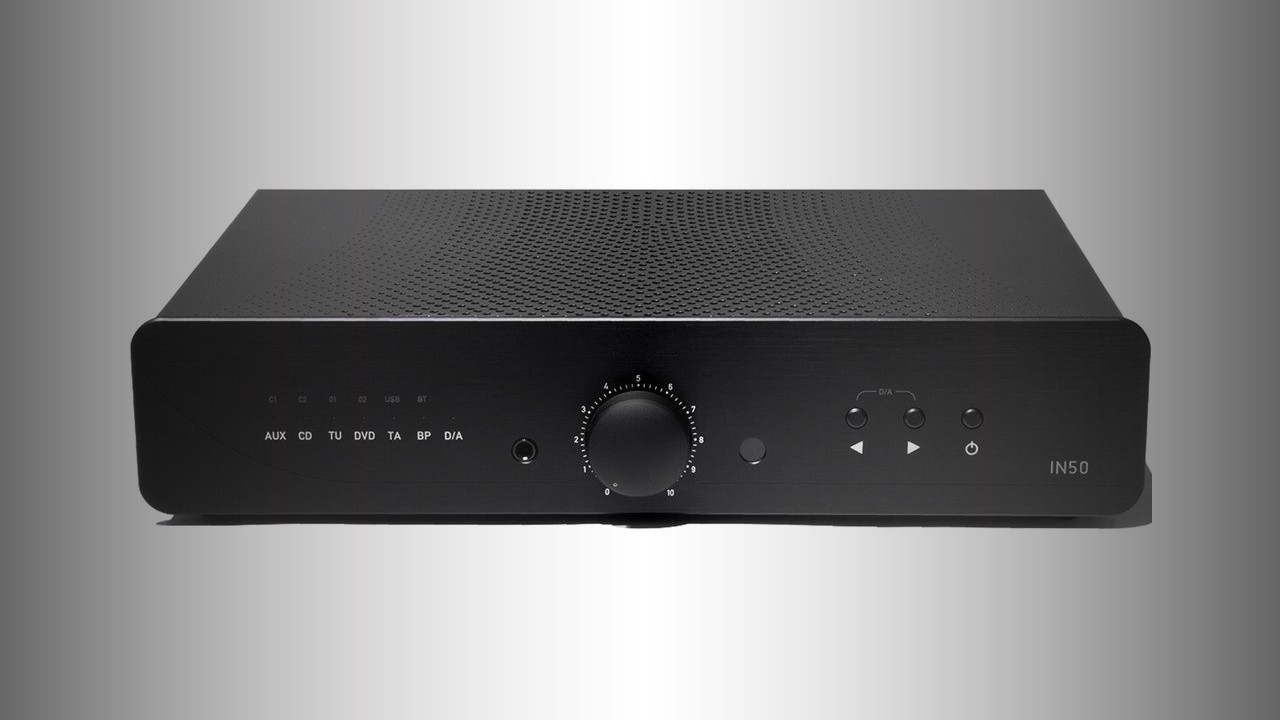
The Atoll IN50 Signature is a deliberately unfussy integrated amplifier for listeners who want a conventional two-channel control centre without digital streaming, DAC circuitry or tone-control networks built into the signal path. Its proposition is refreshingly clear: line-level sources in, loudspeakers out, with an optional internal phono stage for vinyl users and enough analogue connectivity to accommodate a substantial separates-based system.
Rated at 50W per channel into 8 ohms and 70W per channel into 4 ohms, the French-made amplifier occupies the compact end of the traditional integrated-amplifier market. Those figures do not automatically define which speakers it will drive well, but the increase in rated output into 4 ohms is encouraging in principle: it indicates that the amplifier is specified to provide more power when presented with a lower-impedance load. Speaker sensitivity, impedance variation across the frequency range and room size will remain at least as important as the headline wattage.
A genuinely analogue-first amplifier
Atoll has kept the IN50 Signature’s circuit concept intentionally simple. There are no tone controls, digital inputs or integrated network functions mentioned in the specification. That will be a limitation for anyone seeking a single-box streaming system, but it is an attractive approach for an owner who already has, or intends to choose separately, a streamer, DAC, CD player, television audio solution or turntable.
The absence of bass and treble adjustment is not inherently a guarantee of better sound, but it does remove circuitry and switching from the signal route. In an amplifier designed around a short signal path, that is the point: fewer stages and fewer controls between source and output can simplify the electrical design. The trade-off is practical rather than academic. If a recording, room or speaker needs tonal correction, the IN50 Signature does not provide it; system matching and loudspeaker placement will do more of the work.
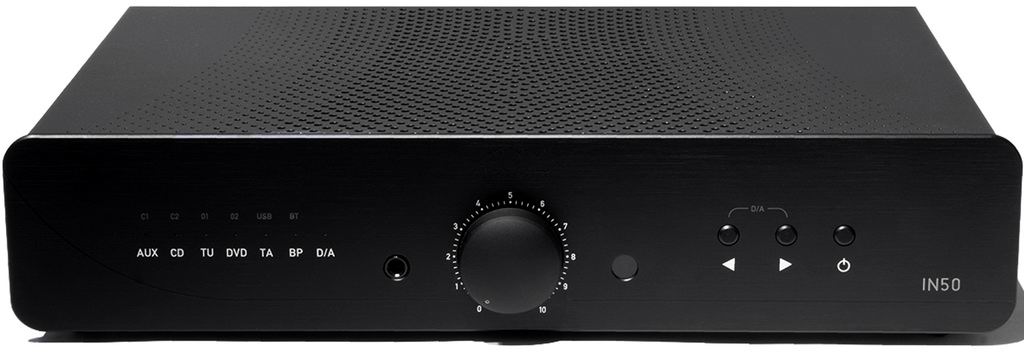
The volume control is linked to an Alps RK-27 potentiometer. This is a conventional analogue potentiometer rather than a digitally controlled volume arrangement. In practical terms, it provides direct, tactile level control and suits the amplifier’s resolutely traditional architecture. Source selection is relay-switched, with LEDs arranged in a semicircle to show the active input. Relays are widely used in serious analogue equipment because they can provide defined switching contacts and keep long mechanical selector paths away from low-level source signals.
Power supply and MOSFET output stage
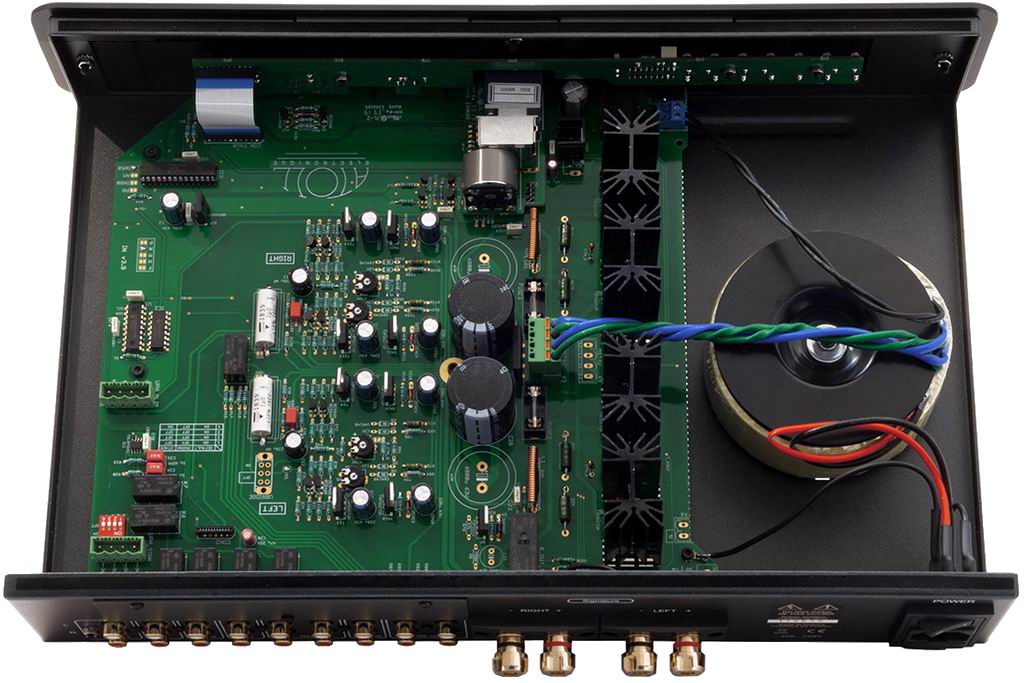
Behind the modest 90mm-high chassis sits a 170VA toroidal transformer and 17,874µF of reservoir, or buffer, capacitance. These are meaningful details because the power supply is central to how any integrated amplifier responds to musical peaks. The transformer converts incoming mains power, while the capacitors store energy and help supply current when a musical transient asks more of the amplifier than a steady sine-wave rating alone can convey.
A toroidal transformer is a common choice in better integrated amplifiers. Compared with a conventional laminated transformer, its circular core can offer efficient operation and potentially lower stray magnetic fields when properly implemented. Placement and internal layout still matter, however, particularly in a chassis that also contains sensitive low-level input circuitry. Atoll positions the transformer on the left-hand side of the case.
The output stage uses MOSFET transistors. MOSFETs are one established type of output device in solid-state amplification; they should not be taken as a shorthand for a particular sound character, since circuit topology, biasing, feedback, power supply design and component selection all have major consequences. Their inclusion nevertheless marks the IN50 Signature as a conventional discrete-output integrated amplifier rather than a compact Class D design or an amplifier based around an integrated chip output stage.
Atoll specifies 50W per channel into 8 ohms, 70W into 4 ohms and 90W of pulse output power. The latter is a short-duration figure and should not be confused with continuous output. It can be useful as an indication that the supply and output devices have some transient headroom, but it is not a substitute for knowing an amplifier’s sustained power delivery into demanding real-world loudspeaker loads. No minimum impedance rating is stated here, so owners of speakers with unusually low impedance dips should confirm compatibility with their dealer or Atoll before purchase.
The quoted frequency response is 5Hz to 100kHz, while the signal-to-noise ratio is specified at 100dB. Frequency-response bandwidth gives a broad view of the amplifier’s intended operating range, rather than telling us how it will sound in a system. Likewise, the signal-to-noise ratio is a useful indication of the noise floor under the manufacturer’s measurement conditions, but does not by itself describe resolution or dynamic expression. The specified input sensitivity and impedance are 100mV and 47kΩ respectively, a normal line-level arrangement intended for sources such as a DAC, streamer or CD player.
Five line inputs, bypass and optional vinyl capability
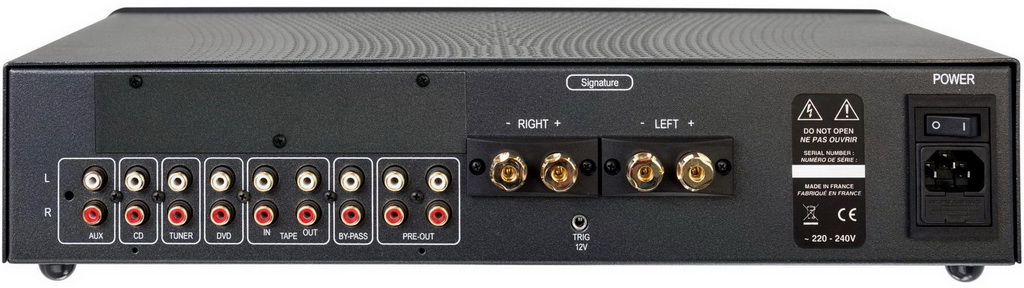
Connectivity is one of the IN50 Signature’s strongest practical features. It provides five RCA line inputs, including facilities for record monitoring, plus a dedicated RCA BY-PASS input that feeds the power-amplifier section directly. A bypass input is valuable in systems where the integrated amplifier must coexist with another volume-controlled component. Most commonly, it can allow the Atoll to power the front left and right speakers in a multi-channel installation, while an AV processor or AV receiver handles volume and surround decoding. It can also be useful with an external preamplifier. Because bypass defeats the integrated amplifier’s normal preamp level control, it should be connected carefully and used only with a source that has appropriate volume management.
There is an RCA record output for feeding a recorder or external device, along with two RCA preamplifier outputs labelled PRE OUT. Pre-outs create a sensible upgrade route: the IN50 Signature can initially be used as a complete integrated amplifier, then later partnered with an external power amplifier if a system requires more loudspeaker-driving authority. The exact behaviour of the two pre-out connections and any switching arrangements should be checked in the manual when planning a more complex installation.
For vinyl replay, Atoll offers internal phono-board options rather than fitting a phono stage as standard. The P50 is intended for moving-magnet cartridges, while the P100 supports both moving-magnet and moving-coil cartridges. This matters because a turntable cartridge produces a much lower signal than a line-level source and requires both gain and RIAA equalisation before it can enter a conventional amplifier input. Moving-coil cartridges generally need more gain than moving-magnet designs, which is why the P100 is the more flexible choice for users considering an MC cartridge now or in a future turntable upgrade.
Installing an optional phono board activates one of the amplifier’s line inputs for turntable use. That is an elegant way to retain the amplifier’s all-analogue character, although it means prospective buyers should account for the loss of one line input when counting sources. Those with an existing external phono preamp can instead use any standard RCA line input and retain all five line-level connections.
Front-panel layout and day-to-day use
The IN50 Signature has a metal enclosure with an aluminium front fascia and measures 440 x 90 x 300mm (W x H x D). At 7kg, it is not a large or exceptionally heavy integrated amplifier, which should make it straightforward to accommodate on a conventional hi-fi rack. Even so, owners should leave sensible ventilation space around any amplifier and avoid enclosing it tightly in furniture, especially when it will be asked to drive speakers at higher levels.
Its front panel is arranged around a central volume knob. The company logo sits on the left, while the right side contains the power control and status indicator, input-selection keys and a 3.5mm headphone socket. The socket adds useful late-night listening convenience, but Atoll does not state the headphone amplifier topology, output power or suitable headphone impedance range. It would therefore be unwise to assume performance with difficult planar-magnetic or very low-sensitivity headphones; prospective owners with demanding headphones should seek confirmation before treating it as a dedicated headphone amplifier replacement.
At the rear are two pairs of gold-plated screw terminals for loudspeakers. Two terminal pairs can make cable connection tidier in systems using more than one set of speakers, but the supplied information does not state whether the outputs are independently switchable or intended for simultaneous A/B operation. Nor should their presence be interpreted as a guarantee of bi-wiring benefits. The important point is to use secure, correctly terminated speaker cables and to observe polarity consistently from amplifier to both loudspeakers.
Speaker matching and system context
With its moderate power rating and compact supply architecture, the IN50 Signature makes most sense with sensibly matched loudspeakers rather than exceptionally insensitive, difficult-to-drive designs. Standmount speakers of reasonable sensitivity are a natural starting point, particularly in small to medium-sized rooms and at realistic listening levels. Compact floorstanders can also be appropriate where a fuller low-frequency foundation is desired, provided their impedance behaviour is amplifier-friendly.
Power ratings are only part of that decision. A speaker with an uncomplicated electrical load can be more comfortable for a 50W amplifier than a nominally similar speaker whose impedance falls sharply at certain frequencies or whose sensitivity is low. Room size and listening distance matter too: doubling the distance from the speakers requires significantly more acoustic output to maintain the same perceived level. Buyers moving from nearfield or small-room listening into a large open-plan space may ultimately benefit from more amplifier headroom.
The source material describes the IN50 Signature as offering articulated bass, defined midrange, open treble and a well-organised three-dimensional soundstage. These should be treated as reported characterisation rather than an independent That’s HiFi listening verdict. What the engineering does establish is that this is an amplifier aimed at directness and system simplicity: a discrete MOSFET output stage, substantial-for-size toroidal supply, relay input selection and no added digital or tone-control feature set.
Who should consider the Atoll IN50 Signature?
The IN50 Signature is for the enthusiast who values a conventional analogue integrated amplifier and prefers to choose digital and vinyl front ends separately. Its optional phono modules, bypass input and pre-outs mean it does not have to remain a closed system: it can accommodate a turntable, work alongside an AV processor and form the preamp portion of a later power-amplifier upgrade.
Its principal trade-off is equally clear. There are no stated digital inputs, wireless facilities, app control, room correction or onboard tonal adjustment. Listeners wanting television integration, streaming and DAC functionality in one chassis will need additional components or should consider a more fully featured amplifier. For a focused two-channel system based around analogue sources or an external streamer/DAC, however, the Atoll’s appeal lies in its straightforward architecture and unusually useful analogue expansion options.
Atoll IN50 Signature specifications
- Nominal output power: 50W per channel into 8 ohms; 70W per channel into 4 ohms
- Pulse output power: 90W
- Input sensitivity / impedance: 100mV / 47kΩ
- Frequency response: 5Hz–100kHz
- Signal-to-noise ratio: 100dB
- Inputs: five RCA line inputs; one RCA BY-PASS input to the power-amplifier section
- Outputs: 3.5mm headphone output; RCA record output; two RCA PRE OUT connections
- Optional phono stages: P50 for MM cartridges; P100 for MM/MC cartridges
- Power supply: 170VA toroidal transformer; 17,874µF total buffer capacitance
- Speaker outputs: two pairs of gold-plated screw terminals
- Dimensions (W x H x D): 440 x 90 x 300mm
- Weight: 7kg