Marantz has announced the European availability of the PM-12 Special Edition integrated amplifier, alongside the matching SA-12 Special Edition SACD player. Previously, the standard PM-12 and SA-12 models had been limited to the Japanese market. The Special Edition programme is intended to take the original platform further through revised circuit work and more selective component choices, informed, Marantz says, by development knowledge from its KI Ruby series.
The PM-12 SE is an analogue-first integrated amplifier with a notably ambitious internal division of labour. It combines a fully discrete, two-stage amplification layout with separate power-supply arrangements for its preamplifier and power-amplifier sections, a moving-magnet/moving-coil phono stage, a power-amp direct input and facilities for multi-amplifier operation. In other words, it is designed not simply as a conventional one-box amplifier for line-level sources, but as a hub that can accommodate a turntable and grow into a more complex bi-amped or multi-channel Marantz system.
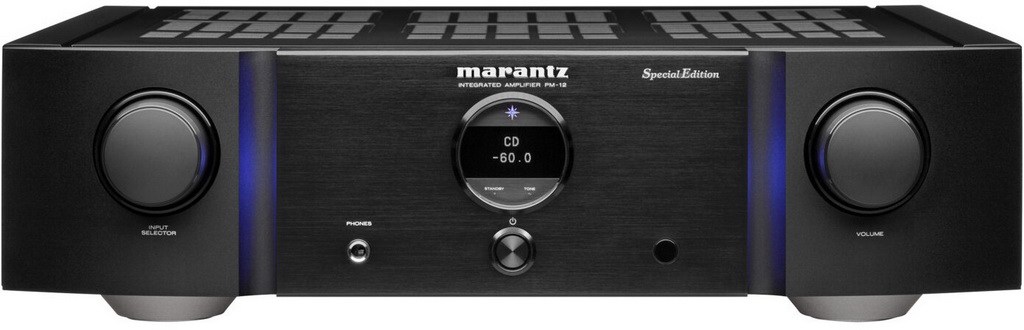
Two amplification stages, with separate supply strategies
At its core, the PM-12 Special Edition is specified to deliver 100W per channel into 8 ohms and 200W per channel into 4 ohms. The doubling of rated output from 8 to 4 ohms is a useful indication of the amplifier’s intended load-driving capability. Loudspeaker impedance is not fixed: many speakers dip below their nominal figure at particular frequencies, where an amplifier must deliver more current to maintain control. The 4-ohm rating does not by itself describe how the PM-12 SE will behave with every difficult speaker, but it suggests that Marantz has designed the output stage with lower-impedance loads in mind rather than treating them as an afterthought.
The amplifier’s quoted damping factor is 500. Damping factor describes the relationship between an amplifier’s output impedance and the loudspeaker load. In practical terms, a high figure can help an amplifier electrically control the back-EMF generated by a moving loudspeaker driver, particularly around bass resonances. It is not a standalone predictor of bass quality—speaker design, room placement and the complete amplifier/speaker interaction remain important—but it is relevant to the PM-12 SE’s control-oriented specification.
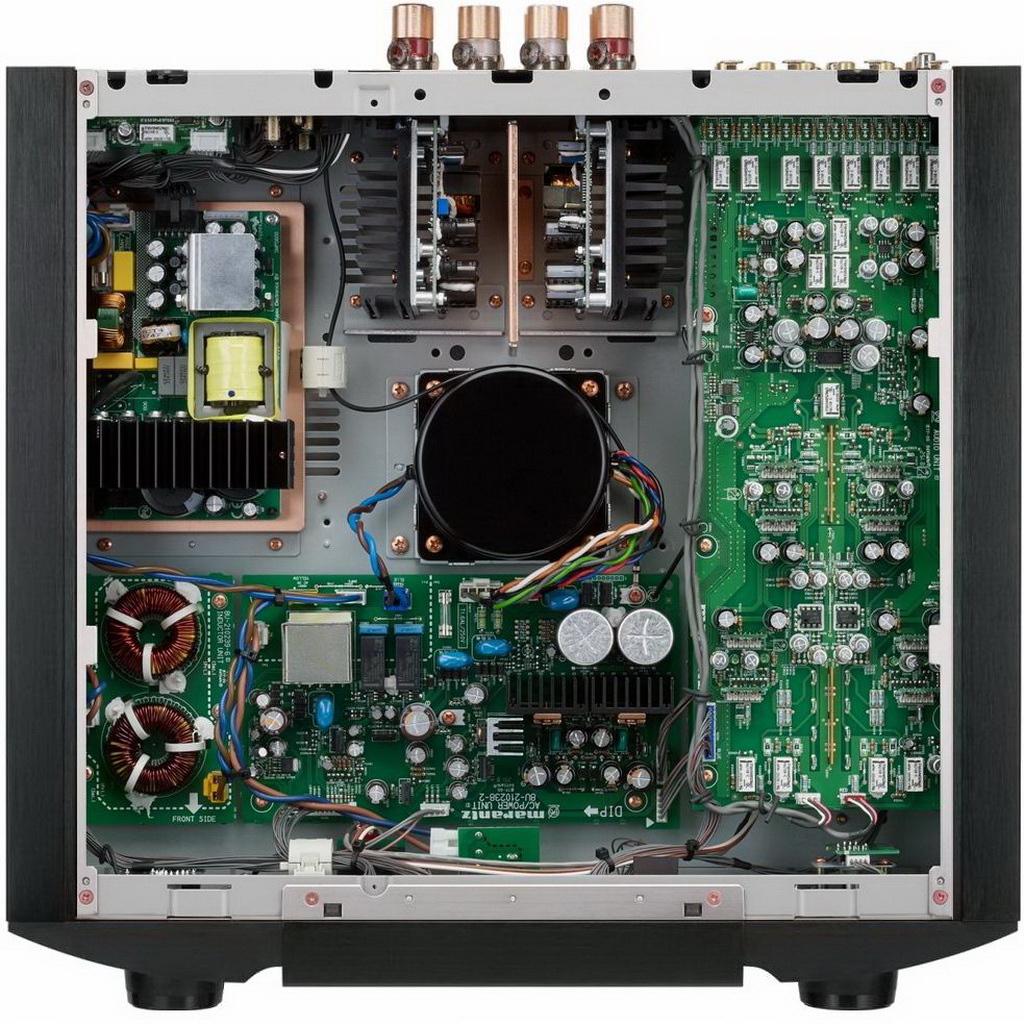
Marantz separates the preamplifier and power-amplifier supplies. The preamp section is fed by a toroidal transformer, while the power stage uses a Hypex NCore switching power supply, an approach also used in the company’s PM-10. A toroidal transformer is commonly valued in low-level analogue circuitry because it can be implemented with low radiated magnetic field, while a well-engineered switch-mode supply can provide a compact, efficient source of energy for a power stage. The aim here is to reduce the extent to which the heavy current demands of the output section influence the more sensitive voltage-gain circuitry upstream.
That separation matters because a preamplifier is dealing with small signals and setting volume before the output stage applies the muscle required to drive loudspeakers. Power-supply noise or disturbance shared between these sections can potentially compromise the quietest parts of the signal path. Marantz’s architecture is therefore a practical attempt to isolate two jobs that make very different demands on an amplifier.
Discrete HDAM modules and current-feedback operation
Rather than relying solely on conventional integrated operational-amplifier chips, the PM-12 SE uses Marantz’s discrete HDAM SA3 and SA2 amplifier modules. HDAM—short for Hyper-Dynamic Amplifier Module—is Marantz terminology for a compact discrete circuit block built from individual components. The relevant point for buyers is not that “discrete” is automatically superior, but that it gives the manufacturer greater scope to tailor the circuit topology and component selection to a particular role than a fixed, off-the-shelf op-amp would allow.
Marantz also specifies current feedback. In broad circuit terms, current-feedback amplifier designs are often selected for their potential to maintain wide bandwidth and fast transient behaviour. The company attributes the PM-12 SE’s wide frequency response, transient response and low noise to this arrangement. Its published frequency-response figure is 5Hz–50kHz, while total harmonic distortion is stated as 0.01%.
These numbers should be read as part of the amplifier’s overall engineering picture rather than as a direct description of its sound. A 50kHz upper limit extends well beyond the conventional audible range and indicates that the circuitry is not intentionally bandwidth-limited close to 20kHz. Meanwhile, the 5Hz lower figure suggests the amplifier is specified to pass very low-frequency content without an early roll-off. Neither specification can tell us how a particular speaker will perform in a particular room, but both are relevant to an amplifier intended to operate cleanly across the full audio band.
Volume is controlled by a linear, high-precision attenuator. This is important in a high-resolution analogue preamp because channel balance and repeatability at lower listening levels can depend heavily on the quality of the volume-control implementation. Marantz also lists Schottky diodes, low-noise transistors, MELF resistors, custom electrolytic capacitors, plus film and mica capacitors among the selected parts in the circuit. Those descriptions should not be mistaken for a guaranteed sonic signature, but they show that the Special Edition work is focused on conventional analogue engineering details rather than adding streaming or digital functions.
A serious provision for turntable users
The PM-12 SE includes the Marantz Musical Premium Phono EQ, supporting both MM and MC cartridges. That makes it a useful proposition for listeners who want to connect a turntable directly without immediately budgeting for an external phono preamp.
Moving-magnet and moving-coil cartridges have very different electrical requirements. MM designs generally produce a higher output voltage and expect a relatively high load impedance, whereas low-output MC cartridges generate far less voltage and require substantially more gain with very careful noise control. The PM-12 SE’s stated phono input values reflect that distinction: 2.3mV and 39k ohms for MM, and 250µV and 100 ohms for MC.
For perspective, 250µV is a very small signal, so the quality of the first gain stage and its noise performance is especially consequential with an MC cartridge. Marantz says its phono stage uses HDAM modules and JFET transistors, omits coupling capacitors and is designed for low noise. JFET devices are commonly used at sensitive audio inputs for their favourable input characteristics, while removing a coupling capacitor from a signal path can avoid one component that might otherwise influence low-frequency behaviour. However, cartridge matching remains essential: the fixed 100-ohm MC loading will not be the preferred electrical match for every moving-coil design, and owners of cartridges with unusual loading recommendations should check compatibility before buying.
The quoted signal-to-noise ratios are 88dB for MM and 75dB for MC operation. The lower MC figure is unsurprising given the much smaller signal level being amplified. More importantly, the presence of both MM and MC support makes the PM-12 SE more flexible than an integrated amplifier with an MM-only phono input, particularly for owners considering a future cartridge upgrade.
Chassis engineering and a connection set built for expansion
The PM-12 SE is housed in a substantial case with thick aluminium panels and a two-layer copper-plated chassis. Its top cover is 5mm thick. Mechanical and electrical construction may sound secondary to an amplifier’s headline power output, but it serves practical purposes. A stiff enclosure can help reduce susceptibility to vibration, while a carefully arranged chassis and copper plating can assist with grounding and screening against electrical interference. Marantz describes the resulting construction as providing resistance to mechanical vibration and electrical noise.
At 440 x 127 x 453mm (W x H x D), the amplifier requires a properly sized equipment shelf; its 453mm depth is worth checking against furniture that is designed around shallower components. It weighs 15.3kg, so installation is best treated as a two-handed job rather than something to perch temporarily on a lightweight rack. The specified power consumption is 130W, falling to 0.2W in standby.
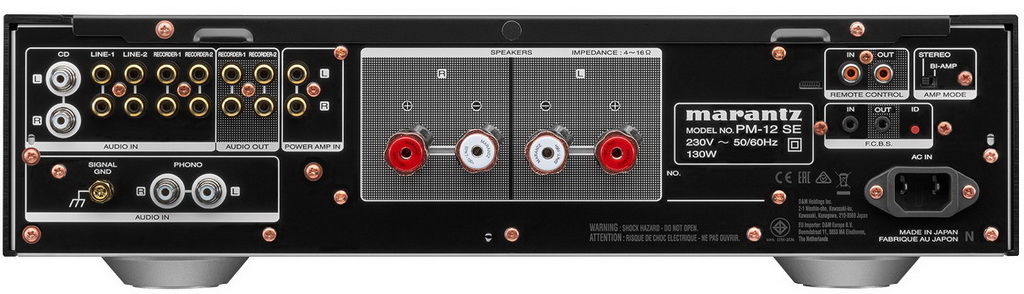
Analogue connectivity is comprehensive, but buyers should be clear about what it does and does not include. The PM-12 SE offers five line-level RCA inputs, including a dedicated CD input with nickel-plated copper RCA connectors, plus two record-monitor inputs. It also has RCA MM/MC phono inputs and two RCA recording outputs. The record-monitor loops are particularly useful in systems that include an analogue recorder or a component requiring a monitor loop, a feature increasingly absent from many contemporary integrated amplifiers.
There is an RCA input that bypasses the normal preamplifier route and feeds the final amplification section directly. Marantz specifies this power-amp direct input at 1.1V/13k ohms, compared with 220mV/13k ohms for the regular line inputs. It can be valuable when the PM-12 SE is used as a power amplifier within a larger system, perhaps with an external preamp, processor or another appropriately configured control component. Because this connection bypasses the integrated amplifier’s usual volume-control section, it requires care: volume must be managed by the upstream device.
Two pairs of Marantz SPKT-100+ high-purity-copper screw terminals allow two speaker pairs to be connected. The rear panel also includes a switch for bi-amp mode, plus D-Bus and FCBS connections. FCBS, or Floating Control Bus System, is Marantz’s means of linking compatible components for coordinated control and multi-amplifier arrangements. In an appropriate system, this can support bi-amping or multi-channel configurations with multiple PM-12 SE amplifiers. Bi-amping requires loudspeakers with separate, accessible high- and low-frequency terminals and should not be confused with merely connecting two sets of speaker cables to a single pair of terminals.
Who the PM-12 Special Edition makes sense for
The PM-12 SE is aimed at a listener building a high-quality, source-led analogue system rather than someone seeking an all-in-one streaming amplifier. There are no digital inputs, network facilities, Bluetooth or HDMI connections listed in the specification. That is a limitation for anyone who wants a TV, computer or streamer connected digitally straight to the amplifier. It is also a deliberate simplification for users who already own, or intend to choose separately, a DAC, network player, CD/SACD player or phono source.
Its strongest practical appeal is the combination of meaningful 4-ohm power, a separate-supply pre/power architecture, MC-capable phono amplification and unusual flexibility for expansion. The matching SA-12 Special Edition may be the natural partner for disc playback, but the PM-12 SE can equally form the amplification foundation of a system with a standalone streamer and DAC connected to one of its line inputs.
For loudspeaker matching, the published 100W/8-ohm and 200W/4-ohm figures make the amplifier a plausible candidate for many conventional passive designs, including speakers whose impedance presents a more demanding load than an easy nominal 8 ohms. Yet sensitivity, minimum impedance and the size of the listening room still matter. Prospective owners should use the speaker manufacturer’s recommended amplification range as a starting point, not assume that wattage alone settles suitability.
The supplied universal RC005PMSA remote completes a package that favours traditional component-system ownership: physical sources, physical inputs and the option to add capability externally as requirements evolve. The PM-12 Special Edition’s appeal lies less in a long digital feature list than in the depth of its analogue engineering and the care taken to keep its sensitive preamp functions apart from the loudspeaker-driving output stage.
Marantz PM-12 Special Edition specifications
- Output power: 2 x 100W into 8 ohms; 2 x 200W into 4 ohms
- Frequency response: 5Hz–50kHz
- Total harmonic distortion: 0.01%
- Damping factor: 500
- Signal-to-noise ratio: 107dB (preamplifier, 2V input); 88dB MM / 75dB MC (phono stage)
- Line input sensitivity/impedance: 220mV/13k ohms (RCA)
- Power-amp direct input sensitivity/impedance: 1.1V/13k ohms
- Phono input sensitivity/impedance: MM: 2.3mV/39k ohms; MC: 250µV/100 ohms
- Amplifier modules: HDAM SA3 and SA2
- Inputs: five line RCA inputs, including CD and two record-monitor inputs; MM/MC phono RCA; RCA power-amp direct input
- Outputs: 6.3mm headphone output; two RCA recording outputs
- Speaker outputs: two pairs of Marantz SPKT-100+ screw terminals
- Control connections: two D-Bus connectors; two FCBS connectors; ground terminal
- Power supplies: toroidal transformer for preamp section; switching supply for power stage
- Power consumption: 130W; 0.2W standby
- Remote: RC005PMSA universal remote control
- Dimensions (W x H x D): 440 x 127 x 453mm
- Weight: 15.3kg