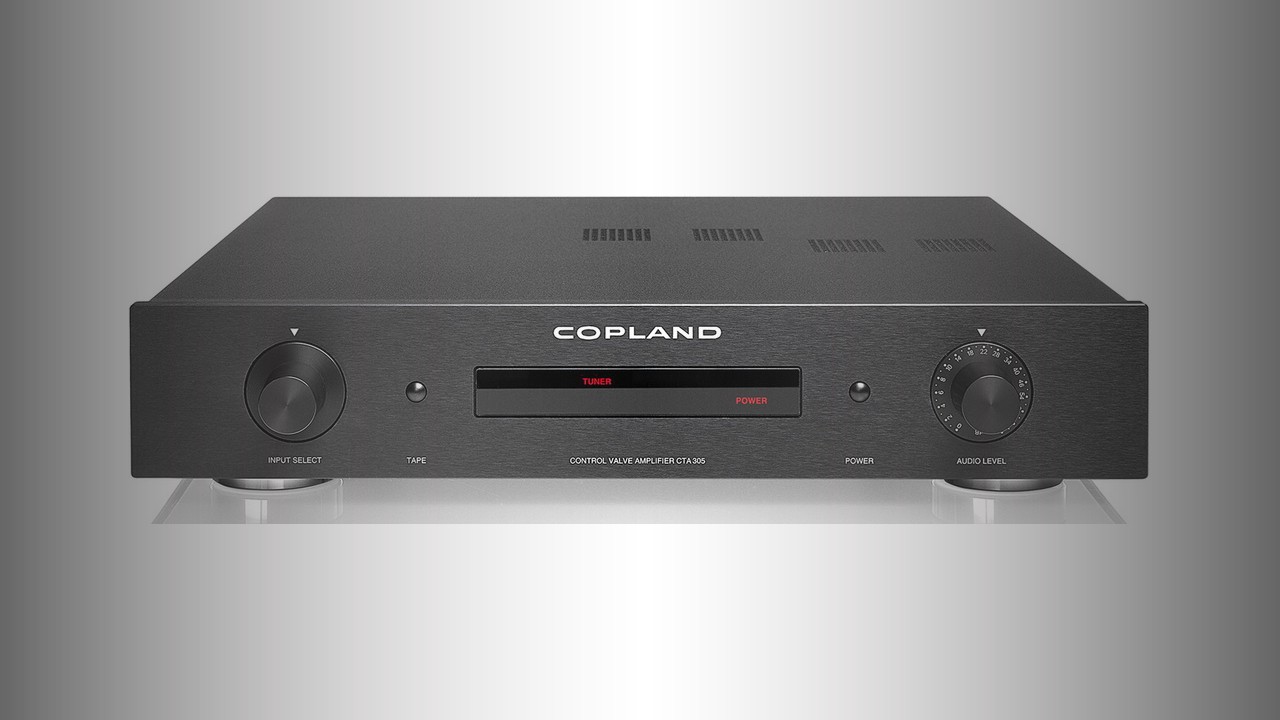
The Copland CTA 305 is a line-and-phono valve preamplifier for listeners building a conventional high-end separates system around a dedicated power amplifier. Rather than attempting to be an all-in-one integrated amplifier, it takes on the tasks that matter between source and power amp: selecting inputs, applying volume control, adding gain where necessary and presenting an electrically suitable signal to the next component in the chain.
Its appeal is straightforward. The CTA 305 combines five line-level inputs, a tape monitor loop and an RIAA-equalised phono input in one compact valve design. That makes it relevant to systems that still accommodate several physical sources—perhaps a DAC or network streamer, CD player, tuner and analogue deck—while retaining facilities that are increasingly absent from minimalist contemporary preamplifiers.
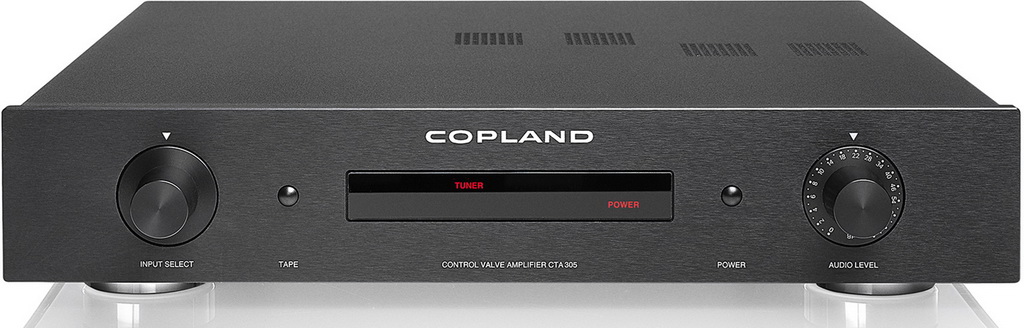
A proper control centre for a separates system
A preamplifier is often described simply as a volume control, but its role is more consequential than that suggests. It must accept the voltage produced by a range of sources, select between them cleanly, set the desired listening level and drive the cable to the power amplifier without undue signal loss, noise pickup or frequency-response change. It is also the point at which source and amplifier impedances meet.
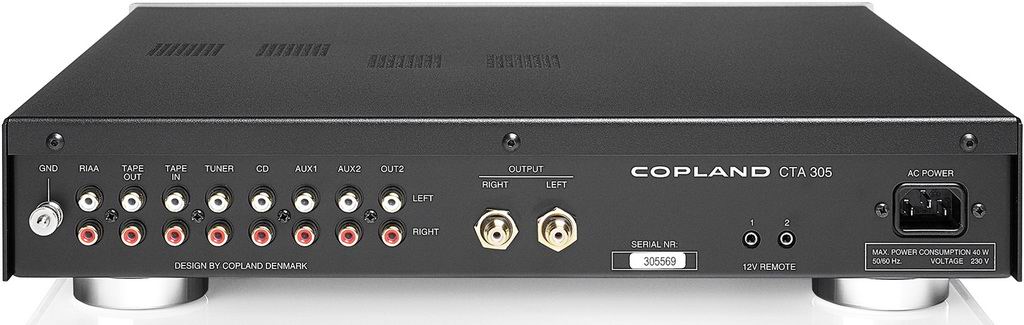
Copland specifies five line inputs on the CTA 305. These are intended for sources already operating at line level, such as a CD player, standalone DAC, streamer, tuner or the line output of another component. The stated line input sensitivity is 300mV for 1V output, while the input impedance is 50kOhm. In practical terms, a 50kOhm line input is a relatively easy load for normal source equipment, which usually expects to feed an input substantially higher in impedance than its own output impedance.
The CTA 305 also includes a tape monitor loop, with both an input and an output. This is useful not only for a tape recorder, as Copland notes, but conceptually for any external recording or monitoring chain that needs a fixed-level feed from the selected source. A genuine monitor loop allows the user to hear the return signal from a compatible recorder, rather than merely sending an output to it. For enthusiasts with cassette, reel-to-reel or outboard recording equipment, it is a valuable legacy connection that cannot be assumed on modern preamps.
Valve gain stage and output-drive considerations
The CTA 305’s amplification circuitry uses two 12AX7 valves and two 6922 valves. Both are familiar small-signal tube types, but they are generally chosen for different electrical roles: the 12AX7 is widely associated with high-voltage-gain stages, while the 6922 is commonly used where low noise, linear operation and the ability to drive a following stage are priorities. Copland specifically highlights the 6922’s low-noise characteristics and high input impedance.
More important than tube names alone is how a preamp behaves at its outputs. Copland quotes an output impedance of less than 600 Ohms. A low output impedance helps a preamplifier drive the capacitance of its interconnect cable and the input of the power amplifier with less sensitivity to cable electrical properties. Copland says the CTA 305 can be connected to power amplifiers with input impedances spanning several thousand ohms to one million ohms.
That broad stated compatibility is particularly useful in a separates system, where power amplifiers do not all present the same load to a preamp. Although sensible cable lengths and conventional amplifier matching remain good practice, the figures suggest that the CTA 305 is designed to be less fussy about the preamp-to-power-amp connection than a circuit with a markedly higher output impedance. Its nominal output voltage is 2V, rising to a quoted maximum of 40V, so there is substantial stated voltage headroom for power amplifiers requiring a higher input voltage for full output.
The published frequency response is 10Hz to 100kHz, within +0/-1dB. This is a wide specified bandwidth for a preamplifier. The audible significance is not that music extends to 100kHz, but that the design is specified to keep level changes tightly controlled throughout and beyond the conventional audio band. As ever, the overall result in a finished system will also depend on the connected source, power amplifier, loudspeakers and room.
Passive parts and regulated power supply
Copland says the CTA 305 uses polypropylene and polystyrene capacitors in its signal circuits, alongside tight-tolerance film resistors. These component choices address two important concerns in low-level audio circuitry: consistency of component value and unwanted losses or nonlinear behaviour in parts carrying the audio signal.
Film capacitors such as polypropylene are commonly valued in signal applications for low dielectric loss and stable behaviour. Polystyrene capacitors are also associated with precision applications, although their use is generally more constrained by available values and physical size. Copland’s claim is that these parts avoid the loss of fine detail it associates with dielectric losses and dynamic changes in more conventional capacitor types. The relevant practical point is that component selection in a preamp is not cosmetic: coupling capacitors, resistors and the layout around them all contribute to the conditions under which the small audio signal is amplified.
The power supply is described as stabilised, with near-zero output resistance. A regulated supply is intended to hold its voltage steady as circuit demand varies and as the incoming mains supply changes within normal limits. In a valve preamplifier, stable supply conditions help maintain the intended DC operating points of the tubes; those operating points influence the linearity and available headroom of the gain stages. Copland says this arrangement keeps the valves processing audio free from fluctuations originating on the AC mains.
Specified power consumption is 40W. The unit is factory configured for either 115V or 220V operation according to its destination country, with a stated supply-voltage tolerance of +/-12%. Buyers moving equipment between regions should therefore treat mains configuration as a dealer or manufacturer matter rather than assuming the voltage setting is user-switchable.
Phono stage: what the quoted figures tell us
For turntable users, the CTA 305 includes an RIAA-equalised phono input. A phono stage has a significantly more demanding job than a line input. The signal from a cartridge is very small, and records are cut with RIAA equalisation that must be accurately reversed during playback. This means the preamp must provide substantial gain while keeping noise low and applying the correct frequency contour.
Copland lists the phono input as suitable for “MM or MS” cartridges. The supplied information uses the term MS; prospective buyers should confirm the intended cartridge type and any loading or gain options with a dealer before purchase, particularly if they use a low-output moving-coil design. The specified phono sensitivity is 2.7mV for 1V output, and phono input impedance is 47kOhm. A 47kOhm input is the conventional loading value associated with moving-magnet cartridges, and the 2.7mV sensitivity figure is meaningful in that context because many moving-magnet designs produce output in the millivolt range.
The phono signal-to-noise ratio is specified at greater than 80dB, with total harmonic distortion below 0.1% at 1V output. For line and CD inputs, Copland quotes a signal-to-noise ratio above 95dB and THD below 0.1% at 1V output. These figures should not be used as a shortcut to predict sound quality, but they establish the manufacturer’s noise and distortion targets under its stated conditions. The lower signal-to-noise ratio on phono compared with line is expected in principle: the phono stage has to amplify a far smaller source signal by much more.
Remote-controlled volume and system integration
Copland specifies an electric motor drive for precise volume control, and the CTA 305 can be operated from a Copland remote control. A motorised analogue control is a familiar solution for valve preamplifiers: it preserves a conventional physical volume control while allowing level adjustment from the listening seat. That is especially useful where the preamp is installed in a rack between source equipment and a separate power amplifier.
The chassis measures 430mm wide, 86mm high and 390mm deep, dimensions that place it comfortably within standard full-width hi-fi furniture but make its 390mm depth worth checking against a shallow rack. Packaged weight is quoted at 7kg. As with any valve component, it is sensible to allow clear space around the unit rather than enclosing it tightly, both for access and for the heat generated by the valves during normal operation.
In system terms, the CTA 305 is best understood as the hub for an owner who already has, or intends to add, a separate power amplifier. It offers no stated digital inputs, network streaming platform or headphone output, so digital sources will require their own DAC or analogue output stage, and headphone listeners will need a separate headphone amplifier unless their source or power amplifier provides one. Conversely, that absence of digital hardware keeps the product focused on analogue line-level control and phono replay, and avoids tying the preamp’s core role to a particular streaming ecosystem or DAC generation.
Who should consider the Copland CTA 305?
The CTA 305 will make most sense for listeners who value source flexibility, a built-in RIAA phono stage and a conventional pre/power architecture. Its tape loop is a notable attraction for users of physical recording equipment, while the five line inputs should suit a system with multiple analogue-output sources. The specified low output impedance and generous maximum output voltage also point to a design intended to work across a broad range of power-amplifier input arrangements.
The key checks before purchase are practical ones. Confirm that the phono stage’s cartridge compatibility suits the cartridge fitted to the turntable, establish the available input and output connector types with the retailer, and make sure the connected power amplifier is appropriate for the system’s loudspeakers. Because the CTA 305 is a preamplifier rather than an integrated amplifier, its final performance and functionality will be determined by those partnering components. For the right system, however, its combination of valve circuitry, regulated supply, remote volume control and unusually comprehensive traditional switching makes a strong case for the dedicated preamp route.
Copland CTA 305 key specifications
- Valves: 2 x 12AX7, 2 x 6922
- Inputs: five line inputs, tape monitor loop input/output, RIAA phono input
- Output voltage: nominal 2V; maximum 40V
- Frequency response: 10Hz–100kHz (+0, -1dB)
- THD: phono <0.1% (1V output); CD <0.1% (1V output)
- Input sensitivity: phono 2.7mV (1V output); CD/line 300mV (1V output)
- Input impedance: phono 47kOhm; CD/line 50kOhm
- Output impedance: <600 Ohms
- Signal-to-noise ratio: phono >80dB; CD/line >95dB
- Power consumption: 40W
- Mains supply: 115V or 220V, factory set by destination; +/-12% tolerance
- Dimensions (W x H x D): 430 x 86 x 390mm
- Weight: 7kg (packaged)