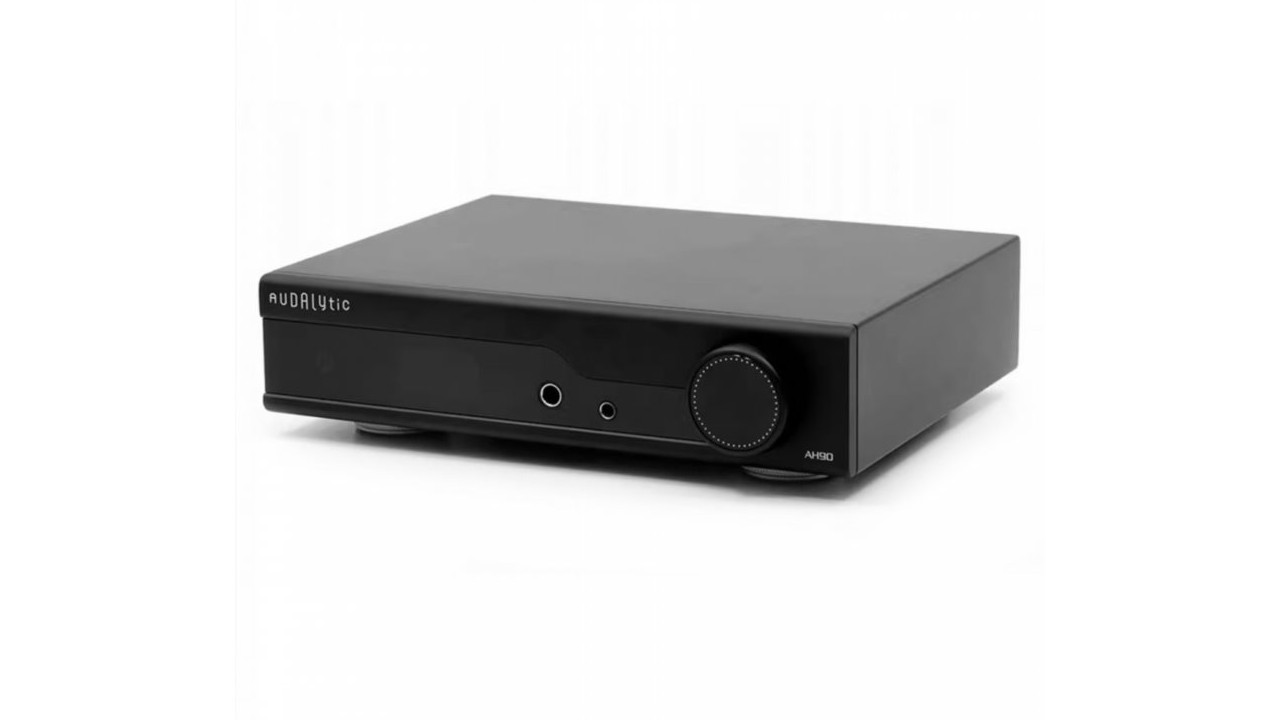
The Audalytic AH90 is a compact digital hub rather than simply a standalone DAC. Alongside its AKM AK4499EX conversion stage, it combines network playback over Ethernet, USB and S/PDIF digital inputs, fixed-level RCA and XLR analogue outputs, and a headphone amplifier with both 6.35mm single-ended and 4.4mm balanced sockets.
That is a notably broad brief for a component measuring 220 × 170 × 50mm. In practical terms, the AH90 could serve as the front end of a conventional integrated amplifier system, a powered-speaker desktop setup, or a headphone-based listening station, while its RJ45 connection gives it a route into a music library held on a computer or NAS. Audalytic is a subsidiary brand of Gustard, a company known in the digital-audio market for DACs, clocking products and headphone amplification.
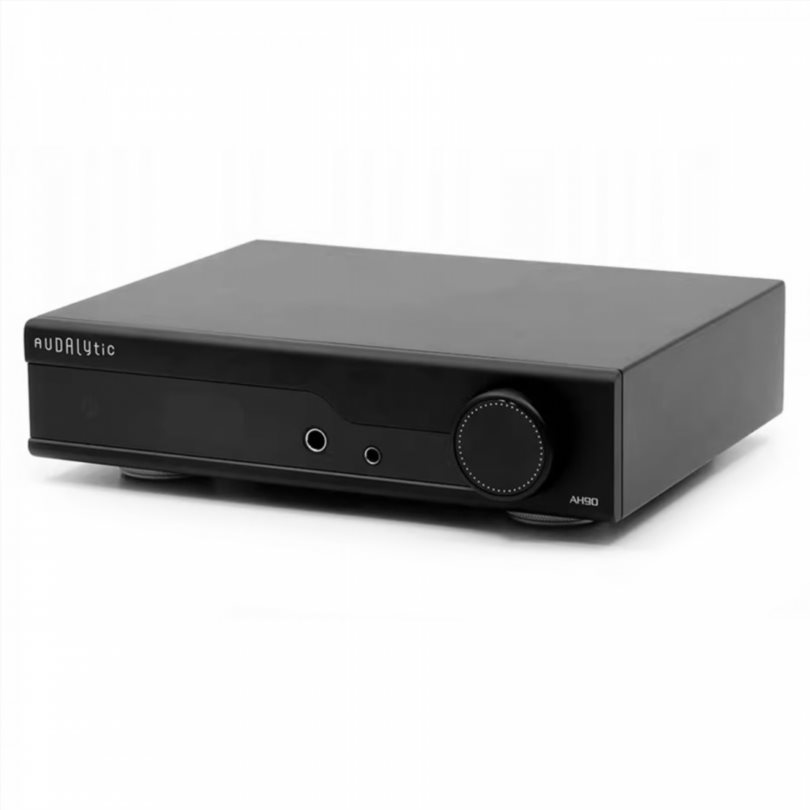
A DAC built around AKM’s AK4499EX platform
At the centre of the AH90 is an AKM AK4499EX DAC chip. A DAC’s job is to turn the numerical data in a digital music file or stream into the analogue signal that an amplifier and loudspeakers—or headphones—can use. The converter chip is important, but it is only one part of that process: power supply design, clocking, digital processing and the analogue output stage all influence how effectively a finished DAC performs.
The AH90 is specified to accept PCM up to 32-bit/768kHz and native DSD512 through USB and LAN. These maximum figures provide substantial format headroom for owners with high-resolution downloads or local music libraries. They should not, however, be read as a guarantee that higher sample rates automatically improve every recording; the quality of the master and the implementation of the playback chain remain more consequential than a format’s headline resolution.
For optical and coaxial S/PDIF sources, the limits are PCM up to 24-bit/192kHz and DSD via DoP up to DSD64. That is consistent with the lower bandwidth available through those established interfaces. Optical remains useful where electrical isolation between source and DAC is desirable, while coaxial is often found on CD transports, streamers and older digital components. The two coaxial inputs are particularly welcome in a system with more than one such source.
The supplied information also lists MQA support on USB/LAN and optical/coaxial inputs. MQA is a format and processing system encountered on certain files and services; its presence may matter to listeners with existing MQA material, though prospective buyers should check the currently available service support and the exact behaviour of their preferred playback software before making it a deciding factor.
FPGA processing and clocking: why jitter is part of the design story
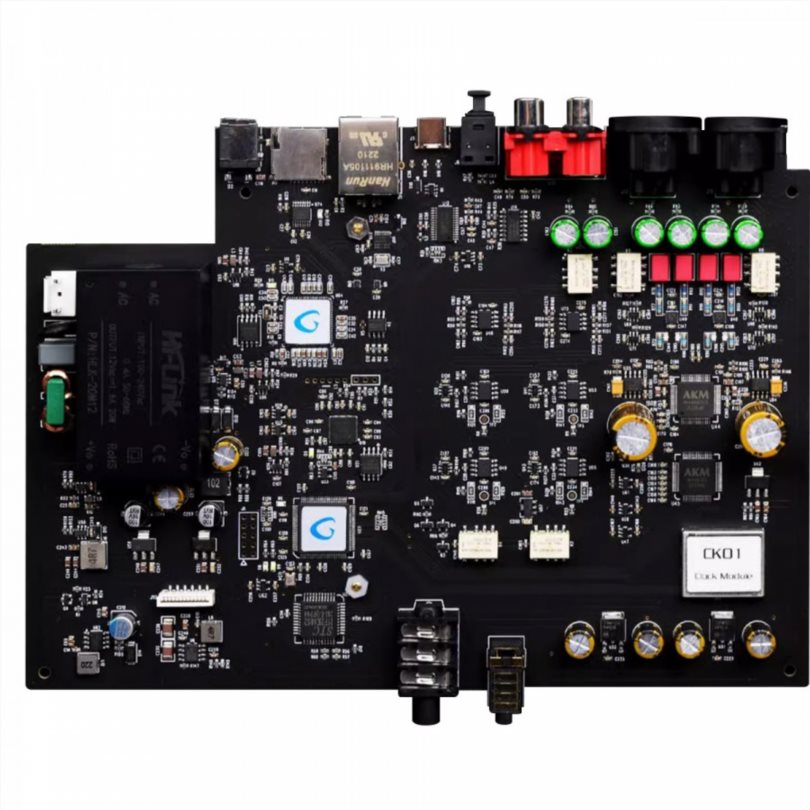
Audalytic says the AH90 uses a custom-programmed FPGA—field-programmable gate array—for clock-signal processing, fed by its CK-01 clock generator. An FPGA is a reconfigurable logic device that can be programmed for dedicated digital-audio tasks. In a DAC, that can include managing incoming data, digital filtering and timing-related operations before the signal reaches the converter stage.
The stated aim is to reduce jitter. Put simply, jitter is timing variation in the digital signal: conversion must occur at extremely regular intervals, so unwanted uncertainty in that timing is something DAC designers work to minimise. It is not a specification that can be judged meaningfully from a description alone—measurements would be required to quantify the result—but the use of dedicated clocking and FPGA-based processing indicates that Audalytic is treating timing control as a distinct part of the AH90’s architecture rather than relying solely on the incoming source clock.
This is especially relevant in a multi-input DAC. USB, network and S/PDIF inputs all deliver audio in different ways, and a well-designed internal timing strategy is intended to ensure that the converter receives a stable, appropriately managed data stream regardless of source. The published frequency response is 20Hz–20kHz, ±0.5dB.
Network playback makes the AH90 more than a USB DAC
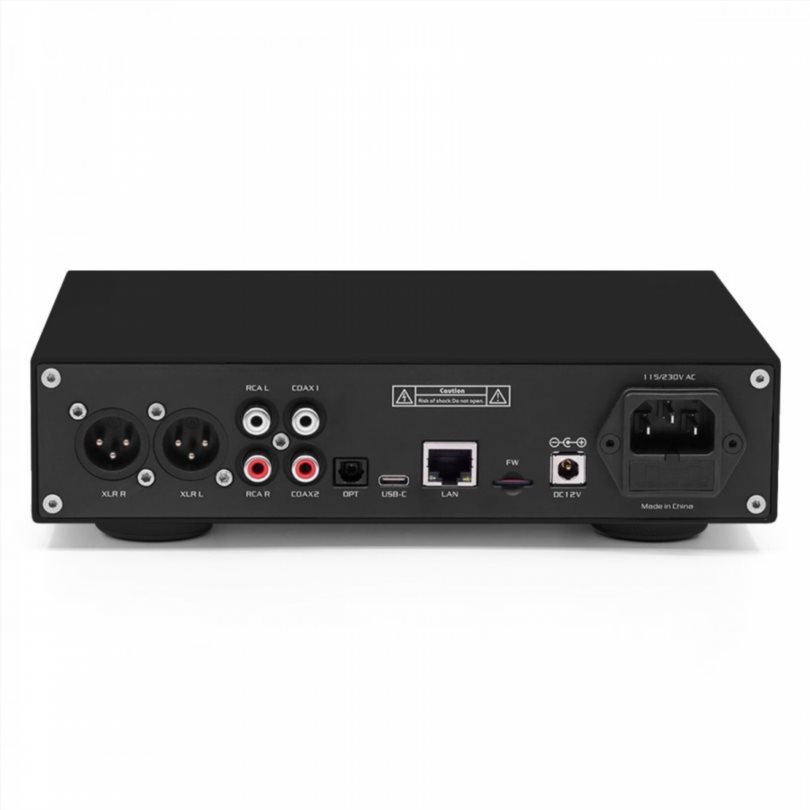
The rear-panel RJ45 Ethernet port enables the AH90’s streamer function. It supports DLNA, AirPlay and Roon, allowing music to be sent across a local network from compatible computers, smartphones and network-attached storage. A wired Ethernet connection is generally the sensible option for a fixed hi-fi component: it avoids depending on the quality and congestion of a home Wi-Fi network and provides a stable link for high-resolution local playback.
DLNA support is useful for browsing and playing files from compatible media-server software or NAS drives. AirPlay offers straightforward playback from Apple devices and compatible applications, while Roon support will appeal to listeners who use Roon’s library-management and multi-room ecosystem. The supplied specifications do not identify a dedicated control app, Wi-Fi provision, built-in streaming-service integration or support for platforms such as Spotify Connect, Tidal Connect and Chromecast. Those details are worth confirming for anyone whose listening is centred on a particular service rather than local library playback.
There is one point of uncertainty in the supplied material: the body copy calls the computer input USB-C, while the specifications list one USB-B input. As these are physically different connector types, buyers should verify the final rear-panel connection with the retailer or manufacturer. The important technical point is that the USB input is said to use a third-generation XMOS XU316 interface, a modern USB-audio controller platform capable of handling the AH90’s stated high-resolution PCM, DSD and MQA formats.
Headphone and line-level connectivity
The AH90 has two analogue line outputs: unbalanced RCA and balanced XLR. Its specified output levels are 2Vrms on RCA and 4Vrms on XLR, which are conventional nominal levels for domestic hi-fi connections. RCA will suit the vast majority of integrated amplifiers, active loudspeakers and preamplifiers. XLR is useful where the partnering amplifier provides balanced inputs, particularly when longer cable runs are necessary or where a system is designed around balanced connections.
These figures describe line-level output rather than power output, so they do not by themselves indicate how loud a system will play. Loudspeaker volume remains dependent on the downstream amplifier, speaker sensitivity, room and listening distance. Similarly, the specifications supplied do not establish whether the AH90’s line outputs operate at fixed or variable level; that is an important detail to confirm before connecting it directly to active speakers or a power amplifier.
For private listening, the integrated headphone amplifier provides a 6.35mm single-ended socket and a 4.4mm balanced socket, together with two gain settings. Gain selection matters because headphones vary dramatically in sensitivity and impedance. Lower gain can offer more usable volume-control range with sensitive headphones and in-ear monitors, while higher gain is intended to provide additional voltage swing for less sensitive designs. Audalytic does not state headphone power into particular loads in the supplied specifications, so it is not possible to determine from the available information how it will drive especially demanding planar-magnetic or high-impedance headphones.
The presence of a 4.4mm balanced socket should also be interpreted carefully. It requires a headphone cable terminated for 4.4mm balanced operation; it is not appropriate to attach ordinary single-ended headphones through an unsuitable adaptor. Balanced headphone operation can offer separate signal returns for each channel, but the real-world benefit depends on the amplifier’s circuit implementation and the headphones in use, not the connector alone.
System fit, power options and what to check before buying
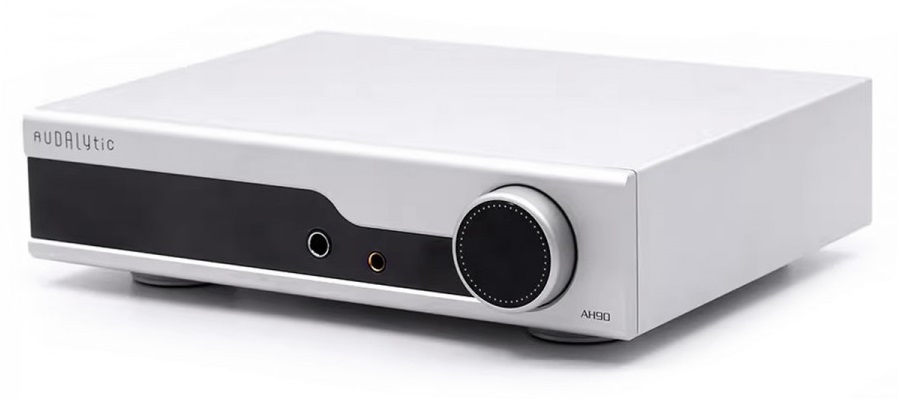
With its compact footprint, black or silver finish, line outputs and network capability, the AH90 is most naturally positioned as a digital control point for a small-to-medium system. It could feed an integrated amplifier and passive loudspeakers, connect to active speakers on a desk, or replace separate USB DAC and network-renderer boxes in a headphone setup. Its two coaxial inputs also make room for a disc transport and another S/PDIF source alongside a computer and network connection.
The unit can be powered from 100–240V AC or 9–15V DC according to the supplied specification. That may be helpful for installations where DC power is preferred, but prospective owners should confirm the supplied power arrangement and any requirements for an external DC supply rather than assuming one is included.
What stands out is the attempt to cover several digital-audio roles without increasing box count: high-resolution USB playback, network rendering, conventional S/PDIF connectivity, balanced line output and balanced headphone listening are all included. The trade-off is that several ownership-critical details are not contained in the available information, including volume-control behaviour on the line outputs, headphone output power, streaming-service implementation and the final USB connector type. Those are the right questions to answer before choosing the AH90 for a particular system.
Audalytic AH90 specifications
- Product type: DAC
- DAC chip: AKM AK4499EX
- Inputs: 1 × Ethernet RJ45, 1 × USB-B, 1 × optical Toslink, 2 × coaxial
- Outputs: 1 × balanced stereo XLR, 1 × single-ended stereo RCA
- Headphone outputs: 4.4mm balanced and 6.35mm single-ended
- USB / LAN support: PCM up to 32-bit/768kHz; native DSD up to DSD512; DSD DoP up to DSD256; MQA
- Optical / coaxial support: PCM up to 24-bit/192kHz; DSD DoP up to DSD64; MQA
- Frequency response: 20Hz–20kHz, ±0.5dB
- Output level: RCA 2Vrms; XLR 4Vrms
- Supply voltage: 100–240V AC or 9–15V DC
- Dimensions: 220 × 170 × 50mm
- Colours: Black or silver