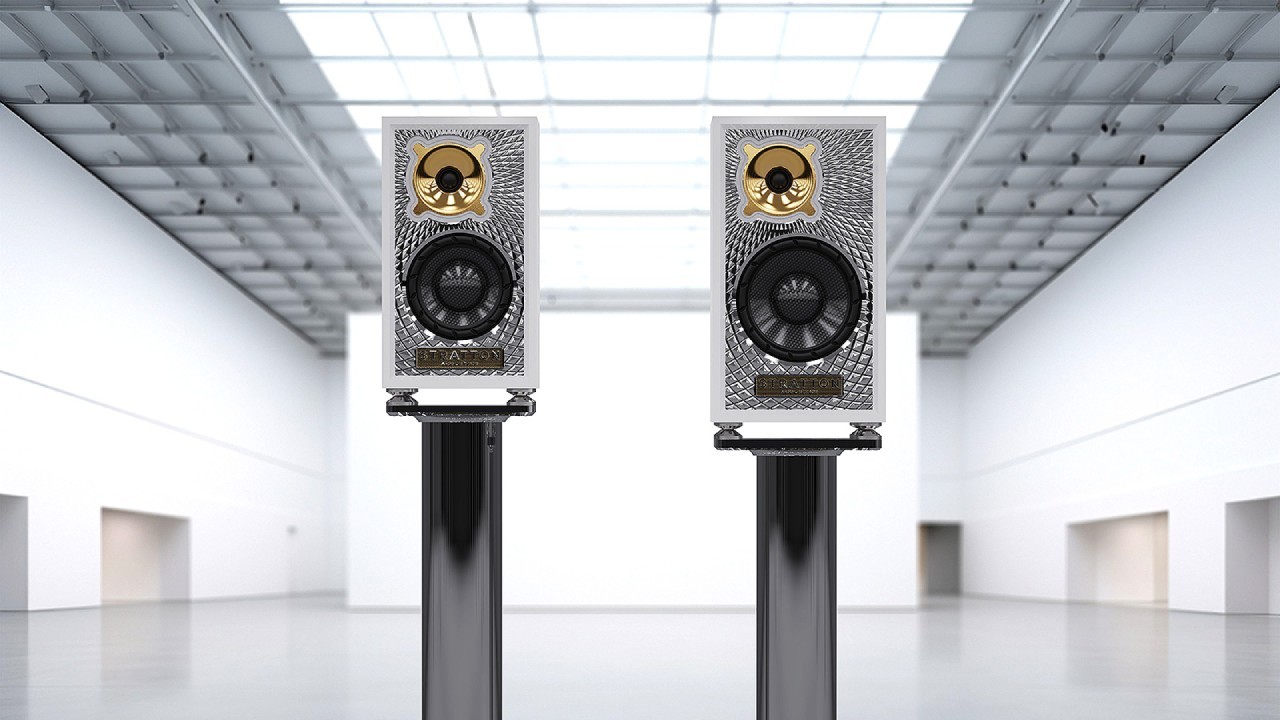
Stratton Acoustics has used the Axpona audio fair to unveil the Element 6 and Element 8, a pair of compact loudspeakers intended to broaden the British manufacturer’s range below its larger Elypsis 1512 and Element 12 models. They are the company’s third and fourth loudspeaker models, and represent its entry-level offerings—though with pricing of £15,000 and £20,000 per pair respectively, they remain firmly positioned in the high-end standmount market.
The key proposition is not simply a smaller cabinet. Stratton is applying several of the construction ideas used in its larger speakers to models intended for smaller to medium-sized rooms, as well as nearfield installations in the Element 6’s case. Both use a 29mm soft-dome tweeter with a waveguide, a carbon-fibre midrange/woofer, CNC-machined aerospace-grade aluminium baffles and cabinets formed from an acrylic-silica polymer matrix. The Element 8 adds a larger bass driver and a bass-reflex alignment with an unusual dual resistive-port arrangement.

Two sizes, two system roles
The Element 6 is the more compact of the two new models and employs a 6-inch carbon-fibre midrange/woofer. In conventional two-way loudspeaker terms, a driver of this size is a logical choice where listening distance and room volume are limited: it can cover the crucial bass-to-midrange region without requiring the physical scale of a large standmount or floorstander. Stratton specifically positions it for smaller rooms and nearfield listening.
Nearfield use places particular demands on a loudspeaker. At a desk or in a compact dedicated listening space, the direct output from the drivers has a greater influence than the room’s reflected sound, so driver integration, dispersion and cabinet control become especially important. A carefully implemented waveguide can be useful here because it shapes how the tweeter radiates into the room and can help it blend with the midrange/woofer around the crossover region. Stratton says its 29mm soft-dome tweeter is decoupled and waveguide-loaded for wide dispersion and accurate imaging.
The Element 8 moves to an 8-inch version of the carbon-fibre driver. The extra cone area should, in principle, give the designer more scope for low-frequency output and dynamic headroom than a 6-inch unit, which is why Stratton positions this larger speaker for bigger rooms and listeners seeking more substantial bass. That is a physical advantage rather than an automatic guarantee of a particular bass extension or maximum output; Stratton has not supplied frequency-response, sensitivity, impedance or power-handling figures in the launch information. Those specifications will be important for prospective owners assessing amplifier compatibility and room suitability.

Cabinet materials and baffle engineering matter
Both Element models use an enclosure made from an acrylic-silica polymer matrix, with a CNC-machined baffle in aerospace-grade aluminium. The cabinet is not merely a cosmetic shell around the drive units: its job is to provide a stable mechanical reference while avoiding storing and re-radiating energy that can blur low-level detail. Loudspeaker cabinets can vibrate in response to the drivers’ back pressure and reaction forces, and their panels can contribute delayed, frequency-specific colouration if they are insufficiently controlled.
Stratton’s choice of a polymer matrix and a substantial aluminium front baffle suggests an approach focused on stiffness, mass and damping rather than a conventional all-MDF construction. Aluminium is especially useful around the driver mounting area because it can provide a rigid, precisely machined surface, while a composite cabinet material may be selected to manage resonance differently from metal or wood-derived panels. The exact internal bracing, damping treatment and crossover construction have not been detailed, so it would be premature to draw conclusions about the final acoustic behaviour. Still, the material combination is central to the Element range’s engineering identity.
The 29mm tweeter is also said to be decoupled from the enclosure. Decoupling generally means the manufacturer is seeking to reduce the transfer of cabinet vibration into the tweeter assembly. High-frequency drivers work with very small diaphragm movements, so limiting unwanted mechanical energy at the mounting point can be meaningful in a design pursuing clean treble and stable stereo focus. The supplied information does not describe the specific decoupling mechanism, but the intended purpose is clear.
Element 8 uses dual resistive bass ports
The Element 8 is specified as a bass-reflex design with dual resistive port openings. In a typical reflex speaker, the port and the air volume inside the cabinet form a tuned system that supports bass output around a chosen frequency. It is an efficient way to obtain useful low-frequency extension from a compact enclosure, but conventional ports can introduce their own audible signatures. Air turbulence, pipe resonances and a mismatch between the port’s contribution and the main driver can all make bass seem less clean or less well controlled.
Stratton says its dual resistive ports are designed to minimise tube resonance and avoid port colouration, with the goal of fast, melodic bass. A resistive port approach introduces acoustic resistance rather than relying solely on the behaviour of an open tube; broadly speaking, this can be used to control resonant behaviour and reduce the prominence of the port itself. How effectively that works depends on the final tuning, enclosure volume and driver parameters, none of which have been published here. What is clear is that the Element 8 is not presented as a simple scaled-up version of the Element 6: its bass system is part of the larger model’s intended role.
In practical installation terms, the Element 8’s low-frequency behaviour will still be influenced by its distance from rear and side walls. Reflex-loaded speakers commonly benefit from some experimentation with placement, as room boundaries reinforce bass and can make particular frequencies over-prominent. The appropriate final position will depend on the room and listening seat, rather than a universal measurement. Buyers should also establish whether Stratton provides recommended wall clearances when ordering.

Dedicated stands are part of the intended installation
Alongside the speakers, Stratton has introduced Element Stands, priced at £3,500 per pair. They are made from aerospace-grade aluminium and have been designed to match the speakers visually, but their relevance is more than aesthetic. A standmount speaker needs a support that places the tweeter at an appropriate height relative to the seated listener, provides a stable platform and limits unwanted movement. A poorly matched stand can undermine imaging, bass definition and the repeatability of setup.
Stratton says the stands are engineered for rigidity, stability and vibration control, while reducing floor interference. That latter phrase should be understood in the context of a speaker’s mechanical relationship with the floor and the nearby boundaries: a stable, well-sited stand can help preserve the geometry of the stereo pair and reduce the likelihood of the support adding its own obvious resonance. The final result will depend on the floor construction and on how the stands are installed. The launch details do not state their height, mass, interface method or whether they are supplied with spikes, feet or a dedicated speaker-fixing arrangement.
For either Element model, matching left and right speaker positions, equalising their distance to the listening seat and carefully setting toe-in should be fundamental parts of setup. The wide-dispersion waveguide arrangement may offer flexibility in off-axis listening, but it does not remove the need to experiment with orientation. Small changes in toe-in alter the balance of direct and reflected high-frequency energy, and can change the perceived width, centre focus and tonal balance of a stereo image.
Finish, manufacture and pricing
All of Stratton’s models are built in the UK by the company’s artisan builders. At launch, the Element 6 and Element 8 are offered in a high-gloss piano lacquer finish with silver baffles, with further finishes planned. The visual contrast between the lacquered cabinet and machined metal baffle gives these speakers a more overtly sculptural appearance than many conventional box loudspeakers, an important consideration in the sort of living-room systems where a £15,000-plus standmount is likely to be used.
Founder David Fowler said: “These latest models reflect our dedication to designing speakers that deliver not only exceptional sound quality but also aesthetic appeal. While the Element 6 and Element 8 are compact, they do not compromise on performance. They are designed for music enthusiasts who seek to immerse themselves in the emotional depth of music while appreciating precision engineering and enduring beauty.”

Which Element model is likely to suit your room?
On the available information, the Element 6 is the more natural candidate for a small room, a system where speakers must sit relatively close to the listener, or an installation where compact proportions are a priority. Its 6-inch midrange/woofer should also make it the sensible starting point where the room itself is likely to reinforce bass strongly.
The Element 8 is aimed at listeners with more space to fill and a desire for greater low-end weight and dynamic scale from a standmount format. Its 8-inch driver and dual resistive bass ports distinguish it as the more ambitious low-frequency design, although its ultimate suitability will depend on room size, placement freedom and amplifier matching. Before purchase, enthusiasts should seek the missing electrical and acoustic specifications—especially nominal impedance, sensitivity, recommended amplifier power and frequency response—and ideally arrange a dealer demonstration in a system relevant to their own.
The Stratton Acoustics Element 6 costs £15,000 per pair. The larger Element 8 costs £20,000 per pair, while the matching Element Stands are available separately for £3,500 per pair.