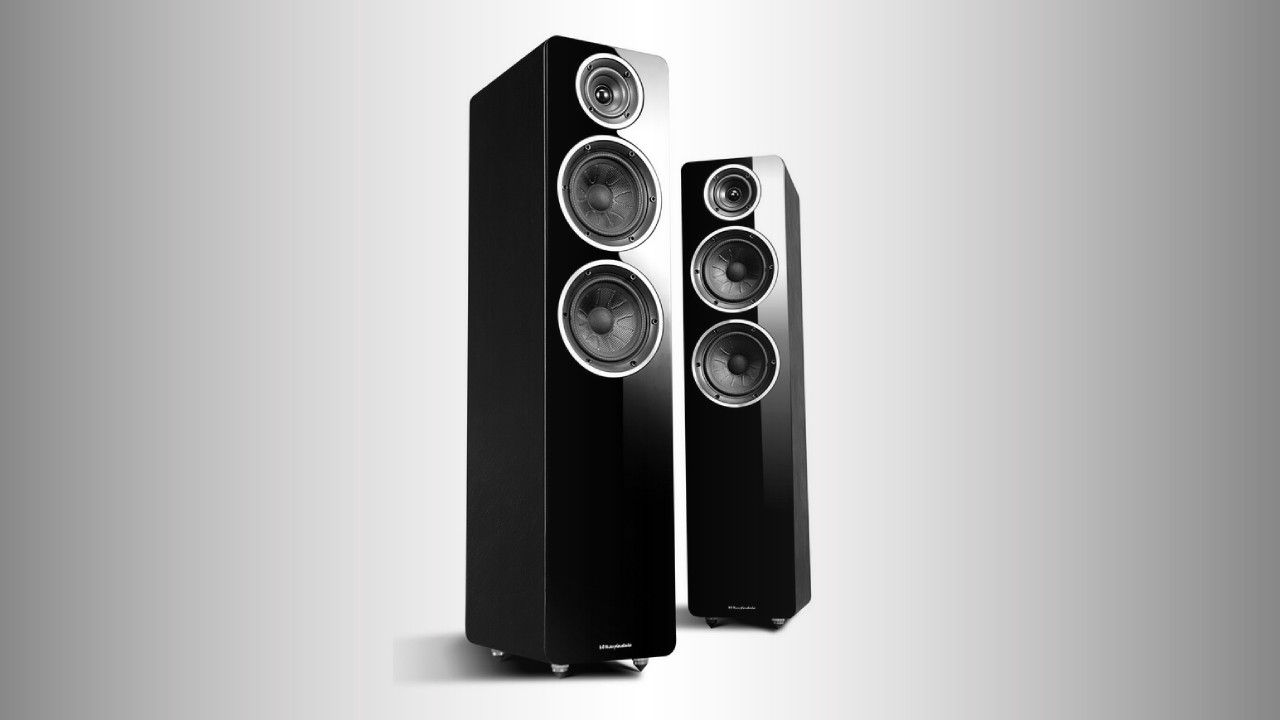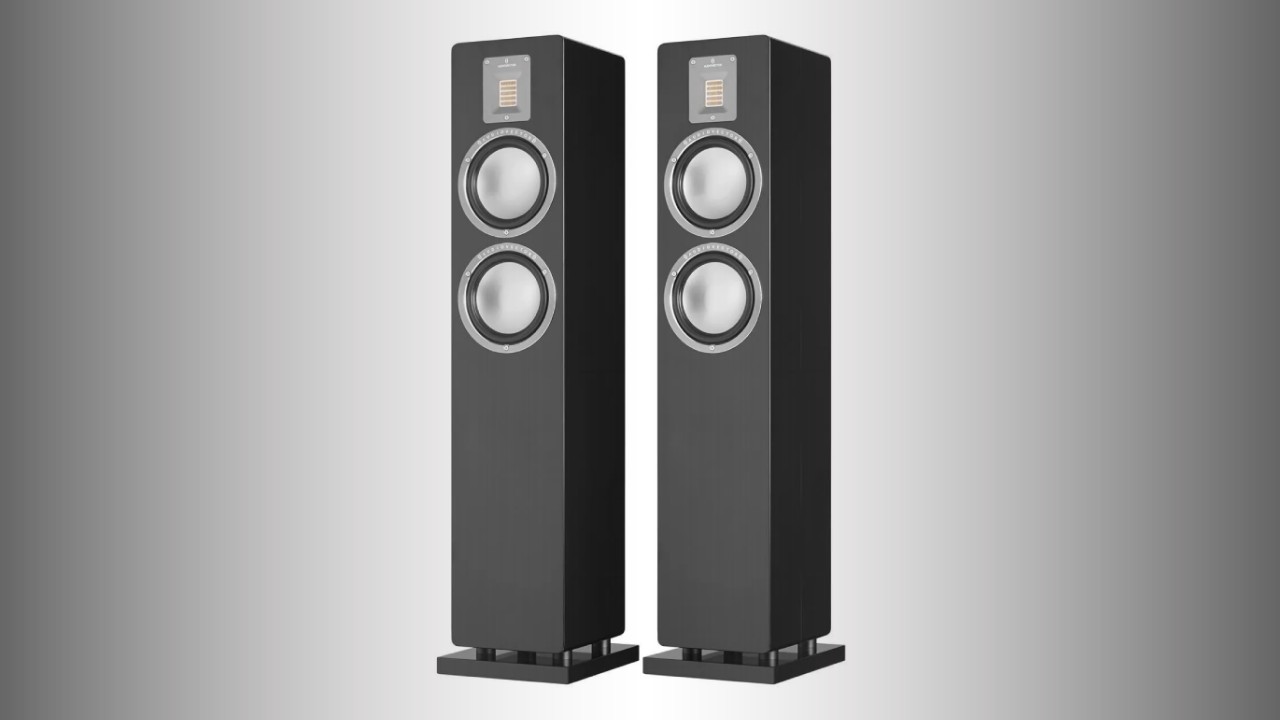
The Audiovector QR3 is a relatively slim floorstanding loudspeaker built around an appealingly purposeful brief: deliver the scale, low-frequency weight and dynamic headroom associated with a larger multi-driver design without imposing a large cabinet on the room. It is a three-driver, 2.5-way bass-reflex design, using two 150mm bass/midrange units and Audiovector’s AMT Gold Leaf high-frequency driver.
On paper, its 190 x 942 x 232mm dimensions make it a notably compact floorstander, while its claimed 90dB sensitivity, 8-ohm nominal impedance and 4-ohm minimum impedance suggest a speaker that should be broadly amplifier-friendly, while still rewarding an amplifier with decent current capability. The QR3’s stated frequency range is 30Hz to 45kHz, and it is rated for up to 200W input power.
Those figures only tell part of the story. The QR3 is interesting because its engineering addresses several of the hard parts of compact floorstander design: how to share bass duties without congesting the midrange, how to control a metal-cone driver at higher output, and how to obtain the speed and dispersion benefits of an AMT tweeter without making treble balance needlessly aggressive.
A 2.5-way layout designed to keep the midrange clear
The QR3 uses a 2.5-way crossover arrangement rather than a conventional three-way layout. Both 150mm drivers operate together at low frequencies, where moving more air matters most and musical energy is greatest. The lower driver is filtered at 800Hz, leaving the upper driver to continue through the midrange before handing over to the tweeter at 3,000Hz.
This is a common but effective way of extracting greater bass output and power handling from a narrow enclosure. Two drivers working in parallel in the bass region offer more radiating area than one, which can help a compact cabinet energise a larger room. Above 800Hz, however, only the upper unit remains active. That avoids having two separated drivers reproducing a broad span of midrange information, where their physical spacing can otherwise affect dispersion and create interference away from the central listening axis.
In practical terms, the arrangement aims to give the QR3 the weight and dynamic authority expected from a floorstander while retaining the coherence of a single midrange source. The 3,000Hz handover point to the AMT tweeter is also high enough that the 150mm upper driver is responsible for much of the vocal band, an area where crossover execution and driver behaviour are especially audible.

Sandwich-cone drivers and a dual-magnet motor system
The QR3’s 150mm cones use a sandwich construction: two thin aluminium skins surround a porous polymer core. In loudspeaker engineering, this is a useful route to high stiffness without the mass penalty of a solid metal diaphragm. A rigid cone is less likely to flex across its surface as frequency and level rise, helping it behave more like an ideal piston over its intended operating range.
Audiovector also gives the cone a concave hemispherical profile. The combination of shape and sandwich structure is intended to maintain rigidity at elevated signal amplitudes. That matters in a 2.5-way speaker because the bass drivers are asked to produce substantial low-frequency excursion, while the upper unit must remain clean enough to reproduce midrange detail.
Driver distortion is influenced not only by the cone but also by the motor system that moves it. Here, Audiovector specifies a dual magnetic system intended to keep the magnetic field consistent through the voice coil’s working travel. A more stable field can reduce changes in driving force as the cone moves, which is particularly relevant at higher levels and in the bass, where excursion is greatest. Robust suspensions are also specified, helping to keep the cone’s movement controlled.
None of this automatically guarantees a particular sonic character, but it explains the QR3’s technical priorities: retain composure when the music demands impact, while avoiding the midrange thickening or strain that can occur when a single small driver is required to cover too much ground.
What the AMT Gold Leaf tweeter brings
The QR3’s AMT Gold Leaf tweeter is the speaker’s most distinctive feature. AMT stands for Air Motion Transformer, a principle in which a folded diaphragm squeezes and expands the air between its folds rather than moving as one flat surface. The very low-mass fluoroplastic ribbon used here is aluminium-coated and described as weighing only 15 to 20mg. Its folded structure provides a radiating area comparable to that of an 8in driver.
The important point is not simply the very high claimed operating limit—Audiovector says the bare AMT unit can work to 150kHz—but the mechanism’s potential for fast transient behaviour. The folded diaphragm moves air at a substantially higher effective velocity than the diaphragm itself travels. This can be valuable with the leading edges of percussion, plucked strings and other rapidly changing signals, where clean transient response contributes to a sense of articulation.
Wide horizontal dispersion is another usual attraction of a well-implemented AMT. Traditional dome tweeters progressively beam as frequency rises; an AMT’s geometry can maintain broader directivity across much of its operating range. That can make the tonal balance less dependent on sitting absolutely on-axis, while also increasing the contribution of room reflections. The latter is neither inherently good nor bad: it makes speaker positioning and room furnishings more relevant.

The S-Stop mesh is more than decoration
Audiovector acknowledges a potential trade-off with this type of fast, extended treble driver. Highly revealing high-frequency units can expose sibilance, microphone edge and compression artefacts in recordings that already emphasise “s”, “sh” and “t” sounds. Rather than leave the AMT entirely unrestricted, the QR3 places an S-Stop filter in front of it.
This is a fine, dense, gold-plated mesh that selectively absorbs part of the upper-frequency output. With the filter in place, the stated upper limit becomes 45kHz rather than 150kHz. That is still well beyond the audible band and beyond the high-frequency content of standard CD, so the aim is not to withhold musically useful treble extension. It is to control the tweeter’s behaviour where the designer considers it most beneficial, potentially preserving transient clarity while moderating unwanted emphasis.
The substantial front flange, carrying the Audiovector logo, is made from aircraft-grade aluminium and anodised in a titanium-like finish. Beyond providing a visual focal point, a rigid mounting structure is desirable around a tweeter because it provides a stable mechanical interface between driver and baffle.

Q-port loading and a deliberately simple crossover
Rather than placing a conventional round reflex port on the front or rear panel, Audiovector routes the QR3’s bass-reflex output through a narrow slot at the bottom of the cabinet. Air exits into the gap between the enclosure and its lower platform. The company calls this a Q-port, referring to its intended role in optimising the system’s quality factor, or Q.
In a bass-reflex loudspeaker, the port and cabinet volume are tuned to support the bass driver over a chosen frequency region. The details of that tuning affect bass extension, output, transient behaviour and the way the speaker interacts with the room. A downward-firing slot also means the port does not fire directly at the rear wall, as it does on many rear-ported speakers. That may make placement somewhat less visually and practically awkward in a living room, although it should not be read as a licence to push the QR3 tightly into a corner: low bass remains strongly affected by room boundaries regardless of port direction.
The supplied listening observations describe a robust, deep low end with sharp dynamic impact, and note that the twin-driver system can energise a substantial space. As always, final bass quantity will depend heavily on room size, speaker distance from boundaries and listening position. The QR3’s compact footprint makes it easier to try several locations than a large floorstander, and that experimentation is likely to be worthwhile.
Audiovector says its crossover networks are intentionally simple, with the aim of reducing component losses and phase shift. Fewer crossover components can be advantageous if the individual drivers are sufficiently well behaved over their assigned ranges; every component adds electrical resistance, reactance and another variable to manage. The necessary compromise is that this approach places considerable importance on the natural roll-off and controlled behaviour of the drive units themselves.
The QR3 has a single pair of input terminals. There is therefore no facility for bi-wiring or bi-amping the speaker through separate high- and low-frequency terminals. For most systems this is no hardship: one properly terminated, sensibly specified speaker cable per channel is all that is required.

Amplifier matching, placement and room setup
The quoted 90dB sensitivity at 2.83V/1m is a useful starting point. It indicates that the QR3 should reach healthy levels with many integrated amplifiers, rather than demanding extreme wattage. However, its minimum impedance is specified at 4 ohms, so an amplifier should be comfortable driving a load that may ask for more current than a purely 8-ohm speaker. A genuinely capable integrated amplifier or power amplifier with a stable 4-ohm rating is the sensible match, especially in a larger room or for listeners who value realistic orchestral and rock dynamics.
The 200W maximum input figure should not be mistaken for a recommendation to use a 200W amplifier. Loudspeaker power ratings do not describe a fixed required amplifier output. Clean power and control are more important than chasing a number, while clipping a lower-powered amplifier can be more damaging to a tweeter than using a more powerful amplifier responsibly.
Placement deserves particular attention because of the AMT’s broad treble dispersion and the QR3’s floor-facing reflex vent. Start with the speakers well clear of immediate side-wall reflections where possible, with equal distance to the main listening position, then adjust toe-in gradually. The supplied assessment notes that, in a softly furnished room, high frequencies can seem slightly subdued. Angling the QR3s further inward can restore more direct high-frequency energy at the listening seat, though greater toe-in may narrow the perceived soundstage.
That is a familiar setup balance. Less toe-in generally increases the proportion of reflected sound and can create a broader presentation; more toe-in gives the listener more direct treble output and often stronger centre-image focus. There is no universal right setting, particularly with an AMT. Use familiar voices, cymbals and acoustic instruments, and make small symmetrical adjustments before deciding where the compromise between openness, tonal balance and image width works best in the room.

Finishes, footprint and the QR3’s appeal
The QR3 is available in black lacquer, dark walnut veneer and matte white. Its grilles attach magnetically, avoiding visible fixing holes on the front baffle when they are removed. At 15.7kg each, these are manageable floorstanders, but they should still be installed carefully and levelled using their spikes. Properly coupling or levelling a speaker on its supports is not cosmetic: a stable cabinet is essential for consistent imaging, and the required floor protection should be used on wood, tile or other vulnerable surfaces.
The original listening notes praise the authenticity and harmonic detail of cymbals, along with forceful bass dynamics, and suggest the QR3 is capable across material ranging from symphonic music to hip-hop and progressive metal. Those observations align with the design’s intended strengths: an AMT tweeter chosen for speed and high-frequency openness, twin bass drivers for scale, and a 2.5-way division of labour intended to keep the midband from becoming overworked.
The QR3 will be most compelling for listeners who want a physically discreet floorstander but do not want to forgo bass reach or dynamic capability. Its single-wire connection arrangement keeps installation straightforward, while its 4-ohm minimum impedance means partnering electronics should be selected with more care than the 90dB sensitivity alone might imply. Most importantly, it is a speaker that appears to reward careful toe-in and room positioning—an investment of time that can matter as much as any cable or accessory change.
Audiovector QR3 specifications
- Configuration: 3 drivers, 2.5-way
- Acoustic design: bass reflex
- Frequency range: 30Hz–45,000Hz
- Sensitivity: 90dB (2.83V/1m)
- Nominal / minimum impedance: 8 / 4 ohms
- Crossover frequencies: 800Hz, 3,000Hz
- Maximum input power: 200W
- Finishes: black lacquer, dark walnut, matte white
- Dimensions with spikes (W x H x D): 190 x 942 x 232mm
- Weight: 15.7kg each