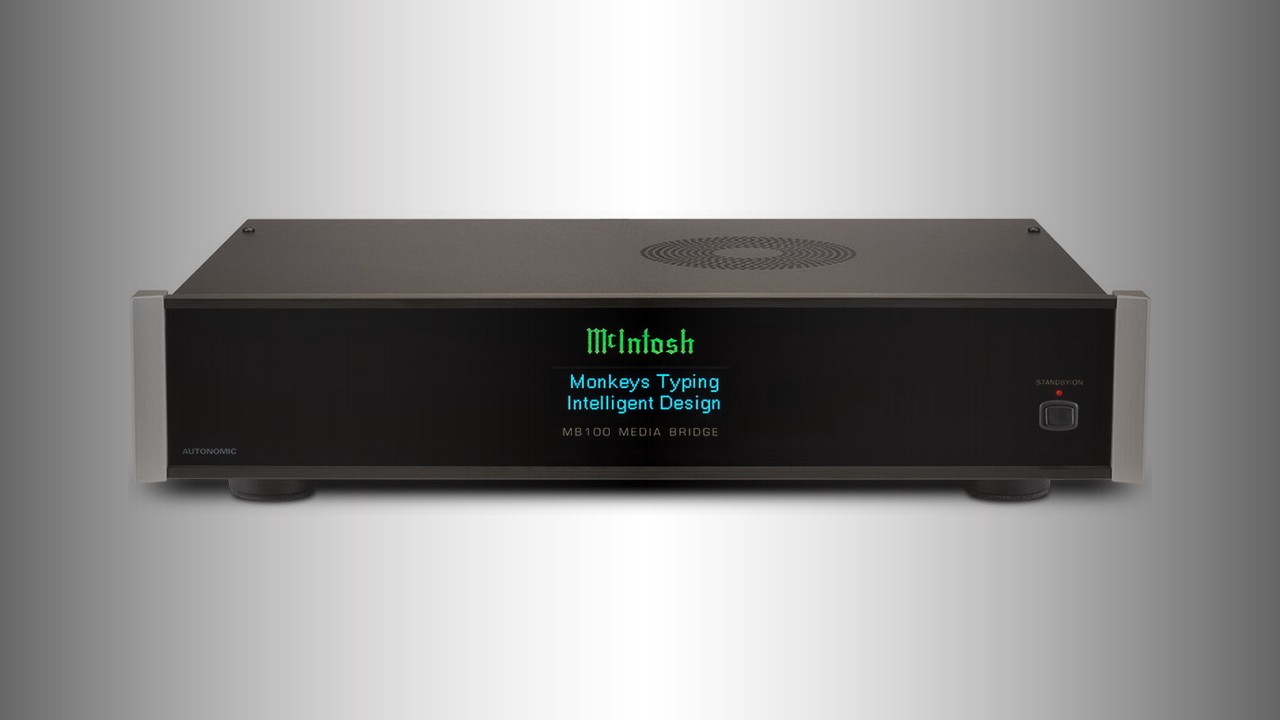
The McIntosh MB100 is a network music server and digital media player built around a simple idea: make locally stored files, network-held music and online services available from one component, then deliver them to a hi-fi system through proper analogue and digital outputs. Its name, Media Bridge, is revealing. Rather than being a conventional CD player or an amplifier with streaming added, the MB100 is intended to sit between a household’s digital music library and the preamplifier, integrated amplifier or external DAC already at the centre of the system.
That remains a useful proposition for listeners with substantial computer-audio libraries. The MB100 combines a built-in 1TB hard drive with provision for USB and eSATA expansion, network content discovery and app-based iOS/Android control. It also includes balanced XLR and unbalanced RCA outputs, allowing it to work as a complete network source via its internal DAC, while optical and coaxial S/PDIF outputs make it possible to use an outboard converter instead.
Its approach is distinctly more installation-oriented than that of a small wireless streamer. The full-width McIntosh chassis, dedicated control connections and separate graphics outputs suggest a component intended to integrate cleanly into a serious rack-based system or a broader custom-installation environment.

A music library at the centre of the system
The MB100’s internal 1TB hard drive is its most obvious server feature. Capacity requirements naturally vary according to file format and library size: lossless CD-quality music requires materially more space than compressed files, while a collection of 24-bit high-resolution albums can consume it faster still. Nevertheless, 1TB provides a meaningful starting point for a locally managed library and means the MB100 does not depend solely on a computer being left running elsewhere in the home.
For users whose collections exceed the internal drive, McIntosh provides four USB ports and an eSATA connection for external storage. Of the USB connections, two are USB 2.0 and two are USB 3.0. This is important because storage expansion is not merely about adding capacity; keeping music on dedicated external drives can make library management, backup and future migration far more straightforward. eSATA was particularly useful for direct-attached storage, offering an alternative to USB for compatible drives.
The player can also discover content available on network devices automatically. In practical terms, that is intended to remove the need to copy every album onto the MB100 itself: music held on a network-attached storage device or another compatible shared source can be found and selected from the control app. A unified view of internal, attached and network-based music is the attraction of this server architecture, although the exact browsing experience will depend on the library’s metadata quality and the network devices in use.
McIntosh specifies playback of popular file formats, including high-resolution lossless files up to 24-bit/192kHz. That ceiling covers a wide range of PCM downloads and rips, and matches the maximum 24-bit/192kHz output specified for the player’s S/PDIF connection. It should not be read as a claim of support for every format or for DSD, as neither is specified here. For a prospective owner, the sensible step is to confirm support for the precise file types, tags and network-sharing methods used in their existing library.
App-led operation, not front-panel browsing
McIntosh gives the MB100 its familiar visual identity, but deliberately keeps the front panel minimal. There is only a two-line fluorescent display, with music selection and player control handled from a dedicated iOS or Android application. This makes sense for a library player: album artwork, search, playlists and service browsing are substantially more useful on a phone or tablet screen than on a narrow component display.
The trade-off is equally clear. The MB100’s day-to-day experience depends heavily on the control software and the continuing compatibility of the mobile devices and services it uses. A smartphone- or tablet-led interface can be elegant and immediate, but it is less self-contained than a source with full front-panel controls and display-led navigation. Buyers considering an older network component should establish the current status of its app and service support before purchase.
The supplied specification lists Pandora, SiriusXM, Spotify, Rhapsody, TuneIn, Amazon Cloud Drive and Apple iCloud among the supported services, alongside internet-radio access. These services illustrate the MB100’s ambition to unite personal ownership and cloud-based discovery in one interface. However, streaming platforms, account requirements and application support change over time; the list should therefore be treated as the platform’s stated service support rather than a guarantee that every named service remains available in every territory today.
McIntosh says the MB100 uses a motherboard from Autonomic, a company associated with professional media systems. Its operating system is stored on a high-speed hard drive, and the company describes the software organisation as providing rapid response to commands and stable playback from different sources. The engineering relevance is that a network player has two jobs: it must retrieve, catalogue and control media reliably, while keeping the electrically noisy computing processes from compromising the audio section. The MB100 attempts to address both.
DAC architecture and audio outputs
At the heart of the MB100’s audio section is an eight-channel, 32-bit/192kHz DAC, described as the same converter used in McIntosh’s D100 preamplifier. The specification states “2 x 4 balanced mode”. Multi-channel DAC devices are often used in two-channel products by assigning multiple converter channels to each left and right channel, a technique that can support a balanced output arrangement and potentially improve noise-related performance when implemented correctly. McIntosh does not provide a fuller circuit description here, so it would be wrong to infer the exact channel-paralleling or analogue-stage topology beyond that stated configuration.
More importantly, McIntosh says the DAC circuitry is completely isolated from the computing section. This is a meaningful design priority in a music server. Processor activity, storage access and network hardware all create high-frequency electrical noise; isolation is intended to reduce the opportunity for that activity to affect the sensitive conversion and analogue-output stages. Isolation alone does not define sound quality, but separating digital computing and audio circuitry is a sensible goal in a component that combines both roles.
The MB100 provides both balanced XLR and unbalanced RCA analogue outputs. Its specified output level is 4V from the balanced connection and 2V from the unbalanced connection, which are conventional line-level figures for connection to an amplifier or preamplifier. The 600-ohm specified output impedance applies to both balanced and unbalanced outputs. In a normal line-level system, this should be partnered with an amplifier input impedance substantially higher than the source’s output impedance; that relationship helps avoid level loss and unwanted frequency-response effects caused by the interconnect and input load.
Balanced XLR is particularly worthwhile where the receiving component has genuine balanced inputs, or where long cable runs make common-mode noise rejection useful. RCA remains the natural option for an integrated amplifier or preamplifier with single-ended inputs. The presence of both means the MB100 can be fitted into a broad range of traditional two-channel systems without an adaptor-led compromise.
For those who already own a preferred DAC, the optical and coaxial digital outputs offer an alternative signal path. Both are specified to output S/PDIF at up to 24-bit/192kHz. This flexibility matters because it allows the MB100 to remain the library, network and control hub while handing digital-to-analogue conversion to another component. Conversely, the MB100’s own DAC and analogue outputs allow it to be used directly as the digital source, keeping the system simpler.
Connections for a rack-based installation
The rear-panel connectivity is broader than the usual compact streamer. Alongside analogue XLR and RCA, and optical and coaxial digital outputs, the MB100 has HDMI and DVI-D outputs. These are explicitly for graphical user-interface output only, not audio or video playback. They can therefore be used to display the player’s on-screen interface on a suitable screen, but should not be confused with HDMI ARC, an AV input or a video-source output.
There is also USB provision for McIntosh-compatible devices, plus optional Power Control I/O, DATA I/O and an IR sensor input. These connections are relevant to system integration rather than audio quality. Power Control can allow suitably compatible McIntosh components to switch on and off together, DATA connections can support unified control behaviour, and an external IR receiver is helpful when the MB100 is installed inside a cabinet or equipment rack.
The MB100 is powered by an external DC supply. One practical benefit of an external supply is that the mains transformer and its associated electromagnetic fields can be kept out of the main audio chassis. It also means owners need to accommodate the supply itself when planning rack space and cable routing.

What the published measurements tell us
McIntosh specifies a frequency response of 2Hz to 22kHz within ±1dB. That indicates coverage beyond the conventional 20Hz–20kHz audible bandwidth, while the stated tolerance explains how closely the output is held to the reference level across that range.
The quoted signal-to-noise ratio is 102dB, dynamic range is 96dB, and harmonic distortion is 0.005%. These figures describe different aspects of the output stage. Signal-to-noise ratio concerns the level of the wanted signal relative to background noise; dynamic range describes the span between the noise floor and maximum level under the stated measurement conditions; and harmonic distortion indicates unwanted harmonic content introduced by the circuit. They are useful published reference points, though they do not replace independent measurements and must be compared only when test conditions are known to be equivalent.
Who the MB100 makes sense for
The MB100 is best understood as a network source for the listener who wants local storage, external-drive expansion and network discovery in the same full-size component. It is especially logical in a McIntosh system, where its styling, Power Control and DATA connectivity can help create a more integrated installation, but its standard XLR, RCA and S/PDIF connections also make it viable with other brands’ amplification and DACs.
Its core strength is flexibility of source handling rather than a single fashionable streaming protocol. Internal storage can suit a carefully curated collection; USB and eSATA permit growth; network discovery can expose music held elsewhere; and the DAC can either be used directly or bypassed through the digital outputs. That is a more modular proposition than a streamer that exists purely to receive a subscription service.
There are sensible caveats. No Ethernet or Wi-Fi connection details are included in the supplied information, so an installer or buyer should verify network requirements. Nor are the supported file types specified exhaustively. The mobile-control model and named streaming services should be checked for present-day compatibility, particularly when evaluating a unit on the used market. Those questions do not negate the MB100’s broad original feature set; they simply matter more for network products than for a purely analogue source.
McIntosh MB100 key specifications
- Frequency response: 2Hz–22kHz, ±1dB
- Signal-to-noise ratio: 102dB
- Dynamic range: 96dB
- Harmonic distortion: 0.005%
- DAC: Eight-channel, 32-bit/192kHz; 2 x 4 balanced mode
- Maximum playback resolution: Up to 24-bit/192kHz
- Digital output: S/PDIF up to 24-bit/192kHz
- Analogue output level: 4V balanced, 2V unbalanced
- Output impedance: 600 ohms, balanced and unbalanced
- Storage: 1TB internal hard drive; four USB inputs (two USB 2.0, two USB 3.0) and eSATA for external drives
- Outputs: Balanced XLR, unbalanced RCA, optical, coaxial, HDMI (GUI only), DVI-D (GUI only), USB for McIntosh-compatible devices
- Control and integration: iOS/Android control, optional Power Control I/O, DATA I/O and IR sensor input
- Dimensions (W x H x D): 445 x 98 x 406mm
- Weight: 6.1kg
In short, the McIntosh MB100 is a substantial digital-library component from an era when combining stored music, network access and online services in a single hi-fi chassis was a notably ambitious brief. Its internal storage, expansion options, isolated DAC section and flexible outputs are the features that remain most relevant to a system builder; its software and service ecosystem are the areas that warrant careful verification.