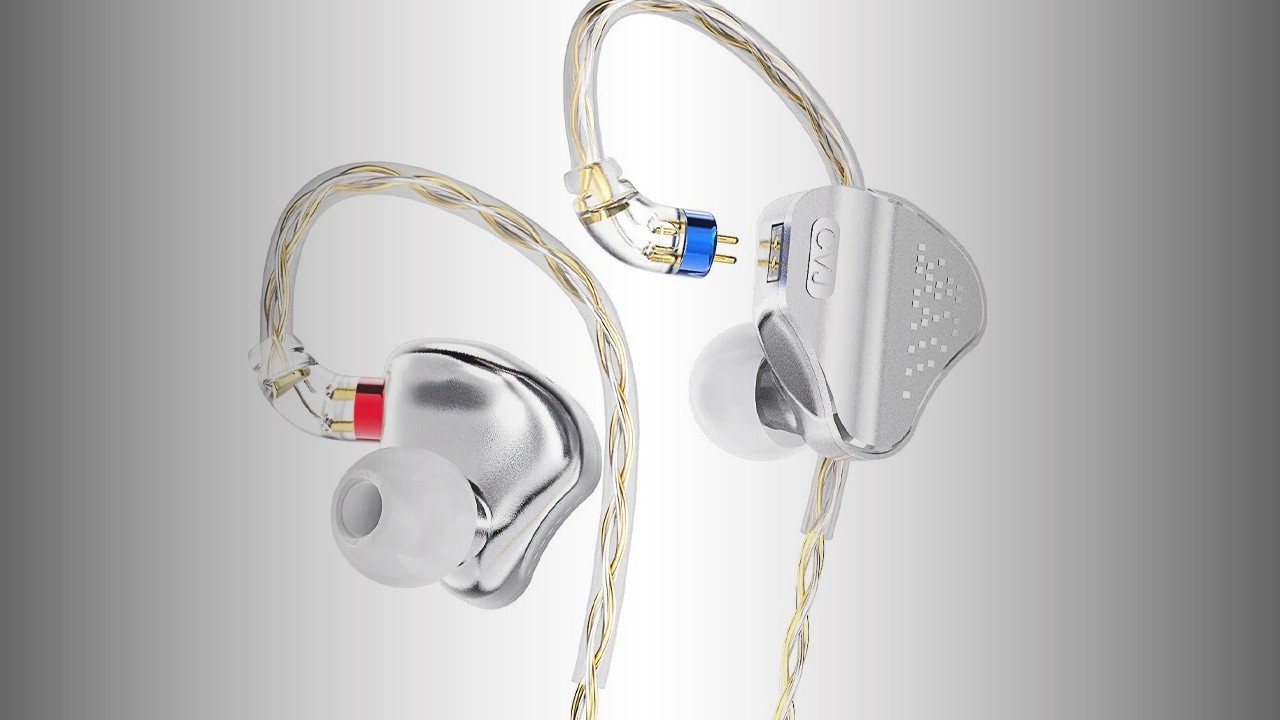
CVJ has announced the Bidong, a limited-edition hybrid in-ear monitor priced at $189. It is an ambitious driver-count design for the money: each earpiece combines one dynamic driver with six balanced armature (BA) drivers, with CVJ specifying a three-way crossover that is both electronic and physical in nature.
That specification matters because a seven-driver earphone is not simply a case of adding more transducers. The central challenge is making drivers with very different operating characteristics behave as one coherent loudspeaker at the ear. CVJ’s stated approach is to assign frequency regions through a three-way network, while also using physical acoustic measures within the earpiece. Whether the result is seamless will ultimately depend on crossover execution, acoustic damping, nozzle design and manufacturing consistency—not driver count alone—but the Bidong’s architecture is clearly intended to offer more targeted bandwidth coverage than a conventional single-driver IEM.

A hybrid array: one dynamic driver and six balanced armatures
The Bidong uses a 1DD+6BA configuration on each side. “DD” denotes a dynamic driver, the familiar moving-diaphragm principle also used in most headphones and loudspeakers. In a hybrid IEM, the dynamic driver is commonly used for low-frequency duties because its diaphragm can move a comparatively large volume of air. That makes it a natural candidate for bass and lower-midrange work, although CVJ has not published the individual driver allocation or crossover frequencies for the Bidong.
The remaining six drivers are balanced armatures. BA units are extremely compact transducers originally developed for applications where small size and high efficiency are valuable. In multi-driver earphones they can be selected and tuned for relatively narrow sections of the midrange or treble. This can give a designer more control over the level and coverage of those regions than asking one driver to reproduce the entire audible range.
It is important, however, not to read the seven-driver arrangement as an automatic guarantee of higher resolution or better sound. A multi-way IEM must reconcile differences in driver sensitivity, phase behaviour and acoustic path length. If those factors are not carefully managed, the listener may perceive discontinuities as the music moves from bass to midrange or from upper midrange into treble. Conversely, a well-integrated hybrid can use the dynamic driver’s low-end capability and the speed and compactness of BA units to address different parts of the spectrum with purpose.
CVJ describes the Bidong as delivering “punching bass, detailed mids and sparkling highs”. Those are the manufacturer’s intended tonal goals rather than independently verified listening findings. The published technical information does not identify which of the six BA drivers cover the midrange and treble, nor does it describe their acoustic loading. Those details would be useful for anyone trying to understand exactly how the seven-driver system is divided.
Why the three-way electronic and physical crossover is significant
CVJ’s most meaningful design claim is its three-way electronic and physical crossover. In a multi-driver IEM, an electronic crossover usually refers to the passive components in the signal path—such as resistors and capacitors—that attenuate or redirect appropriate frequency ranges before they reach particular drivers. The crossover helps prevent a small BA driver from being asked to reproduce deep bass, for example, while ensuring the dynamic driver does not intrude too far into the treble region where another driver may be better suited.
The physical part is just as important in an earphone. Sound from each driver must travel through bores, tubes, chambers or a shared nozzle before reaching the ear canal. The dimensions and damping of those paths affect level, resonance, timing and the way outputs combine. Physical crossover work can therefore include separate acoustic bores, damping materials or carefully controlled internal volumes. CVJ does not provide a diagram or a detailed description of the Bidong’s internal acoustic layout, so it would be premature to state precisely which method it uses. But the wording indicates that the company is presenting the acoustic path as part of the crossover system, rather than relying on electrical components alone.
For owners, the practical objective is integration. The most convincing hybrid IEMs do not draw attention to a change in driver type: a bass guitar should retain its weight and texture as it enters the lower midrange, vocals should not suddenly become detached from accompanying instruments, and cymbals should not sound as though they emerge from a separate acoustic space. A three-way approach can give a designer more scope to optimise those handovers, but its success cannot be judged from a frequency-response range or driver count alone.
Published specifications and what they tell us
- Driver configuration: 1 dynamic driver + 6 balanced armature drivers per earpiece
- Crossover: three-way electronic and physical crossover
- Sensitivity: 112dB
- Specified frequency range: 10Hz–40kHz
- Impedance: 28 ohms
- Connector: 0.75mm 2-pin
- Price: $189
The Bidong’s stated 28-ohm impedance places it in a range that should be straightforward for most modern portable players, USB DAC/headphone amplifiers and smartphones with a suitably capable headphone output or external dongle DAC. Impedance alone does not determine how easy an IEM is to drive, but paired with CVJ’s quoted sensitivity of 112dB, it suggests the Bidong is intended to reach useful levels without a high-power desktop amplifier.
High sensitivity also changes the buying and setup equation. With an efficient IEM, clean low-level volume control and a low-noise source can matter more than outright power. An amplifier with audible background hiss may make that noise more apparent with sensitive in-ears, particularly in quiet passages. Similarly, listeners using a powerful headphone amplifier should begin at low gain and keep the volume down before inserting the earphones. This is basic safe practice with any efficient IEM and helps avoid both excessive level and accidental damage.
CVJ quotes a 10Hz–40kHz frequency range. The figure indicates the manufacturer’s claimed bandwidth, but it should not be confused with a complete picture of tonal balance, extension at a stated tolerance, or perceived detail. Human hearing is generally limited well below 40kHz, and without a measurement condition—such as the decibel window used to define the range—the number cannot tell us how much output the Bidong produces at either extreme. More useful real-world questions include how smoothly the response is tuned through the midrange and treble, and how consistently the IEM seals in the listener’s ears.
0.75mm two-pin connection and source matching
CVJ lists a 0.75mm 2-pin connection. This is a detachable cable interface rather than a headphone jack, despite the original specification’s wording. A detachable cable can be useful if a cable is damaged, if an owner wants a different length or termination, or if they wish to use a cable with an inline microphone or balanced plug. Compatibility still needs care: 2-pin connectors exist in more than one pin diameter, and a 0.75mm connection should not be assumed to be interchangeable with the more common 0.78mm version. Buyers should confirm the connector type with the retailer before ordering a replacement or upgrade cable.
The supplied information does not specify the Bidong’s included cable, plug termination, accessories, housing materials, eartip selection or whether a carrying case is included. Nor does it confirm whether the cable is available in balanced terminations. Those details can have a significant effect on day-to-day ownership. In particular, eartips and insertion depth affect seal, and seal is fundamental to an IEM’s bass response and isolation. An inadequate seal can substantially reduce perceived low bass regardless of the capability of the dynamic driver or the complexity of the crossover.
For source matching, the published sensitivity and impedance point towards portable use, but a quiet output remains desirable. A small USB DAC/headphone adaptor can be a sensible partner where a phone lacks a headphone connection, while a dedicated digital audio player may offer more flexible library management and output options. There is no stated need for a high-power amplifier based on the available specifications. As always with in-ear monitors, listeners should use moderate levels: the acoustic seal that makes an IEM effective can also make excessive listening volume deceptively easy.
Where the Bidong sits in the IEM market
At $189, the CVJ Bidong enters a crowded enthusiast IEM category in which driver configuration is often a headline feature. Its distinguishing proposition is not merely the seven-driver count, but the attempt to combine a dynamic bass-capable driver with a six-BA array under a three-way electrical and acoustic crossover strategy. That makes it an option for listeners specifically interested in a multi-driver hybrid rather than a single dynamic-driver or all-BA design.
The trade-off is that the available announcement information remains limited. CVJ has provided sensitivity, impedance, claimed bandwidth and connector type, but not the crossover points, individual driver roles, enclosure construction, cable specification or a detailed account of the physical crossover. None of those omissions proves a weakness; they simply mean potential buyers should seek confirmation of fit, supplied accessories and connection options before treating the specification sheet as a complete guide.
For those whose priority is a replaceable-cable IEM with a technically elaborate hybrid driver layout, the limited-edition CVJ Bidong is a notable $189 proposition. Its ultimate appeal will rest on the quality of its crossover integration and the fit achieved in an individual listener’s ears—two factors that matter considerably more than the headline number of drivers.