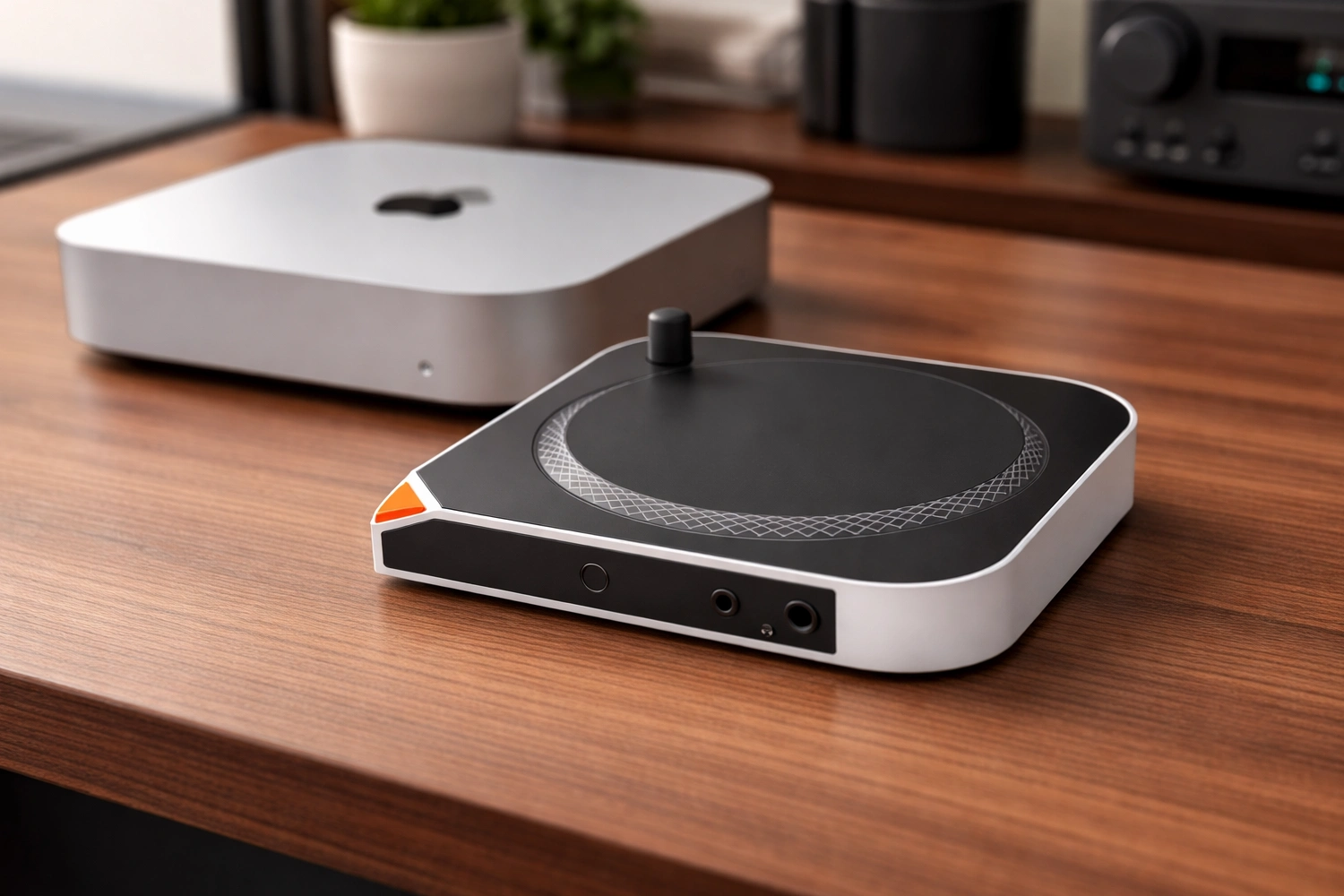
The SMSL DAC MINI takes a notably system-led approach to desktop audio. Rather than simply putting a DAC and headphone amplifier in a small aluminium box, SMSL has designed this 127 × 28.2 × 133.6mm component to physically partner Apple’s Mac mini. It is intended to sit beneath the computer, where it can provide a dedicated USB audio output stage, headphone connections, fixed-level analogue output for a larger system and additional USB connectivity without turning a clean desktop into a cable-heavy stack.
That focus matters because a Mac mini is a capable music server, streaming machine and near-field desktop computer, but its built-in audio hardware is necessarily a general-purpose solution. A separate DAC moves digital-to-analogue conversion and analogue output duties outside the computer, while a headphone amplifier is required to give many wired headphones a properly controlled drive signal. The DAC MINI’s appeal is therefore less about pursuing an exotic format specification in isolation and more about making a computer-based listening system neater and more complete.
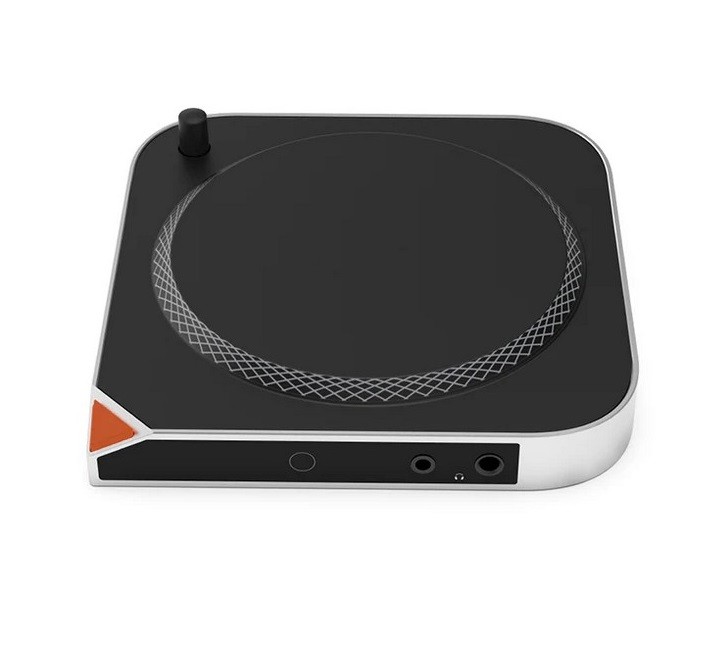
A desktop DAC designed around the Mac mini
The enclosure is CNC-machined from aluminium and closely follows the Mac mini’s footprint. That does not by itself guarantee better sound, but it is a sensible choice for a device that will live permanently beneath a computer: a rigid metal case protects the electronics, gives the compact product a stable platform and provides a passive route for dispersing the modest heat produced in use. SMSL specifies power consumption of less than 4W, so this should not be a component that adds significant warmth to a desktop stack.
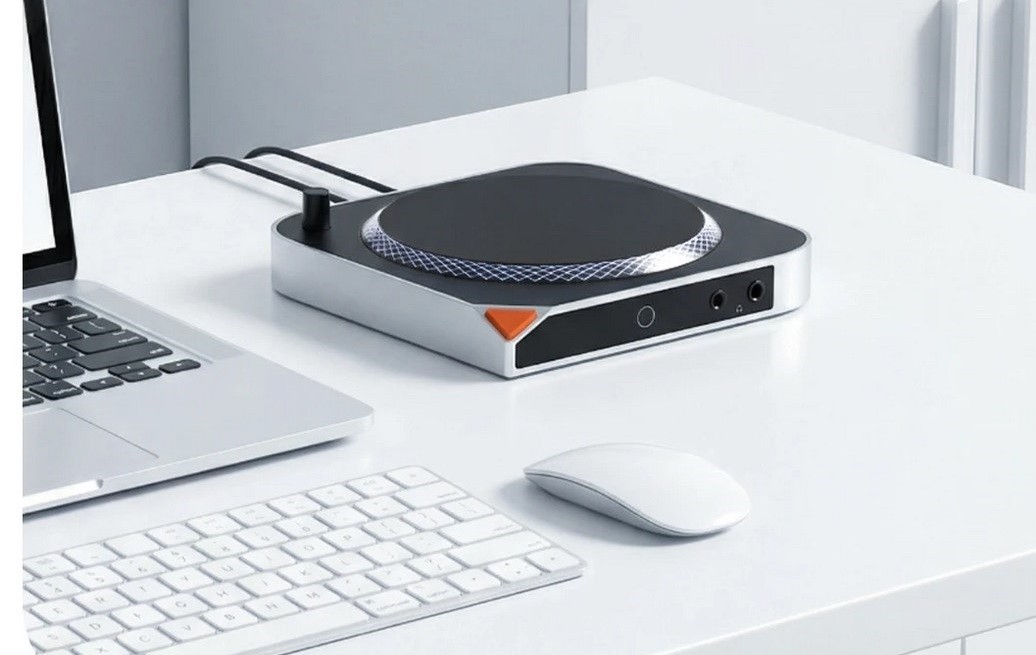
At 28.2mm high and weighing 0.244kg, the DAC MINI is also low enough to preserve the Mac mini’s compact, horizontal form rather than demanding a separate shelf. The practical gain is straightforward: the USB cable between computer and DAC can be short, headphone access is brought to the front of the desk, and the permanent audio hardware can look like part of one installation instead of an afterthought.
A physical Mac power control
The unusual feature is a front-panel mechanical power-on system that SMSL says can wake the associated Mac mini when its button is pressed. It is a small integration detail, but potentially more meaningful than another menu option or a theoretical sample-rate capability. Desktop audio is often used in short sessions—at a work desk, in a study or with active speakers—and eliminating the need to reach behind or around the computer can make the system more inviting to use.
Prospective buyers should nevertheless confirm compatibility with their particular Mac mini generation and desired installation method before treating this as a universal solution. The supplied information does not detail how the mechanism is implemented, nor whether it affects every Mac mini configuration. What is clear is the design intent: this is not merely a Mac-compatible USB DAC, but a product intended to operate as part of the Mac mini’s physical desktop environment.
ES9039Q2M conversion and XMOS USB interface
At its core, the DAC MINI uses ESS Technology’s ES9039Q2M digital-to-analogue converter and an XMOS XU-316 USB processor. The converter is responsible for turning the stream of digital samples from a computer into the analogue signal used by the headphone outputs and rear line output. The XMOS device handles the USB audio connection, a task that encompasses data transfer and the interface between the host computer and the DAC’s audio hardware.
These component choices do not reveal every aspect of a DAC’s eventual performance—the surrounding power supply, analogue output circuitry, PCB layout and implementation are all consequential—but they establish the DAC MINI as a current high-resolution USB design rather than a basic USB audio adaptor. SMSL quotes line-output THD+N of 0.000125%, headphone-output THD+N of 0.000178%, dynamic range of up to 122dB and a signal-to-noise ratio of up to 121dB.
Those figures describe the level of unwanted distortion and noise relative to the wanted signal under the manufacturer’s test conditions. Lower THD+N means the measured harmonic and noise residue is very low, while 121–122dB noise and dynamic-range figures indicate a large gap between signal and background noise. They are useful indicators of an electronically quiet design, although they should not be read as a guarantee of a particular sonic character or as a substitute for matching levels and headphones correctly in a real system.
High-resolution format support in context
Over USB, the DAC MINI supports PCM from 44.1kHz to 768kHz at up to 32-bit, plus DSD64 to DSD512 and DoP256. PCM is the format used by conventional CD-quality music, downloads and the overwhelming majority of streaming playback. The 44.1kHz lower limit therefore covers standard CD-derived material, while higher PCM rates accommodate high-resolution files where the playback software and source material support them.
DSD is a different encoding approach used by some download libraries and SACD-derived files. Native DSD support to DSD512 will be relevant mainly to listeners with such collections, while DoP—DSD over PCM—packages DSD data for carriage over a PCM-style digital link. The headline capability is broad, but it is worth keeping perspective: access to 768kHz PCM or DSD512 does not improve ordinary 44.1kHz music automatically. More important for everyday ownership is that the DAC handles the formats a listener actually owns without unwanted conversion by the operating system or player.
On macOS, SMSL states that the DAC MINI works without a driver, which is the expected convenience advantage of USB Audio Class support on Apple computers. It is also listed as compatible with Windows, Linux and Android. The supplied specifications do not state whether a dedicated Windows driver is required to access every listed format, so Windows users planning high-rate PCM or DSD playback should check the current software documentation and their chosen player’s output settings.
Headphone outputs: useful power, but match the load
The front panel provides both a 3.5mm single-ended headphone output and a 4.4mm balanced output. The 3.5mm socket suits headphones and earphones supplied with a conventional small jack, while the 4.4mm Pentaconn connection is increasingly common on detachable-cable headphones that can be wired for balanced operation. Balanced headphone wiring uses separate return paths for the left and right channels; it should not be confused with a blanket promise of better sound. It requires a correctly terminated balanced cable and should never be connected via an improvised adaptor that ties the separate returns together.
SMSL specifies output power of up to 265mW ×2 into 32 ohms, 120mW ×2 into 150 ohms, 60mW ×2 into 300 ohms and 30mW ×2 into 600 ohms. These figures show the usual relationship between amplifier output and headphone impedance: as impedance rises, the available power figure falls. They also provide a more useful starting point than a vague claim that an amplifier will drive “everything”.
For typical portable-style 16–32-ohm headphones and many efficient full-size designs, the 32-ohm rating is the relevant reference. With 150-ohm, 300-ohm and 600-ohm headphones, sensitivity becomes at least as important as impedance: two headphones with the same nominal impedance can require very different voltage levels to play at the same loudness. The DAC MINI’s published ratings suggest a sensible fit for a broad range of desktop headphones, but buyers considering exceptionally inefficient planar-magnetic models or demanding high-impedance designs should compare the manufacturer’s sensitivity specification with the DAC MINI’s published output data rather than assuming compatibility from impedance alone.
There is also a practical distinction between this product and a large dedicated headphone amplifier. The DAC MINI prioritises a shallow Mac mini-matched chassis, USB integration and a choice of front outputs. Listeners who need multiple headphone sockets, switchable gain, a preamp section or unusually high power will need to establish whether those features are available elsewhere in SMSL’s range; they are not listed in the supplied DAC MINI specification.
Line output, S/PDIF bridge and USB hub
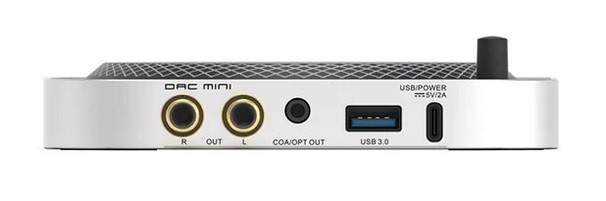
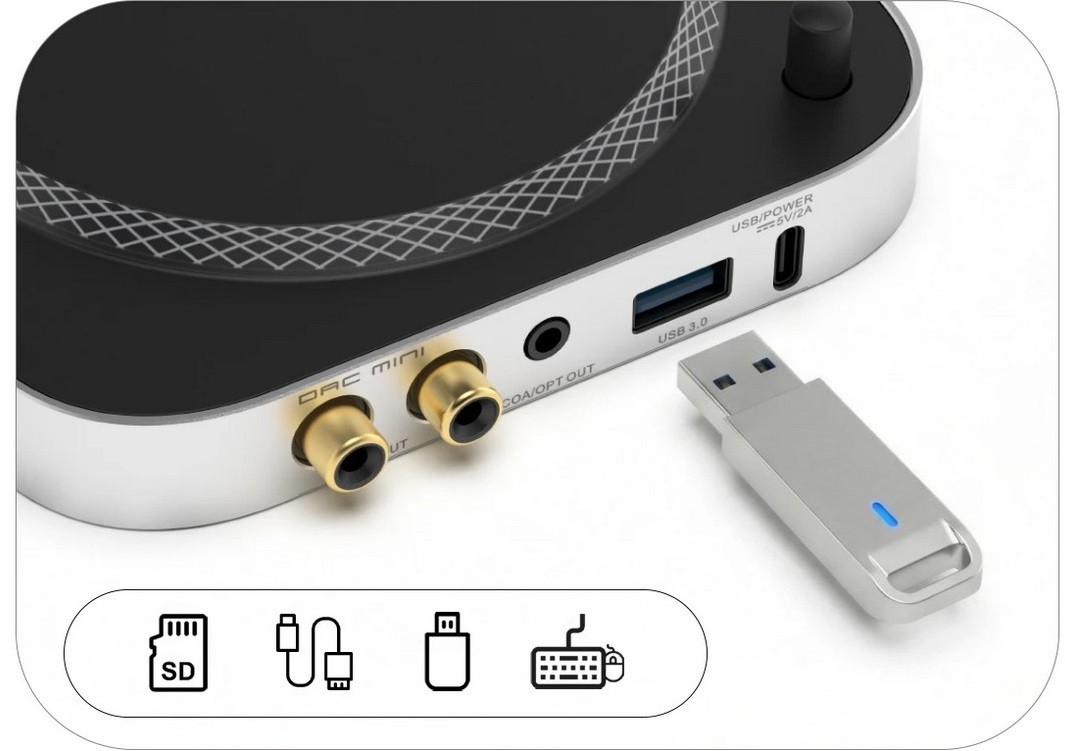
At the rear, the DAC MINI offers a 2Vrms line-level output. A 2Vrms output is the conventional nominal level expected by many integrated amplifiers, preamplifiers and active loudspeakers, making this connection the route to use when the Mac mini is the source for a conventional two-channel system. In that scenario, the DAC MINI performs conversion and passes an analogue signal onward to the component responsible for volume control and speaker drive.
Owners should check whether their active speakers or amplifier expect fixed line level and where volume is controlled in the chain. The source material identifies this as a line output but does not specify whether its level is adjustable, so it is prudent to treat it as a conventional fixed output unless SMSL confirms otherwise. This is particularly important with powered speakers, where an unexpectedly high level can be inconvenient at switch-on.
A combined optical/coaxial digital output adds a second role: the DAC MINI can act as a USB-to-S/PDIF bridge. This can be useful if an owner already has an external DAC, integrated amplifier or digital processor with an optical or coaxial input that they prefer to use. S/PDIF carries digital audio rather than an analogue signal, so the downstream component remains responsible for conversion. The supplied material does not specify supported output sample rates for this connection, and that is worth confirming for users with high-resolution libraries.
Finally, the integrated USB hub addresses a particularly mundane but genuinely valuable desktop problem. A DAC normally consumes one of the computer’s ports; a hub can return some connection flexibility for peripherals or accessories. SMSL does not specify the hub’s number of ports, USB version or power-delivery capability in the information provided, so it should not be assumed to replace a powered dock. Still, incorporating the function into the audio component has the potential to reduce the number of boxes and cables beside the Mac mini.
Who the SMSL DAC MINI is for
The DAC MINI is most compelling for the listener who has already chosen a Mac mini as the centre of a desktop or compact hi-fi system and wants an audio component that respects that decision physically as well as electrically. Its combination of an ES9039Q2M DAC, XMOS XU-316 USB interface, 3.5mm and 4.4mm headphone outputs, 2Vrms line output, S/PDIF digital output and USB hub is unusually broad for such a low-profile unit.
Its trade-off is equally clear. The Mac mini-specific form and power-control idea are central advantages for an Apple desktop installation, but potentially less relevant in a general-purpose rack, living-room system or laptop setup. And while the published headphone power is stated across 32, 150, 300 and 600 ohms, buyers of difficult headphones should make a sensitivity-led comparison before purchase.
For a Mac mini user feeding headphones, powered monitors or an amplifier, however, the product’s strongest argument is coherence. It consolidates several desktop functions—USB audio, conversion, headphone drive, analogue output, digital bridging and USB expansion—into one compact component designed to sit exactly where that system needs it.
SMSL DAC MINI specifications
- DAC: ESS ES9039Q2M
- USB processor: XMOS XU-316
- Headphone outputs: 3.5mm / 4.4mm balanced
- Line output level: 2Vrms
- Output power (32Ω): up to 265mW ×2
- Output power (150Ω): up to 120mW ×2
- Output power (300Ω): up to 60mW ×2
- Output power (600Ω): up to 30mW ×2
- THD+N (line out): 0.000125%
- THD+N (headphone out): 0.000178%
- Dynamic range: up to 122dB
- Signal-to-noise ratio: up to 121dB
- PCM support: 44.1–768kHz / 32-bit
- DSD support: DSD64–DSD512
- DoP: DoP256
- Compatibility: Windows / macOS / Linux / Android
- Power consumption: <4W
- Standby power: <0.3W
- Dimensions: 127 × 28.2 × 133.6mm
- Weight: 0.244kg