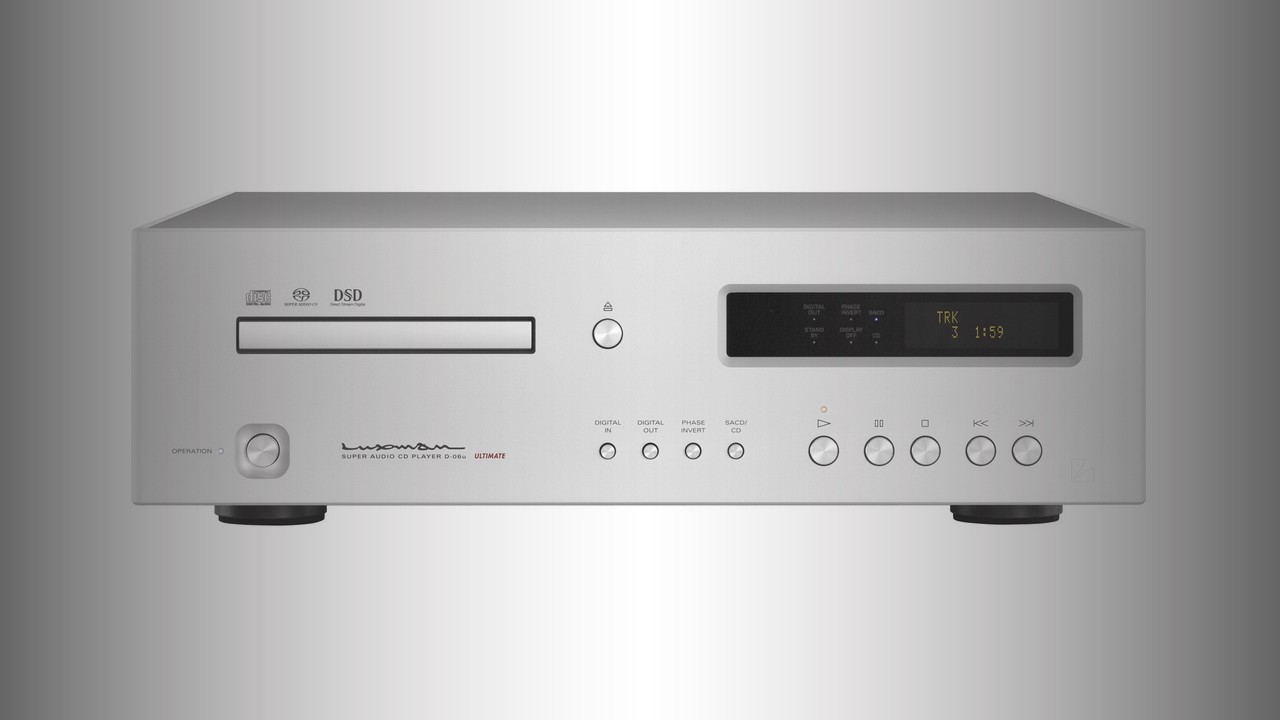
The Luxman D-06U is built around an increasingly relevant brief for a high-end disc player: preserve the dedicated SACD/CD transport, but make the component equally useful as the digital front end for a computer-based music library. It plays two-channel SACDs and conventional CDs, while its USB input accepts PCM streams up to 32-bit/384kHz and DSD up to 5.6448MHz from a connected computer.
That combination places the D-06U in a different category from a conventional CD player. Rather than serving only physical media, it can act as a standalone DAC for computer playback and can accept several additional digital sources through its coaxial, optical and AES/EBU inputs. Luxman has paired that connectivity with a dual-mono DAC arrangement, a balanced discrete output buffer and substantial attention to mechanical and electrical isolation—areas that matter when extracting analogue audio from digital sources.
Assembled in Japan and derived in concept from Luxman’s flagship D-08U, the D-06U is therefore intended as a single-box source component for listeners who still value a disc collection but do not want to separate it from high-resolution file playback.
A dedicated transport remains central to the D-06U
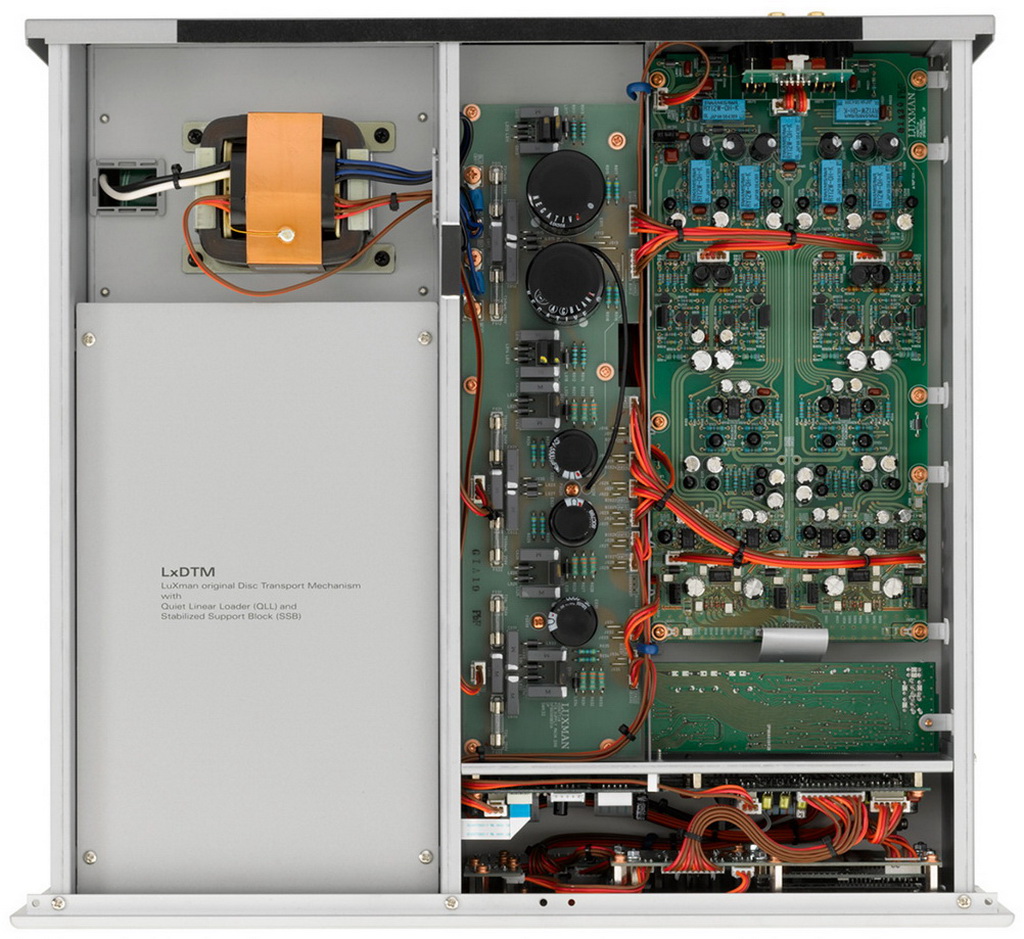
At the heart of the player is Luxman’s proprietary LxDTM disc transport mechanism. A disc transport’s task is not simply to spin a CD or SACD: it must hold the disc securely, maintain accurate tracking and recover data reliably while managing the mechanical vibration created by a rapidly rotating optical disc. Luxman describes the LxDTM mechanism as stable and quiet, with an emphasis on reducing mechanical vibration during operation.
This is significant in a component that contains sensitive digital and analogue circuitry in the same enclosure. Mechanical vibration can travel through a chassis and circuit boards, while the motors and servo systems required by an optical mechanism are potential sources of electrical noise. The D-06U’s approach is to combine the transport with an anti-resonance chassis and isolating mounts intended to reduce the transfer of internally generated vibration to the rest of the player.
The player is limited to two-channel SACD playback, alongside CD-Audio. That should be read as a focused stereo source rather than a multichannel SACD player for an AV system. For a conventional two-channel pre/power or integrated-amplifier setup, this is often the more relevant implementation: the D-06U is designed to deliver a stereo analogue signal through its RCA or XLR outputs.
USB DAC capability: PCM to 384kHz and DSD to 5.6MHz
The D-06U’s defining difference from the related D-06 is its asynchronous-style computer-audio role via USB, although the supplied specification does not state the precise USB transfer implementation. Connected to a Mac or Windows computer, the USB input accepts PCM at word lengths from 16 to 32 bits and sample rates from 32kHz to 384kHz. This covers the usual CD-derived 44.1kHz family, including 88.2kHz, 176.4kHz and 352.8kHz, as well as the 48kHz family up to 384kHz.
It also supports 1-bit DSD at 2.8224MHz and 5.6448MHz—commonly called DSD64 and DSD128—via USB. Luxman specifies use of its ASIO 2.1 DSD driver for this mode. Prospective Windows users should therefore ensure that the appropriate Luxman driver and playback software are installed before expecting DSD playback. The supplied information does not specify the playback software, USB class mode or the exact DSD handling available under every operating system, so those details should be checked against the current Luxman documentation before purchase.
In practical system terms, using the D-06U over USB allows a computer to become a music-library controller and transport while leaving digital-to-analogue conversion to the dedicated Luxman hardware rather than the computer’s integrated audio output. This can be useful for locally stored downloads, ripped CDs and software-based playback platforms. It should not be confused with a network streamer: no Ethernet, Wi-Fi, streaming-service integration or control app is listed in the supplied specification. A computer or another external digital transport remains necessary for file and streaming-service playback.
Additional digital inputs make it more than a computer DAC
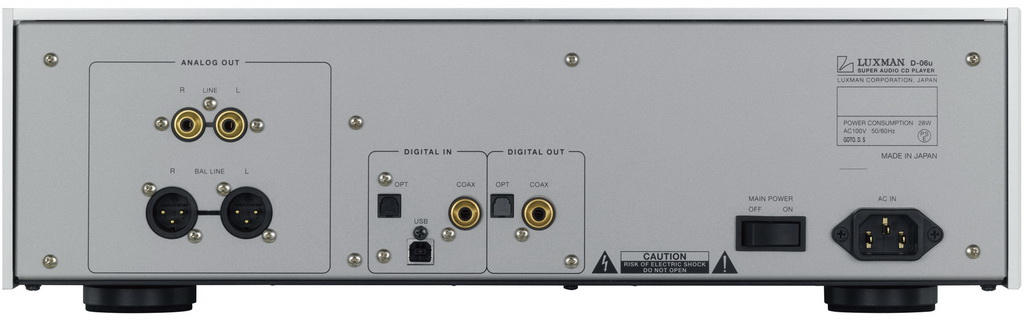
USB is not the only route into the D-06U. Its rear panel provision includes two coaxial inputs, two optical inputs and an AES/EBU input. These interfaces accept PCM signals at 16-, 20- and 24-bit depth, from 32kHz to 192kHz. That makes the player a potential DAC for a CD transport, digital streamer, television with a suitable optical output, or professional-style source using AES/EBU.
The distinction in supported rates is important. USB is the input to use for PCM above 192kHz and for the specified DSD playback. Coaxial, optical and AES/EBU are specified to a maximum of 192kHz PCM. Optical connections can be especially convenient where electrical isolation between source and DAC is desirable, while coaxial and AES/EBU are common choices for dedicated digital transports; compatibility at the required sample rate should always be confirmed between the source and the input being used.
The D-06U also provides coaxial and optical digital outputs. These give owners a route to feed a separate external DAC or digital recorder, subject to the capabilities and copy-protection behaviour of the connected source and downstream equipment. The supplied information does not state which signals are available at these outputs, so it would be unwise to assume that every input or SACD signal is passed through digitally.
Dual-mono DAC architecture and balanced analogue output
Digital conversion is handled by two Texas Instruments PCM1792A DAC chips, with one converter allocated to each channel. This is what Luxman means by a dual-mono configuration at the DAC stage. Separating the left and right conversion paths can help preserve channel independence within the component, provided the supporting analogue stages, power arrangements and board layout follow the same principle.
Luxman says the D-06U uses a symmetrical PCB layout and a balanced audio circuit based on the dual-mono principle. Its output stage is a fully balanced buffer circuit built from discrete, high-grade components rather than an unspecified integrated buffer solution. A buffer stage is responsible for presenting a stable, low-impedance drive to the interconnect and the input of the following preamplifier or integrated amplifier. The D-06U’s stated output impedance is 300 ohms on its unbalanced RCA output and 600 ohms on its balanced XLR output.
Both balanced XLR and unbalanced RCA analogue outputs are fitted. Balanced connection is most useful when the partnering preamplifier or integrated amplifier has a genuinely balanced input stage, or where longer cable runs make common-mode noise rejection beneficial. RCA remains the appropriate connection for the many high-quality systems built around unbalanced inputs. Neither connector is automatically superior in every installation; the sensible choice is the output that matches the amplifier’s input topology and gives the cleanest, simplest cable route.
Luxman quotes a 2.5V output signal level, with the impedance figures above. This is a line-level source output intended to feed a preamplifier, integrated amplifier or active loudspeaker with suitable line inputs. There is no volume control or analogue input specified, so the D-06U should be viewed as a source/DAC rather than a preamplifier or all-in-one control centre.
What the published figures tell us
The supplied specification lists a frequency response of 5Hz–20kHz, within -0.4dB. For CD and SACD playback, this confirms a response that remains effectively even across the conventional audible band; it does not, on its own, describe the player’s response beyond 20kHz.
Luxman’s stated harmonic-distortion figures are 0.0015% for CD, 0.0011% for SACD and 0.0009% for coaxial, optical and USB inputs. Signal-to-noise ratio is quoted as 122dB for CD, 104dB for SACD and 123dB for the digital inputs, while dynamic range is specified at 100dB for CD, 104dB for SACD and 123dB through coaxial, optical and USB. Stereo separation is given as 110dB for CD, 103dB for SACD and 124dB via the external digital inputs.
These are source-specific measurements rather than a single headline specification. They indicate that Luxman has published separate performance data for disc playback and external digital-input operation, which is more informative than treating all modes as identical. As ever, measurements should be considered alongside system compatibility and the engineering of the complete signal path, not as a standalone prediction of how a particular system will sound.
Power supply, screening and physical construction
The D-06U uses a dedicated custom shielded power transformer, with separate supply circuits for analogue and digital sections and associated electronics. Separating these supply domains is a familiar high-end digital-audio design strategy. Digital logic, clocks and disc servo electronics switch at high frequencies, whereas the analogue output stage works with very small continuous audio signals. Keeping their power arrangements and physical layout controlled can reduce opportunities for unwanted noise to reach the analogue section.
Luxman also states that each functional unit is mounted on its own printed circuit board and placed in a shielded compartment. The purpose is to limit crosstalk and interference between sections such as the transport control electronics, digital processing and analogue output circuitry. While this does not by itself guarantee a particular sonic result, it is a materially more considered approach than treating a transport, DAC and output stage as one undifferentiated circuit area.
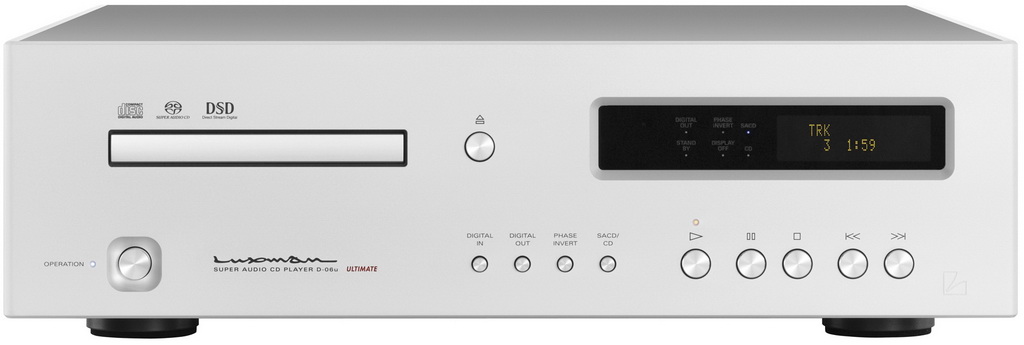
The chassis measures 440 x 133 x 410mm (W x H x D) and the player weighs 15.7kg. It is consequently a full-width, substantial component rather than a compact desktop DAC. Owners should allow for the 410mm depth before buying a rack, and should use a stable shelf capable of supporting the unit’s weight. The clean, minimalist front-panel approach fits the D-06U’s role as a traditional disc player, while the anti-resonance chassis and isolating feet reinforce the emphasis on physical stability.
Where the D-06U fits in a modern system
The D-06U makes most sense for a listener who has both physical discs and digital files, and wants a single high-quality source component rather than a separate SACD player and external DAC. It can feed an integrated amplifier or preamplifier from its RCA or XLR outputs, while its digital inputs leave room to add a dedicated network streamer, computer, television or external transport.
Its high-resolution USB capability is particularly relevant to a computer-centred library. If the system instead revolves around app-controlled streaming, the D-06U should be paired with a separate streamer because no network platform is specified. That is not necessarily a disadvantage: it allows the streaming front end to be changed later without replacing the disc mechanism and DAC. Equally, listeners who only play CDs and have no use for SACD, USB audio or digital inputs may find that much of the D-06U’s capability goes unused.
There is also a practical distinction between its SACD and file-playback roles. SACD playback gives access to an existing stereo SACD library through the player’s own transport and conversion stages. USB provides a route to high-resolution PCM and DSD files held on a computer. The latter demands some software and driver setup, especially for the specified ASIO DSD mode, but offers the flexibility to organise a large library and add streaming playback through the computer.
Ultimately, the D-06U’s appeal lies in the seriousness of its underlying architecture: a dedicated LxDTM transport, separate DAC chips for left and right channels, discrete balanced buffering, isolated power arrangements, and a wide range of digital connections. It is not presented as a network streamer or a minimalist USB DAC. It is a substantial, disc-first digital source designed to bridge established SACD/CD collections and the computer-audio workflows that became essential to many two-channel systems.
Luxman D-06U specifications
- Disc playback: SACD playback (2 channels), CD-Audio
- USB DSD support: 1-bit / 2.8224 / 5.6448MHz, using ASIO 2.1 DSD driver
- USB PCM support: 16, 20, 24, 32-bit / 32, 44.1, 48, 88.2, 96, 176.4, 192, 352.8, 384kHz
- Coaxial, optical and AES/EBU PCM support: 16, 20, 24-bit / 32, 44.1, 48, 88.2, 96, 176.4, 192kHz
- Inputs: USB, 2 x coaxial, 2 x optical, AES/EBU
- Outputs: Coaxial, optical, XLR, RCA
- Frequency response: 5Hz–20kHz (-0.4dB)
- Harmonic distortion: 0.0015% (CD), 0.0011% (SACD), 0.0009% (coaxial/optical/USB)
- Signal-to-noise ratio: 122dB (CD), 104dB (SACD), 123dB (coaxial/optical/USB)
- Dynamic range: 100dB (CD), 104dB (SACD), 123dB (coaxial/optical/USB)
- Stereo separation: 110dB (CD), 103dB (SACD), 124dB (coaxial/optical/USB)
- Output signal / impedance: 2.5V / 300 ohms (unbalanced), 600 ohms (balanced)
- Dimensions (W x H x D): 440 x 133 x 410mm
- Weight: 15.7kg