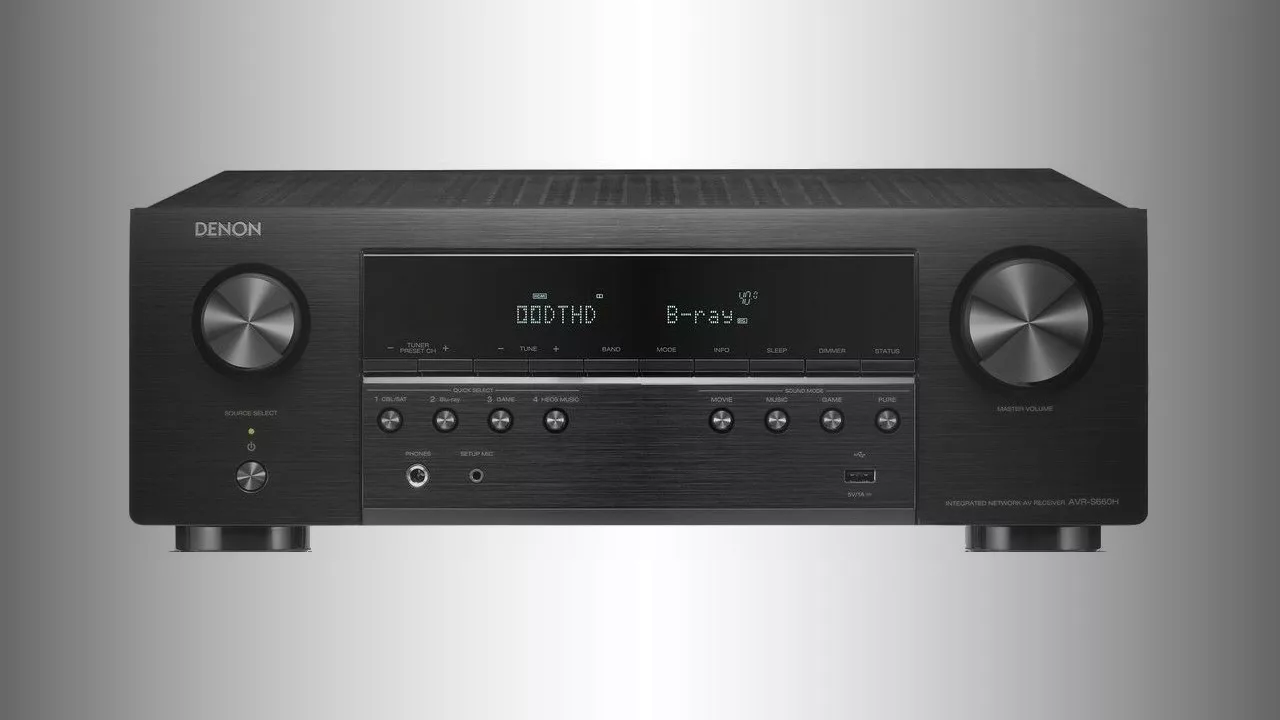
The Denon AVR-S660H is a five-channel AV receiver aimed at the space-conscious home-cinema system that still needs proper surround decoding, modern HDMI connectivity and a credible route into network music. It sits in Denon’s S-series range and is configured for a 5.2 layout: five passive speakers plus up to two active subwoofers. That makes it a natural fit for a conventional front left/centre/right and surround left/right installation, rather than the height-speaker-based Dolby Atmos layouts supported by larger-channel-count receivers.
Its appeal is in the breadth of integration. Alongside discrete amplification and support for lossless Dolby and DTS soundtracks, the AVR-S660H brings 8K/60Hz video compatibility, eARC, Audyssey MultEQ calibration, HEOS multiroom streaming, Wi-Fi, Bluetooth and an MM phono input into a chassis measuring 434 x 151 x 329mm without its antennas. At 7.8kg, it is substantially more manageable than many full-width receivers, although it remains a component that needs sensible ventilation around it.
A 5.2 receiver for conventional surround systems
The AVR-S660H uses five high-current amplifier channels built from discrete components. In practical terms, discrete output devices are individual amplifier parts rather than a single all-in-one power-amplifier module; the architecture gives a manufacturer control over the amplifier stage’s implementation. The draft does not provide a detailed circuit topology or current-delivery measurement, so it would be unwise to draw conclusions about its behaviour into especially difficult loudspeaker loads. It does, however, specify speaker terminals suitable for 4-16 ohm speakers.
Denon quotes three power figures, and it is important to read them in the context of the test conditions:
- 75W per channel into 8 ohms, 20Hz-20kHz, with two channels driven and 0.08% THD.
- 100W per channel into 6 ohms, 1kHz, with two channels driven and 0.7% THD.
- 135W into 6 ohms, 1kHz, with one channel driven and 1% THD.
The first figure is the most useful broad indication for stereo playback because it covers the full audible bandwidth at a comparatively low distortion threshold, albeit with only two channels active. The 135W headline maximum is a one-channel, 1kHz measurement at a higher distortion limit, so it should not be treated as five channels each delivering 135W simultaneously during a film’s busiest action sequence. This distinction is normal in AV receiver specifications and matters when matching speakers and setting expectations.
For typical medium-sensitivity 4-8 ohm home-cinema speakers in a modest or medium-sized room, the stated power is likely to be relevant. Very low-sensitivity speakers, exceptionally large rooms and listeners who require sustained cinema-reference levels are situations in which a higher-powered receiver or separate amplification may be worth considering. The AVR-S660H has no stated multichannel pre-out provision for adding external power amplifiers; its pre-outs are for two active subwoofers.
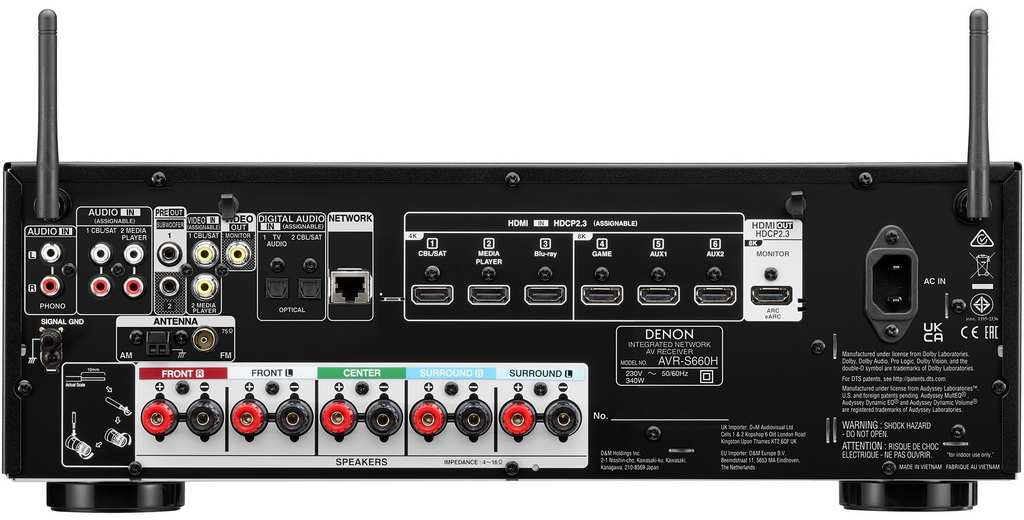
There are five pairs of colour-coded screw terminals. Colour coding is more than a cosmetic convenience when five loudspeakers need connecting: maintaining correct red-to-red and black-to-black polarity is essential for proper bass integration and stable imaging around the front soundstage. The receiver also includes a 6.3mm headphone socket for private listening.
Lossless surround formats, calibration and two-subwoofer flexibility
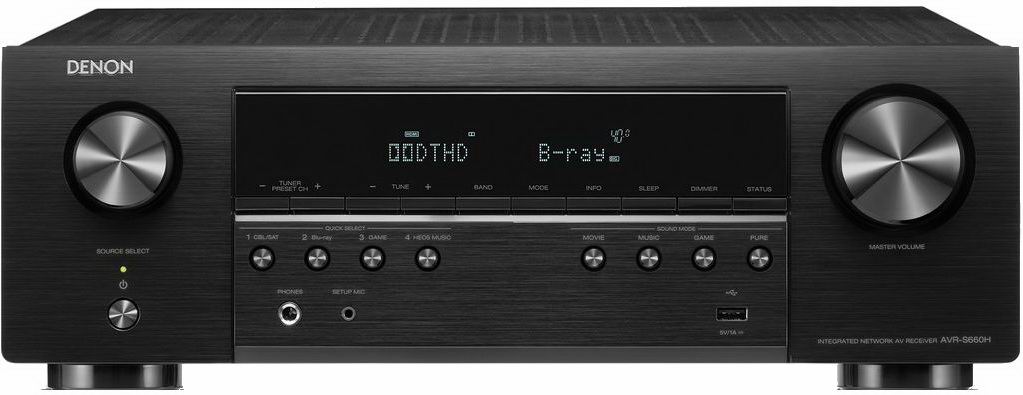
The receiver decodes Dolby TrueHD and DTS-HD Master Audio, the lossless formats commonly carried on Blu-ray discs and other compatible sources. It also supports Dolby Digital Plus, Dolby Pro Logic II, DTS-HD High Resolution Audio, DTS Neo:6, DTS Digital Surround, DTS 96/24 and DTS Express. Dolby TrueHD and DTS-HD Master Audio are particularly significant for a disc-based or dedicated-media-player system because they can carry the full-resolution multichannel soundtrack rather than a legacy lossy Dolby Digital or DTS bitstream.
Its five amplified channels mean these decoders are used in a 5.1-style speaker arrangement, with the low-frequency effects channel handled by a powered subwoofer. The AVR-S660H provides two RCA subwoofer pre-outs, allowing two active subs to be connected. Dual subwoofers can be useful not simply for more output but for improving bass consistency across a room: low frequencies interact strongly with room dimensions, creating peaks and nulls at different listening positions. Two carefully positioned subwoofers can help distribute those room effects more evenly, though the final result depends on placement and calibration.
Denon includes Audyssey MultEQ automatic speaker calibration, along with Dynamic EQ and Dynamic Volume. Audyssey MultEQ uses the supplied calibration microphone connection to measure the speaker-and-room response and establish settings such as speaker distance, level and correction filters. Room correction cannot change a room’s physical acoustics, nor can it fully rescue poor speaker placement, but it can be valuable in integrating a centre speaker, matching surround levels and taming some response irregularities at the listening seat.
Dynamic EQ and Dynamic Volume have distinct roles. Dynamic EQ is intended to retain perceived tonal balance as volume is reduced, compensating for the way human hearing becomes less sensitive to bass and treble at lower levels. Dynamic Volume addresses large swings between quiet dialogue and loud effects. These can be useful for late-night television and inconsistent broadcast material, although listeners who prefer an unaltered dynamic range for films or music may choose to disengage Dynamic Volume.
A Direct mode is also specified. This is generally the mode to investigate when using analogue stereo sources and seeking the most direct available signal path, although the exact processing that is bypassed should be confirmed in the receiver’s manual for each selected input and configuration.
HDMI, 8K video and eARC for TV-based systems
Video connectivity is a major part of the AVR-S660H proposition. The specification list states six HDMI inputs with 8K/60Hz and HDCP 2.3 support, plus HDR10, HLG, Dolby Vision and BT.2020 compatibility. The original overview refers to five HDMI inputs, so buyers planning a source-heavy installation should verify the final regional product specification before purchase. Either way, the receiver is intended to act as the central HDMI switcher for sources such as a games console, streaming box, disc player and set-top box.
8K/60Hz support means the HDMI section is equipped to pass an 8K video signal at up to 60 frames per second from a compatible source to a compatible display. It also supports 4K at 50/60Hz with 4:4:4 Pure Color, a chroma format relevant to preserving fine colour detail from compatible video sources. HDR10, HLG and Dolby Vision support covers the principal HDR formats listed in the supplied specification. HDCP 2.3 is the copy-protection standard required by compatible protected video sources.
There is one HDMI output with ARC, eARC and CEC. eARC, or Enhanced Audio Return Channel, is particularly useful when the television’s own apps are the main source of streaming video. Rather than running a separate audio cable from TV to receiver, eARC sends sound back through the HDMI connection and can carry formats including Dolby TrueHD where the TV, app/source and programme support it. CEC enables linked control functions with compatible Smart TVs, potentially allowing a TV remote to handle basic receiver operation.
Beyond HDMI, the receiver carries two composite video inputs and a composite output. These legacy connections are useful only for older video equipment; they should not be mistaken for an alternative route to modern 4K or 8K video. Two optical digital inputs provide a straightforward connection for a television or older digital source that lacks eARC, while the LAN port offers the most stable option for network streaming where an Ethernet run is practical.
HEOS streaming and high-resolution local playback
The AVR-S660H is also a network audio component through Denon’s HEOS ecosystem. It can play music from computers and NAS drives on the local network, as well as external USB storage connected to the front-panel USB port. For users with a downloaded music library, a wired Ethernet connection is often preferable where possible: it avoids dependence on wireless signal strength and keeps network bandwidth free for other devices. Dual-band 2.4GHz/5GHz Wi-Fi is included for installations where cabling is impractical, with support for IEEE 802.11a/b/g/n.
Supported LAN and USB formats include MP3, WMA, AAC, FLAC, ALAC and WAV, with FLAC, ALAC and WAV supported to 24-bit/192kHz. DSD playback is specified to 5.6MHz. These capabilities cover a wide range of CD-quality and high-resolution library files. The receiver also supports gapless playback for FLAC, WAV, ALAC and DSD, an important detail for continuous recordings such as live albums, DJ mixes and classical works whose movements run together.
Streaming services listed for the platform include TuneIn, Spotify Connect, Tidal, Deezer and Amazon Prime Music. Service availability can vary by territory and may change over time, but Spotify Connect is especially convenient for Spotify users because music can be handed off from the Spotify app to the receiver, which then streams directly rather than relying on the phone as the continuous audio source.
HEOS extends that network capability beyond the main room. Within a compatible HEOS installation, the AVR-S660H can join a multiroom group with other HEOS devices, playing the same programme synchronously in several rooms or different sources in selected rooms. Control is handled through the HEOS app, which also provides a central route to local music and supported streaming services.
AirPlay and AirPlay 2 are supported, giving Apple-device users a familiar way to send audio to the receiver and to include it in an AirPlay 2 multiroom group. Bluetooth 4.1 is also onboard, with a stated maximum range of up to 30m. Bluetooth is useful for quick guest playback and casual phone listening, while network playback is the more appropriate route for accessing the receiver’s stated high-resolution file support.

Analogue sources still have a place
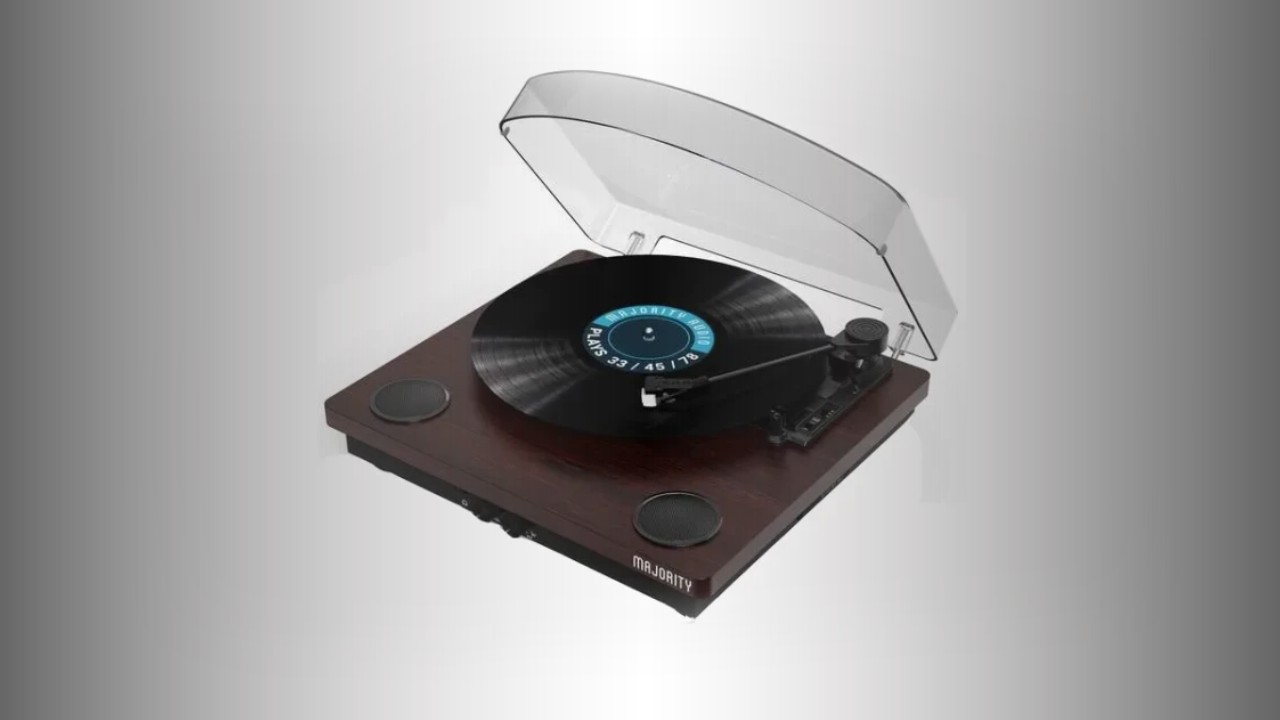
Unlike some entry-level AV receivers that treat analogue connectivity as an afterthought, the AVR-S660H has two RCA line inputs and a dedicated moving-magnet phono input. The phono input is intended for a turntable fitted with an MM cartridge, which produces a much lower signal than a conventional line-level source and requires RIAA equalisation. A turntable with an MM cartridge can therefore connect directly to the AVR-S660H, with its ground wire attached to the provided ground terminal.
Turntables with a moving-coil cartridge will generally require an external phono stage that provides suitable gain and loading, unless the turntable itself has a built-in phono preamp. Likewise, a turntable with an integrated phono stage should be connected to a regular line input rather than the receiver’s MM phono input. These distinctions are important: connecting a line-level signal to a phono stage will result in excessive level and incorrect tonal balance.
For analogue listening, the specified frequency range is 10Hz-100kHz (+1/-3dB) in Direct mode via the analogue connectors, while the line-input signal-to-noise ratio is quoted at 98dB in Direct mode. Input sensitivity is specified at 200mV for line inputs and 2.5mV for the MM phono stage. The latter is in the expected territory for an MM cartridge, but cartridge output varies, so especially low-output designs may need more gain than an integrated MM stage can comfortably provide.
Setup and ownership considerations
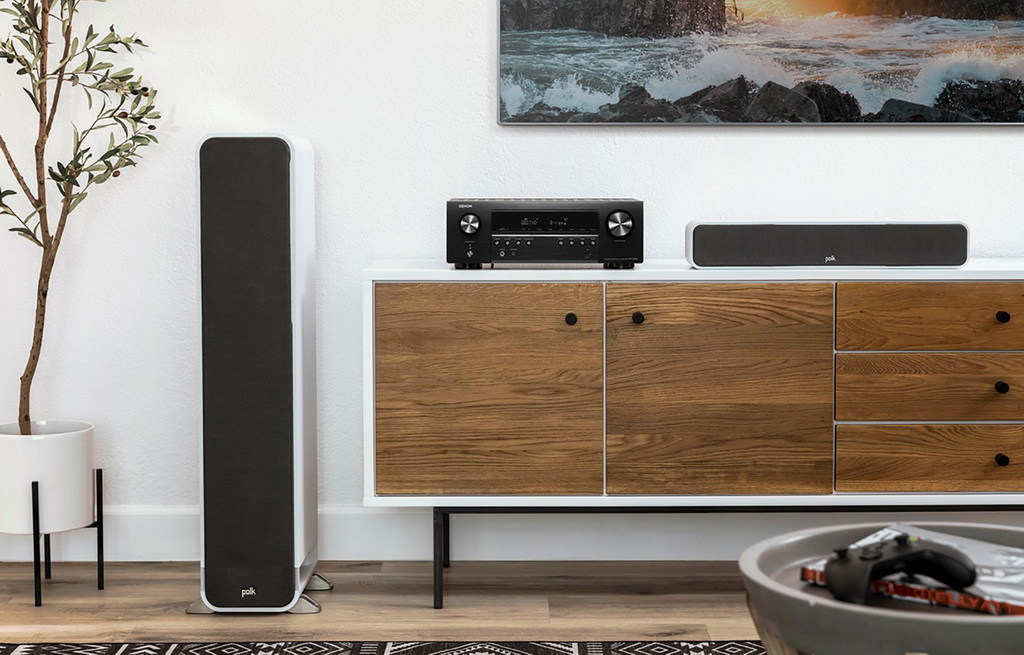
Denon supplies its Setup Assistant to guide initial installation, while the calibration microphone input supports the Audyssey process. For a first 5.1 setup, it is worth taking time over the physical arrangement before running correction: position the centre speaker as close as possible to screen height, aim the front left and right speakers towards the main listening area, and keep surround speakers placed to the sides or slightly behind the listening position. A subwoofer should be tested in more than one location, since room modes often have a larger effect on perceived bass than small changes to receiver settings.
Control options include the supplied remote, the HEOS app and voice-assistant integration with Amazon Alexa, Google Assistant and Apple Siri. Voice control can be practical for simple playback and volume tasks, while the physical remote and on-screen setup remain the more useful tools for configuration changes. An AM/FM tuner is included for users who still rely on terrestrial radio.
The AVR-S660H is best understood as a well-connected, conventional 5.2 receiver rather than an all-channel-format solution. Its strongest case is the living-room system requiring modern HDMI switching and TV integration, network music and a turntable input without moving to a larger, more expensive receiver. Its limitations are equally clear from the channel count and connectivity: there is one HDMI output, no stated support for height-channel speaker layouts, and no stated pre-outs for external power amplification beyond the two subwoofer outputs.
For a five-speaker system built around a TV, projector or disc player, though, its combination of lossless surround decoding, eARC, 8K/60Hz HDMI capability, Audyssey calibration and HEOS makes a coherent and practical feature set. The sensible next step for a prospective owner is to count HDMI sources, confirm the final input count for their market, check that the chosen loudspeakers fall within the stated 4-16 ohm range, and plan speaker and subwoofer placement before the receiver is installed.
Denon AVR-S660H key specifications
- Amplification: 5 channels; 75W per channel into 8 ohms (20Hz-20kHz, 0.08% THD, two channels driven); 100W per channel into 6 ohms (1kHz, 0.7% THD, two channels driven); 135W into 6 ohms (1kHz, 1% THD, one channel driven).
- Speaker compatibility: 4-16 ohms; five pairs of colour-coded screw terminals.
- Surround decoding: Dolby TrueHD, Dolby Digital Plus, Dolby Pro Logic II, DTS-HD Master Audio, DTS-HD High Resolution Audio, DTS Neo:6, DTS Digital Surround, DTS 96/24 and DTS Express.
- Room correction: Audyssey MultEQ, Dynamic EQ and Dynamic Volume.
- HDMI: specification list states six HDMI inputs; one HDMI output with ARC, eARC and CEC; 8K/60Hz, HDCP 2.3, HDR10, HLG, Dolby Vision and BT.2020 support.
- Analogue and digital connections: two RCA line inputs, MM phono input, two optical inputs, front USB, LAN, two composite inputs, composite output, two RCA subwoofer pre-outs and 6.3mm headphone output.
- Network audio: HEOS, Wi-Fi 802.11a/b/g/n at 2.4GHz/5GHz, Bluetooth 4.1, AirPlay and AirPlay 2.
- File playback: WAV, ALAC and FLAC up to 24-bit/192kHz; DSD up to 5.6MHz; gapless FLAC, WAV, ALAC and DSD playback.
- Dimensions: 434 x 151 x 329mm without antennas.
- Weight: 7.8kg.