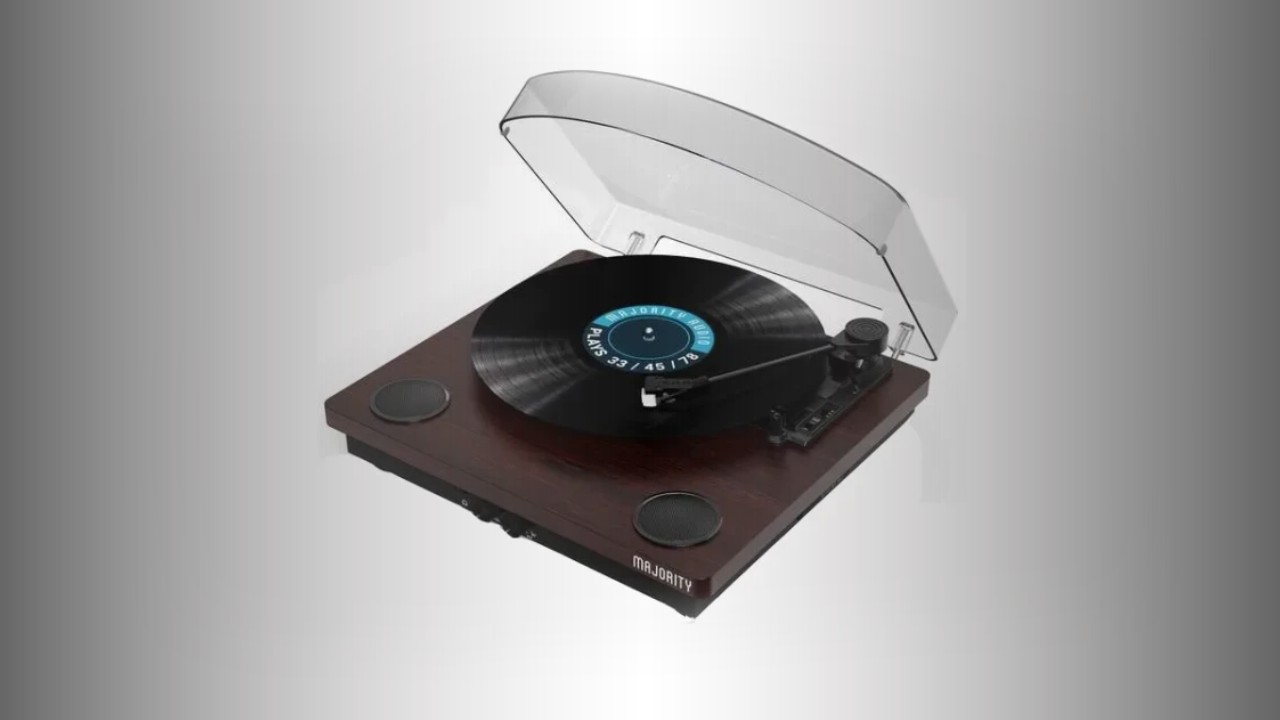
Majority has announced the Moto, a budget-focused vinyl player that combines the essentials of record playback with a USB connection for digitising records and Bluetooth 5.3 output for wireless listening. Priced at $79.95, the Moto is positioned less as a conventional separates-system turntable and more as an accessible way to play an existing record collection, transfer it to digital files and use it with modern wireless speakers or headphones.
Its key hardware includes an Audio-Technica AT3600L moving-magnet cartridge, a built-in phono preamplifier and support for 33, 45 and 78rpm records. Majority says the Moto is due for UK release on 1 March; pricing for the UK and availability in territories beyond Britain have not been confirmed in the supplied information.
A record player designed around convenience
The Moto’s appeal is straightforward: it brings together several functions that would otherwise require separate boxes and cables. A traditional entry-level turntable normally needs a phono stage somewhere in the system, whether that is built into an amplifier, supplied as an external unit or integrated into the deck itself. Anyone wishing to archive vinyl also needs a route from analogue playback to a computer or recording device. And a wireless speaker owner needs either Bluetooth transmission from the turntable or a separate transmitter.
Majority incorporates each of those functions in the Moto. That does not automatically make it a replacement for a carefully set-up hi-fi turntable, phono stage and amplifier, but it does make the product relevant to listeners who want to use records without first assembling a full component system.
At $79.95, the price is also central to its proposition. New vinyl has become expensive enough that a small handful of albums can account for a significant proportion of the outlay on a deck such as this. For somebody inheriting records, buying inexpensive second-hand LPs or simply wanting to revisit a collection already at home, the Moto offers a low-cost point of entry.
AT3600L cartridge and built-in phono stage: what they mean
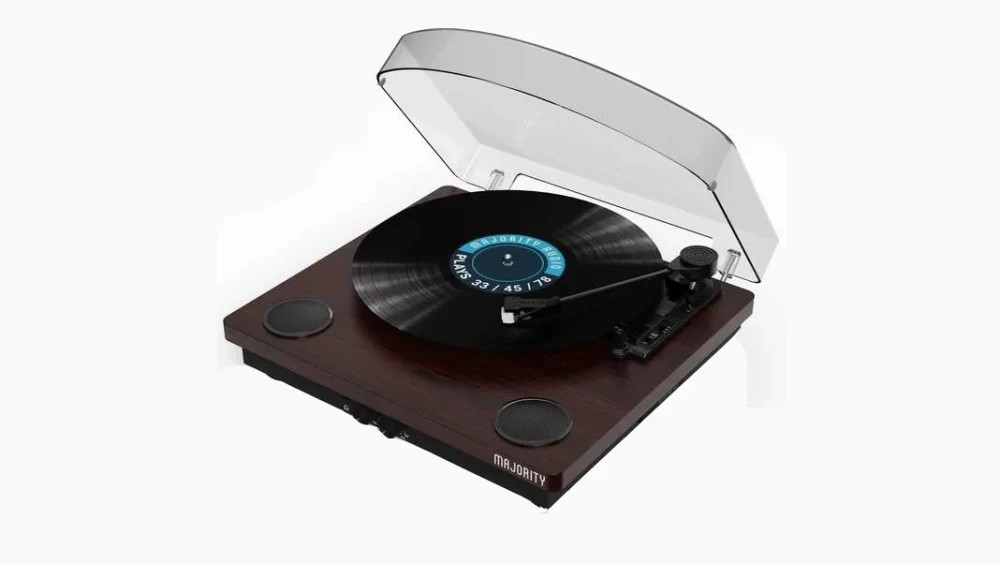
The Moto is fitted with an Audio-Technica AT3600L moving-magnet (MM) cartridge. The cartridge is the small electromechanical transducer at the end of the tonearm: its stylus follows the groove, generating a very low-level electrical signal. In a vinyl system, that signal cannot normally be sent directly to a standard line-level amplifier input, powered speaker or wireless transmitter.
That is where the built-in phono preamplifier matters. A phono stage increases the cartridge’s low output to a usable line level and applies the equalisation required by the record-cutting process. With this stage integrated into the Moto, the deck is intended to work with equipment that accepts a standard analogue line-level source rather than requiring a dedicated phono input.
For a first system, this arrangement can simplify connection considerably. It is especially useful with active speakers, compact desktop audio systems and amplifiers that do not include a phono stage. It also avoids accidentally connecting a turntable’s raw cartridge output to a line input, which would result in very low level and incorrect tonal balance.
The trade-off of an integrated approach is flexibility. Enthusiasts building a more ambitious vinyl system often choose a separate phono stage to tailor the analogue front end to a particular cartridge and amplifier. Majority has not supplied details of bypass facilities, adjustment options or the Moto’s analogue output connections, so prospective buyers who expect to add an external phono stage should confirm those points before purchase.
USB digitising is useful, but the workflow matters
USB is included primarily for digitising records. In practical terms, this gives an owner a way to capture an LP or single as a digital file, subject to the computer, recording software and operating-system compatibility being used. Digitisation can be useful for preserving rare records, making personal listening copies or bringing unavailable vinyl into a music library for use away from the turntable.
The process is not fully automatic simply because a USB socket is present. The record still plays in real time, so a 40-minute album takes roughly 40 minutes to capture. Once recorded, files may need trimming, track splitting, naming and metadata before they are convenient to browse in a library. Surface noise, clicks and crackles are also part of the original capture unless the user chooses to apply restoration processing in software.
Majority has not stated the recording resolution, supplied software, computer requirements or file formats for the Moto. Those are important questions for anyone whose main reason for buying the deck is archival work. A USB turntable can be an effective and simple tool for casual transfers, but the quality and convenience of the end result depend on the implementation, the record’s condition and the recording workflow as much as the presence of USB itself.
Bluetooth 5.3 is output-only
The Moto also includes Bluetooth 5.3, dedicated to output. This means the deck can transmit audio wirelessly to compatible Bluetooth speakers or headphones. It is a meaningful feature for homes where the main playback system is a portable speaker, a compact pair of active speakers or a set of wireless headphones rather than a conventional integrated amplifier and passive loudspeakers.
The output-only designation is worth noting. It describes a one-way connection from the Moto to a Bluetooth receiving device; it should not be read as support for receiving music from a phone or tablet and playing it through the turntable. Majority has not specified the Bluetooth audio codecs supported by the Moto, so buyers should not assume a particular codec or transmission mode.
Wireless playback removes the need for a long analogue cable between the turntable and speakers, but it introduces encoding and transmission into what begins as an analogue source. That may be an entirely sensible compromise for convenient everyday listening, particularly at this price, but it is different from maintaining an all-analogue signal path into a wired amplifier. Bluetooth can also introduce delay, which is generally irrelevant for listening to records but can be noticeable if the audio is being used alongside video.
Three speeds broaden record compatibility
Majority specifies 33, 45 and 78rpm operation. The first two speeds cover the formats most listeners will encounter: 33rpm LPs and many 12-inch singles, plus 45rpm seven-inch singles and certain 12-inch releases. Including 78rpm potentially opens the door to older shellac discs and early records, which run faster than modern LPs.
There is an important caveat for buyers with a serious 78 collection. Historic 78s commonly use groove dimensions that differ from those of modern microgroove LPs and singles, and a stylus suited to contemporary records is not necessarily the appropriate tool for optimum 78 playback. The supplied information confirms 78rpm speed selection, but does not state whether a dedicated 78 stylus is included, available or compatible. Anyone intending to play valuable shellac records should check the manual and cartridge/stylus options first.
For standard modern records, correct speed selection remains essential. An LP played at 45rpm will sound too fast and high in pitch, while a 45 played at 33rpm will sound slow and low. The presence of all three speed settings gives the Moto broader format coverage, but it does not eliminate the need to choose the setting appropriate to the record.
Who should consider the Majority Moto?
On the available information, the Moto makes most sense for the listener who values low cost and simple integration. It could suit a newcomer with a few records, someone wanting to make digital copies of a collection, or an owner of Bluetooth speakers who wants vinyl playback without buying an amplifier and separate phono stage. The Audio-Technica moving-magnet cartridge and integrated phono electronics address the basic requirements for playing records, while USB and Bluetooth give the deck routes into both computer-based and wireless systems.
It is less clearly aimed at the enthusiast planning a long-term, upgradeable analogue system. Majority has not provided information on tonearm adjustment, platter and motor design, replaceable stylus options, physical isolation, wired connections, cartridge upgrade compatibility or phono-stage bypass. Those details influence setup, future expansion and performance potential, and should be established before treating the Moto as the foundation of a more serious hi-fi system.
There is also the practical matter of placement. Like any turntable, the Moto should sit on a stable, level surface away from strong vibration. A deck placed directly beside a loudspeaker can pick up mechanical energy, potentially affecting playback. Bluetooth may eliminate a signal cable to the speakers, but it does not remove the basic need to give a record player a firm, sensible home.
The Majority Moto’s value is therefore in its combination of functions rather than in an implied pursuit of a purist vinyl setup. For $79.95, it offers playback at three speeds, an AT3600L MM cartridge, onboard phono amplification, USB digitising and Bluetooth output in one product. Provided buyers match those features to their intended system and verify the still-unpublished details most important to them, it is an interestingly equipped entry-level option when it reaches the UK on 1 March.