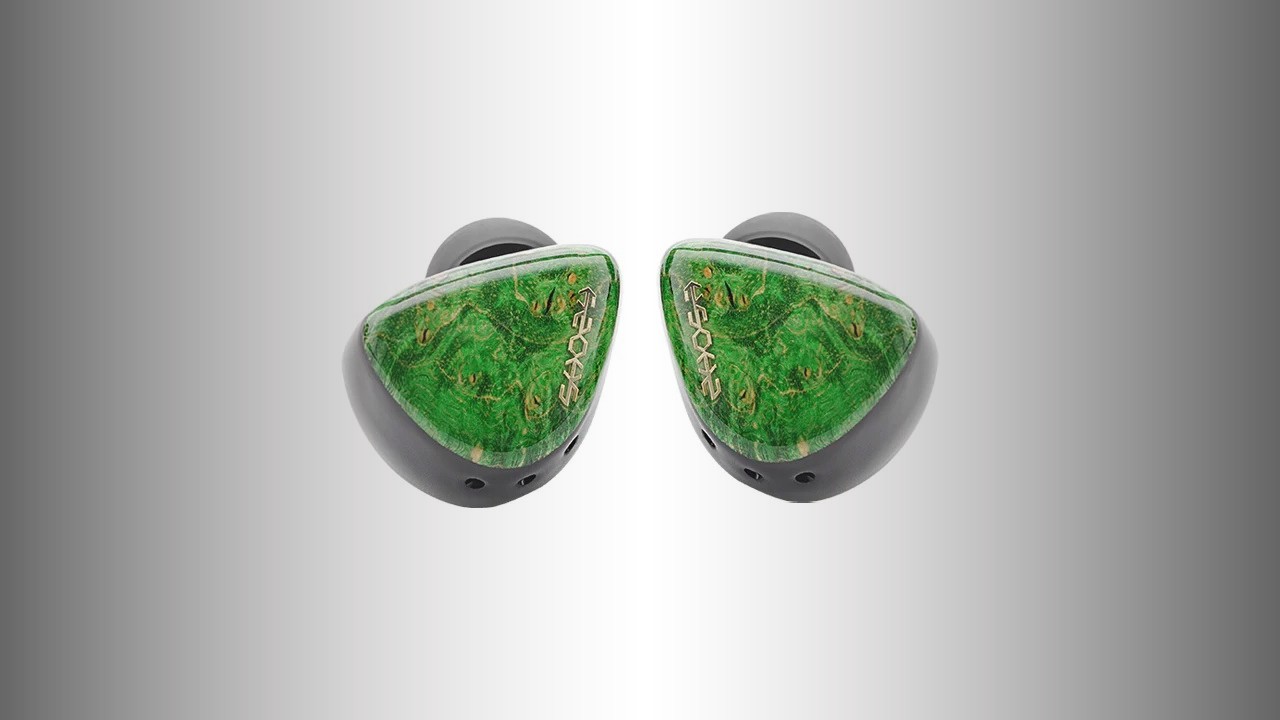
Shozy has introduced the P10, a $109 in-ear monitor (IEM) that uses a hybrid driver arrangement described as 1DD+1PLR: one dynamic driver partnered with one planar driver. In Shozy’s own terminology, this is a Planar+DD compound driver design, intended to combine the differing operating characteristics of dynamic and planar transducers in a compact earpiece.
That basic architecture is the P10’s most significant point of difference. Hybrid IEMs are common, but the usual combinations involve a dynamic driver for bass and one or more balanced-armature drivers for midrange and treble. A dynamic-plus-planar arrangement takes a different route. It potentially offers designers a way to retain the air-moving capability associated with a dynamic driver while using a planar element where speed and low moving mass are priorities. Whether the final tuning succeeds, however, depends not just on the drivers themselves but on the acoustic design, crossover implementation and fit in the ear—areas for which Shozy has not yet published technical detail.
A hybrid driver concept, not simply a driver count
The P10’s “1DD+1PLR” description refers to its two-driver layout: a single dynamic driver and a single planar driver. Dynamic drivers work much like miniature loudspeaker drivers. A voice coil moves a diaphragm, displacing air to create sound. They are widely used in IEMs because they can provide substantial excursion from a small assembly, which is useful when reproducing low-frequency energy.
A planar driver operates on a different principle, using a thin diaphragm driven across a broader area. In headphone design, planar technology is often valued for its controlled diaphragm motion and rapid transient behaviour. Applying that concept inside an IEM presents packaging and acoustic challenges, but it gives a manufacturer another set of tools when shaping the response of the finished earphone.
Shozy says its newly developed composite Planar+DD design aims for fast transient response, low distortion and wide-ranging sound. Those are sensible objectives for a hybrid system, but they should not be treated as a complete performance description. Transient response concerns how quickly a driver starts and stops in response to a signal, influencing the definition of attacks and decay in percussion or plucked strings. Distortion, meanwhile, is unwanted output that is not present in the input signal. Both matter, but neither can be assessed from driver technology or a marketing statement alone.
Just as importantly, a multi-driver IEM has to integrate its transducers convincingly. If the drivers cover different frequency regions, the handover between them needs to be managed acoustically and electrically. Phase alignment, the output level of each driver and the resonances within the nozzle and shell can all affect tonal continuity. Shozy has not specified the P10’s crossover method or frequency allocation, so buyers should avoid assuming that either driver is assigned to a particular band.
Compact shells with stabilized wood panels
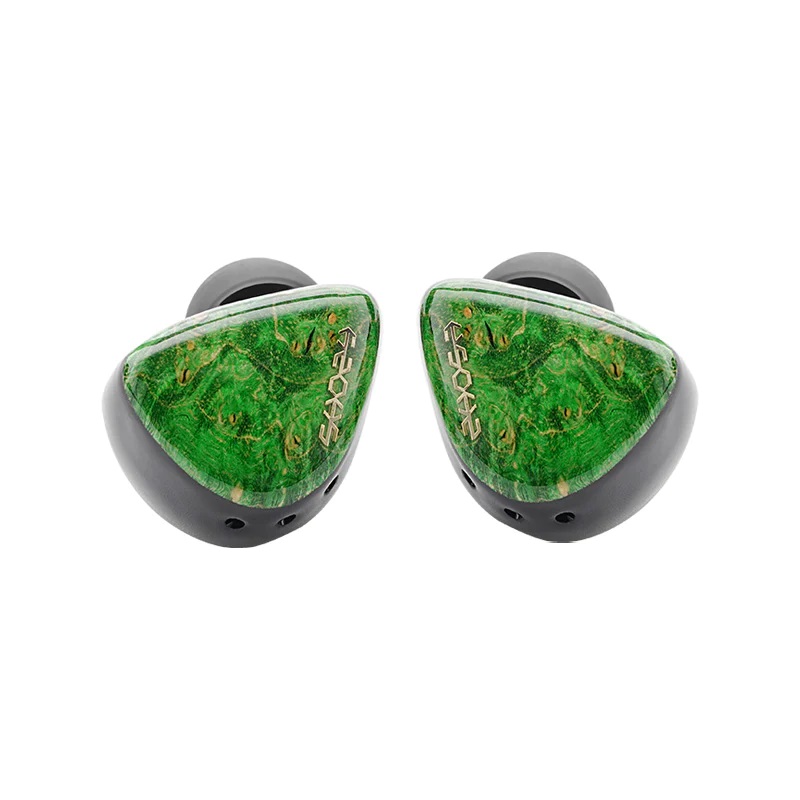
Rather than using a conventional uniform plastic enclosure, the P10 has a compact, pebble-like form factor with stabilized wood panels. Stabilized wood is wood treated with resin to improve its durability and dimensional consistency. In this application it is primarily a visual and tactile feature, giving each earpiece a more individual appearance than a plain moulded finish. Shozy describes the panels as jewel-like, and variations in natural material mean that no two sets should look precisely identical.
The form of an IEM matters beyond aesthetics. A small, rounded shell can make it easier to achieve a comfortable, secure fit for many listeners, particularly during longer sessions. But fit remains inherently personal: ear shape, tip choice and insertion depth all have a large effect on comfort, seal and bass response. A poor seal can substantially reduce perceived low-frequency weight and compromise external noise isolation, regardless of the driver specification.
Shozy also cites triple ventilation in the P10’s construction. Vents are an important part of the acoustic system in many dynamic-driver IEMs. They can control air pressure behind the diaphragm and help tune bass response, though the trade-off can be less passive isolation than a fully sealed design. The presence of three vents does not by itself reveal how the P10 will isolate or how its bass is tuned; those outcomes depend on vent dimensions, location, damping and the complete enclosure design. Still, it indicates that Shozy has not treated the shell simply as decorative housing.
What the published specifications do—and do not—tell us
Shozy quotes a sensitivity of 105 dB and a frequency range of 20Hz–20kHz for the P10. These figures provide a starting point, though there are important caveats for anyone planning a source upgrade or comparing IEMs on paper.
- Sensitivity: 105dB. Sensitivity indicates how loudly an earphone plays for a given input. A figure of 105dB suggests the P10 should not demand the high output voltage normally associated with difficult full-size headphones. However, the reference condition has not been stated—sensitivity may be quoted per milliwatt or per volt—and Shozy has not supplied an impedance figure. Consequently, it is not possible to calculate precise power requirements or make firm claims about source matching from sensitivity alone.
- Frequency range: 20Hz–20kHz. This covers the conventional nominal limits of human hearing, but it is not a frequency-response graph. The specification does not reveal how even the response is, the output level at either extreme, the amount of bass emphasis, or the presence of peaks in the upper midrange and treble. Those details are considerably more useful in anticipating an IEM’s voicing.
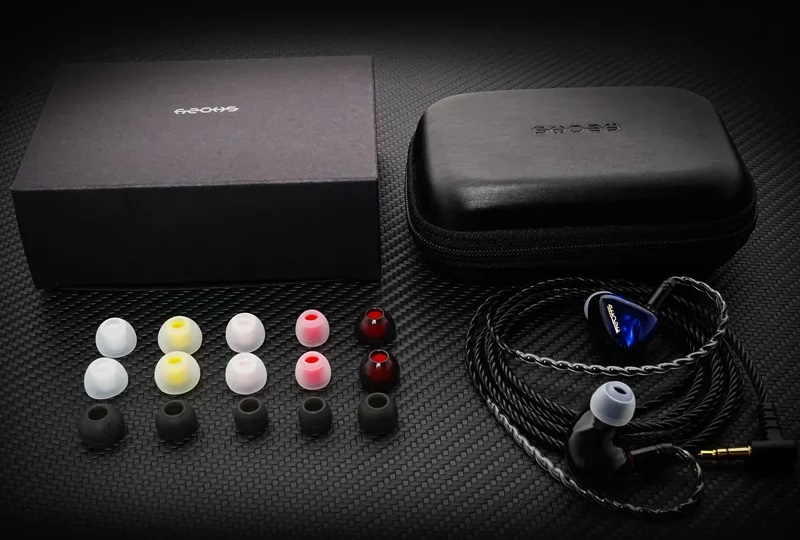
- Connector: 0.78mm 2-pin. Shozy lists a 2-pin 0.78mm connection. This is a common IEM connector format and is relevant for users who already own compatible cables or who prefer the option of replacing a damaged cable rather than replacing the earphones. As always, physical compatibility is not the only consideration: recessed versus flush socket geometry, pin polarity and cable ergonomics should be checked before buying an aftermarket cable.
Source and cable considerations
On the published information, the P10 looks most naturally suited to portable listening from a phone with a suitable audio adapter, a compact DAC/headphone amplifier or a dedicated digital audio player. Its 105dB sensitivity means users should take care with volume, especially when moving between sources with different gain structures. High sensitivity can be convenient for portable gear, but it also makes quiet volume adjustment and a low noise floor more important. Any audible hiss from a source becomes more noticeable with sensitive in-ear monitors.
There is no stated impedance, supplied cable specification, plug termination or balanced-drive option in the launch information. That means it would be premature to recommend a balanced cable or claim a particular amplifier pairing advantage. In general, the audible priority should be a clean, suitably low-noise source and a comfortable ear-tip seal, rather than pursuing more output power than the earphones need.
The 0.78mm 2-pin connection may be useful over the longer term, particularly for owners who value cable replacement or want a different length, microphone arrangement or connector for a specific player. Yet cable changes should be approached as an ergonomic and connectivity decision first. The core sound signature will be determined by the P10’s acoustic design and the seal achieved in the ear.
Positioning: an affordable planar-dynamic alternative
At $109, the Shozy P10 enters a busy affordable IEM market in which buyers can choose from single dynamic-driver, balanced-armature hybrid and planar-based designs. Its appeal is not a long published feature list but the particular combination of a dynamic and planar driver, plus a more decorative stabilized-wood shell treatment than is typical at this price.
The potential trade-off is that several practical details remain unconfirmed. Shozy has not stated the impedance, cable termination, included eartips, isolation figure, crossover arrangement or a detailed frequency-response measurement. Prospective buyers who need an IEM for a particular source, or who are sensitive to a specific tonal balance, should seek confirmation of those points and independent listening or measurement information before treating the P10’s driver complement as a guarantee of a preferred sound.
What can be said from the announcement is that the P10 is a compact two-driver IEM with a technically interesting hybrid premise, replaceable-cable-format connectivity and an emphasis on crafted appearance. For listeners seeking an alternative to the familiar dynamic-plus-balanced-armature formula at around $100, it is a model worth watching—provided its eventual tuning and fit suit their needs.
Shozy P10: stated specifications
- Driver configuration: 1DD+1PLR, described by Shozy as Planar+DD
- Sensitivity: 105dB
- Frequency range: 20Hz–20kHz
- Connector: 0.78mm 2-pin
- Price: $109