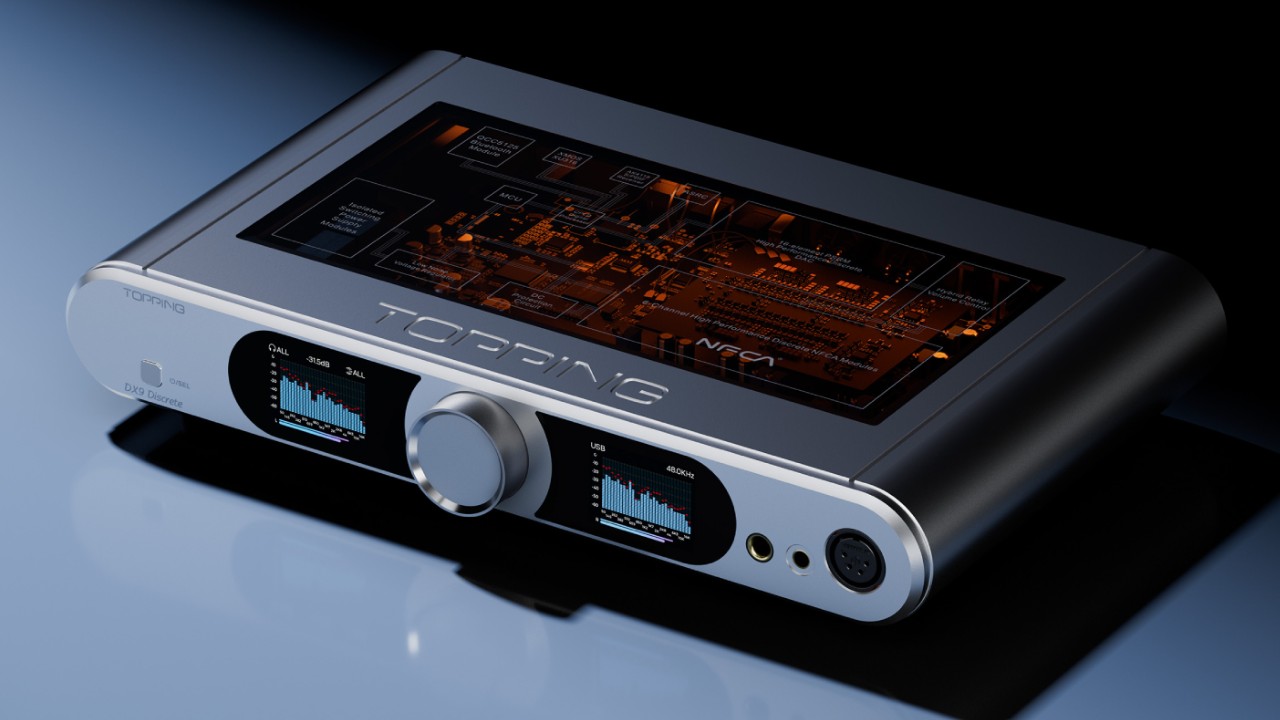
Topping has positioned the DX9 Discrete as the flagship of its desktop DX series: a full-width digital control centre that combines a proprietary discrete DAC, powerful headphone amplification and variable-output preamplifier facilities in one aluminium enclosure. At $1,299 / €1,299, it sits well above familiar models such as the DX3 Pro+, DX5 MK II and DX7, and targets listeners who want to run demanding headphones while retaining the flexibility to feed an active-speaker system or separate power amplifier.
Its headline is not simply a long list of inputs or a large power figure. The DX9 Discrete uses Topping’s second-generation 1-bit PSRM discrete DAC architecture, rather than a specified off-the-shelf DAC chip, and pairs it with a six-channel discrete NFCA headphone amplifier module. The claimed measurements are exceptionally low in distortion and noise, while the hardware provision is unusually expansive for a desktop DAC/headphone amplifier: USB, AES/EBU, I²S, two optical inputs, two coaxial inputs and Bluetooth are all included.
A discrete 1-bit DAC at the centre of the DX9
A DAC converts the numerical data in a PCM or DSD music file into analogue voltage for an amplifier or pair of headphones. In many desktop products, that conversion is handled by an integrated DAC chip. Topping instead describes the DX9 Discrete as using its second-generation discrete 1-bit PSRM DAC. “Discrete” here means that the conversion architecture is constructed from individual circuit elements rather than being identified as a single commercial converter chip; it does not, by itself, establish how the product will sound, but it is a different engineering route from the common chip-based approach.
The company specifies an A-weighted signal-to-noise ratio of 131dB through XLR and 128dB through RCA. Signal-to-noise ratio expresses the separation between the wanted audio signal and the unit’s residual noise. A high figure is particularly relevant in a desktop component that may be used with very sensitive in-ear monitors as well as full-size headphones, because unwanted hiss is easier to notice with efficient earphones and at close listening distances.
Quoted THD+N is below 0.00006% on XLR and below 0.00007% on RCA. THD+N combines harmonic distortion and noise in one measurement, so it is a useful indication of how cleanly a component handles a test signal, although it should not be treated as a complete description of overall musical performance. Topping also rates frequency response at 20Hz–40kHz, within ±2dB.
For computer and compatible I²S sources, the DX9 Discrete accepts linear PCM to 32-bit/768kHz and DSD512. The optical, coaxial and AES inputs are specified for PCM to 24-bit/192kHz. That distinction is normal: USB has the bandwidth to carry very high-rate PCM and DSD, whereas S/PDIF-family connections are more restricted. I²S can avoid the usual S/PDIF encoding stage, but users should confirm pin compatibility between source and DAC before assuming an I²S HDMI-style connection will work; connector layouts are not universally standardised across manufacturers.
Headphone amplification: high output, broad intended use
The DX9 Discrete’s proprietary six-channel discrete NFCA amplifier module is specified to deliver more than 7W per channel into 32 ohms. Topping’s fuller ratings quote up to 10,000mW × 2 at 16 ohms from the balanced headphone output, and up to 3,300mW × 2 at 16 ohms unbalanced. Those are substantial desktop-amplifier figures. In practical terms, they suggest generous voltage and current capability for many power-hungry full-size headphones, including models with low sensitivity or difficult impedance characteristics.
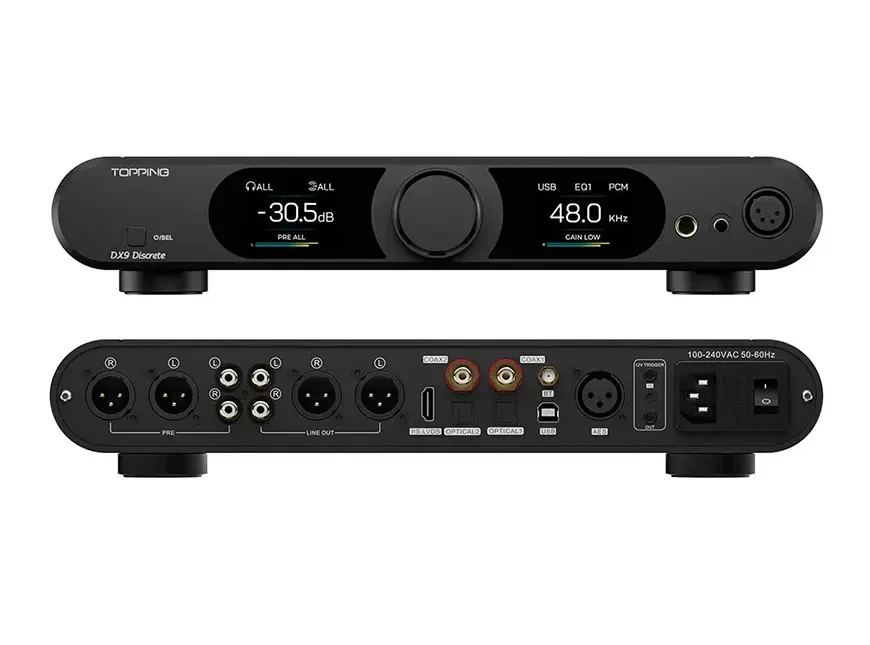
Power alone is not a universal headphone-matching metric. A headphone’s sensitivity, impedance and the amplifier’s available voltage and current all affect achievable level and control. Still, the DX9’s balanced output rating is relevant to owners of demanding designs who find modest USB DAC/headphone dongles or entry-level desktop units short of headroom. The supplied front-panel connections cover the most common serious-headphone terminations: 4.4mm Pentaconn, 6.35mm single-ended and 4-pin XLR.
The unit has Low and High gain modes, a useful provision given the breadth of headphones it is intended to accommodate. Lower gain can provide a more manageable volume range with efficient headphones and in-ear monitors; higher gain is more appropriate when a headphone needs greater level. Topping says the fully balanced hybrid relay volume control maintains channel balance at all volume settings. That matters most at low listening levels, where conventional analogue controls can sometimes exhibit small left/right mismatches.
Two processing features extend beyond basic gain and volume. A 10-band parametric EQ permits adjustment of frequency, gain and Q—the latter determining how wide or narrow each correction is. This is more targeted than a simple bass-and-treble control. It can be used, for example, to make a carefully judged narrow correction around a known headphone response feature, or to apply a broader tonal adjustment. The usefulness depends on sensible settings: aggressive boosts can consume headroom, while corrective EQ is most effective when based on reliable measurements or patient listening.
The DX9 Discrete also supports headphone crossfeed. Crossfeed blends a controlled amount of each stereo channel into the other, broadly mimicking part of the acoustic interaction that occurs when listening to loudspeakers. Some listeners find it can make strongly left/right-panned recordings feel less exaggerated on headphones. It is a preference-based option rather than an upgrade in accuracy for every recording, and is best treated as a selectable listening tool.
Inputs, outputs and a credible role as a desktop hub
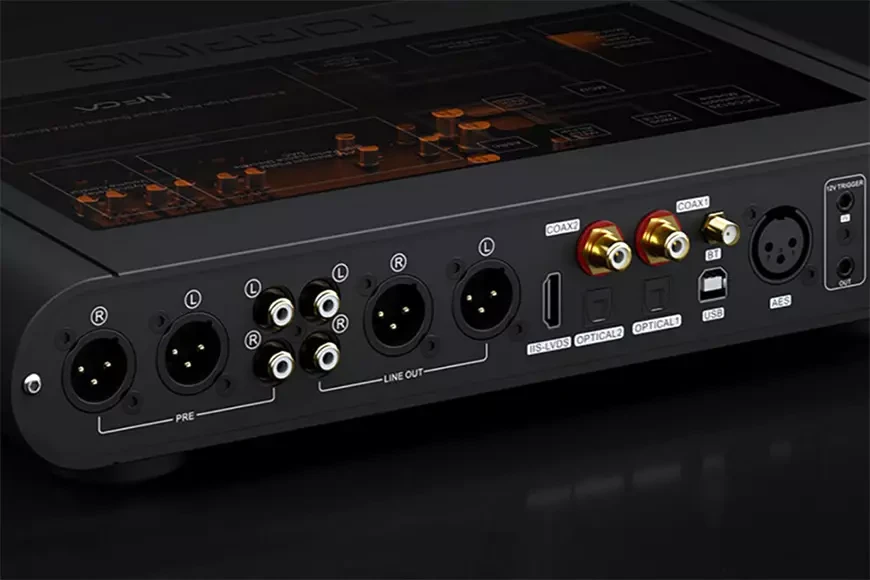
Connectivity is one of the DX9 Discrete’s strongest practical arguments. Its digital input roster comprises USB-B, AES/EBU, I²S, two optical S/PDIF and two coaxial S/PDIF inputs. This allows a computer, network streamer, CD transport, television optical output or legacy digital source to be brought into a single DAC and headphone system. AES/EBU is particularly useful for equipment fitted with the professional-style balanced digital connection, while the duplicate optical and coaxial inputs make switching between several conventional S/PDIF sources possible without recabling.
Bluetooth is supplied via an adapter using Qualcomm’s QCC5125 chipset and Bluetooth 5.1. Supported high-resolution codecs include LDAC, aptX HD and aptX Adaptive. Bluetooth remains a convenience-focused connection compared with a wired digital source, but support for these codecs gives compatible phones and portable players an option beyond basic Bluetooth audio. Codec availability in day-to-day use will depend on what the transmitting device supports.
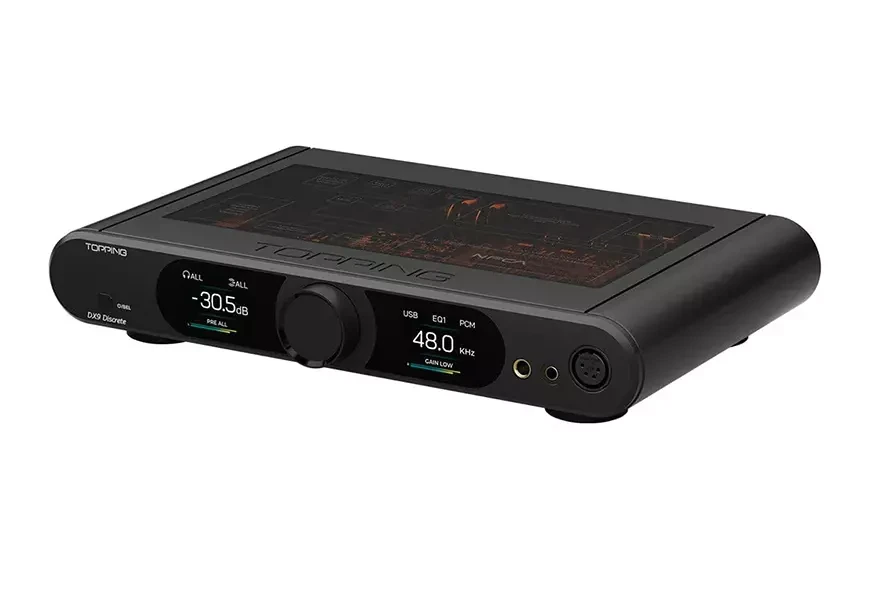
On the analogue-output side, the DX9 can be used as a standalone DAC, a DAC/headphone amplifier or a preamplifier. Both RCA and XLR connections are provided for line and variable outputs. The stated line-output voltages are 5.2V on XLR and 2.5V on RCA. Balanced XLR is often valuable in a desktop or rack system where longer interconnects are needed or where a power amplifier and active speakers offer balanced inputs; its noise-rejection benefits derive from the balanced connection working as a complete system, rather than from the connector alone.
Variable output is what gives the unit its preamp role, allowing its volume control to govern a downstream power amplifier or active monitors. Conversely, a fixed-level DAC output is appropriate when volume is managed by an integrated amplifier or separate analogue preamplifier. Prospective buyers should decide which arrangement suits their system before installation, especially where there is more than one volume control in the signal path.
CNC aluminium casework and dual-screen operation
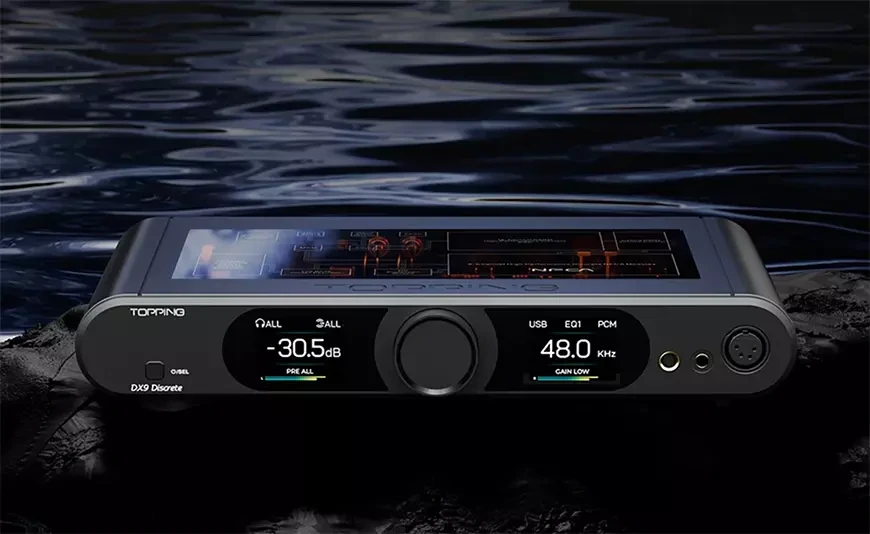
The DX9 Discrete is housed in a premium CNC-machined aluminium-alloy chassis with a clear top panel. CNC machining is commonly used in upper-tier desktop audio components for close panel tolerances and a more substantial enclosure than folded sheet-metal construction. Beyond appearance, a rigid metal enclosure can provide physical protection for internal circuitry; however, Topping has not supplied further details here on internal compartmentalisation, power-supply design or thermal arrangement.
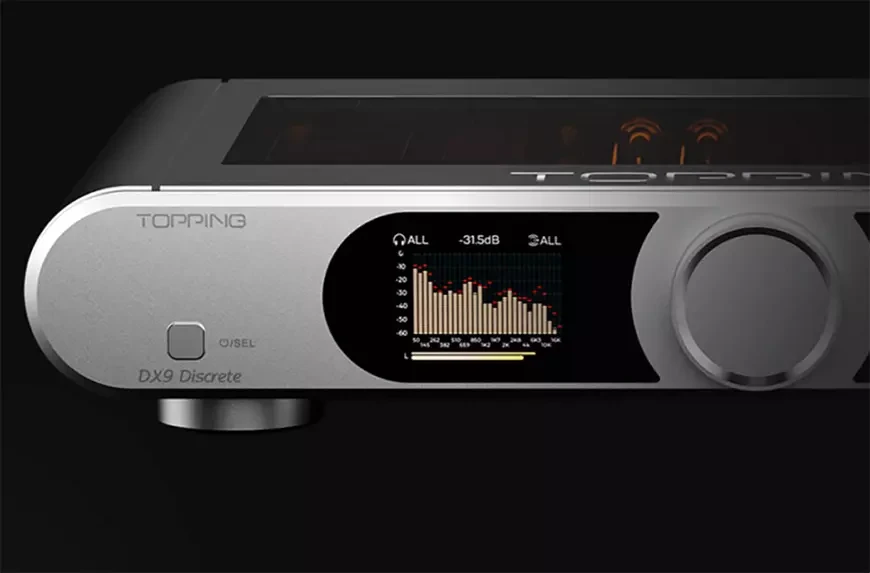
Its front panel uses two colour displays running Topping’s Aurora UI. Alongside operational information, the displays can show FFT spectrum visualisation and VU-meter graphics. These displays are not merely decorative if they make input, level and operating-state information easier to read from a listening position, though buyers who prefer a minimalist rack aesthetic may regard the visualisation modes as optional. The clear top panel and two-screen layout make this a notably more overtly desktop-oriented product than a conventional black-box DAC.
Who the Topping DX9 Discrete is for
The DX9 Discrete makes the most sense for a listener consolidating a digital desktop system. It has the output capability to cover both sensitive IEMs and much harder-to-drive full-size headphones, while its XLR and RCA outputs enable it to become the source and volume controller for a speaker system. The inclusion of multiple S/PDIF inputs, AES/EBU and I²S also gives it broader source flexibility than a USB-only DAC/headphone amp.
Its central trade-off is inherent in that all-in-one ambition. Buyers who need analogue source inputs, dedicated phono support or a network-streaming platform will need additional equipment, as none is specified here. Likewise, the I²S input will be most useful only to owners of a confirmed compatible transport or streamer. For USB-based computer audio, conventional coaxial/optical sources and Bluetooth playback, the DX9’s connection options are more straightforward.
The DX9 Discrete is available now at a suggested retail price of $1,299 USD / €1,299. On paper, it is a specification-led flagship desktop component with the output power, balanced connectivity and configurable DSP tools to serve as the centre of a serious headphone setup—and potentially a compact digital preamp for active speakers or a separate power amplifier.
Topping DX9 Discrete specifications
- Digital inputs: USB-B, Bluetooth, 2 × optical S/PDIF, 2 × coaxial S/PDIF, AES/EBU, I²S
- Supported formats via USB and I²S: Linear PCM 32-bit/768kHz, DSD512
- Supported formats via optical/coaxial/AES: Linear PCM 24-bit/192kHz
- Frequency response: 20Hz–40kHz (±2dB)
- THD+N: <0.00006% (XLR); <0.00007% (RCA)
- Signal-to-noise ratio, A-weighted: 131dB (XLR); 128dB (RCA)
- Line-output voltage: 5.2V (XLR); 2.5V (RCA)
- Balanced headphone output: up to 10,000mW × 2 at 16 ohms
- Unbalanced headphone output: up to 3,300mW × 2 at 16 ohms
- Gain modes: Low / High