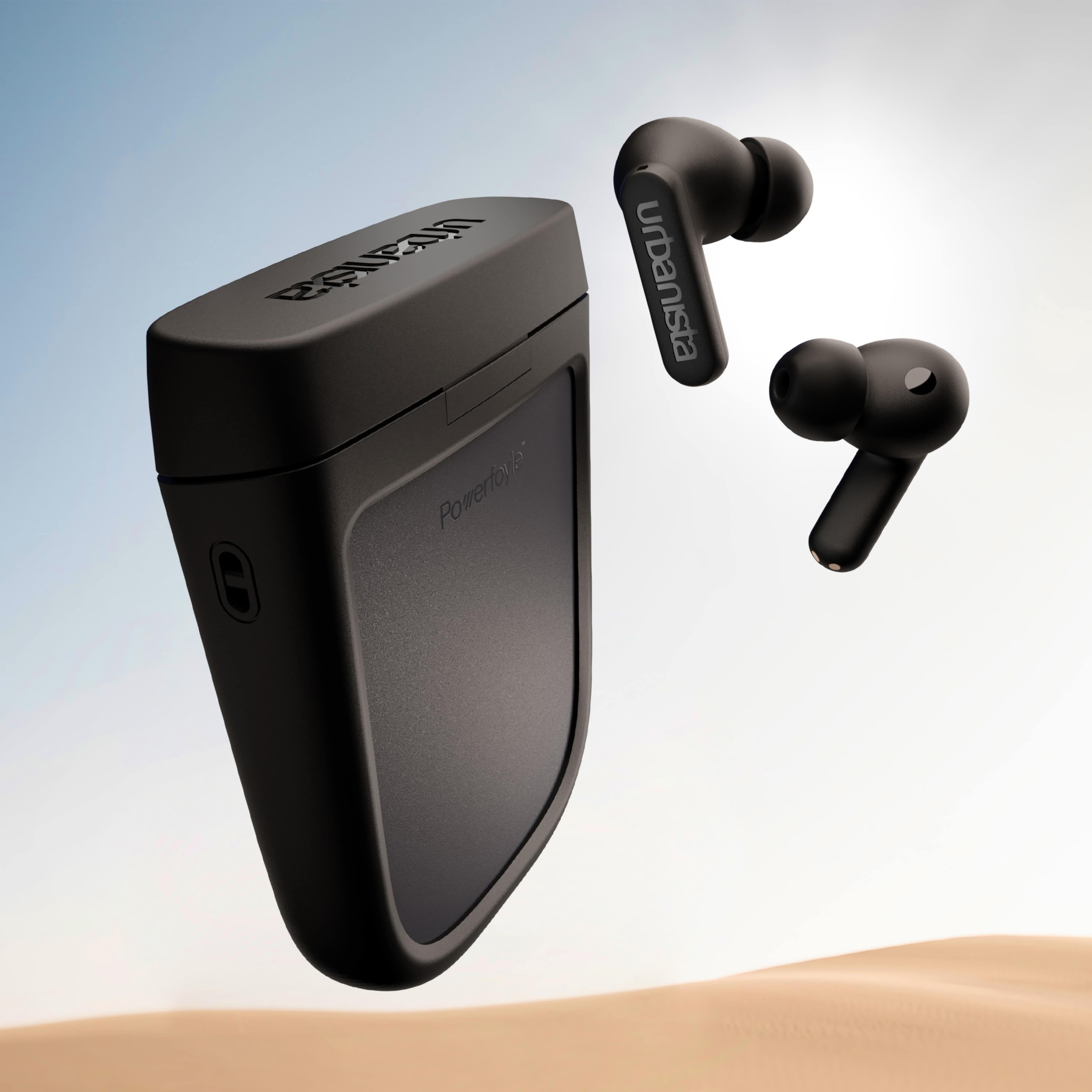
Urbanista will use CES 2024 in Las Vegas to unveil second-generation versions of its light-charging Los Angeles over-ear headphones and Phoenix in-ear models. Both employ the latest flexible Powerfoyle material from Swedish firm Exeger, intended to continuously replenish battery power when exposed to natural or artificial light.
The premise is unusually practical in a wireless-headphone market dominated by USB-C charging cases and increasingly long claimed runtimes. Rather than positioning solar collection as a one-off emergency feature, Urbanista’s approach is intended to make light exposure part of normal ownership: headphones sitting on a desk, being worn outdoors or placed in a well-lit room can receive a supplementary charge. How much energy is recovered will inevitably depend on the strength, duration and angle of available light, so it should not be read as a guarantee that mains or USB charging will never be needed. But it addresses a genuine irritation of battery-powered listening: remembering to charge a product that may be used only intermittently.
Second-generation Powerfoyle, not simply a cosmetic refresh
Powerfoyle is a flexible photovoltaic material developed by Exeger. Urbanista first used it in the Los Angeles headphones in 2021, before bringing the concept to the Phoenix in-ear model in December 2022. For these new versions, the company says the technology has received substantial improvements to efficiency and design.
That matters because a light-harvesting surface on a pair of headphones has to satisfy more than electrical requirements. It needs to conform to the product’s exterior without making the headphones unduly rigid, heavy or visually cumbersome, while continuing to collect usable energy under artificial as well as daylight conditions. The source material does not specify the exact charging output or quantify the efficiency improvement, so those are important details to await closer to launch. Still, the continued use of flexible material is central to why this implementation differs from fitting a conventional rigid solar panel to a headphone band or charging case.
The two products are made from recycled plastic and are described as complete redesigns, with revised ergonomics and an adaptive noise-cancelling system. Recycled content alone does not establish a product’s overall environmental footprint, but it is a relevant material choice in a category where battery replacement and end-of-life recycling can be difficult. More significantly for daily use, ergonomic changes are potentially valuable: wireless headphones and earphones are often worn for long sessions, so fit, pad contact and stability have a direct bearing on comfort, passive isolation and the consistency of perceived bass.
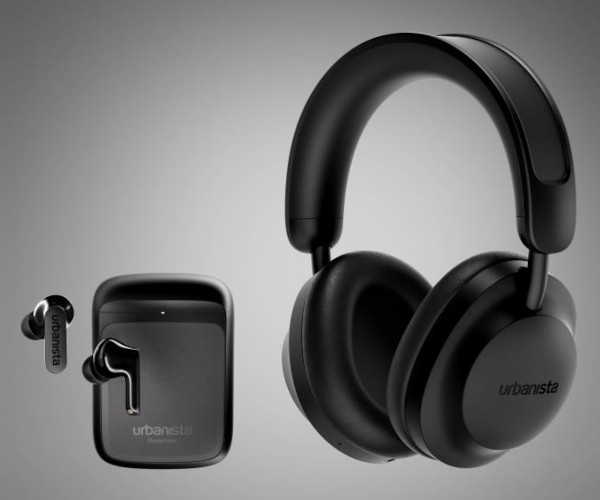
Los Angeles: the over-ear model gains larger earpads
The second-generation Los Angeles remains Urbanista’s over-ear option and is specified with a claimed 60-hour battery life from a full charge. That is the stored-battery figure; the practical attraction of Powerfoyle is that light exposure may add to it over time. For an over-ear design, the larger available exterior area also provides an obvious home for the light-harvesting material without requiring a separate charging case.
Urbanista says the new Los Angeles has larger earpads. This is more than a comfort-led change. In a closed or noise-cancelling over-ear headphone, the ear cushion is part of the acoustic seal between driver and listener. A stable seal helps preserve low-frequency response and reduces intrusion from external sound before electronic cancellation is applied. Larger pads may also give more space around the ear, although the company has not provided dimensions, driver details or information on the pad materials.
The model’s adaptive noise cancellation is said to be tuned to remove unwanted noise while retaining sound clarity. Adaptive systems typically use microphones and processing to respond to changing external conditions rather than applying one fixed cancellation profile at all times. Its success in practice depends on microphone placement, processing and fit, none of which can be judged from the available announcement. It is therefore sensible to treat this as a feature claim rather than a prediction of isolation performance. The same caution applies to any noise-cancelling headphone: steady low-frequency sounds such as transport rumble are generally a different challenge from irregular, high-frequency sounds and nearby speech.
Phoenix: compact true wireless earphones with stronger claimed noise reduction
Phoenix is the more compact in-ear member of the pair. Urbanista quotes eight hours of battery life from the earphones themselves, with a further 32 hours available from the charging case. Those figures are useful to distinguish because the earphones’ own runtime determines how long a single listening session can last, while the case determines how many top-ups are possible away from a cable.
For the new Phoenix, the company claims noise reduction of up to –45dB. This should be understood as a maximum claimed attenuation figure, not a universal result across every frequency, environment or ear shape. In-ear products rely heavily on the physical seal made by their tips; the supplied silicone tips are therefore important not merely as accessories but as part of the isolation system. Choosing a tip that seals comfortably can improve passive attenuation, stabilise bass response and reduce the amount of external noise that ANC has to address.
The Phoenix earphones carry an IP54 water-resistance rating. In practical terms, the first digit indicates protection against dust ingress at the stated level, while the second refers to resistance to splashing water. It is a helpful rating for exercise, commuting and changeable weather, but it is not the same as a claim of submersion resistance. Prospective owners should also note that the rating is stated for Phoenix in the supplied information; it should not be assumed to apply to the Los Angeles model or to the charging case.
Urbanista says the Phoenix case is more compact than that of its predecessor. Case size is a meaningful consideration with true wireless earphones: the case is both the transport container and the product’s power bank, so a smaller one can make the earphones easier to carry but must still accommodate battery capacity and the light-collecting design. No dimensions or case charging specification have yet been provided.
Connectivity, app control and daily-use features
Both second-generation models support Bluetooth 5.3 and can connect to multiple devices at the same time. Multipoint-style connectivity is particularly useful for listeners who move between a phone and a laptop: it can reduce the need to manually disconnect one device before taking a call or resuming playback from another. The announcement does not identify supported Bluetooth audio codecs, so buyers with a specific requirement for a particular codec should wait for the full specification.
Both products also work with the Urbanista mobile app, which offers EQ adjustment and charge tracking. An equaliser is a valuable inclusion because headphone tuning is personal and source material varies widely. Used carefully, it can make modest tonal changes—such as reducing an over-prominent bass region or adding a little presence—without requiring a new pair of headphones. Charge tracking is especially relevant here, since it should help owners understand the relationship between battery level and the available light-based top-up system.
In-ear detection is included for automatic pause and playback when the earphones are removed or reinserted. This is a convenience function rather than an audio-quality feature, but it can make a meaningful difference when taking brief conversations or moving through a working day. Both models will initially be available in black, with further colour options promised later.
What to consider before buying
Urbanista’s two models address different listening habits. The Los Angeles is the better fit for someone who wants an over-ear design, a claimed 60-hour fully charged runtime and the potential convenience of harvesting light across a larger physical surface. Its larger earpads may be particularly welcome for longer desk, travel or home-listening sessions. The Phoenix is aimed more directly at pocketable use, with a compact case, IP54 rating and a claimed total of 40 hours when the earphones and case are considered together.
In either case, the charging proposition should be judged as a convenience benefit rather than as a substitute for assessing core headphone priorities. Fit remains decisive with Phoenix, while the clamp, pad comfort and seal will matter with Los Angeles. Prospective buyers should also look for confirmation of codec support, charging connections, microphone performance and detailed ANC modes when Urbanista publishes full specifications. These are all factors that can affect everyday satisfaction but are not addressed in this initial announcement.
Urbanista plans to ship both products during 2024, although a specific date has not been announced. The Los Angeles is priced at $178 and the Phoenix at $129. More information is available from Urbanista.