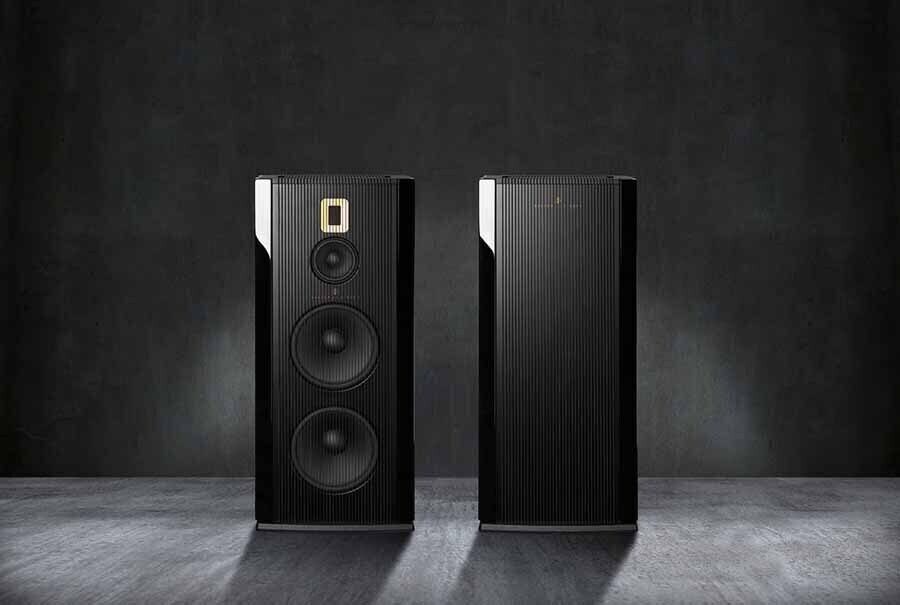
Steinway & Sons’ Model A is an unusually purposeful take on the luxury floorstanding loudspeaker. Rather than asking for a metre or more of clear space behind it, as many high-end speakers do, it has been conceived to work against a wall. Its cabinet is only 270mm deep, yet it incorporates a three-way driver array with two 30cm bass units and reaches a claimed 25Hz to 22kHz frequency range, quoted at -3dB.
That combination explains the Model A’s appeal. It is not simply a decorative, slimline loudspeaker: it is designed as part of the wider Steinway Lyngdorf digital system, where processor-based crossover duties and RoomPerfect room correction can be brought to bear on what is normally one of the most challenging speaker positions in a domestic room. The Model A was designed and hand-assembled in Denmark, and was announced with European availability from the second quarter of 2022 at a price of around €22,000 per pair.
A floorstander designed for the wall, not the middle of the room
Most conventional high-performance floorstanders are positioned well away from the front wall. This is done to control reflections and, particularly, to prevent the wall from disproportionately reinforcing upper bass and low bass. It can work superbly, but it is a demanding layout in real homes: large speakers may project far into the room, alter sight lines and become difficult to accommodate in apartments or multipurpose living spaces.
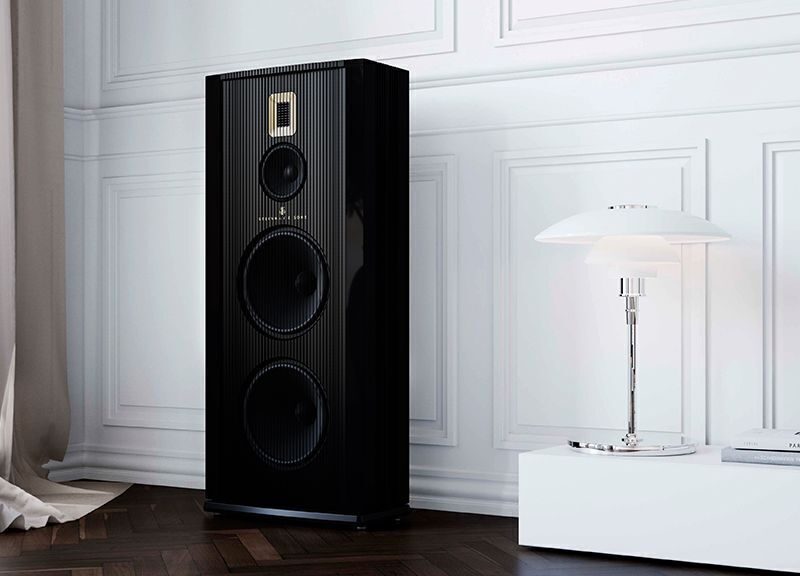
The Model A takes the opposite approach. Steinway & Sons specifies placement against a wall, so the loudspeaker is intended to be integrated with the room architecture rather than treated as a freestanding object that must be pulled into the listening area. With a 270mm cabinet depth, the visual and physical intrusion is far lower than its bass-driver complement might suggest. The company explicitly positions it for apartments, penthouses and yachts—environments in which available floor area, décor and installation constraints can matter as much as outright acoustic ambition.
Importantly, “wall-positioned” should not be confused with a tiny satellite speaker. At 1150mm high and 76kg each, the Model A is a substantial floorstanding design. It sits on a steel base, while the main enclosure combines aluminium and MDF. That mass and mixed-material construction are relevant in a loudspeaker carrying two large woofers: unwanted cabinet vibration can store energy and blur the response of the drive units. Aluminium offers rigidity, while MDF is widely used for its damping characteristics; the precise internal construction has not been detailed, but the use of both materials suggests that mechanical control was central to the design.
Three-way driver array in a closed cabinet
The Model A is a three-way loudspeaker, assigning treble, midrange and bass to dedicated drivers. This is a sensible architecture for a speaker expected to combine serious low-frequency extension with high output capability and a relatively compact front-to-back footprint. Each driver can be optimised for a narrower portion of the audible range instead of asking one unit to reproduce too much of it.
AMT treble and an aluminium-cone midrange
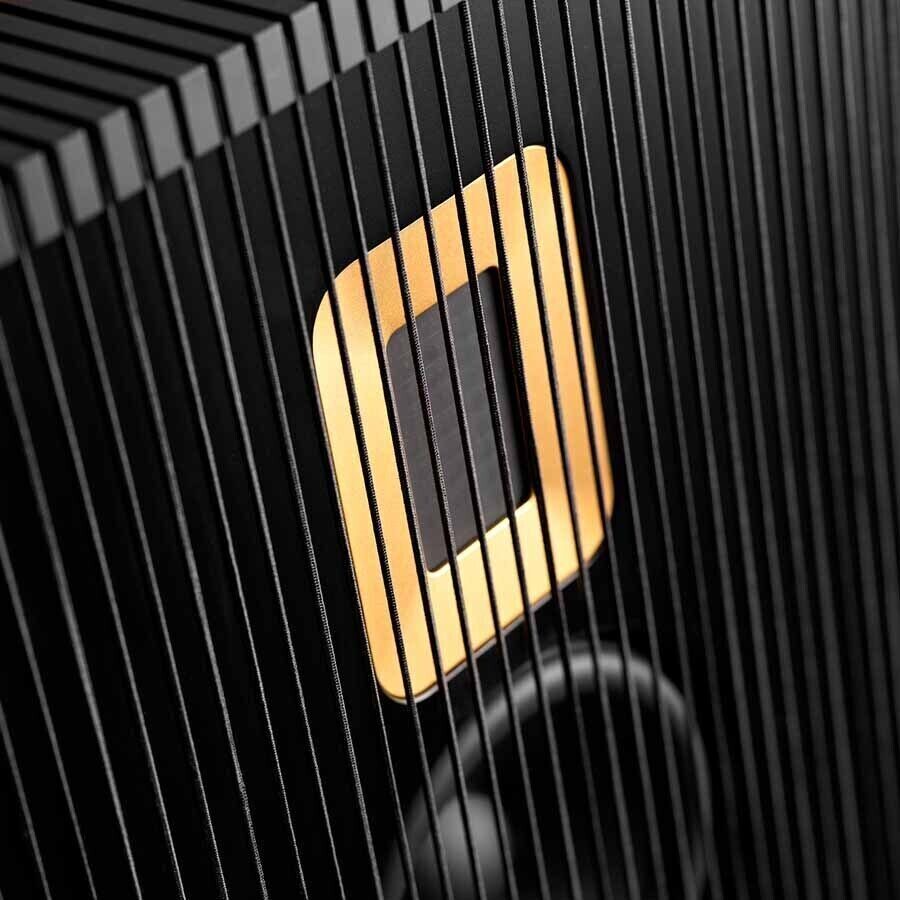
High frequencies are handled by an Air Motion Transformer (AMT) tweeter using a proprietary Steinway Lyngdorf membrane. An AMT operates differently from a conventional dome tweeter: its pleated diaphragm squeezes air as it moves, rather than acting as a simple piston. In general, this approach can provide a large radiating area within a compact physical aperture and can be useful where high-frequency speed and dispersion behaviour are key design considerations. The exact membrane material and crossover implementation are not specified here, so no particular sonic conclusion should be drawn from the AMT designation alone.
The midrange driver measures 165mm and uses an anodised aluminium cone. Metal cones are valued for their stiffness, which can help a driver retain piston-like behaviour through its intended working band. However, every cone material brings its own resonant behaviour, making crossover design and damping critical. In a three-way system, handing the lowest frequencies to separate woofers allows the midrange unit to concentrate on the band where voices, instruments and much of a stereo image are most exposed.
Bass comes from a pair of 30cm woofers. Two drivers of this diameter provide a considerable combined radiating area, which is particularly significant in a shallow enclosure. Larger cone area can move more air for a given excursion, potentially reducing the excursion each driver requires at a given output level. It is an approach that makes sense for a speaker intended to deliver full-scale bass without occupying much depth in the room.
Why the sealed enclosure matters
The Model A uses a closed, or sealed, cabinet rather than a ported bass-reflex alignment. In a sealed speaker, the air trapped inside the enclosure acts as a restoring force on the woofer cones. A ported design can extend output around its tuning frequency, but it also introduces a vent and its associated resonant behaviour. A sealed system avoids that port output and is often a logical partner for active equalisation or digital room correction, because the bass response can be shaped electronically within the safe operating limits of the drivers and amplifiers.
Steinway & Sons quotes a frequency range of 25Hz–22kHz, with -3dB variation. The -3dB point is a standard way of expressing the boundaries of a speaker’s useful bandwidth: it indicates that output has fallen modestly relative to the reference level, rather than claiming perfectly flat response to the extreme ends of the range. How much of that low-frequency extension is realised at the listening seat will still depend heavily on room dimensions, construction, speaker position and processing—precisely why the Model A is designed around a calibrated Steinway Lyngdorf installation.
Digital active crossover and RoomPerfect are central to the concept
The recommended configuration connects the Model A to a Steinway Lyngdorf stereo processor and digital amplifier, enabling the company’s RoomPerfect correction technology. Room correction is especially relevant for wall-adjacent speakers. Nearby boundaries strongly affect bass output, and every room produces resonances—or modes—at particular low frequencies. These can create peaks, dips and uneven bass decay that are determined as much by the room as by the loudspeaker itself.
A measurement-based correction system cannot repeal the laws of acoustics or entirely fix a deep cancellation at one listening position. What it can do is analyse the acoustic result in the room and apply carefully targeted equalisation and other processing to improve the overall balance. In a system deliberately intended for close-to-wall placement, this is a more meaningful proposition than treating DSP as an optional convenience.
The Model A can be partnered with Steinway & Sons A1 or A2 digital power amplifiers. When operated in-band, Steinway & Sons stereo or surround processors can function as active crossovers, processing the signal in the digital domain. In practical terms, an active crossover divides the music signal into the frequency bands intended for the individual drive units before amplification, rather than relying solely on a passive crossover network between amplifier and drivers.
Active operation can offer the system designer tighter control over driver roll-off, level matching and protection, while separate amplifier channels can be allocated to the relevant bands. It also makes digital equalisation and room optimisation a more integrated part of the speaker system. The draft does not state the amplifier-channel requirements, crossover frequencies or whether every Model A installation is supplied in this configuration, so prospective buyers should confirm the precise electronics and cabling required for their intended stereo or surround system.
Installation, finish and ownership considerations
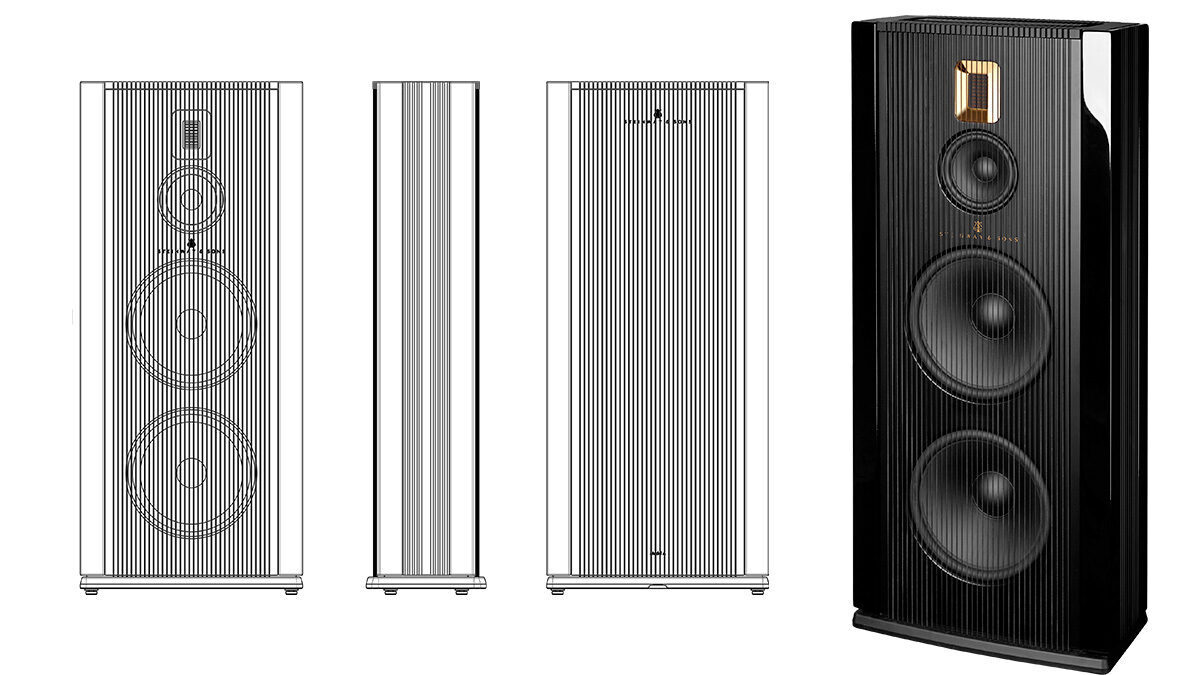
The Model A’s visual treatment is as deliberate as its positioning. The 270mm-deep cabinet is trimmed with strings and matte-gold inserts, and the sides can be finished in black or white piano lacquer; the company states that, in principle, any colour is possible. That broad finish flexibility matters with a wall-positioned speaker, because it becomes a prominent architectural element rather than an object that can be visually softened by placing it far into a room.
Its 76kg weight also means installation should be planned rather than improvised. The shallow footprint may save living space, but moving, levelling and securing the speakers on their steel bases will remain a two-person task at minimum. Wall proximity needs to be treated as part of the acoustic design, not merely a styling choice: the recommended processor, calibration procedure and final position should be settled together. Careful symmetry relative to the main listening position is still desirable for stable stereo imaging, even when the speakers are intended to sit close to a boundary.
For system builders, the key point is that the Model A is not presented as a conventional passive floorstander to be casually paired with any integrated amplifier. Its most distinctive capabilities are tied to Steinway Lyngdorf processors, digital amplification and RoomPerfect. That makes it attractive to buyers seeking a high-end, highly integrated installation with stereo or surround potential, but less naturally suited to someone who specifically wants to retain an established analogue pre/power chain and passive-speaker workflow.
Who the Model A is for
The Steinway & Sons Model A addresses a specific high-end problem: how to install genuinely large-scale loudspeaker capability in a room where deep, free-space placement is either impossible or unacceptable. Its dual 30cm woofers, sealed enclosure and three-way array provide the physical basis for wide-band performance, while the processor-led active crossover and RoomPerfect route provides the control needed to make wall placement viable in a real room.
Its trade-off is clear as well. The speaker’s full proposition is an ecosystem proposition, involving compatible Steinway Lyngdorf processing and amplification rather than just a pair of cabinets and a conventional amplifier. For installations where visual integration, limited room depth and digital calibration are priorities, that is likely the point rather than a restriction. At the announced price of around €22,000 in Europe, the Model A was aimed squarely at bespoke premium systems where the loudspeaker, room and electronics are planned as one.
More information is available from Steinway Lyngdorf’s Model A page.