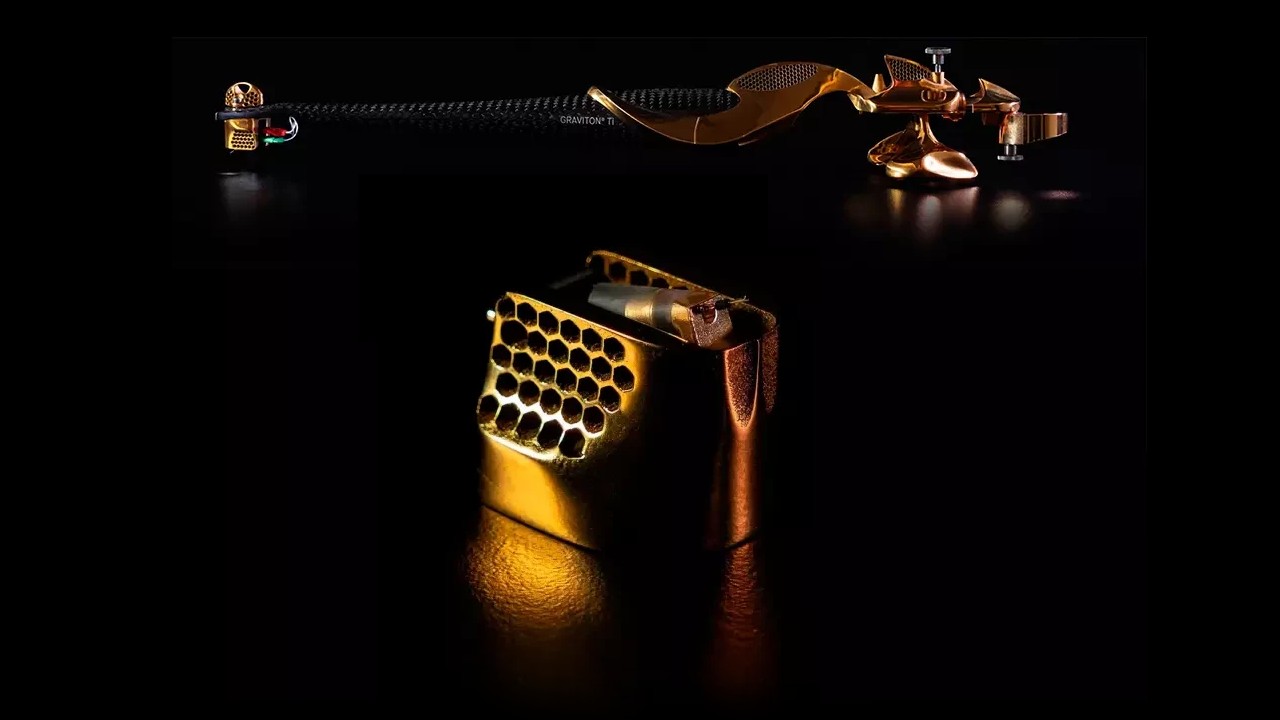
Wilson Benesch has introduced the TESSELLATE Ti-D, a high-end moving-coil cartridge built around two ambitious engineering ideas: a titanium-alloy body made by selective laser sintering, and a hybrid cantilever system combining diamond with unidirectional carbon fibre. At US$15,800, it is plainly a statement-level analogue component rather than an incremental cartridge update.
The central claim is that the TESSELLATE Ti-D is the first cartridge series to use this hybrid diamond/UD-carbon cantilever arrangement. Its purpose is not simply to use exotic materials, but to address a difficult mechanical problem at the very front of the analogue replay chain: extracting minute groove modulations while preventing the cantilever, cartridge body and mounting interface from storing and releasing unwanted vibrational energy.
In a moving-coil cartridge, the stylus traces the record groove, the cantilever transfers that movement to the coils, and the coils generate a tiny electrical signal in the magnetic circuit. Every part of that mechanical path matters. Mass, stiffness, damping and resonant behaviour all influence how accurately the stylus can remain in contact with the groove walls, particularly during loud, complex or highly modulated passages. Wilson Benesch’s approach is therefore focused on the cantilever and body structures rather than on adding cosmetic complexity.
A titanium body made by selective laser sintering
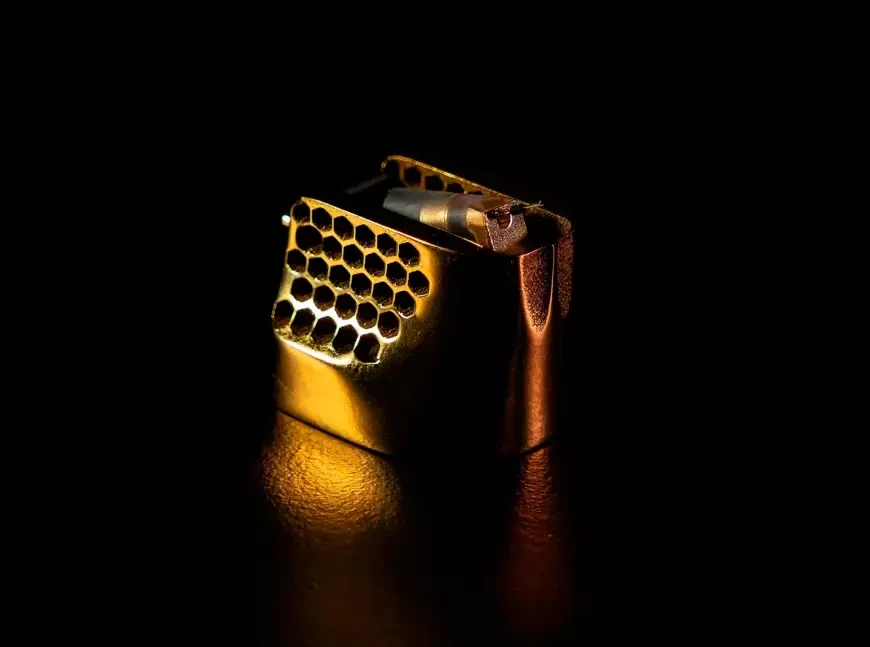
The TESSELLATE Ti-D body is manufactured from titanium alloy using Selective Laser Sintering (SLS), an additive-manufacturing process in which a laser fuses metal powder in successive layers. Unlike conventional machining, where material is removed from a solid block, SLS permits shapes that may be difficult or impractical to cut conventionally, including internal voids, thin sections and intricate supporting structures.
Wilson Benesch developed the cartridge body with Renishaw PLC, a specialist in additive-manufacturing technology. The result is described as a mosaic, semi-open architecture. This matters because a cartridge body has to do two seemingly conflicting jobs: it needs to hold the generator assembly and cantilever system in a stable relationship, yet it must avoid becoming an unnecessarily large resonant mass around that sensitive assembly.
Titanium is a logical material for such a structure because it offers high stiffness for its mass, while additive manufacturing allows the material to be placed where it is structurally useful rather than used as a solid shell everywhere. The semi-open design is also not a new stylistic direction for Wilson Benesch. The company says it stems from research undertaken for its original cartridge range in the 1990s, and from subsequent cartridge designs that investigated the effect of structures close to the cantilever.
That area is particularly significant. Energy enters the cartridge at the stylus tip and travels up the cantilever into the generator, but some energy can also return through the assembly and excite nearby parts. A body that is rigid, low in excess mass and carefully shaped around the cantilever may help control those mechanical interactions. That is the engineering rationale behind the TESSELLATE Ti-D’s open lattice-like form; it should not be mistaken for a purely visual feature.
What the hybrid cantilever is intended to achieve
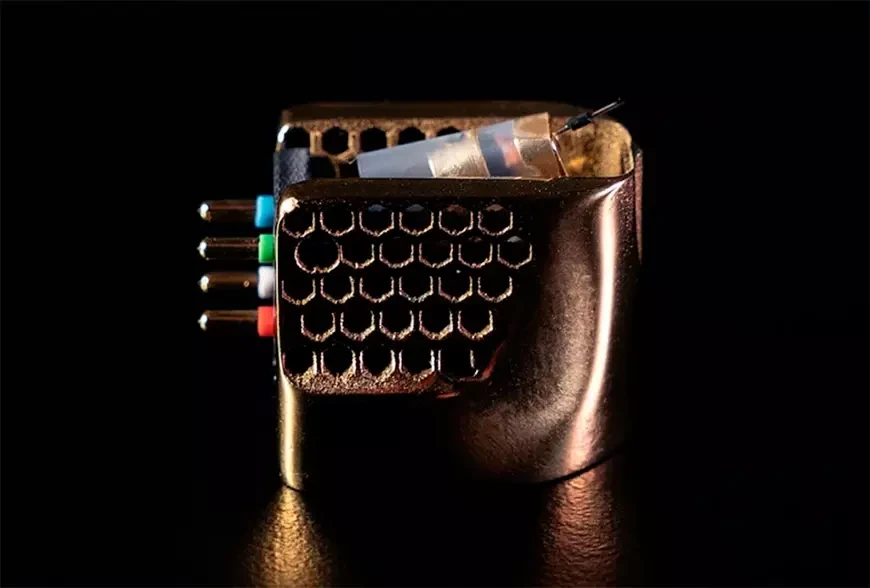
The Ti-D’s headline feature is its hybrid cantilever. Wilson Benesch specifies a diamond cantilever with a UD carbon-fibre damping ring, employing a unidirectional carbon-fibre tube in an offset, asymmetrical position at the cantilever’s centre. The company says this is intended to raise stiffness and damping while keeping mass exceptionally low.
Cantilever materials are a major point of differentiation in premium moving-coil designs. Aluminium is common and relatively light, while boron, sapphire and diamond are used where a designer is pursuing greater rigidity. However, stiffness alone is not the whole story. Every cantilever has resonant modes, and a very rigid, lightly damped structure can shift those resonances rather than necessarily eliminating their effects.
Carbon fibre can be especially interesting in this application because its behaviour depends on fibre orientation and how it is incorporated into a composite structure. Wilson Benesch’s use of unidirectional carbon fibre is intended to take advantage of the material’s strength along the fibre direction while adding damping to the diamond cantilever system. The deliberately offset placement is also notable: it suggests the carbon-fibre element is being used to tune the mechanical behaviour of the assembly rather than simply applied symmetrically as a cosmetic sleeve.
In practical terms, the claimed aim is better control of cantilever resonance and more secure groove tracking. These are closely related priorities. If the stylus remains accurately coupled to the groove under dynamic conditions, the cartridge has a stronger foundation for low distortion, stable channel performance and clean retrieval of high-frequency information. Whether the design delivers a particular sonic character will, of course, require independent listening and measurement; Wilson Benesch’s published information establishes the intended mechanical strategy, not a substitute for a review.
The cartridge uses a Micro Ridge stylus profile with a specified 3 x 80µm radius. A Micro Ridge profile is designed to present a very small contact area in the groove’s high-frequency region while maintaining a larger contact patch in the direction of travel. In principle, such advanced line-contact profiles can retrieve fine groove information and spread tracking force over a larger vertical contact area than simpler conical or elliptical tips. The trade-off is that setup becomes correspondingly critical. Alignment, azimuth, vertical tracking angle and anti-skate all deserve careful attention on a cartridge of this type.
Generator, output and phono-stage matching
The TESSELLATE Ti-D is specified with a Pure Iron Square Coil generator, 0.35mV output at 3.54cm/s and 6-ohm internal impedance. Those figures identify it as a low-output moving-coil cartridge and mean that the phono stage is an essential part of the system partnership.
An output of 0.35mV is within the normal territory for a low-output MC, but it is far below the output of a moving-magnet cartridge. The phono stage or step-up transformer must therefore provide enough clean gain without adding excessive noise. A dedicated MC gain setting is likely to be required; the right choice will depend on the gain structure of the complete preamplifier or integrated amplifier system.
Wilson Benesch recommends a load resistance between 100 and 330 ohms. Cartridge loading is not merely a number to enter by habit. It changes the electrical damping seen by the moving coils and can affect the cartridge/phono-stage interface. Owners whose phono stage offers adjustable resistive loading should regard the stated range as the sensible starting point, then fine-tune within it only after ensuring that cartridge alignment, tracking force and system gain are correct.
The quoted frequency response is 20Hz–32kHz, within ±1dB. While records do not contain unlimited ultrasonic information and the final response at the loudspeaker will depend on the entire system, an extended and tightly specified response suggests that Wilson Benesch is targeting controlled behaviour well beyond the conventional audible band. Its channel separation is specified as better than 35dB at 1kHz, while channel imbalance is better than 0.5dB. Both are important figures in stereo replay: good separation supports stable image placement, and close channel matching helps prevent the centre image from pulling subtly to one side.
Tonearm compatibility and precision setup
Wilson Benesch recommends a medium-mass tonearm and specifies dynamic compliance at 15µm/mN. Compliance describes how readily the cantilever suspension moves. Together with tonearm effective mass and cartridge mass, it determines the arm/cartridge resonant frequency. That resonance needs to sit in a sensible region: too low and it can be excited by warps, footfall or record eccentricity; too high and it can intrude into low-frequency musical information.
The company’s medium-mass recommendation is therefore useful guidance, but it is not a complete compatibility calculation. The cartridge itself weighs a substantial 17.1g, so prospective owners should first confirm that their tonearm can be correctly balanced with it. Some arms may need a heavier counterweight or an additional headshell mass arrangement; whether that is necessary depends on the individual arm and should be checked before purchase.
The recommended tracking-force range is 1.1–1.4g, with 1.3g identified as optimal. That is the place to begin, using an accurate stylus-force gauge rather than relying solely on a tonearm’s calibrated counterweight scale. Tracking too lightly is rarely a benign choice with a sophisticated stylus profile: it can reduce groove contact security and increase mistracking risk. Once force is set at 1.3g, the next essential adjustments are overhang and offset angle, azimuth, VTA and anti-skate.
Wilson Benesch gives VTA as 20 degrees. In real-world installation, VTA adjustment generally begins with the tonearm approximately parallel to the record surface, then is refined if the arm permits. Because a Micro Ridge stylus has a highly developed contact geometry, small changes in arm height and azimuth can be audible and may also affect channel balance and distortion. The record surface must be level before these settings can be meaningfully finalised.
The stated tracking capability is 85µm at 315Hz with optimal tracking force. This is a laboratory-style indicator of the cartridge’s ability to negotiate demanding groove modulation under the specified condition, rather than a guarantee that every record will behave identically. Record condition, pressing quality, turntable isolation and setup accuracy remain highly consequential.
Finishes, ownership considerations and price
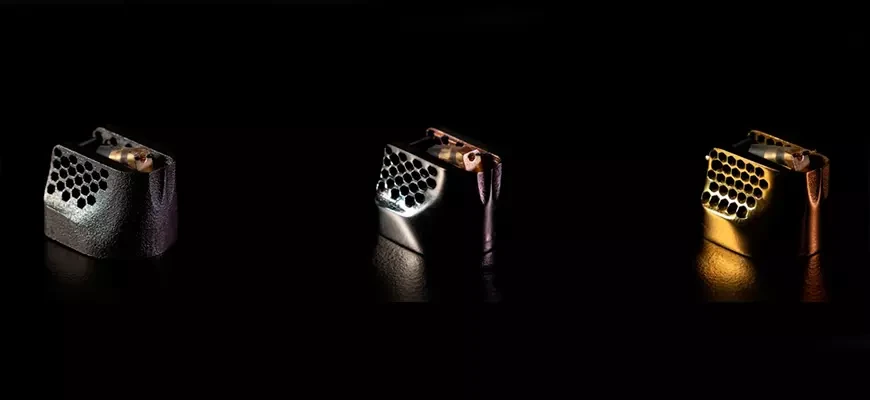
The TESSELLATE Ti-D is available in Textured Matt Titanium, hand-polished Polished Silver and Polished Gold finishes. The Gold version receives its finish through vapour deposition after the cartridge body has been hand polished. These alternatives do not alter the published technical specification, so the choice is primarily one of appearance and how the cartridge suits the tonearm and turntable on which it will be installed.
Wilson Benesch recommends a 30-hour break-in period. As with any new cartridge, it is sensible to use that time to verify tracking force and alignment once more after initial use, particularly where the arm’s mounting hardware or suspension may settle slightly. It is also wise to keep the stylus clean using a method approved for the cartridge, and to avoid lateral force on the cantilever during cleaning.
At US$15,800, the TESSELLATE Ti-D belongs in a system where the turntable, arm, phono stage and installation standard are commensurately serious. Its 0.35mV output and recommended 100–330-ohm loading call for a flexible, quiet MC phono stage, while its 17.1g mass and medium-compliance specification make careful arm matching necessary. The cartridge’s novel value proposition is not simply its titanium finish or 3D-printed form, but an attempt to control mechanical energy at both ends of the cartridge: a light, stiff semi-open body around the generator and a damped hybrid structure at the cantilever.
Wilson Benesch TESSELLATE Ti-D specifications
- Hybrid cantilever: diamond cantilever with UD carbon-fibre damping ring
- Stylus profile: Micro Ridge
- Stylus radius: 3 x 80µm
- VTA: 20 degrees
- Coil: Pure Iron Square Coil
- Output voltage: 0.35mV at 3.54cm/s
- Internal impedance: 6 ohms
- Frequency response: 20Hz–32,000Hz (±1dB)
- Channel separation: better than 35dB at 1kHz
- Channel imbalance: better than 0.5dB
- Tracking: 85µm at 315Hz with optimal tracking force
- Dynamic compliance: 15µm/mN
- Recommended load resistance: 100–330 ohms
- Recommended tracking force: 1.1–1.4g
- Optimal tracking force: 1.3g
- Recommended tonearm weight: medium
- Break-in period: 30 hours
- Weight: 17.1g
Price: US$15,800