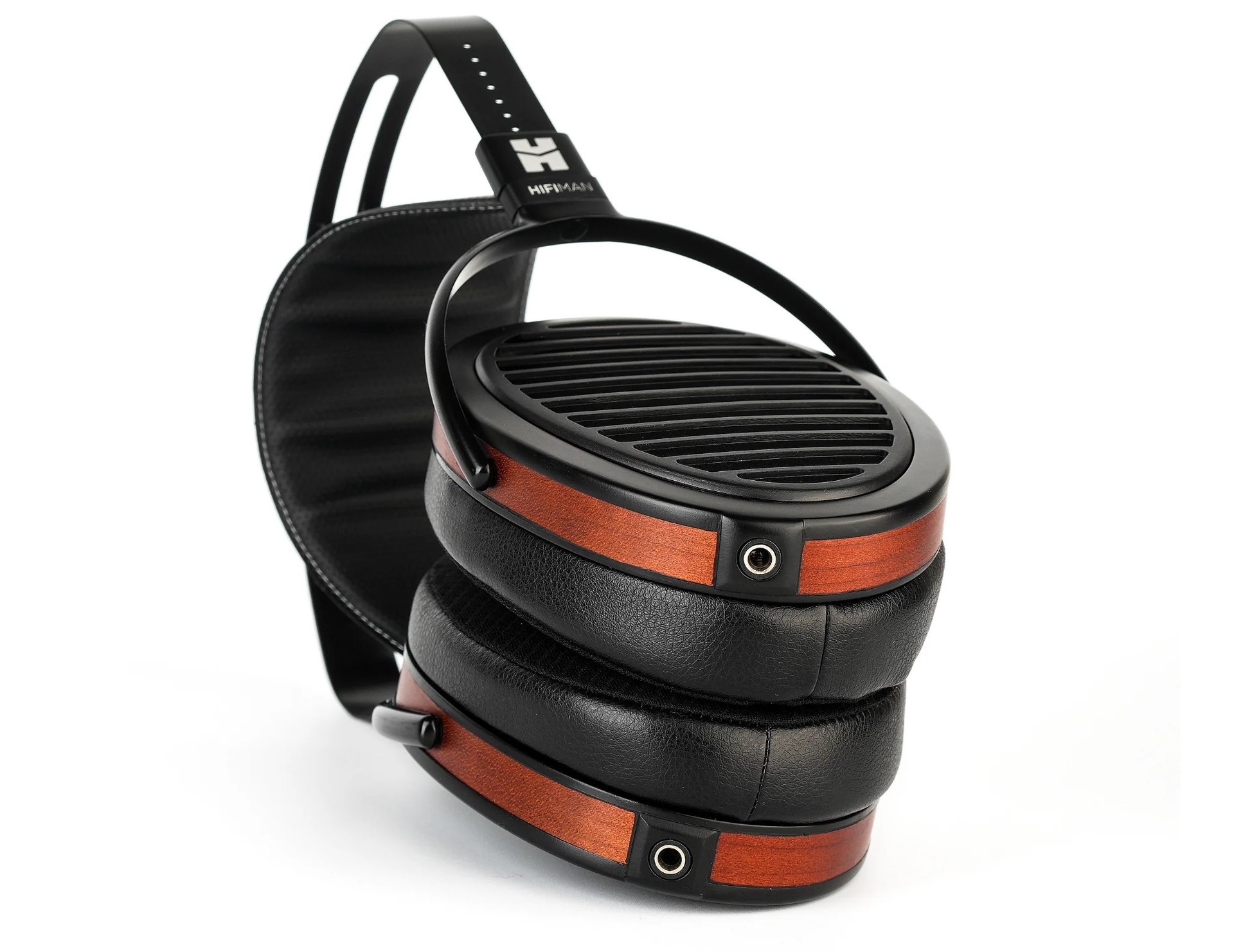
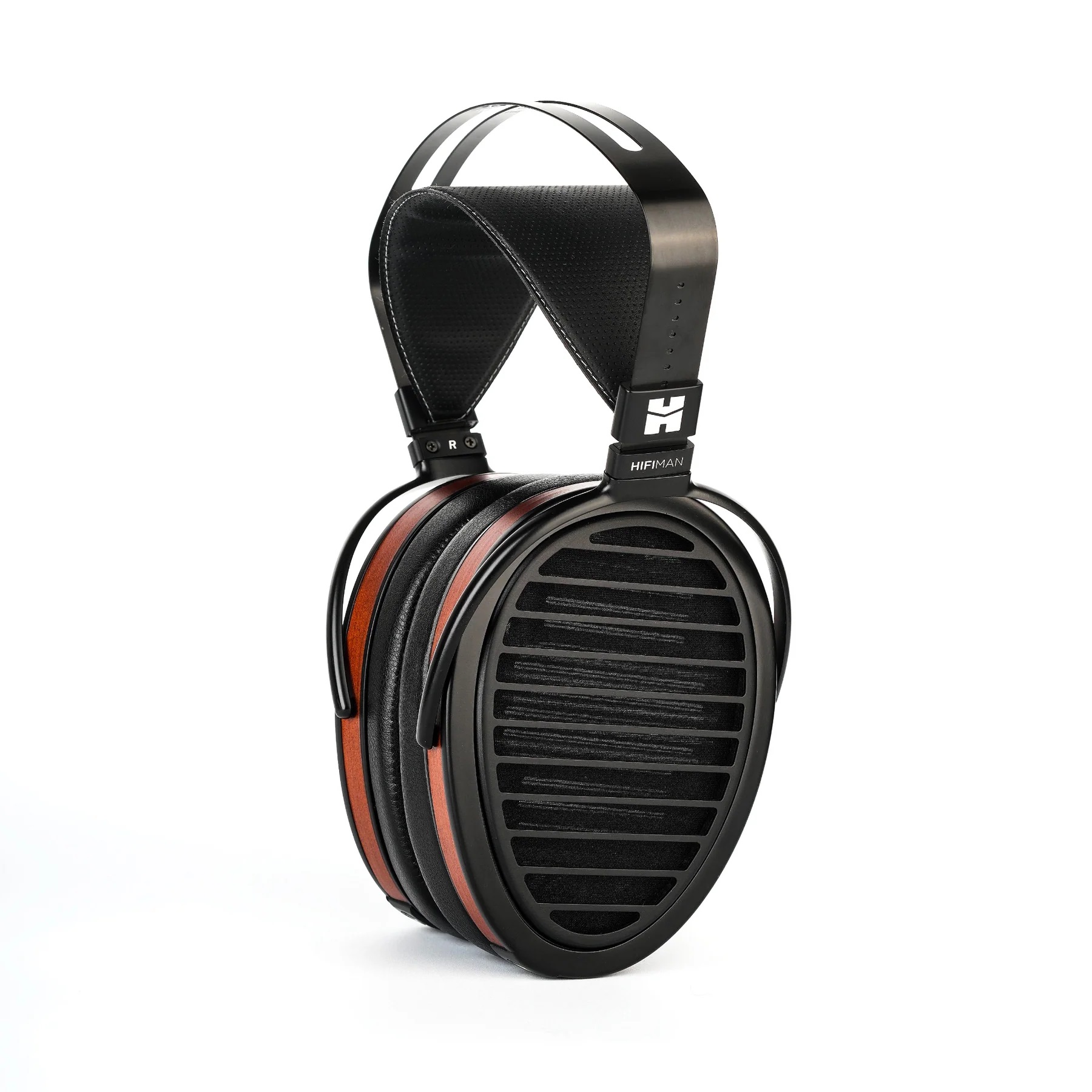
HiFiMAN has begun shipping the Arya Organic, the third generation of its Arya open-back planar-magnetic headphones. The new model retains the broad soundstage, imaging focus and nominally neutral balance associated with the earlier Arya and Arya Stealth Magnets, while introducing a revised industrial design with wooden earcups and a stated aim of delivering a fuller overall sound.
That makes the Arya Organic an evolution rather than a wholesale change of direction. Its core engineering remains HiFiMAN’s familiar large planar driver, ultra-thin diaphragm and magnet structure designed to minimise obstruction between the diaphragm and the listener. The headline electrical change is a 16-ohm impedance, paired with 94dB sensitivity, which should make the Arya Organic less demanding of voltage than some high-impedance headphones. However, its low impedance also means an amplifier needs to supply current cleanly and maintain good control into a 16-ohm load.
A new Arya, rather than a new concept
The Arya Organic sits in the established Arya family, which HiFiMAN describes as one of its most successful headphone lines. Its intended appeal is clear: this is a full-size, open-back planar headphone for listeners who value spatial presentation and detail but want a richer, more substantial voicing than they associate with previous Arya versions.
HiFiMAN says the wooden earcups are part of the revised industrial design and contribute to a “fuller sound”. That is a manufacturer claim rather than an independent listening finding, but it points to an important aspect of headphone design. In an open-back headphone, the earcup is not a sealed acoustic chamber in the way it is with a closed-back model. Its material, shape, internal geometry and grille arrangement can nevertheless affect reflections, resonances and how the rear radiation from the driver is dispersed. Those factors can influence the tonal balance and the sense of openness a designer is trying to achieve.
The open-back construction is also fundamental to the Arya Organic’s use case. It is intended for quiet listening spaces, where its open structure can help avoid the enclosed, pressurised sensation that some listeners experience with sealed headphones. The trade-off is substantial sound leakage in both directions: the listener will hear room noise, and people nearby will hear the music. It is therefore not the sensible choice for commuting, offices or shared spaces where isolation matters.
“Arya fans often ask for a next-generation model with an even more ‘full sound signature,’ meaning more detail and improved overall frequency response. Arya Organic is our answer, with a soundstage and sonic output that will satisfy the most demanding audiophiles and music lovers.”
Fang Bian, President and CEO of HiFiMAN Electronics
Planar-magnetic fundamentals: the diaphragm matters
Unlike a conventional dynamic headphone driver, which generally uses a voice coil attached to a cone or dome, a planar-magnetic driver uses a thin, flat diaphragm carrying conductive traces. That diaphragm is driven across a larger area by a magnetic field. In principle, spreading the driving force over a broad, light membrane can reduce the tendency for the diaphragm to flex unevenly, which is one reason planar designs are often chosen for their resolution, transient precision and low-distortion potential.
HiFiMAN specifies a nanometer-thick diaphragm for the Arya Organic, describing it as an extremely thin film that is difficult to work with. The company does not state an exact diaphragm thickness in the supplied information, so no precise figure should be assumed. The useful point is that diaphragm mass is critical in any headphone driver. A lighter moving assembly has less inertia, potentially allowing it to start and stop more rapidly in response to the musical signal. Whether that translates into a particular audible character depends on the complete driver, magnetic circuit, acoustic design and amplifier being used—not diaphragm thinness alone.
For owners, planar construction brings practical implications as well as potential performance benefits. Large planar diaphragms can present an amplifier with a low-impedance load, and their sensitivity may not tell the whole story without knowing the manufacturer’s measurement reference. HiFiMAN gives the Arya Organic a sensitivity rating of 94dB, but does not specify in the supplied material whether that figure is referenced to 1mW or 1V. It is therefore best treated as a broad indication rather than a guarantee that every portable output will provide the same headroom.
Stealth Magnets and an asymmetrical magnetic circuit
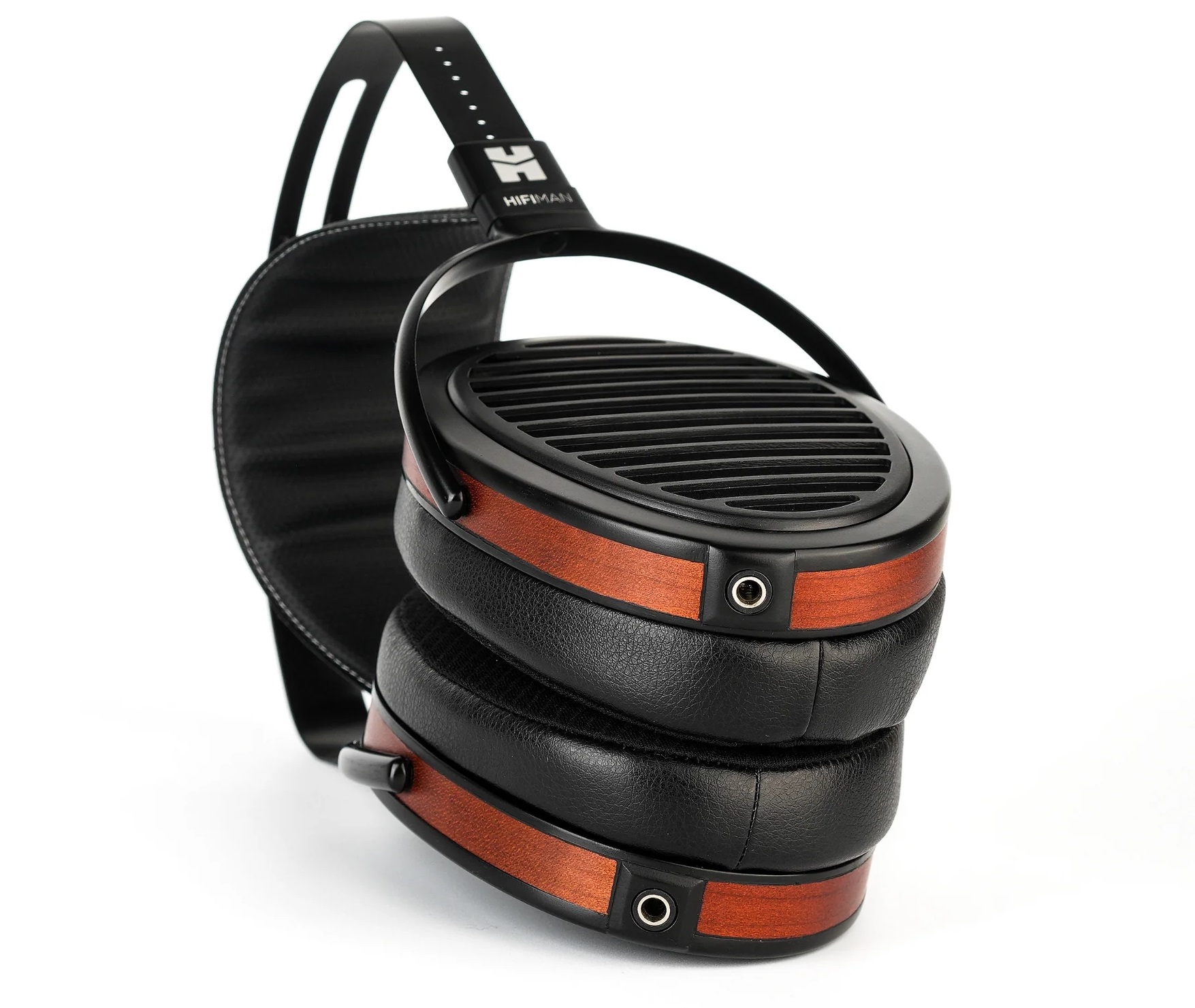
HiFiMAN’s Stealth Magnet system is a central part of the Arya Organic design. Conventional bar magnets positioned close to a planar diaphragm can obstruct or reflect some of the sound waves travelling through the driver. HiFiMAN says its specially shaped Stealth Magnets are acoustically transparent, allowing those waves to pass with less interference. The design objective is to reduce wavefront degradation and distortion before the sound reaches the ear.
This is worth separating from the usual marketing shorthand. A magnet cannot literally disappear acoustically, but its shape, placement and profile can be engineered to reduce obstruction and turbulence compared with a more blunt structure. In a planar headphone, where the diaphragm radiates through a magnet array, reducing that obstruction is a logical route towards preserving the detail and spatial cues the driver is intended to reproduce.
The Arya Organic also uses an advanced asymmetrical magnetic circuit. HiFiMAN says this places smaller magnets on the ear-facing side, with the purpose of reducing interference with sound transmitted from the diaphragm. Again, the broader engineering aim is acoustic transparency: keep the magnetic structure effective enough to drive the diaphragm while reducing its unwanted influence on the path between diaphragm and ear.
These two features should be understood as parts of one system. The diaphragm, conductive traces, magnet arrays, earcup structure and open grille all interact. It would be misleading to assign the headphone’s eventual performance to one element alone, but the use of a shaped, asymmetrical magnet arrangement clearly shows that HiFiMAN is addressing both motor force and the acoustic path around the driver.
Window Shade grilles and the pursuit of space
HiFiMAN also retains its patented “Window Shade” grille design. The company says this reduces reflections and expands the soundstage. On an open-back headphone, the outer grille needs to protect the driver while allowing rearward sound to escape with as little reflection or obstruction as practical. A more open grille can help limit acoustic reflections that might otherwise feed back towards the diaphragm or alter the headphone’s perceived openness.
Soundstage in headphones should always be approached with some caution. Headphones do not interact with a listening room in the same way as loudspeakers, so the sense of width, depth and image placement comes from channel information, frequency response, driver geometry, ear and pad interaction, and the recording itself. Still, an open construction and carefully managed reflections can support the spacious presentation HiFiMAN is targeting.
For prospective buyers, this means the Arya Organic is likely to be most relevant to listeners who prioritise convincing imaging and a less enclosed presentation over isolation or portability. It is also a design that places considerable importance on source material: naturally recorded acoustic music, live recordings and well-produced multi-track material can all reveal spatial information differently. That is not a claim about the Arya Organic’s sound in use, but a practical reason why spacious open-back headphones reward careful source selection.
16 ohms and 94dB: amplifier matching needs more than a phone output
The Arya Organic is specified at 16 ohms and 94dB sensitivity. The lower impedance is a notable figure in the context of full-size planar headphones. It reduces the voltage required to reach a given level compared with a higher-impedance design, but it can increase current demand from the amplifier. In short, “low impedance” does not automatically mean “easy to drive well”.
A capable dedicated headphone amplifier or a well-designed headphone output on an integrated amplifier, DAC/headphone amplifier or network player should be a more appropriate partner than assuming any low-power portable source is ideal. The practical requirement is not simply a high advertised power number. A suitable amplifier should be comfortable into low impedances, have a low enough output impedance to avoid undesirable electrical interaction, and provide usable volume control without audible noise or channel imbalance at normal listening levels.
HiFiMAN has not supplied output-power requirements, maximum input level, cable termination details or included accessories in the information available here. Those are details worth confirming before purchase, particularly for listeners planning balanced operation or using an existing headphone amplifier. “Balanced” headphone connection, where offered by a source and cable, is not inherently an upgrade in itself; the benefit depends on the amplifier’s circuit design and available power into the headphone load.
The supplied 8Hz–65kHz frequency range also needs sensible interpretation. It indicates the claimed bandwidth over which the driver can produce output, but no tolerance is given. Without a response graph and stated measurement conditions, it does not reveal how flat the headphone is at either extreme. The 8Hz lower figure should not be read as a promise of a particular in-room-style bass response, while the 65kHz upper figure is well beyond conventional human hearing. These numbers are more useful as an indication of the driver’s claimed operating bandwidth than as a complete tonal description.
Fit, weight and everyday ownership
HiFiMAN describes the Arya Organic as ergonomically designed for comfort across a wide range of listeners. The stated weight is 440g, a meaningful figure for a headphone intended for long sessions. Weight alone does not determine comfort: headband distribution, clamp force, earpad material and shape, and how the cups articulate all matter. Nevertheless, 440g places the Arya Organic firmly in full-size headphone territory, and buyers who are sensitive to weight should audition it where possible.
Open-back headphones can be easier to wear for extended periods because they admit air around the ear, but individual fit remains decisive. A proper audition should include more than a brief listen. Check whether the pads seal consistently around the ear, whether the headband creates a pressure point, and whether the cups remain stable when moving naturally. Fit can alter bass balance and imaging as well as comfort, so it is not merely an ergonomic concern.
Who should consider the HiFiMAN Arya Organic?
The Arya Organic is aimed at the listener building a serious home headphone system around an open-back planar design. Its appeal lies in the combination of HiFiMAN’s established Arya platform—large planar diaphragm, Stealth Magnets, asymmetric magnetic circuit and open Window Shade grille—with a revised wooden-earcup design intended to add a fuller presentation.
Its strengths on paper are its technically focused driver architecture, emphasis on minimising magnetic obstruction, low 16-ohm impedance and stated 94dB sensitivity. The principal compromises are inherent to the category: no isolation, substantial leakage and a need to consider amplifier current capability rather than relying solely on the low impedance figure. At 440g, long-term fit will also be personal.
For existing Arya owners, the key question will be whether the manufacturer’s stated move towards greater fullness is the desired direction while retaining the line’s soundstage and imaging priorities. For new buyers, the Arya Organic should be assessed as part of a complete chain: a clean DAC, a headphone amplifier happy driving low-impedance planar loads, high-quality recordings and, crucially, a quiet room. The specifications establish a promising technical basis, but an audition remains the best way to determine whether its balance and ergonomics suit the listener.
HiFiMAN Arya Organic specifications
- Type: Open-back planar-magnetic headphones
- Frequency range: 8Hz–65kHz
- Impedance: 16 ohms
- Sensitivity: 94dB
- Weight: 440g