Arcam has used ISE 2026 in Barcelona to introduce the Radia AV Series, a six-model home-cinema range that goes considerably further than a conventional receiver refresh. The line comprises three AV receivers, the 16-channel AVP45 processor and two dedicated multi-channel power amplifiers, creating a route from a comparatively compact immersive system to a fully separated installation.
That breadth is the important point. AV buyers often have to choose between an all-in-one receiver and an expensive processor-led system, with limited continuity between the two. Arcam’s proposed Radia platform instead gives an owner or installer a common design language, software environment and control approach across both. A system can begin with an AV receiver and, where the room, loudspeakers or channel count demand it, move towards external amplification and a processor without changing brand or operating ecosystem.
The range is announced for staged arrival in 2026. The AVA15, AVA25, AVA35 and AVP45 are expected in the third quarter, followed by the PA4 and PA9 amplifiers in the fourth. Arcam has also confirmed indicative European prices ranging from €999 for the PA4 to €6,999 for the flagship AVA35.
A Radia platform for receiver and separates systems
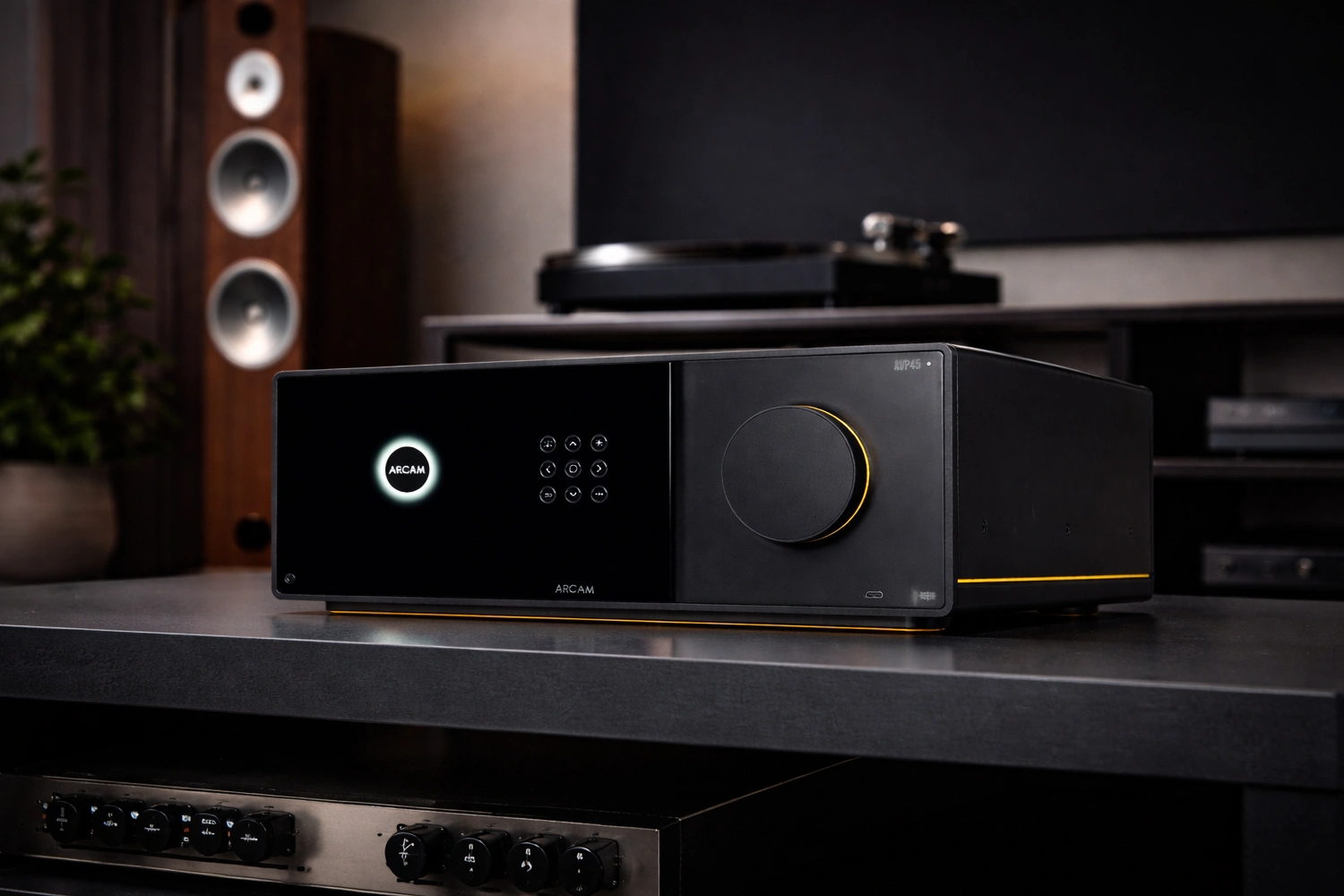
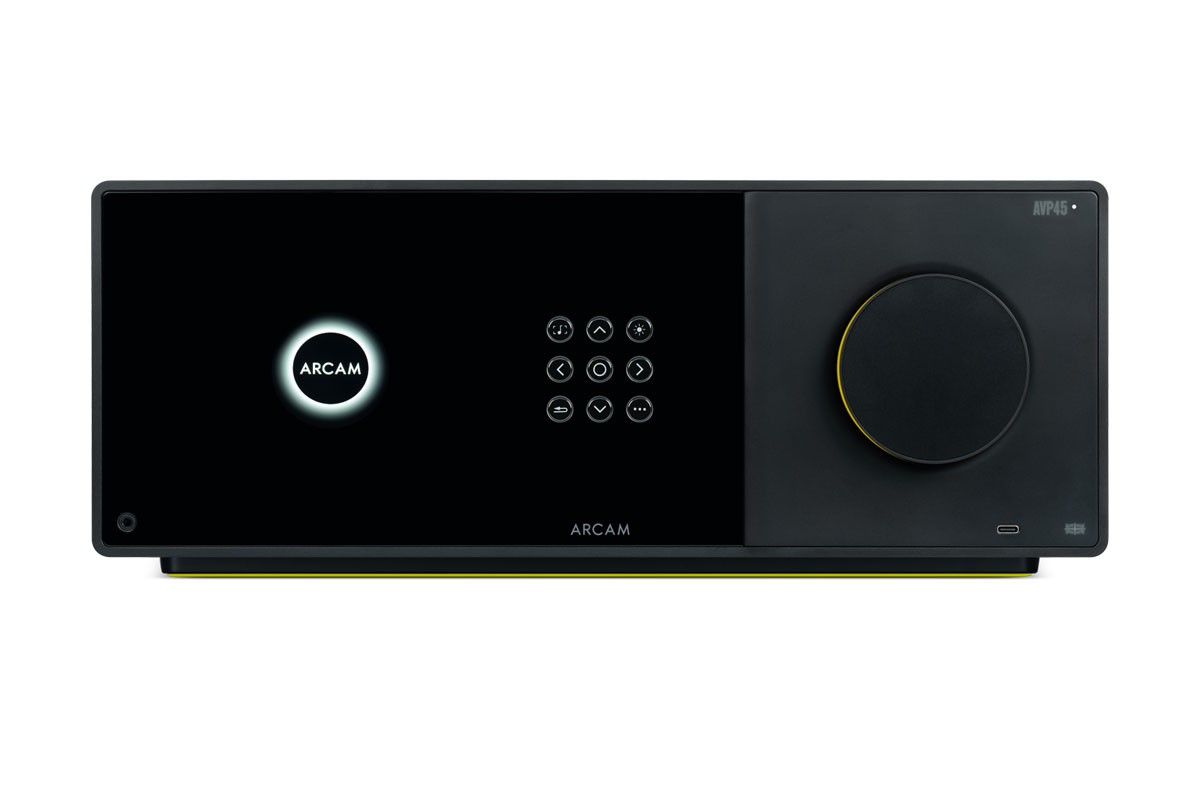
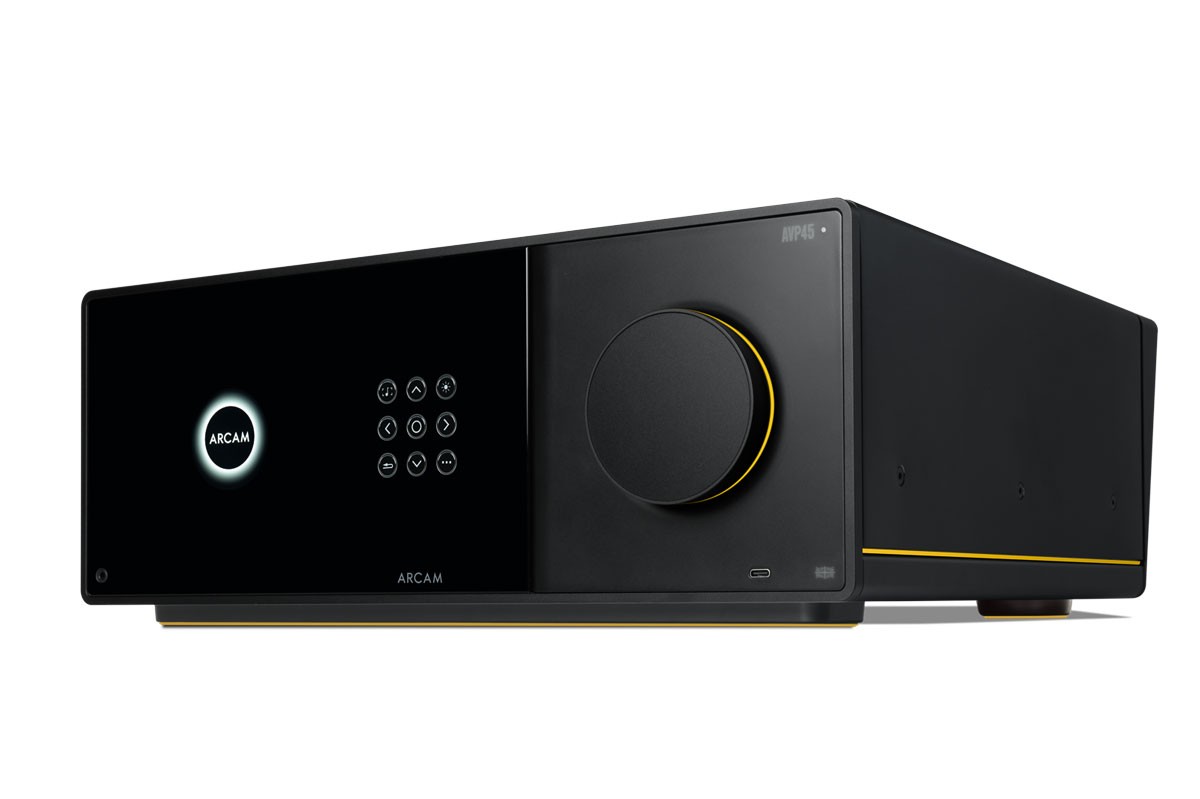
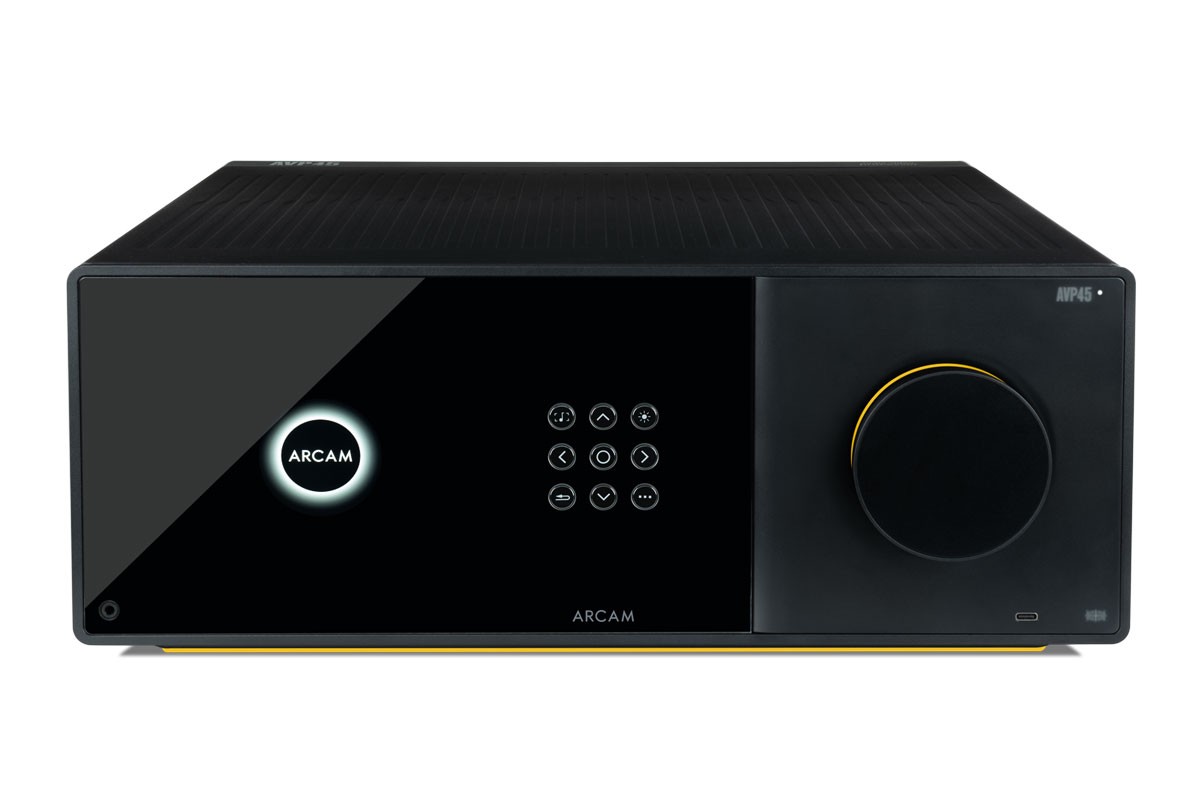
Visually, the new components carry the established Radia identity: dark-finished chassiswork, restrained yellow highlights and a centrally positioned colour display. That consistency is more than a cosmetic exercise in a rack containing several boxes. In a multichannel installation, clear front-panel feedback and familiar navigation can make source selection, setup checking and fault-finding less cumbersome than with a mixture of unrelated components.
Arcam says the products also share software and control logic. The practical attraction is continuity: someone accustomed to operating a Radia receiver should not need to relearn the basic environment when progressing to an AVP45-based system. Precisely which control integrations, app functions and installation features will be available remains to be detailed, but the stated common platform is a meaningful part of the series’ positioning.
At its simplest, an AV receiver combines HDMI switching, surround decoding, digital and analogue source management, volume control and power amplification in one chassis. It is often the most space-efficient way to build a serious cinema system. Separates divide those jobs: a processor handles switching, decoding and level control, while one or more power amplifiers drive the speakers. This adds cost, cabling and rack space, but it can make sense where more channels, greater amplifier capability or more flexible system expansion are priorities.
Three AV receivers, with different amplification approaches
AVA15: the compact immersive-system entry point
The AVA15 is positioned as the entry model and is intended for more compact immersive installations. Arcam cites layouts such as 7.1.2 and 5.1.4 as examples of the kind of system it can anchor. The first digit describes the main bed-layer speaker channels, the second the subwoofer channel(s), and the final digit the number of height channels. Thus, a 5.1.4 arrangement combines five conventional surround speakers, a subwoofer channel and four ceiling or height speakers.
Such layouts can deliver a notably more convincing object-based soundtrack than a basic 5.1 system, provided the height speakers are positioned carefully and the room has enough physical separation between listening positions. The AVA15’s appeal is therefore not simply the number of speakers it can accommodate, but its ability to provide an integrated starting point for Atmos-era cinema without immediately requiring external power amplifiers.
AVA25: Class AB for larger rooms and tougher loads
Above it sits the AVA25, which uses Class AB amplification. Arcam positions it for larger rooms or loudspeakers that are more demanding to drive. No output-power or load figures have yet been supplied, so prospective buyers should not infer a specific wattage advantage from that description alone. Those figures, along with the number of amplified channels available simultaneously, are key information to check once final specifications are released.
In broad engineering terms, Class AB is a linear amplifier topology in which the output devices are biased so that each handles more than half of the waveform. It is a long-established approach in hi-fi and AV amplification, valued for combining low crossover distortion with more manageable heat and efficiency than pure Class A. In a real cinema installation, however, amplifier suitability depends on more than a headline power rating. Speaker impedance variation, sensitivity, listening distance, room volume and the demands of film soundtracks all matter. A low-sensitivity loudspeaker in a large room can need considerably more voltage and current headroom than an easy-to-drive design used at modest distance.
AVA35: Arcam’s Class G flagship
The AVA35 is the range-topping receiver and employs Arcam’s Class G amplification. Class G is not switching amplification: it is a linear amplifier approach that uses multiple supply rails. At lower and moderate output levels, the amplifier can operate from lower-voltage rails, moving to higher rails as the music or soundtrack demands greater voltage swing. The intended benefit is improved efficiency relative to a conventional fixed-rail linear amplifier, while retaining the operating principles of a linear output stage.
For home cinema, that design has a practical rationale. Soundtracks contain large transient swings—an abrupt effects peak, orchestral crescendo or musical impact can require much more instantaneous headroom than average dialogue level suggests. Better power-supply efficiency can also reduce the thermal burden of a high-performance multi-channel chassis. It does not remove the need for sensible ventilation, especially in a cabinet, and Arcam has not yet published the AVA35’s output or heat-management specifications. But Class G clearly marks this as the receiver aimed at systems where dynamics and speaker control are central concerns.
All three receivers support Dolby Atmos and DTS:X. These object-based formats allow a soundtrack to describe the intended position and movement of sounds, while the processor renders that information for the connected speaker layout. The higher-tier models add Auro-3D, according to Arcam. That may matter to enthusiasts with Auro-encoded music or film material, and to installers seeking broader format support, though the preferred speaker layout should still be planned around the content and processing modes an owner expects to use most often.
AVP45 processor and external power amplification
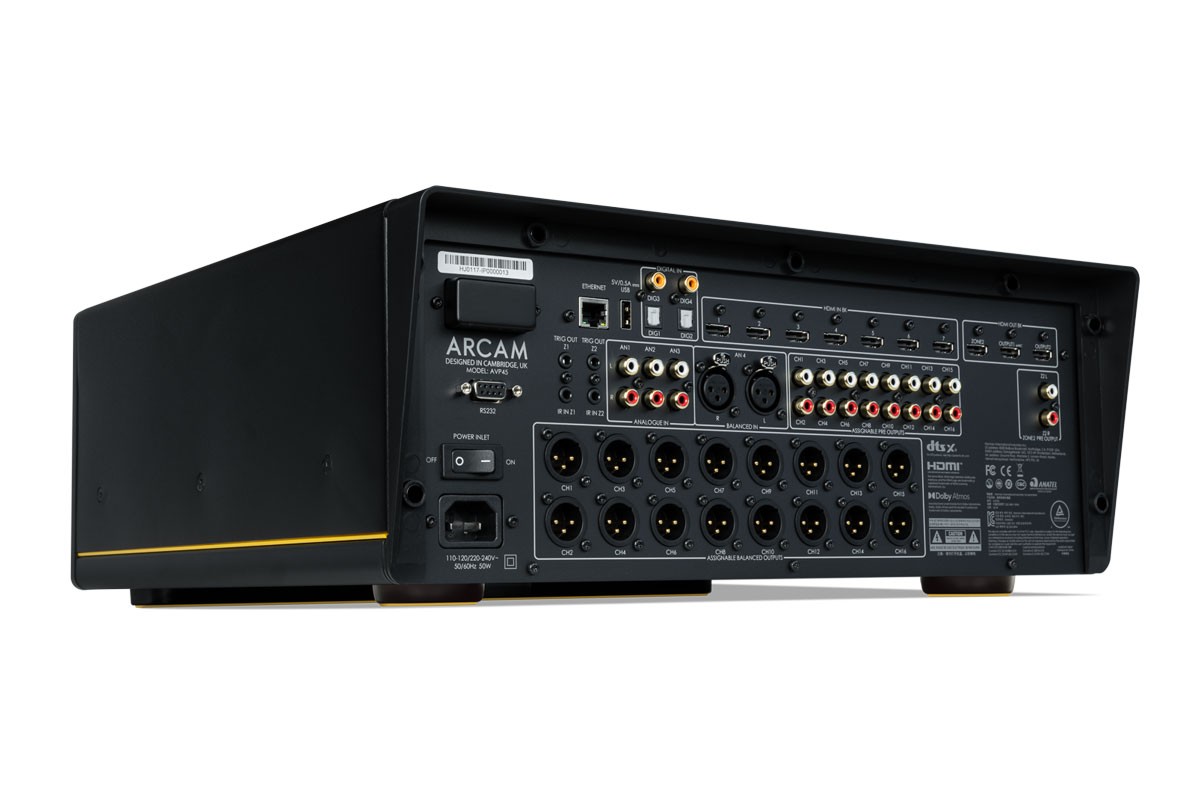
The AVP45 is the centrepiece for those choosing separates. It is a 16-channel processor with balanced XLR outputs and flexible channel mapping, designed to feed external power amplifiers. Sixteen channels offer considerable scope for immersive cinema systems, but the exact usable speaker configuration will depend on the final processing and mapping implementation. Buyers planning an elaborate layout should therefore verify supported channel allocations before committing to speakers or amplifiers.
Balanced XLR outputs are especially relevant in this context. A balanced connection is designed to reject noise picked up along the cable run, which can be useful when a processor sits in an equipment rack some distance from its amplifiers, or where a system has several interconnected components. It is not automatically a guarantee of better sound than a well-executed unbalanced connection, but it is a sensible provision for installation-led systems and longer analogue interconnects.
Because the AVP45 contains no stated onboard speaker amplification, its performance and system character will be shaped in part by the amplifiers attached to it. That is the central trade-off of separates: more boxes and more setup work, but also the ability to specify amplification according to the demands of each speaker group. An owner might prioritise substantial amplification for the front stage, for example, while using a more compact multi-channel amplifier for surrounds or height speakers.
PA4 and PA9: two distinct expansion options
Arcam’s PA4 is a compact four-channel Class D power amplifier. The company positions it for height channels, surround channels or secondary zones. This is a logical application for compact Class D amplification: height and surround speakers often need multiple channels but may be physically distant from the main equipment, while rack space and heat can be at a premium. The PA4 could therefore be a practical way to add channels to an expanding immersive system, though Arcam has not yet provided output, dimensions or connection details.
The PA9 is the larger companion amplifier, with nine channels of Class G amplification. It is intended to partner the AVP45 or provide an upgrade path for a receiver-based system where more external amplifier capability is wanted. Nine channels make it potentially useful as a single amplifier for a substantial part of a cinema layout, but the best allocation will depend on the speakers, available channels and the final system architecture. Its Class G design aligns it conceptually with the AVA35’s flagship approach, prioritising linear amplification with multi-rail efficiency rather than using a Class D topology.
HDMI 2.1, Dirac correction and music streaming
Across the main models, Arcam specifies an HDMI 2.1 platform with 8K support, gaming features including variable refresh rate (VRR), and modern HDR formats. HDMI 2.1 is not a single guarantee of every feature on every port, so anyone building around a games console, gaming PC or 8K display should confirm the final port count and bandwidth capabilities. Still, VRR support is valuable in principle because it allows a compatible display to vary its refresh timing to follow the source, helping reduce visible tearing during gameplay.
The series also incorporates Dirac room-correction technology, including Dirac Live, Dirac Live Bass Control and support for Dirac Live ART. Room correction measures the combined behaviour of loudspeakers and listening room, then applies processing intended to improve the result at the listening position. It can be particularly helpful below the room’s transition region, where room modes can cause large peaks and dips in bass response; it cannot, however, entirely substitute for sensible speaker and subwoofer placement.
Dirac Live Bass Control extends that process to manage the relationship between subwoofers and full-range speakers, while Dirac Live ART is intended to coordinate the system’s speakers to address room effects more comprehensively. These are potentially significant tools in a multi-subwoofer cinema, but their success depends on accurate measurement, viable loudspeaker positions and careful target-curve choices. Users should also establish what calibration microphone, licences and feature availability are included with each final model, rather than assuming every Dirac option is bundled as standard.
For music, the platform supports Spotify Connect, TIDAL Connect, Qobuz, Apple AirPlay, Google Cast and Roon Ready certification. Connect-style services generally let a compatible app hand playback to the component itself, allowing the AV product rather than the phone to retrieve the stream. AirPlay and Google Cast offer broad device interoperability, while Roon Ready matters to users who organise local and streaming libraries through Roon. The announced support makes the Radia AV components plausible all-in-one music hubs as well as movie processors, although detailed format support and network connectivity specifications have not yet been announced.
Pricing, availability and who the Radia AV range is for
Arcam’s indicative European pricing is as follows:
- AVA15: €2,990
- AVA25: €4,990
- AVA35: €6,999
- AVP45: €5,990
- PA4: €999
- PA9: €3,990
The AVA15, AVA25, AVA35 and AVP45 are expected in the third quarter of 2026, with the PA4 and PA9 scheduled to follow in the fourth quarter.
The Radia AV Series is most interesting for buyers who see home cinema and serious music replay as parts of one system rather than separate pursuits. A receiver-based installation can keep the equipment count under control while retaining modern immersive decoding, HDMI connectivity and streaming. The AVP45, PA4 and PA9 then create a deliberate upgrade route for installations that need more channels, more flexible amplifier selection or the practical advantages of balanced processor outputs.
There are still consequential details to come—notably power ratings, HDMI socket specification, channel-allocation limits, physical dimensions and the precise Dirac feature set for each model. Those will determine the best receiver for a given loudspeaker package and whether the separates represent better value than a receiver plus external amplification. What Arcam has established at launch, though, is a properly tiered AV proposition: not just a flagship processor or a solitary receiver, but a coherent platform capable of scaling from an integrated Atmos system to a serious multi-box cinema.