Cayin is marking its 30th anniversary with the Pearl 30i, an unapologetically ambitious integrated valve amplifier that places its power supply in a separate enclosure and uses eight KT-170 output valves. At $22,000 in black, this is firmly a flagship component, aimed at listeners who want the scale, power and ownership ritual of large-valve amplification without needing separate pre- and power amplifiers.
The headline specification is substantial: Cayin rates the Pearl 30i at 145W RMS per channel in Triode mode and 230W RMS per channel in Ultralinear mode. Those figures matter because many valve amplifiers make a deliberate trade-off in favour of modest power and easy-to-drive loudspeakers. The Pearl 30i instead appears intended to bring valve operation to a considerably broader selection of speaker systems, including larger floorstanders and designs that benefit from meaningful power reserve. As ever, a speaker’s impedance behaviour and sensitivity remain at least as important as its nominal 4- or 8-ohm rating, but the Cayin is specified with dedicated 4-ohm and 8-ohm speaker connections for sensible matching.
A two-chassis amplifier with power supply separation
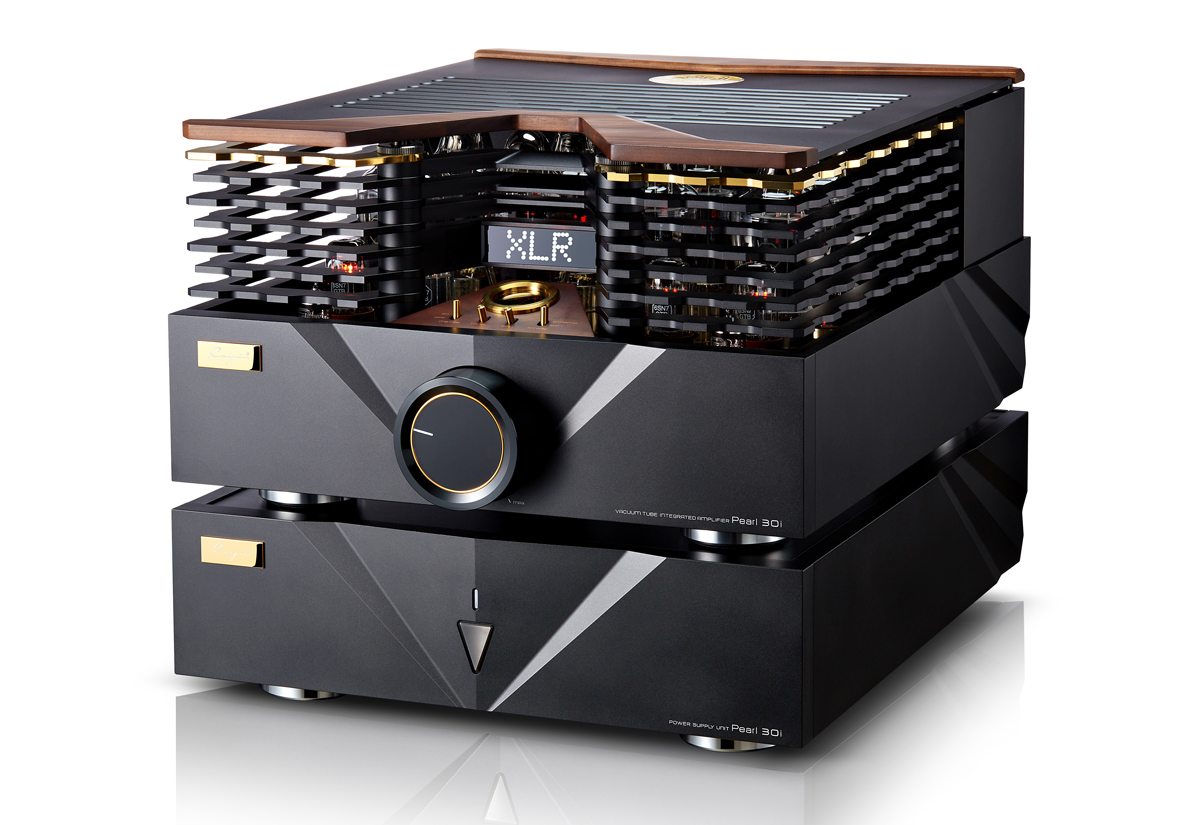
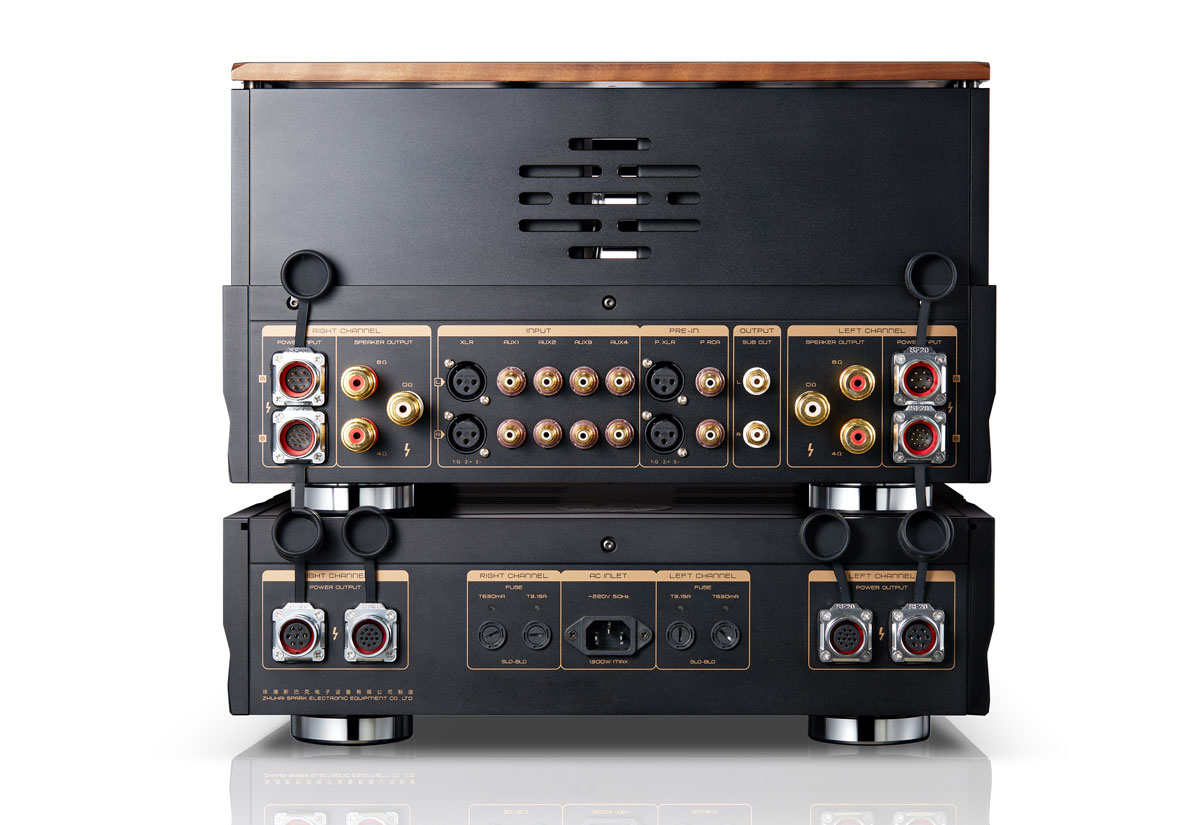
The Pearl 30i comprises two purpose-built enclosures: one contains the audio amplification circuitry, while the other is devoted to the power supply. Separating these roles is a well-established approach in high-end audio. Power transformers, rectification and associated supply circuitry can generate mechanical vibration and electromagnetic fields; moving them out of the signal chassis gives the designer more freedom to keep sensitive low-level amplification stages away from those potential sources of interference.
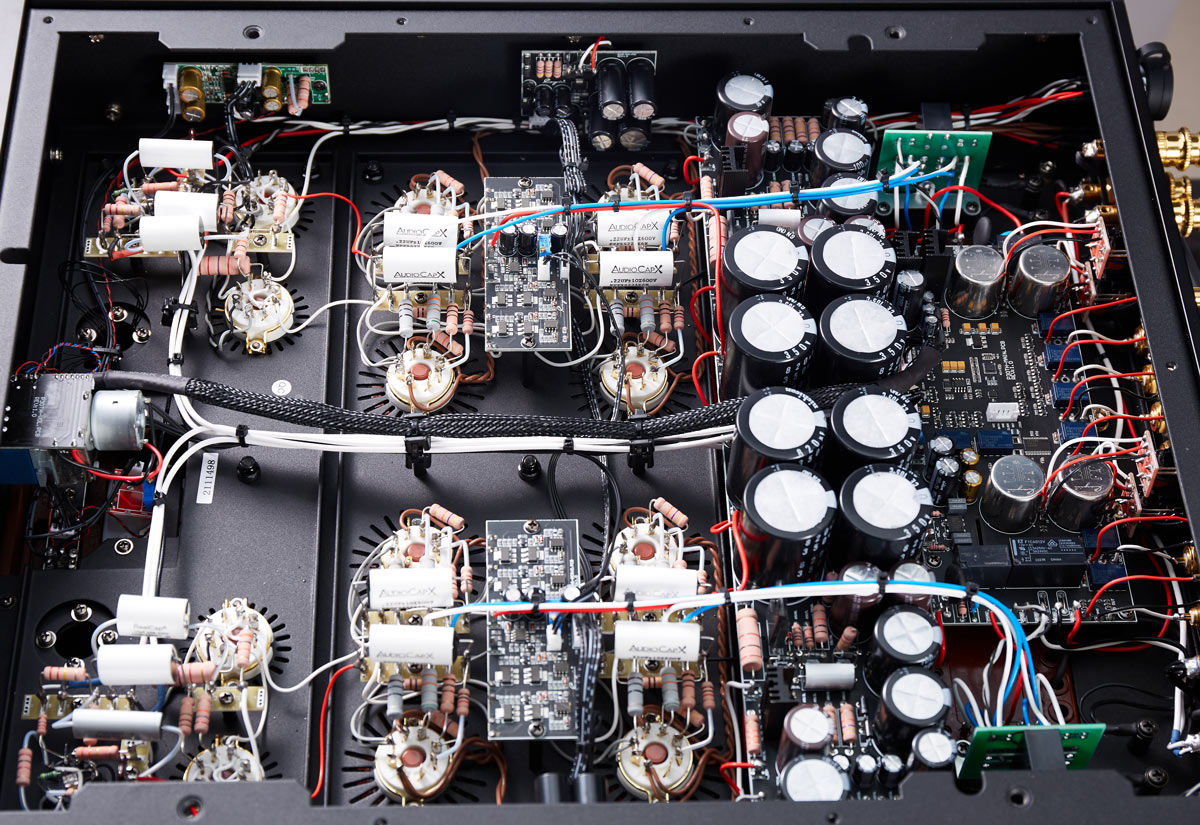
In Cayin’s implementation, the outboard supply uses four power transformers. The company says that power is split and independently supplied to the left and right channels, with two transformers managing the supply arrangement. The purpose is to provide the high-voltage rails required by valve amplifier stages and the lower-voltage supplies needed by control and other circuitry without asking one shared supply path to serve every part of the amplifier. In practical terms, this kind of channel-conscious supply architecture is intended to reduce interaction between channels when musical demand rises, while allowing each section of the amplifier to receive the voltage it needs.
The two enclosures can be arranged side by side or stacked. The latter creates a tall, tower-like installation, which may be useful where equipment-rack width is limited, though owners will need to allow adequate access around the units and ensure that the valve-equipped amplifier section can shed heat safely. The draft does not state the Pearl 30i’s dimensions, weight or ventilation requirements, so those are details worth confirming with a dealer before commissioning furniture or a rack.
Cayin supplies dedicated cables to link the power supply and amplifier sections. They use seven-pin SF20 connectors and silver-plated 6N copper conductors. The important ownership point is not simply the conductor description, but that this is a proprietary high-current, multi-pin connection between the two chassis: it should be installed carefully, routed without undue strain and used exactly as Cayin intends. It is not an interchangeable analogue interconnect.
Valve complement and Class AB1 push-pull output stage
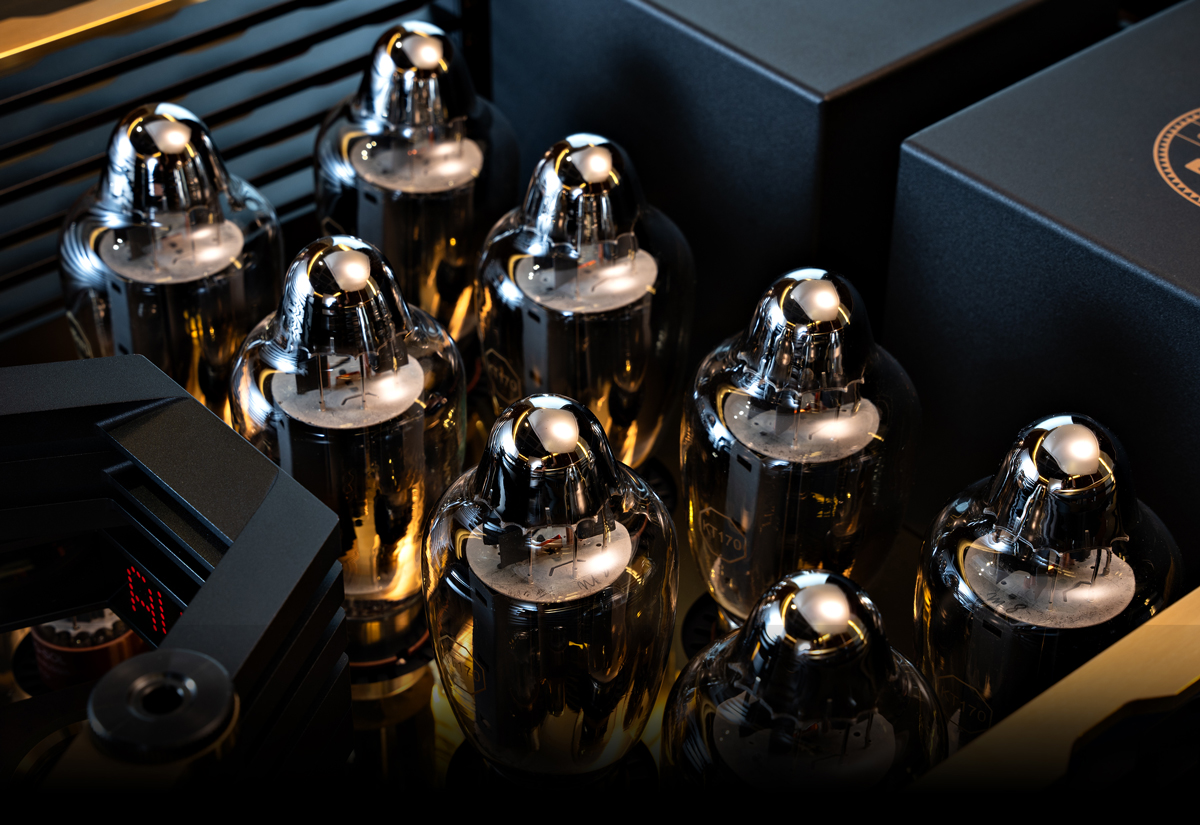
Signal gain begins with a pair of Mullard CV4004/12AX7 valves in the preamplification stage, followed by four TungSol 6SN7GTB valves in the driver stage. The 12AX7 family is widely used where high voltage gain is required, while the driver stage has the vital job of supplying an appropriately controlled signal to the output valves. Cayin mounts the 6SN7GTB valves on porcelain bases, a material chosen for its heat tolerance and insulating properties in demanding valve applications.
The final stage employs eight KT-170 valves in a Class AB1 push-pull arrangement. Push-pull output stages use groups of output devices to handle opposite halves of the waveform before recombining them at the output transformer. This is a route to significantly higher output power than a single-ended design, while Class AB operation is commonly used when a designer wants more power and efficiency than pure Class A can provide. The “AB1” designation refers to operation without driving the output-valve grids into positive current during normal use.
Valve amplifiers require output transformers to couple the high-voltage, relatively high-impedance output valves to loudspeakers, which present a much lower impedance load. These transformers are therefore central to the amplifier’s behaviour, not a peripheral part. Cayin specifies windings of high-purity copper strands around Z11 audio-grade silicon steel sheets. The company’s stated aim is signal purity; more broadly, transformer design influences bandwidth, power delivery and the way an amplifier accommodates the varying load presented by a real loudspeaker.
For owners, the output-valve count also signals that the Pearl 30i is a serious long-term maintenance proposition rather than a fit-and-forget compact integrated. Valves are consumable components and will eventually need replacing. Cayin addresses one of the more intimidating aspects of ownership with an automatic bias circuit. Bias sets the output valves’ operating point: if it is incorrect, tube life, heat, distortion and reliability can all suffer. Automatic bias removes the need for the user to perform routine manual adjustment, while an optical indicator monitors bias status. Cayin says the amplifier will enter a protected operating mode if an abnormality is detected, allowing investigation without risking damage or danger.
Triode and Ultralinear modes: two output-stage approaches
The Pearl 30i offers switchable Triode and Ultralinear operation. This is more than a cosmetic sound-setting: it changes how the output valves are configured and therefore the balance struck between output power and operating characteristics.
Triode mode is rated at 145W RMS per channel. Cayin describes it as harmonious and gentle, positioning it for instrumental music and vocal-led recordings. That is Cayin’s characterisation rather than an independent listening finding, and the final result will depend heavily on the speakers, room and recording. Still, the useful practical point is that 145W per channel remains a high nominal figure for a triode-connected valve amplifier, so selecting this mode should not automatically mean restricting the Pearl 30i to small or unusually sensitive speakers.
Ultralinear mode increases the stated output to 230W RMS per channel. Ultralinear operation takes a screen-grid connection from a transformer tap, occupying a territory between classic triode and pentode operation. It is often selected when greater output and a different compromise between linearity and efficiency are desired. Cayin presents this setting as the higher-performance option for dynamic material with greater impact. Again, that should be treated as a design intention, not a substitute for auditioning, but it gives the owner two genuinely meaningful operating choices rather than merely two DSP-style voicings.
A separate timbre control offers Dynamic and Soft settings. Cayin says Dynamic produces a more intense, fuller presentation, while Soft is intended to be mellower. The source does not explain the circuit implementation behind these settings, so it would be unwise to assume exactly what electrical parameter is being changed. Nonetheless, they add a further layer of adjustment for owners who enjoy tailoring a system to recordings, speakers or personal taste.
Inputs, pre-in facilities and subwoofer integration
Despite its physical scale and specialist valve architecture, the Pearl 30i is designed to serve as the control centre of a conventional two-channel system. It provides four pairs of RCA line inputs plus one balanced XLR line input. That is sufficient for a streamer or DAC, CD player, phono stage and another analogue source, with the XLR input available for a source component offering balanced analogue output.
It also includes RCA and balanced XLR pre-in connections for use with an external preamplifier. This is useful for systems in which a dedicated preamp, analogue control unit or perhaps a home-cinema control arrangement needs to take over source selection and volume duties. Prospective buyers should establish precisely how Cayin implements this input and the required operating procedure, as the source does not specify whether it is a fixed-gain power-amplifier input or how gain is managed. That detail is important for avoiding unexpected level changes when combining components.
Two outputs are provided for active subwoofers. This is a welcome inclusion on a full-range integrated amplifier because it permits a properly integrated two-channel system to use one or two active subs for the lowest octave, room-mode management or greater bass extension. The draft does not specify whether these are fixed- or variable-level outputs, nor whether any crossover facilities are included, so buyers planning sophisticated bass management should confirm this. In many hi-fi installations, the subwoofers’ own level, phase and crossover controls will still be central to a successful result.
The selected input is shown on a large dot-matrix display at the front. Cayin also provides remote control of input selection, volume and the available operating adjustments, avoiding the need to reach across a hot valve amplifier during daily use.
Controls, display and physical presentation
At the centre of the amplifier chassis sits a large volume control with 106 steps, governed internally by a JRC Muses 72320V controller. Fine stepped volume adjustment is valuable in a powerful amplifier because it allows more precise repeatable level setting than a coarse analogue control, particularly with efficient loudspeakers where a small movement can otherwise produce a substantial change in level.
Above it is a wooden panel containing four toggle switches and a VU meter. The switches control the meter and its backlight, select timbre and operating mode, and choose the input channel. The VU meter adds visual theatre appropriate to a large exposed-valve design, but it also gives the front panel a clear functional focus rather than treating it as decoration alone.
Who the Cayin Pearl 30i is for
The Pearl 30i is for the enthusiast seeking a statement integrated amplifier that combines the tactile appeal of valve hardware with output figures more commonly associated with powerful solid-state amplification. Its separate power supply, eight KT-170 output valves, auto-bias provision and broad analogue connectivity make it a deliberate alternative to assembling separate pre- and power-amplifier components.
Its attractions are clear: substantial claimed power in two modes, a dual-chassis power-supply strategy, provision for active subwoofers and an unusually complete set of line-level and pre-in connections. The trade-offs are equally clear. This is a large, complex, heat-generating valve component with a $22,000 price, proprietary inter-chassis cabling and eventual valve replacement to consider. It has no stated onboard digital inputs, DAC, network streaming or phono stage, so those functions require appropriate external source components.
For the right system, however, that division of labour may be a strength. A separate streamer/DAC and phono stage allow an owner to choose the digital and analogue front ends that suit their priorities, while the Pearl 30i concentrates on the task of controlling sources and driving loudspeakers. The key before purchase will be careful speaker matching, proper installation and an audition across both operating modes—not just to assess the amplifier’s capability, but to decide which of its two distinct output-stage configurations best suits the rest of the system.
Price and availability
The Cayin Pearl 30i has a recommended retail price of $22,000 in a black finish.