A subwoofer is often the component that turns a convenient wireless speaker system into something more convincing at room scale. The Sonos Sub (Gen 3) is built to do precisely that for compatible Sonos setups: it takes responsibility for the lowest frequencies, allowing the accompanying Sonos speakers or soundbar to concentrate on the range above. The potential benefit is not simply more apparent bass. Done well, a dedicated subwoofer can bring greater weight to music, more physical impact to film sound and less strain on the speakers handling midrange and treble.
This is not a general-purpose wireless subwoofer that can be paired with any amplifier, television or active speaker. It is a system-specific component for Sonos, configured through the Sonos app and intended to work as part of a Sonos stereo, multi-room or TV system. That closed approach is its principal limitation, but it is also the reason installation is considerably more straightforward than with a conventional subwoofer connected by analogue cable to an AV receiver or stereo amplifier.
What the Sonos Sub (Gen 3) adds to a system
In a compact Sonos music system, the Sub (Gen 3) provides a separate route for bass information that small speaker cabinets can struggle to reproduce with authority. Low frequencies require significant air movement; asking a small full-range speaker to deliver deep bass as well as voices, guitars, percussion and high frequencies can limit clean output. Bringing in a subwoofer changes that division of labour. The Sonos system can manage the relationship between the paired products, while the Sub handles the low-end energy that gives kick drums, bass lines and large-scale recordings their foundation.
The same principle applies even more clearly in a television system. When paired with a Sonos soundbar, the Sub (Gen 3) is intended to supply the effects channel’s low-frequency weight: the impact of explosions, the rumble of engines and the sustained atmosphere in a soundtrack. A soundbar can create a useful and tidy TV solution on its own, but its shallow enclosure inherently restricts the size of the drivers and cabinet volume available for deep bass. A separate subwoofer is therefore a meaningful upgrade where more scale and impact are wanted.
Sonos also allows a broader wireless surround arrangement using a Sonos soundbar and additional Sonos speakers as rear channels. This creates a practical five-channel-style layout without speaker cable runs around the room. It should not be confused with a traditional separates-based home-cinema installation, where an AV receiver offers extensive loudspeaker choice, manual calibration and connection options. The Sonos route is instead aimed at listeners who value an uncluttered room and app-led simplicity, while still wanting more enveloping film sound than television speakers can offer.
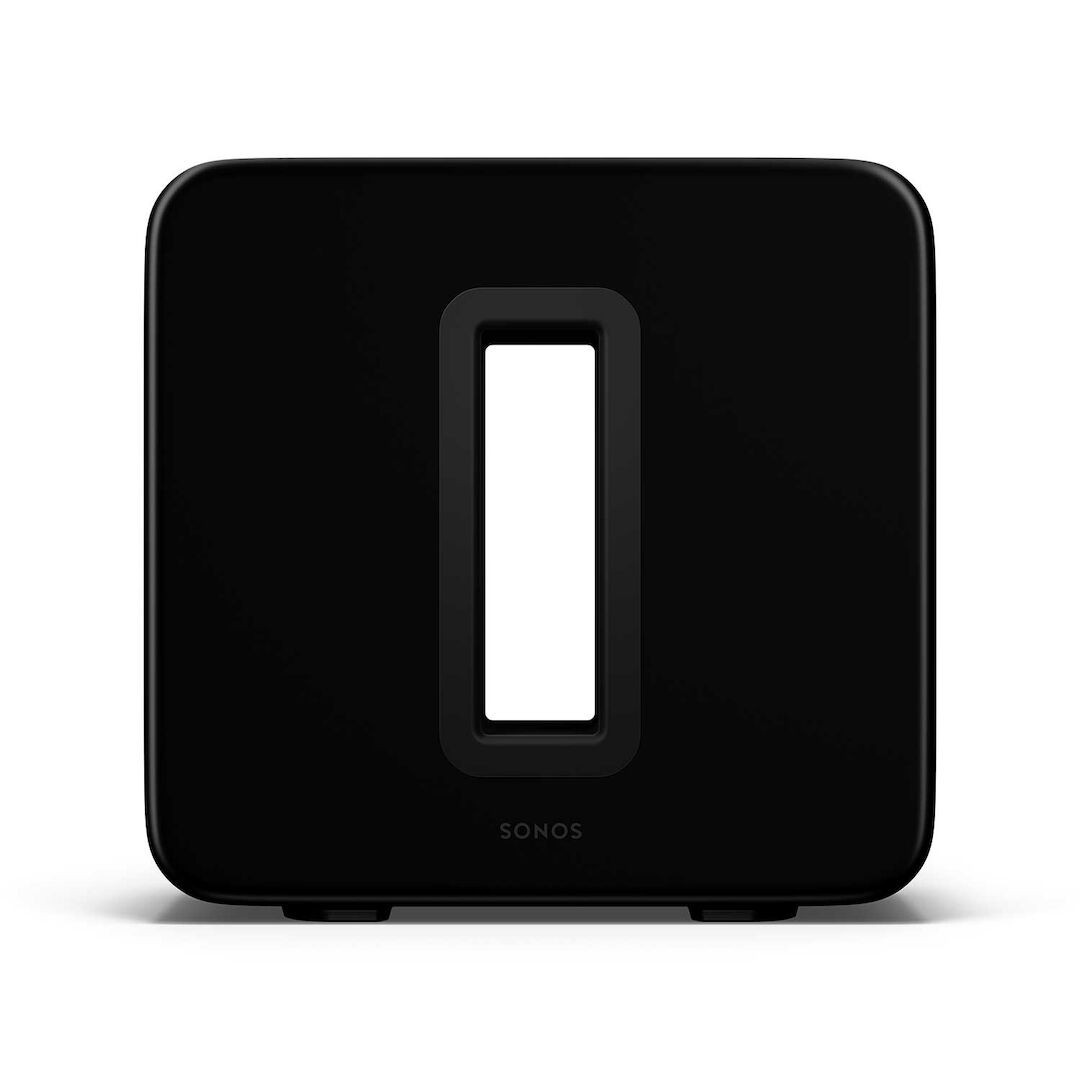
Opposed bass elements and vibration control
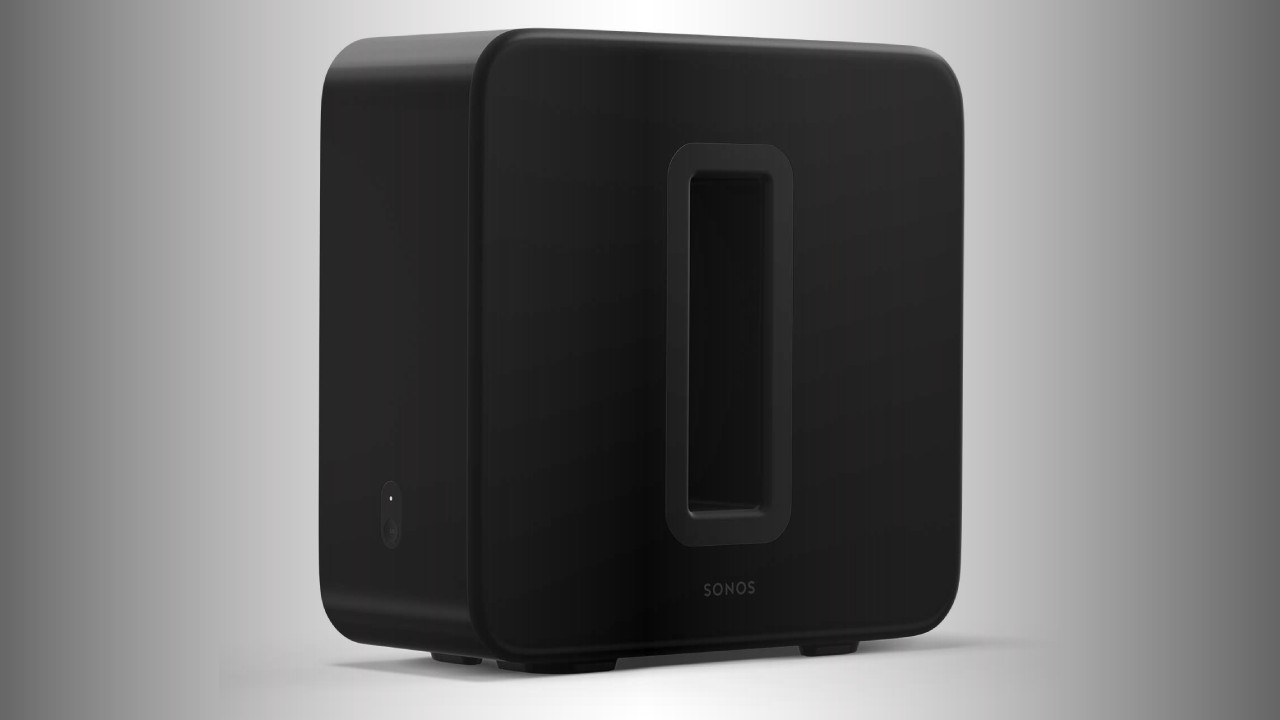
The Sub (Gen 3) uses two front-facing bass elements in a force-cancelling arrangement intended to reduce cabinet vibration. The important engineering idea is that driver movement creates a reactive force: when a conventional subwoofer cone moves, the enclosure can move or resonate in the opposite direction. That unwanted cabinet activity can colour the result, cause audible rattles on furniture and make placement more troublesome in a living room.
By arranging two bass elements so their mechanical forces oppose one another, a subwoofer can substantially reduce the vibration transferred to its enclosure. In practical terms, that makes the distinctive Sonos design more suitable for placement close to furniture than a design that shakes more vigorously. It does not remove the normal acoustic challenges of bass in a room—walls, corners and furnishings still strongly influence low-frequency level and evenness—but it addresses mechanical vibration at the product itself.
The cabinet may be positioned vertically or horizontally, giving owners useful flexibility when integrating it into a real room. A vertical position may suit an open area beside a media unit, while horizontal placement can make it easier to locate beneath suitable furniture, provided there is adequate clearance and the product is not obstructed. Sonos also offers a dedicated wall-mount accessory. Wall mounting can free up floor space, though it is worth remembering that walls and corners can reinforce bass. The most convenient position is not always the most even-sounding one, so it is sensible to try the available locations before making a permanent installation.
Finished in high-gloss black or white, the Sub (Gen 3) is visually more overt than a fabric-covered conventional box subwoofer, but its sculptural form is clearly designed to complement Sonos speakers and soundbars. The choice of finish is useful in systems where the subwoofer will remain visible rather than being hidden beside a sofa or cabinet.
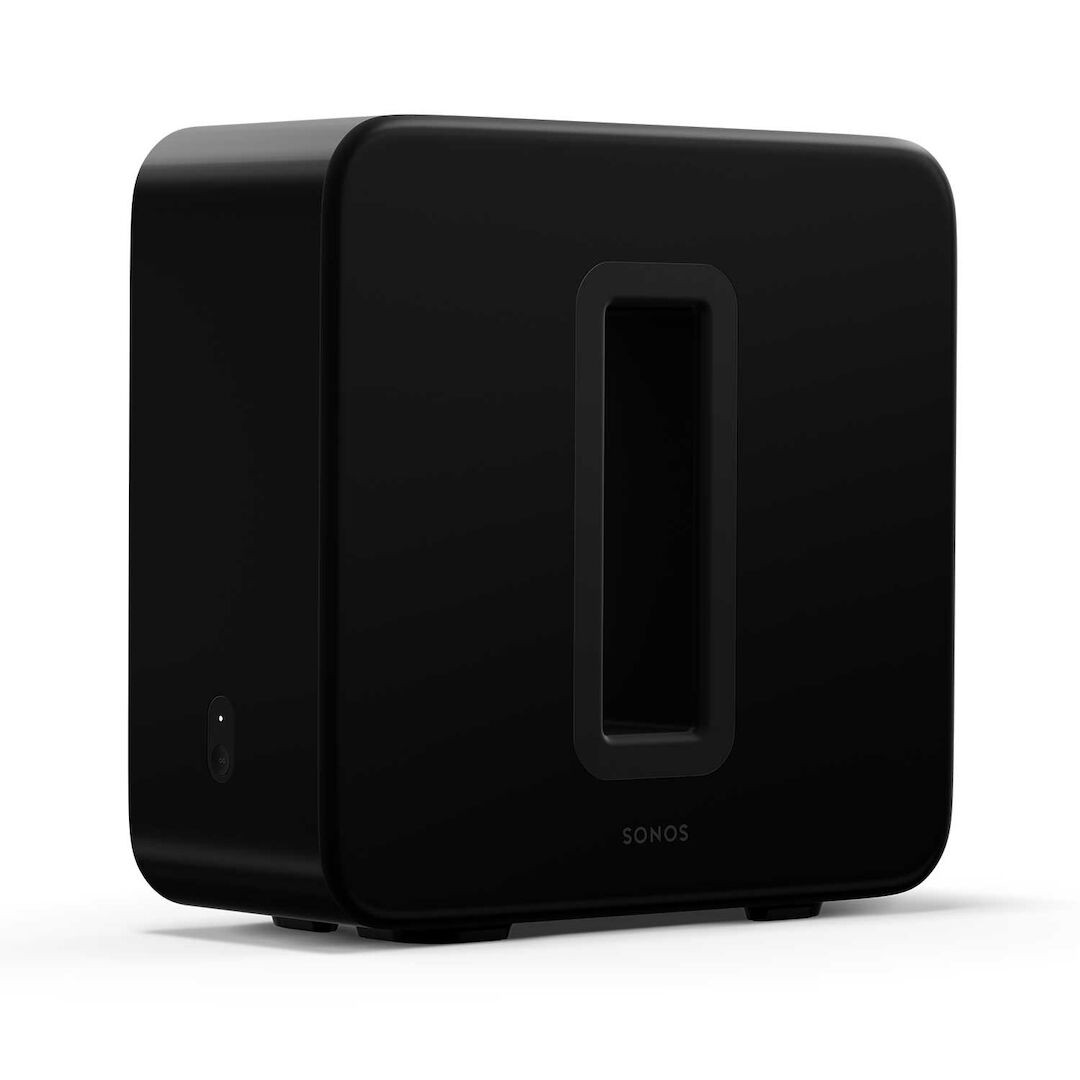
Setup: the advantage of an integrated Sonos component
Setup is one of the strongest arguments for the Sub (Gen 3). It connects to mains power, while its signal connection to the compatible Sonos system is wireless. The Sonos app guides the user through adding it to the relevant room or home-theatre setup. There is no separate analogue subwoofer cable to conceal, no receiver menu to navigate and no need to manually match a conventional subwoofer’s volume and crossover controls from scratch.
That convenience is particularly valuable in rooms where running a cable from the television position to the preferred subwoofer location would be impractical. It also makes the Sub a straightforward upgrade path: an owner can begin with a Sonos speaker pair or soundbar, then add bass later when the budget or room allows.
However, wireless signal transmission should not be mistaken for a completely cable-free product. The Sub (Gen 3) still needs a nearby mains outlet. Its final position is therefore a balance between power access, furniture layout and bass performance. Avoid placing it where loose objects, cabinet doors or lightweight ornaments may buzz in response to low-frequency energy. Such rattles are usually a room or furniture issue rather than a fault in the subwoofer, but they can be surprisingly audible once a system gains meaningful bass extension.
Compatibility and the Sonos S2 requirement
The Sub (Gen 3) requires the newer Sonos S2 app and system environment. This is a crucial point for existing Sonos owners: some older Sonos products remain on the earlier S1 app, and a mixed S1/S2 arrangement cannot provide the same all-in-one upgrade path. Before buying, check the compatibility of every product that is intended to share the room with the Sub, particularly if the system includes earlier Sonos hardware.
For a new or fully S2-compatible household, the app-based model is simple. The same control environment covers music playback, grouping rooms and operating the TV system. Sonos supports integrations with services including TIDAL, Spotify, Deezer and Apple Music, with control available from iOS and Android phones or tablets, as well as PC and Mac. The breadth of service integration is a major part of Sonos’s appeal: rather than choosing hardware around a single streaming app, the platform is intended to centralise multiple music services and rooms.
Software updates are also part of the ownership proposition, with features and platform changes delivered through the Sonos system. The corresponding trade-off is that the Sub’s usefulness depends on Sonos’s software environment and product compatibility. Unlike a conventional powered subwoofer with line-level inputs, it cannot be repurposed later with a non-Sonos integrated amplifier, active speakers or an AV receiver.
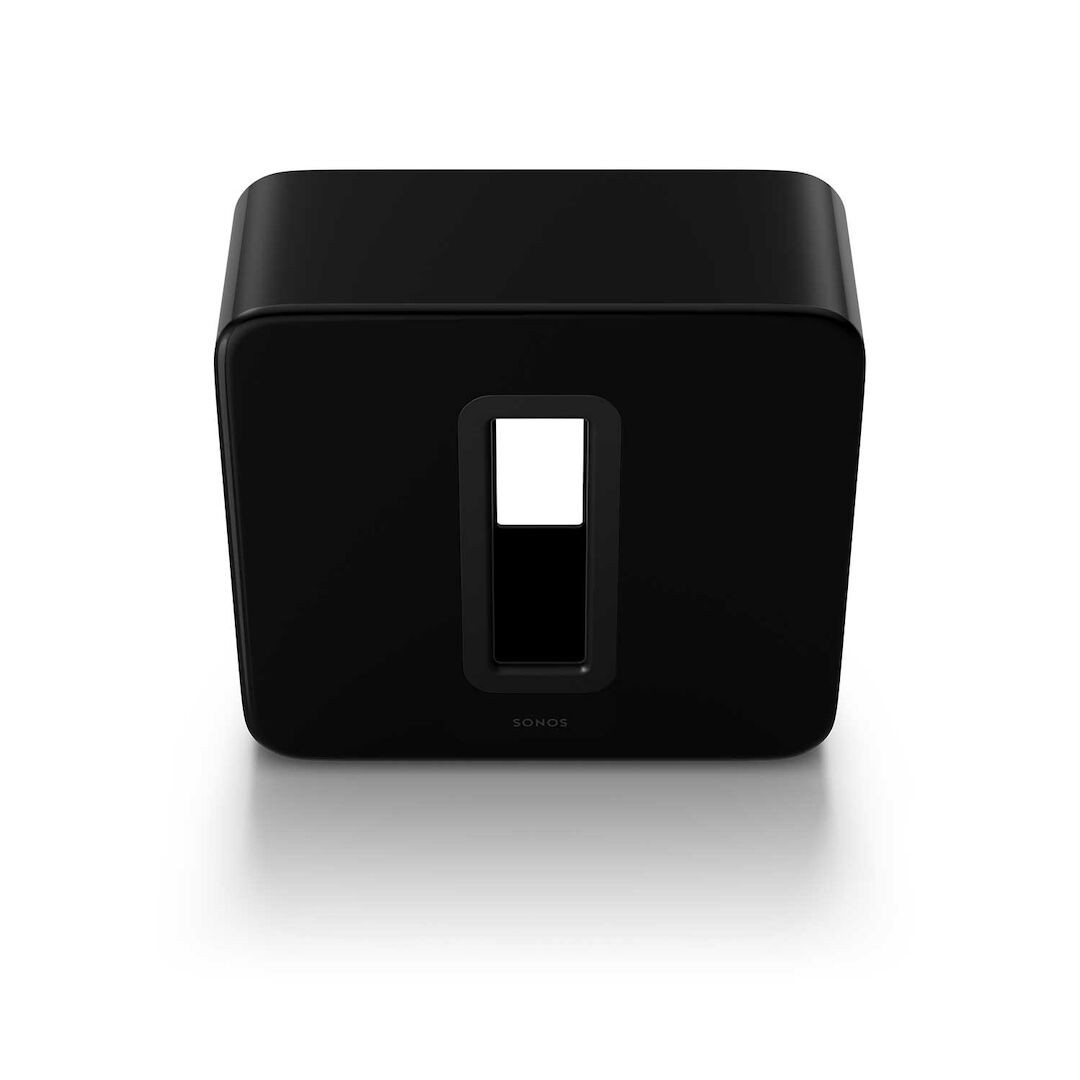
Placement and system-matching considerations
Although the Sonos app removes much of the technical setup burden, subwoofer placement still matters. Bass wavelengths are long enough that the room itself becomes part of the system. A corner often produces more bass output through boundary reinforcement, but can also exaggerate particular notes and make bass sound less even. Moving the Sub (Gen 3) a modest distance can alter the balance at the listening position considerably.
Start with a practical position near the front of a TV system or near the main speaker pair in a music system, then listen to familiar material with sustained bass and kick drum. If the low end feels boomy or certain notes dominate, try a less corner-bound location. If it lacks weight, a position closer to a wall may help. The Sub’s vibration-reducing architecture makes vertical and horizontal experimentation more viable than with some conventional designs, but care should still be taken not to block the bass elements or trap the unit so tightly that it cannot operate freely.
For music, the Sub (Gen 3) makes the most sense with Sonos speakers that are being asked to fill a larger room, or with listeners who want more convincing low-end scale at moderate levels. For film and television, it is most relevant alongside a Sonos soundbar where cinematic effects and soundtrack dynamics are a priority. In either case, its greatest advantage is not flexibility across brands but the ease with which it slots into an existing compatible Sonos room.
Who should choose the Sonos Sub (Gen 3)?
The Sonos Sub (Gen 3) is a focused upgrade for someone already committed to Sonos who wants deeper, more dynamic bass without introducing the cables and complication of a conventional separates system. Its opposed bass-element design addresses cabinet vibration, its vertical and horizontal placement options help with domestic integration, and app-led setup keeps the process approachable. The optional wall bracket provides a further installation option where floor space is limited.
Its restrictions are equally clear. It is not especially compact compared with some traditional alternatives, it works only within Sonos, and listeners seeking the last word in bass precision and adjustability may prefer the control offered by a conventional subwoofer in a separates system. Those alternatives can offer broader connection options and more manual tuning, but they also demand more planning, cabling and system knowledge.
For the right Sonos household, though, the Sub (Gen 3) addresses the part of the frequency range that compact wireless systems most often leave behind. It is best viewed not as a standalone subwoofer purchase, but as a deliberate way to make a compatible Sonos stereo or TV installation sound larger, more grounded and more involving.