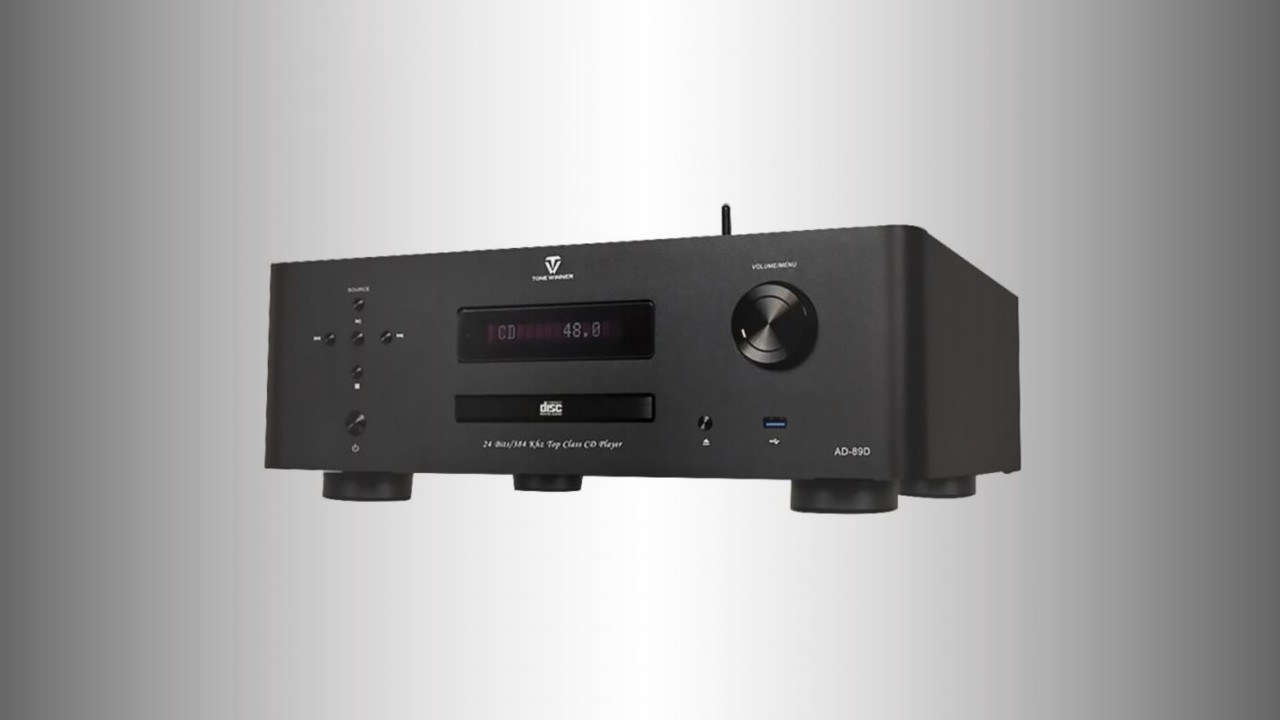
The ToneWinner AD-89D is an unusually comprehensive take on the traditional integrated amplifier. Alongside its stated 2 x 130W output into 8 ohms, it incorporates a CD player, digital and analogue inputs, Bluetooth reception, HDMI ARC for TV sound, local-file playback from USB storage and TF cards, and a subwoofer output for a 2.1-channel system.
That breadth matters because it potentially replaces several separate boxes: a conventional stereo amplifier, CD player, basic DAC, TV audio interface and Bluetooth receiver. The AD-89D is therefore aimed less at the purist who already owns dedicated source components than at someone building a full-featured music and television system around passive loudspeakers. Its ability to operate as either an integrated amplifier or a power amplifier further broadens its possible role in a system.
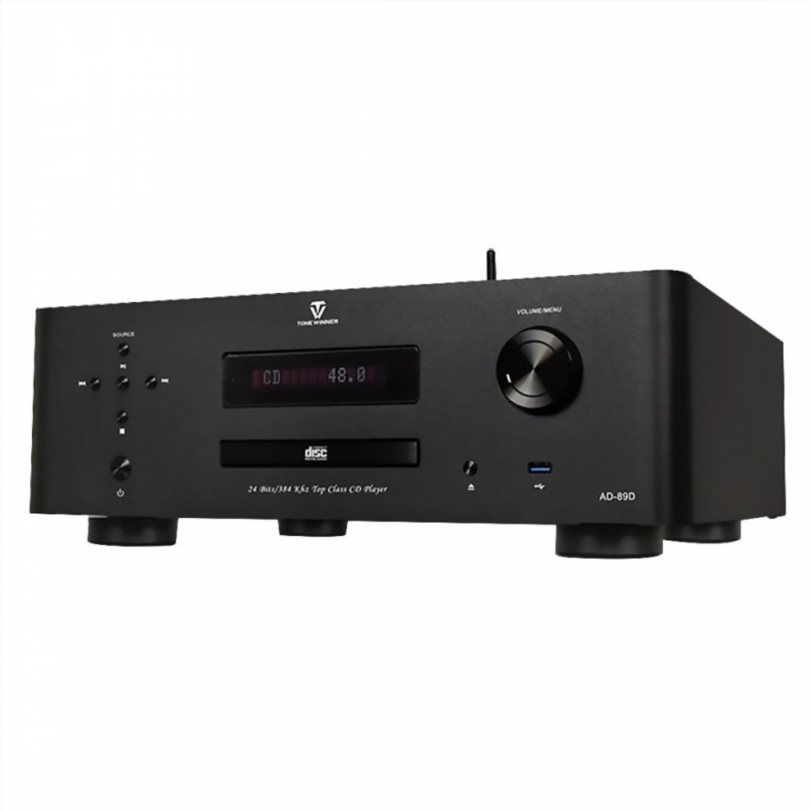
A Class AB amplifier built around a substantial linear supply
The AD-89D is specified as a Class AB design. Class AB remains a familiar approach in conventional integrated amplifiers: the output devices share the musical waveform between them, while a small standing bias is used to reduce the crossover distortion that can occur when one device hands over to the other. In practice, it is a topology valued for combining relatively low distortion with the current capability and thermal practicality needed for a powerful full-width amplifier.
ToneWinner rates the AD-89D at 2 x 130W into 8 ohms at 1kHz. This is a healthy on-paper figure for a stereo integrated amplifier and should provide useful headroom with many conventional passive loudspeakers. However, a power rating alone does not establish how an amplifier will behave with every speaker. Sensitivity, impedance variation and the room’s required listening level all remain important. Particularly demanding low-impedance speakers can place more stress on an amplifier than an 8-ohm rating suggests, and ToneWinner does not state a 4-ohm output figure in the supplied specifications.
More revealing than the headline output is the stated power-supply architecture. The AD-89D uses a 350VA toroidal transformer and 40,000µF of reservoir capacitance. A toroidal transformer is commonly chosen in hi-fi equipment for its compact shape, potentially low external magnetic field and ability to supply substantial current. The capacitors store energy after the mains has been rectified, helping the power supply meet short-term demands from musical transients. This does not itself guarantee a particular sonic outcome, but it is a sensible engineering foundation for an amplifier expected to drive real loudspeaker loads rather than merely achieve a headline figure.
ToneWinner also says the internal structure separates the power section from the input and signal-processing stages, with the left and right channels processed independently. The practical objective is to limit noise and interference: high-current switching and charging currents around the power supply can contaminate low-level analogue and digital circuitry if layout and grounding are poorly managed. Physical separation and careful channel routing can therefore be useful in a densely specified all-in-one unit, where disc transport, digital processing and high-power amplification coexist in one chassis.
The original product information refers to a “high-speed, low-distortion Class A amplifier circuit” while listing the AD-89D’s amplification type as Class AB. Those terms should not automatically be read as confirmation that this is a pure Class A amplifier. Class AB is the formal topology given in the specifications; the Class A wording may refer to an aspect of the circuit’s biasing or input-stage design, but further technical documentation would be needed to establish precisely what ToneWinner means. Likewise, the supplied text mentions eight “matched tubes” in the output stage, although no valve type or circuit diagram is provided. Prospective buyers should seek clarification from the manufacturer or retailer on that terminology rather than assume a conventional valve output stage.
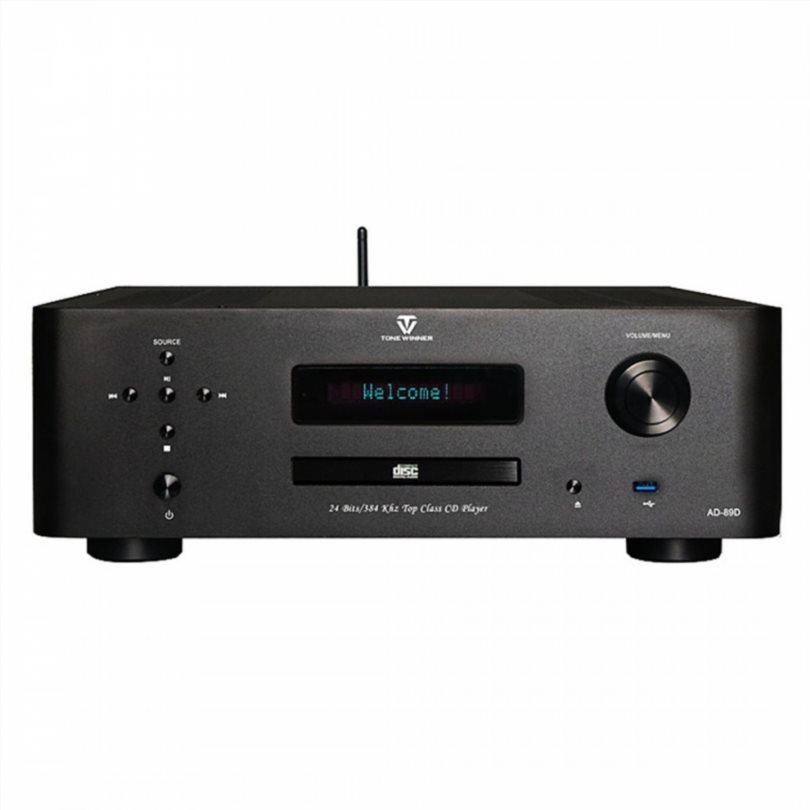
Integrated amplifier today, power amplifier tomorrow
A notable AD-89D feature is its U-ring connection arrangement. With the supplied links fitted, the preamplifier and power-amplifier sections are connected internally, so the unit works as a normal integrated amplifier: select a source, set the volume and drive a pair of speakers.
Removing the U-rings separates those sections and allows the AD-89D to be used as a power amplifier in a larger system. This is a useful route for an owner who later adds an external preamplifier, streamer with a variable analogue output, home-cinema processor or more specialised control component. It also means the AD-89D is not necessarily discarded if system priorities change.
There are practical caveats. The supplied information does not identify the exact labelling of the separated connections, their nominal input sensitivity or whether there are fixed-level line outputs for recording or external processing. As with any pre/power-link design, the U-rings should be retained carefully if they are removed, and the system should be powered down before changing the links. Users introducing an external preamp also need to establish which component controls volume, avoiding accidental double gain or a high-level signal reaching the speakers.
The amplifier’s 10kOhm input impedance is specified for its analogue input stage. In broad terms, that is the load presented to an attached source component. Most modern line-level sources are designed to drive such an input comfortably, but owners of unusual passive preamps or older equipment should check output-drive compatibility rather than assuming all pairings are identical.
CD, computer audio, television and local files in one chassis
The AD-89D’s source provision is central to its appeal. It includes an onboard CD player, allowing a disc collection to be played without adding a separate transport or player. For listeners who still buy CDs or want a simple, physical music format alongside streaming and television, this is a meaningful convenience. The supplied information does not state the transport mechanism, disc formats beyond CD, digital output options or the DAC section used for disc playback, so these are areas to confirm for more specialised requirements.
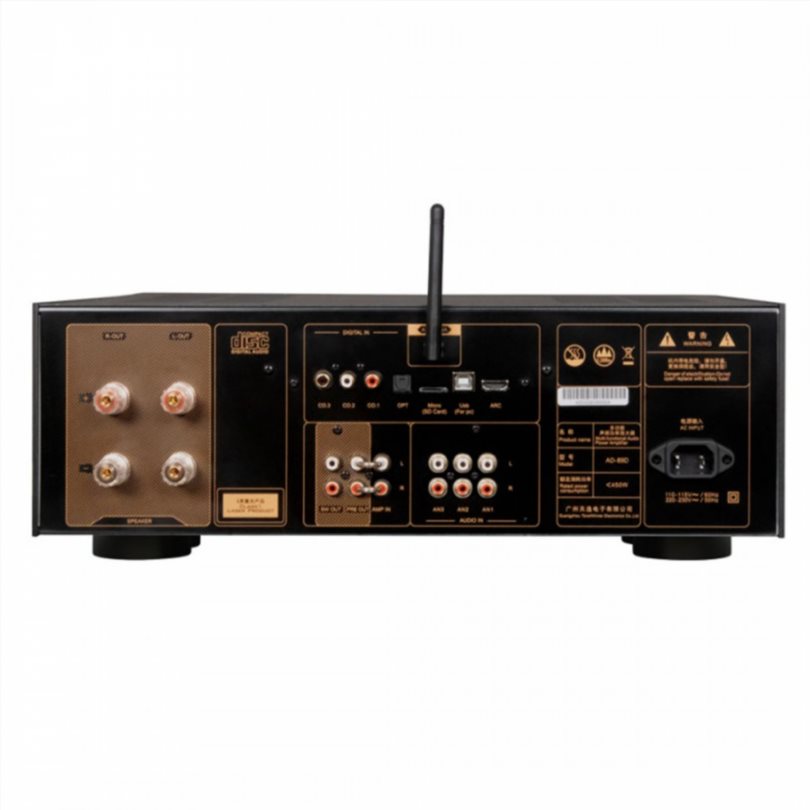
Digital inputs comprise USB-B, one optical Toslink input, three coaxial S/PDIF inputs and HDMI ARC. The USB-B socket supports PCM up to 24-bit/48kHz. This makes the AD-89D suitable as a straightforward computer-audio interface for standard-resolution music and many video or desktop-audio applications. It is important to understand the limit, though: 24-bit/48kHz support does not indicate compatibility with higher-rate PCM files, DSD or every high-resolution streaming output. A computer can normally be configured to resample material to a supported rate, but buyers whose libraries are dominated by 96kHz, 192kHz or DSD files should verify the behaviour they need before purchase.
The optical and coaxial inputs make it easier to accommodate external digital sources. An optical connection can be useful where electrical isolation is desirable, while coaxial S/PDIF remains common on CD transports, streamers and some television or set-top equipment. No supported sample-rate limits are specified for these inputs, so it would be premature to assume they differ from the USB capability.
HDMI ARC is particularly valuable in a stereo-focused living-room system. ARC, or Audio Return Channel, sends audio from a compatible television back down the HDMI cable to the amplifier. That can make the AD-89D the central audio system for both music and TV, avoiding a separate optical cable in many installations and allowing the TV remote to handle volume in a correctly configured ARC/CEC setup. Compatibility and control behaviour depend on the television, its HDMI settings and the source formats used, so it is wise to check that ARC and HDMI-CEC are enabled on the TV during installation.
The AD-89D is not presented as an HDMI switching hub or surround receiver. Its role is to receive TV audio and reproduce it through a stereo or 2.1-channel speaker system. For many rooms, a properly positioned pair of stereo speakers can provide clearer dialogue and more convincing music than a television’s built-in drivers; the optional subwoofer connection can extend low-frequency output without turning the system into a multichannel installation.
Bluetooth, app control and playback from USB storage
Wireless reception is built in, allowing a phone or tablet to send audio to the amplifier via Bluetooth. Bluetooth’s chief advantage is immediacy: guests can play music without joining a network or installing a specific streaming app, and it gives the system a simple fallback source for podcasts, internet radio and casual listening. ToneWinner describes the connection as stable and low in distortion and latency, but the supplied information does not specify the Bluetooth version or supported codecs. That matters because codec support can influence both sound quality and compatibility; it should be confirmed if a buyer specifically wants aptX, LDAC or another format.
A dedicated control app is supplied for source navigation, and its interface includes a TV settings menu. The app also supports file-folder navigation to a depth of eight levels when playing from U disks or TF cards. This is a practical inclusion for users with a locally stored music library, particularly where the amplifier is being used independently of a computer or network streamer.
The AD-89D accepts a U disk of up to 128GB and includes a TF memory-card slot. Folder-based navigation can be more predictable than relying on metadata, provided files are organised logically before the drive is connected. The information supplied does not list supported file formats, maximum resolution for storage playback, gapless playback behaviour or library-search facilities. Those details can be decisive for anyone planning to use local storage as their main music source rather than as an occasional convenience feature.
Connections and 2.1 system integration
For analogue sources, the AD-89D provides three RCA stereo inputs. These can accommodate typical line-level components such as a dedicated streamer, external DAC, phono stage or legacy CD player. There is no phono input listed, so a turntable will require an external phono preamplifier unless it already has a line-level output. This is an important distinction: a cartridge’s output is far too low, and its equalisation requirements too specific, to connect directly to a standard RCA line input.
Speaker terminals provide the primary amplifier output, while a separate subwoofer output supports a powered subwoofer. Adding a subwoofer can make sense not simply for more bass, but for better system flexibility. A well-integrated sub can take responsibility for the lowest octaves, allowing compact standmount speakers to work within their more comfortable range and potentially offering smoother bass in rooms where speaker placement is constrained.
The exact crossover facilities of the subwoofer output are not given. That means buyers should not presume the AD-89D applies a selectable high-pass filter to the main speakers. In many stereo systems, a subwoofer output is a full-range line-level feed and bass integration is managed mainly by the subwoofer’s own crossover, level and phase controls. Placement, crossover frequency and level matching are critical: too much output or too high a crossover can make the subwoofer easy to locate and can thicken upper bass rather than improve extension.
At 430 × 397 × 151mm and 12.7kg, the AD-89D is a substantial full-width component rather than a compact desktop amplifier. Its 450W maximum power-consumption rating also points to the need for sensible installation. It should be placed on a rigid, level surface with clear ventilation around the chassis, rather than tightly enclosed in a cabinet. The model supports 110V–115V/60Hz and 220V–230V/50Hz mains ranges; purchasers should ensure they receive the correct regional version and follow local distributor guidance.
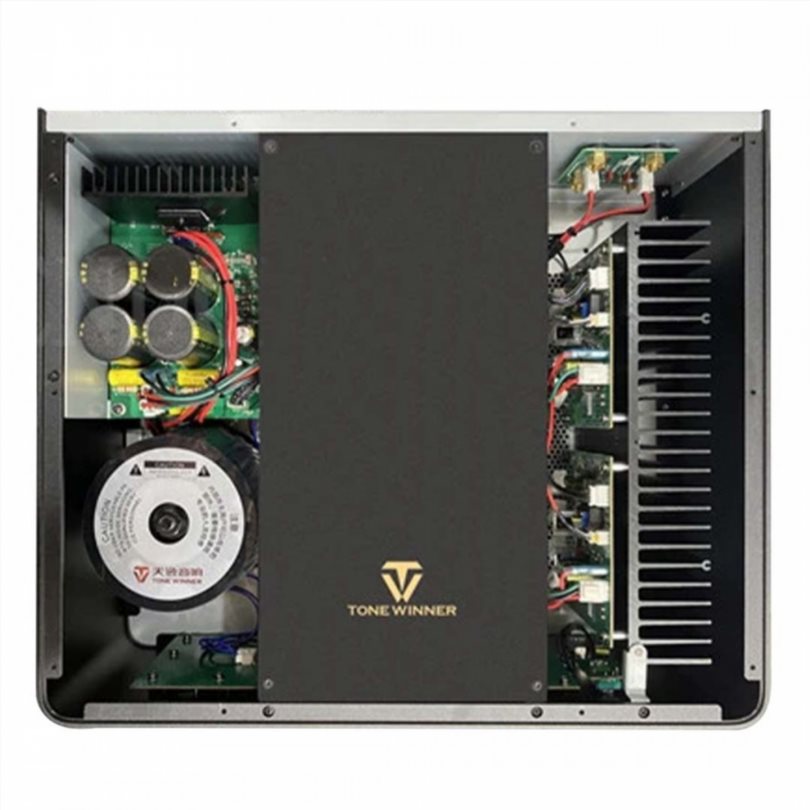
What the ToneWinner AD-89D offers—and what to check
The strongest case for the AD-89D is consolidation. It combines a serious-looking Class AB power-amplifier platform, CD replay, conventional digital inputs, TV connectivity and simple local or Bluetooth playback in one component. The removable pre/power links add an upgrade path that many all-in-one amplifiers do not offer, while the subwoofer output makes it viable at the centre of a compact 2.1 system.
Its trade-off is that convenience features do not automatically equal full support for every modern digital format or streaming ecosystem. There is no network-streaming platform, Ethernet or Wi-Fi connectivity listed, and no support claims for Roon, AirPlay, Chromecast, Spotify Connect, Tidal Connect or Qobuz are provided. The USB-B limit is 24-bit/48kHz, while the capabilities of the S/PDIF, local-storage and Bluetooth sections require further confirmation. Listeners who want app-based network streaming as their primary source may therefore wish to pair the AD-89D with a dedicated streamer via RCA, optical or coaxial connection.
For someone who values CDs, TV integration and a traditional pair of passive speakers, however, the concept is coherent. Match it with speakers of sensible sensitivity and a stable impedance, give the chassis adequate airflow, use HDMI ARC for the television where compatible, and consider a powered subwoofer only after the main speakers have been positioned carefully. The AD-89D’s attraction lies not in doing one task exclusively, but in bringing several familiar hi-fi and living-room functions together without abandoning the scale and upgrade potential of a conventional stereo amplifier.
ToneWinner AD-89D specifications
- Product type: Integrated amplifier
- Amplification type: Class AB
- Channels: 2.1
- Inputs: CD player; USB-B; optical Toslink; three coaxial S/PDIF; HDMI ARC; three RCA stereo; Bluetooth; TF memory-card slot; U disk up to 128GB
- Outputs: Speaker terminals; subwoofer output
- Output power: 2 x 130W (8Ω, 1kHz)
- Input impedance: 10kOhm
- Frequency response: 10Hz–50kHz (+1/-3dB)
- THD: ≤0.05% (A-weighted, analogue direct)
- Signal-to-noise ratio: ≥95dB (A-weighted, analogue direct)
- Global gain: ≥41dB (A-weighted, analogue direct)
- Mains power: 110V–115V (60Hz) / 220V–230V (50Hz)
- Maximum power consumption: 450W / 8Ω
- Dimensions (W × D × H): 430 × 397 × 151mm
- Net weight: 12.7kg