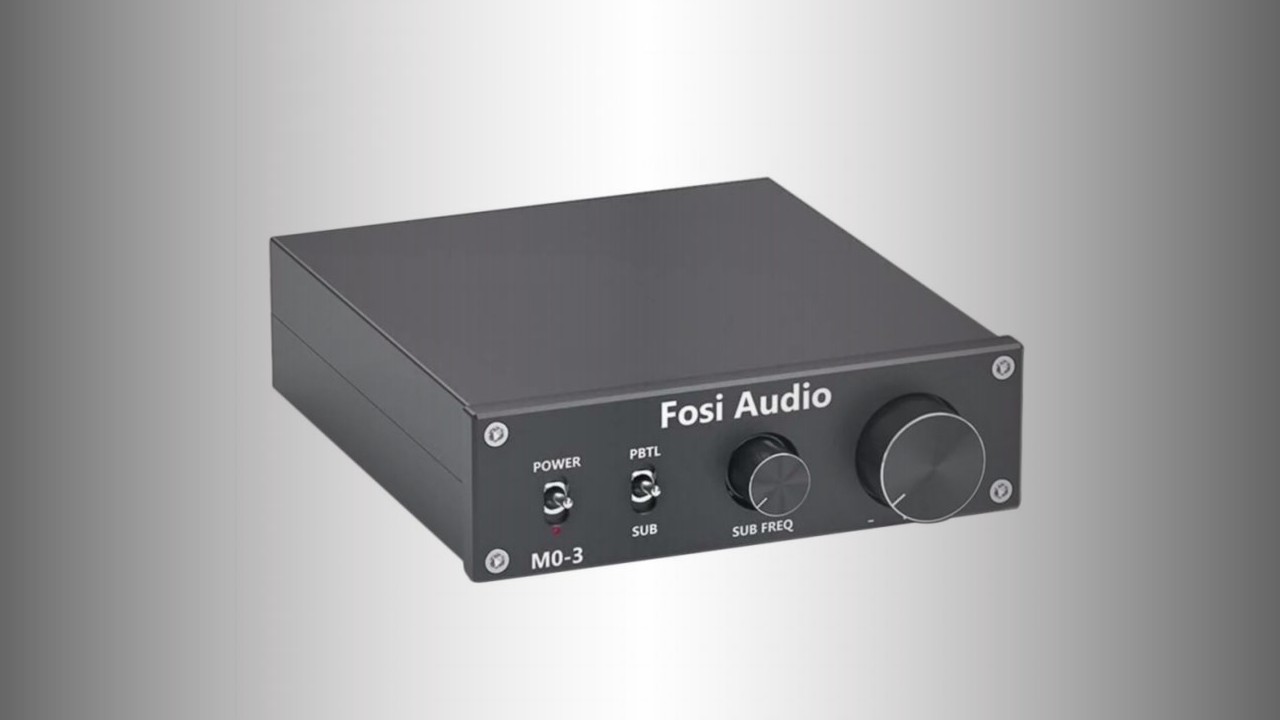
Fosi Audio’s M03 is a compact mono power amplifier with a particular focus on subwoofer use. Rather than being a conventional stereo integrated amplifier, it uses a single Texas Instruments TPA3255D2 Class D amplifier chip and provides two front-panel-selectable operating modes: PBTL for driving a passive mono speaker, and SUB for a passive or active subwoofer application.
Its headline figure is 120W into 4 ohms, while the stated supported load range is 4-8Ω. That is substantial power for a chassis measuring just 130 x 115 x 35mm and weighing 1kg, though—as with any compact amplifier—the result in a real system will depend on the loudspeaker’s impedance behaviour, sensitivity and the demands placed on it. Fosi includes a 32V DC, 5A external power supply, and specifies a 24-36V DC operating range.
The interesting part is not simply the M03’s size, but its attempt to combine amplification and basic bass management in an inexpensive, analogue-input mono component. For a system with a passive subwoofer, that can remove the need to use a full-size power amplifier and a separate external crossover.
A purpose-built mono amp rather than a miniature stereo integrated
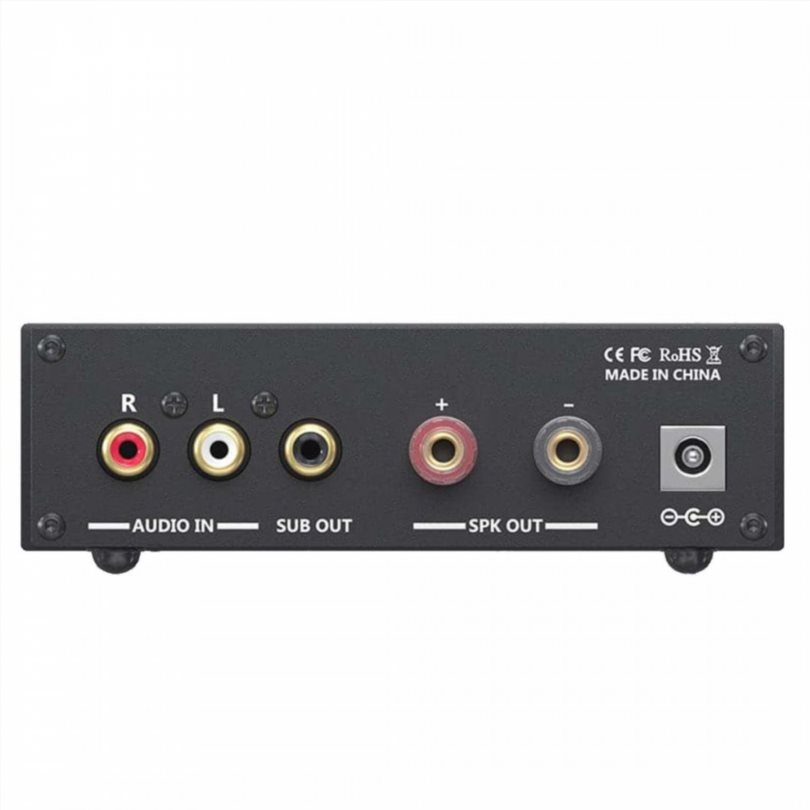
The M03 accepts one RCA input and offers one stated subwoofer output/speaker-terminal output arrangement. It is therefore intended to be placed in a very specific part of a system: after a source, preamplifier, DAC with volume control, AV processor or other component capable of supplying an appropriate analogue signal. It is not presented as a complete source hub, and there are no listed digital inputs, wireless facilities, network-streaming features, phono stage or headphone output.
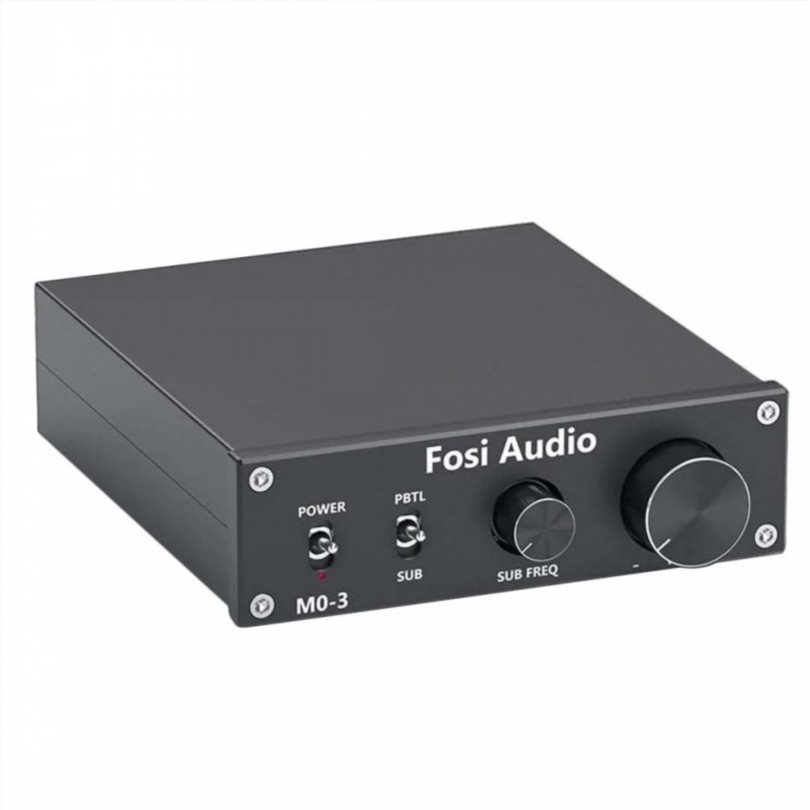
That narrow brief can be an advantage. A passive subwoofer needs amplification, while a typical active subwoofer already contains its own power amplifier and crossover electronics. The M03 is intended to address the former case in SUB mode, while also accommodating a mono loudspeaker use case in PBTL mode. The front-panel controls keep the essential adjustments at hand: one potentiometer sets level, while the other adjusts the low-pass filter.
For clarity, a low-pass filter sends low-frequency information to the subwoofer while progressively attenuating higher-frequency content. This matters because a woofer used as a subwoofer should generally not be asked to reproduce midrange information; doing so can make bass easier to localise and can lead to an untidy overlap with the main speakers. The correct turnover point is system dependent, not a universal setting. It will be influenced by the low-frequency reach of the main loudspeakers, their placement and the room’s bass behaviour.
What the two modes and adjustable filter mean in practice
Fosi specifies two modes selected from the front panel. In PBTL mode, the M03 is described as able to power a passive mono speaker and an active subwoofer. PBTL—parallel bridge-tied load—is an amplifier-output configuration commonly used in Class D designs to make a single mono channel from the available output stages. In broad terms, it is a way of concentrating an amplifier’s resources into one channel rather than dividing them between left and right loudspeakers.
In SUB mode, the M03 is intended for a passive or active subwoofer. The adjustable low-pass filter works only in SUB mode when the amplifier is used with a passive subwoofer. Its adjustment range is specified as 20-300Hz. That is a wide range on paper: settings around the lower end can suit larger main speakers that already produce meaningful bass, whereas a higher setting may be useful with small satellite speakers. The best choice is usually made by listening for the smoothest transition rather than by relying entirely on a dial position.
The published specification also lists a bass range of 20-200Hz, a full frequency response of 20Hz-20kHz (±3dB), and a 20-300Hz cutoff-frequency adjustment. These figures should be read as functional operating parameters rather than a substitute for system setup. A crossover control determines where the subwoofer begins to hand over to the main speakers, but it does not automatically correct room modes, timing differences or level mismatch. Subwoofer placement and level remain at least as important as the selected cutoff frequency.
Owners using an active subwoofer should be especially careful about signal routing and gain staging. An active subwoofer has its own amplifier and usually its own crossover controls; the M03’s low-pass filter is specifically stated to operate with a passive subwoofer in SUB mode. The exact connection approach should therefore be checked against the manuals and available outputs of the associated source and subwoofer, rather than assuming that all subwoofer inputs and outputs are interchangeable.
The TPA3255D2 Class D platform: why it suits this format
At the centre of the M03 is Texas Instruments’ TPA3255D2. This is a Class D power-amplifier IC using TI’s PurePath UltraHD technology. In a Class D design, the output devices switch at high frequency and the amplified signal is reconstructed through an output filter, rather than operating in the continuously linear manner associated with conventional Class A or Class AB power stages. The key practical benefit is efficiency: a Class D amplifier can provide useful power from a small enclosure while producing relatively little waste heat compared with many traditional amplifier approaches.
That efficiency is particularly relevant for a subwoofer or mono-bass amplifier. Bass reproduction asks an amplifier to supply energy over sustained periods, and a physically compact chassis would be difficult to realise if the output stage dissipated large amounts of heat. The M03’s external DC supply also helps keep the main enclosure small. Conversely, the supplied 32V/5A supply forms an important part of the overall package: power output in compact Class D products is closely linked to the available supply voltage and current.
Fosi quotes total harmonic distortion of no more than 0.03% and a signal-to-noise ratio of at least 106dB. These are useful indicators of the amplifier’s stated electrical performance, although they do not by themselves predict how a particular subwoofer will behave in a room. The loudspeaker’s load, enclosure, driver excursion limits and the level required at the listening position all remain decisive. The quoted 120W output is specified into 4Ω, so it should not automatically be treated as the output available into every 8Ω load or under every real-world condition.
Load matching, source level and passive-subwoofer considerations
Fosi gives the M03 a 4-8Ω load range. That makes nominal 4Ω and 8Ω passive subwoofers or mono loudspeakers the obvious candidates, provided the speaker manufacturer does not specify a different amplification requirement. Nominal impedance is only part of the picture: loudspeaker impedance varies with frequency, and bass systems can present a more demanding load at some frequencies than their headline rating suggests. A prospective buyer should therefore check the subwoofer’s nominal impedance and its recommended amplification before connecting it.
The unit’s single RCA input means it expects an unbalanced analogue feed. In a typical two-channel setup, this may come from a preamplifier output, a DAC/preamplifier, or another source component with variable volume control. Where the system provides separate subwoofer or summed-mono outputs, integration can be simpler. If it provides only conventional left and right line outputs, users will need to establish how a mono signal is derived in their particular system; the M03’s published information does not detail its internal summing arrangement or alternative input options.
Fosi lists input sensitivity as ≤ 0.2mV. As published, that is an unusually low figure for a line-level RCA input, so it is sensible to treat it as a manufacturer specification to be verified in the product documentation rather than using it to make assumptions about gain compatibility. In practical terms, the level controls on both the M03 and any connected active subwoofer should be started low, then raised gradually. This reduces the risk of excessive bass output or unexpected level jumps when first integrating the amplifier.
Setup matters more than the small footprint suggests
At 130 x 115 x 35mm, the M03 can be accommodated on a rack shelf, cabinet or desktop more easily than most conventional subwoofer amplifiers. Its small footprint does not eliminate the need for sensible installation, however. The external power supply needs its own space, and the amplifier should not be buried where heat cannot escape or where its controls and speaker terminals are inaccessible. Keep analogue RCA cabling away from power supplies and mains cables where possible, particularly if a system develops hum.
For a passive-subwoofer system, begin with the subwoofer close to the main speakers if integration is the priority, then experiment. Moving a subwoofer a short distance can change bass weight dramatically because low frequencies interact strongly with room boundaries. Set the low-pass control conservatively at first, choose a moderate level, and make small changes while playing familiar music. The aim is normally for the subwoofer to extend the system’s foundation rather than announce itself as a separate sound source.
The M03 does not list high-pass outputs for the main speakers. This is significant: where main speakers continue to receive a full-range signal, adding a subwoofer does not reduce the bass workload placed on their own drivers or amplifier. That can be entirely appropriate in a straightforward add-on subwoofer arrangement, but it differs from an active crossover system in which the main speakers are high-pass filtered. Buyers seeking that more comprehensive form of bass management will need to confirm whether their source, preamplifier or another component in the chain provides it.
Who the Fosi Audio M03 is for
The Fosi Audio M03 is best viewed as a focused utility amplifier for enthusiasts building a compact mono or passive-subwoofer solution. Its appeal lies in combining a TPA3255D2-based Class D output stage, a stated 120W into 4Ω, selectable PBTL and SUB modes, and a 20-300Hz low-pass adjustment in a 1kg enclosure. For DIY subwoofer projects, compact secondary systems or installations where a full-size power amplifier is impractical, those are potentially useful ingredients.
Its limitations are equally clear from the available specification. Connectivity is intentionally sparse, with one RCA input; there are no stated digital or network facilities; and the low-pass control is specified only for passive-subwoofer use in SUB mode. Successful integration will consequently depend on the associated source component, the impedance and sensitivity of the connected speaker, and careful crossover, level and placement adjustment.
For buyers whose priority is a small, analogue-input mono amplifier with bass-specific control rather than an all-in-one component, the M03’s feature set is coherent. Before purchase, it would be prudent to confirm the exact output routing for the intended active-subwoofer or mono-speaker configuration, as well as compatibility with the chosen loudspeaker load.
Fosi Audio M03 specifications
- Product type: Mono amplifier + subwoofer
- Amplification chip: TI TPA3255D2
- Input: 1x RCA input
- Output: 1x subwoofer output/1x speaker terminal
- Output power: 120W
- Supported impedance: 4-8Ω
- Input sensitivity: ≤ 0.2mV
- Frequency response: 20Hz-20kHz (±3dB)
- Bass range: 20-200Hz
- Cutoff frequency: 20-300Hz
- THD: ≤ 0.03%
- Signal-to-noise ratio: ≥ 106dB
- Bass cutoff-frequency adjustment: 20-300Hz
- Power range: 24-36V DC; 32V/5A power supply included
- Net weight: 1kg
- Dimensions: 130 x 115 x 35mm
- Finish: Black