The Electrocompaniet ECI 6 MKII is an analogue integrated amplifier for listeners who want a conventional two-channel control centre with the current capability to take on less accommodating loudspeaker loads. It sits above the ECI 5 MKII on which it was developed, bringing a revised preamplifier section, an improved power section and a modular architecture that can later accommodate a digital streaming and DAC board.
That combination is important. Plenty of integrated amplifiers offer ample headline wattage into an 8-ohm resistor, but a useful amplifier for real loudspeakers also needs a power supply and output stage that remain composed as impedance falls. Electrocompaniet specifies 120W per channel into 8 ohms, 200W into 4 ohms and 370W into 2 ohms for the ECI 6 MKII. Alongside its analogue-only standard connectivity and pre/power integration options, those figures position it as a serious hub for a high-quality stereo system rather than merely an entry-level all-in-one.
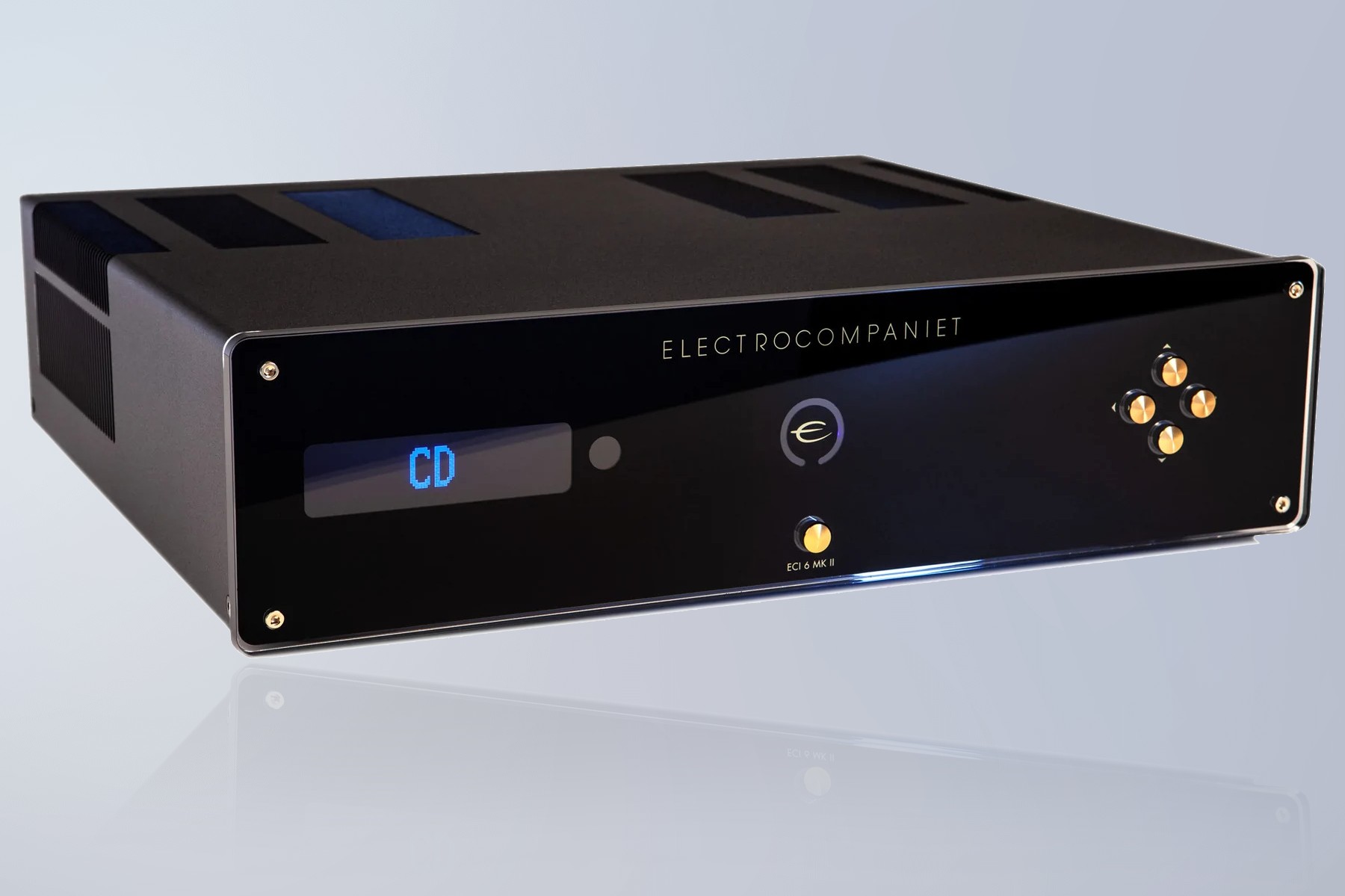
The Norwegian company has long favoured an understated visual language: functional black casework, a distinctive acrylic fascia and minimal controls rather than a dense touchscreen-led interface. The ECI 6 MKII follows that approach, while its internal circuit and power-supply specification reveal the more substantial engineering behind its reserved appearance.
Power delivery is about more than the 120W rating
The ECI 6 MKII is rated at 120W into 8 ohms. In isolation, that is a healthy but not extraordinary figure in the premium integrated-amplifier market. More revealing is the way the stated output rises as the load impedance reduces: to 200W into 4 ohms and 370W into 2 ohms.
Loudspeakers are not fixed resistors. Their impedance changes with frequency, and some designs present demanding low-impedance regions through parts of the bass or crossover range. When this happens, an amplifier must supply more current to sustain voltage at the speaker terminals. The ECI 6 MKII’s specified progression into lower impedances suggests that its output stage and supply have been designed with current delivery in mind. It does not remove the need to consider a speaker’s overall sensitivity, impedance behaviour and room size, but it is a relevant specification for owners of speakers that are less easily driven than a nominal 8-ohm design.
At the centre of the supply is a 500VA toroidal transformer, partnered with a stated 80,000µF of reservoir capacitance. A toroidal transformer is commonly used in serious linear power supplies because it can provide high power in a relatively compact format and can help limit stray magnetic fields when correctly implemented. The large capacitor bank stores energy after rectification, supplying the output stage during dynamic musical peaks. In practical terms, transformer capacity and reservoir storage are two of the foundations that allow an amplifier to maintain output when music asks for short bursts of substantial current.
Electrocompaniet specifies a frequency response of 1Hz to 150kHz and total harmonic distortion of 0.003%. The bandwidth figure extends far beyond the conventional audible range at the upper end. It should not be read as a promise that listeners will hear to 150kHz; rather, it describes the amplifier’s stated operating bandwidth. Likewise, the low distortion number is one piece of a much broader performance picture, but it indicates that nonlinear distortion has been kept low under the conditions of the manufacturer’s specification.

Balanced architecture, discrete Class A input stage
The ECI 6 MKII uses a fully balanced circuit topology. In a balanced audio circuit, the positive and negative halves of the signal are handled symmetrically. This can improve rejection of noise and interference within the circuit, provided the implementation is genuinely balanced rather than an unbalanced design fitted with XLR sockets. Electrocompaniet’s description refers to the circuit topology itself, not simply the presence of a balanced input.
The input stage is built from discrete Class A circuitry and is described as operating without feedback. “Discrete” means the circuit uses individual active devices rather than relying solely on a monolithic integrated-circuit gain block. This gives an amplifier designer direct control over the chosen devices and operating conditions, though discrete construction alone does not define performance.
Class A operation in a low-level input stage means the active devices are biased to remain conducting throughout the signal cycle. It is often used where linearity at small signal levels is a priority, although it brings greater heat and power consumption than a comparable Class AB stage. Electrocompaniet’s no-feedback description applies specifically to this input circuitry. It should not be mistaken for a claim that the entire amplifier has no feedback: the manufacturer states that the high-power transistor output stage uses moderate negative feedback.
Negative feedback compares output with input and corrects deviations. Used judiciously, it can lower distortion and improve control of the loudspeaker load; its ultimate effects depend on the whole circuit, not on a simplistic “more or less is better” rule. Here, the stated split approach—feedback-free discrete Class A input circuitry followed by an output stage using moderate negative feedback—is a useful indication of the design philosophy. Electrocompaniet associates it with the balance of control, bass extension, midrange detail and treble warmth described for the amplifier.

An analogue-first integrated amplifier
In standard form, the ECI 6 MKII is deliberately an analogue component. There are no quoted onboard digital inputs, Bluetooth functions or network-streaming facilities in the supplied configuration. For many systems, that is a strength rather than an omission: it lets an owner select a separate DAC, network player, CD player, phono stage or analogue source without paying for digital hardware that may become outdated sooner than the core amplification.
Its rear panel provides one balanced XLR input and three unbalanced RCA stereo inputs. The XLR input is the natural choice for a source with a true balanced analogue output, particularly where long interconnects are unavoidable or where an installation is susceptible to hum and noise pickup. RCA remains the dominant connection for many turntable phono stages, DACs and legacy sources, so the three single-ended inputs provide practical flexibility for a conventional multi-source system.
One RCA input is configured as a pass-through input. This is particularly useful for integrating a stereo amplifier into a home-cinema system. Connected to the front-left and front-right pre-outs of an AV processor or receiver, the pass-through bypasses the ECI 6 MKII’s normal volume control for that source. The AV processor then controls level and handles surround calibration, while the Electrocompaniet powers the main stereo speakers. Care is essential during setup: because this input is intended for a fixed-level signal, it should only be used with a source that has its own reliable volume control.
There are also balanced and unbalanced preamplifier outputs. These allow the ECI 6 MKII’s preamp section to feed an external power amplifier, potentially supporting a future move to higher-power amplification, bi-amplification where the rest of the system permits it, or a separate active bass solution with the appropriate connections. The source material does not specify a dedicated subwoofer output, so prospective users should check the input and filtering facilities of any active subwoofer or external crossover before assuming plug-and-play integration.

Modular route to streaming and DAC capability
The most forward-looking part of the ECI 6 MKII concept is its modular construction. Electrocompaniet says the amplifier can accept a digital unit incorporating streamer and DAC functions, allowing it to be expanded to ECI-6DX Mk II level. This is a materially different proposition from an integrated amplifier with permanently fixed digital hardware.
A separate optional digital module lets the buyer begin with a purely analogue system, then add network and conversion facilities later if their listening moves towards streaming. It can also simplify system layout: a streamer/DAC inside the amplifier reduces the number of boxes, mains leads and analogue interconnects required compared with an external source component.
However, the supplied information does not state the module’s supported streaming services, network connections, control app, digital inputs, DAC implementation or supported PCM and DSD formats. Those details matter to buyers committed to a particular ecosystem—such as Roon, UPnP, Tidal Connect, Qobuz, AirPlay or Spotify Connect—and should be confirmed for the relevant module and market before purchase. The key confirmed point is the upgrade path itself, not a particular feature list.
Controls and ownership considerations
The ECI 6 MKII’s exterior is recognisably Electrocompaniet. Its black chassis is fronted by an acrylic panel, with a cool-blue display on the left showing the selected input. The display also reports the reason if the amplifier’s protection circuitry is activated. That is more useful than a simple warning lamp: protection systems can intervene for reasons such as overheating, an overload or a speaker-cable fault, and a diagnostic indication can make basic fault-finding less opaque.
A round gold power button sits centrally below the company logo. Four buttons to the right handle volume adjustment and source selection. This is a tactile, direct interface rather than an app-dependent one, which will appeal to listeners whose primary sources remain physical or analogue. All signal connections are located at the rear, maintaining the uncluttered front-panel presentation.
As with any amplifier specified to drive down to 2 ohms, installation should give proper attention to loudspeaker cable termination and ventilation. No dimensions, weight or heat-output figure are supplied here, so there is no basis for prescribing a shelf size or clearance. Nevertheless, it is sensible to place a substantial integrated amplifier on a stable, open shelf rather than enclosing it tightly in furniture, and to ensure there are no stray wire strands that could short speaker terminals.

Who the ECI 6 MKII makes sense for
The ECI 6 MKII is best understood as a high-power, analogue-led integrated amplifier with a credible long-term expansion route. Its combination of 120W into 8 ohms, 200W into 4 ohms and 370W into 2 ohms will be of particular interest to owners of substantial standmount or floorstanding speakers whose impedance demands more than a modest amplifier can comfortably provide. The 500VA transformer and 80,000µF capacitor bank support that positioning.
It is also a logical choice for listeners who value a selected external source today but do not want to rule out a more compact streaming/DAC-based system tomorrow. Conversely, buyers who require HDMI, a built-in phono stage, numerous digital inputs or a confirmed streaming platform from day one should recognise that these facilities are not stated for the standard analogue ECI 6 MKII.
Electrocompaniet’s published description credits the amplifier with a clear, detailed and neutral presentation, a broad soundstage, controlled fast bass and a smooth balance through the frequency range. Those are manufacturer-supplied characterisations, not independent listening findings, but they align with the company’s emphasis on a substantial supply, balanced circuit design and carefully apportioned feedback. What is firmly established by the specification is that the ECI 6 MKII is not a minimalist low-power integrated: it is a technically purposeful analogue amplifier designed to retain control when speaker loads become more demanding, while leaving the door open to a future digital upgrade.